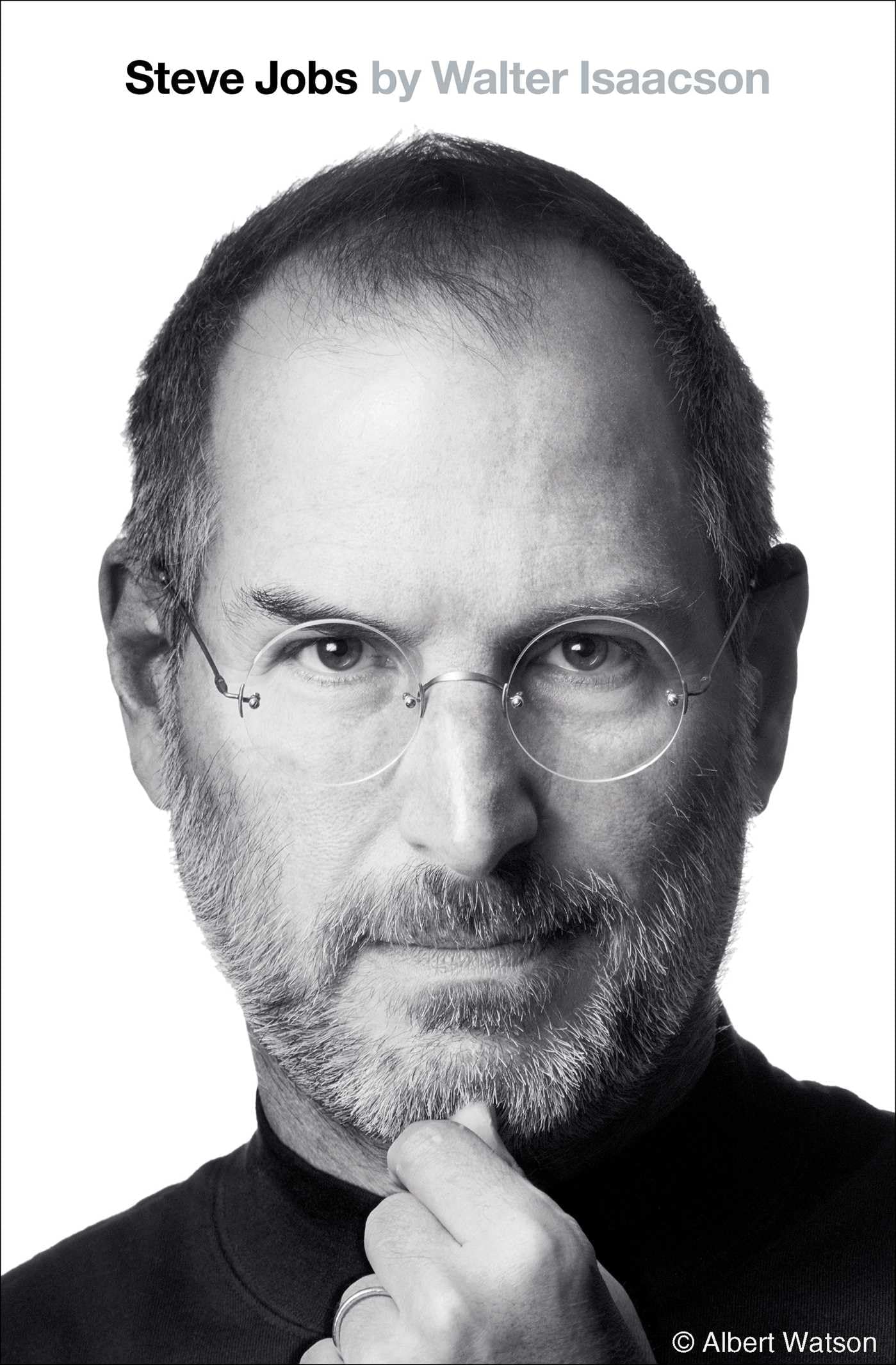
Steve Jobs: A Biography
Product ID: 778330250
Desertcart purchases this item on your behalf and handles shipping, customs, and support to Iceland.
Walter Isaacson's "enthralling" ( The New Yorker ) worldwide bestselling biography of Apple cofounder Steve Jobs. Based on more than forty interviews with Steve Jobs conducted over two years--as well as interviews with more than 100 family members, friends, adversaries, competitors, and colleagues--Walter Isaacson has written a riveting story of the roller-coaster life and searingly intense personality of a creative entrepreneur whose passion for perfection and ferocious drive revolutionized six industries: personal computers, animated movies, music, phones, tablet computing, and digital publishing. Isaacson's portrait touched millions of readers. At a time when America is seeking ways to sustain its innovative edge, Jobs stands as the ultimate icon of inventiveness and applied imagination. He knew that the best way to create value in the twenty-first century was to connect creativity with technology. He built a company where leaps of the imagination were combined with remarkable feats of engineering. Although Jobs cooperated with the author, he asked for no control over what was written. He put nothing off-limits. He encouraged the people he knew to speak honestly. He himself spoke candidly about the people he worked with and competed against. His friends, foes, and colleagues offer an unvarnished view of the passions, perfectionism, obsessions, artistry, devilry, and compulsion for control that shaped his approach to business and the innovative products that resulted. His tale is instructive and cautionary, filled with lessons about innovation, character, leadership, and values. Steve Jobs is the inspiration for the movie of the same name starring Michael Fassbender, Kate Winslet, Seth Rogen, and Jeff Daniels, directed by Danny Boyle with a screenplay by Aaron Sorkin. Review: Interesting insights into the Steve Jobs success story - For anyone interested in business and design this is a must read; what is so interesting about it is the extent to which the ultimate success and triumph of the man was built on a succession of what can only be described as failures; getting booted out of Apple; the NeXT adventure which can only be described as random and the chance success of Pixar; a revelation inasfar as it was based as the man himself admitted on luck and instinct against the conventional business tools he had acquired as a leader at Apple. This last deal really made the man and his subsequent unparalleled triumphs with Apple were based on the philosophy that he was true to in his business career; namely the preeminence of good design in creating products of unimaginable beauty and simplicity. Given this life story and the eccentricities of the man (esp. his quite awful behaviour at times) it would be hard to produce a book that was anything but interesting. At times it does go too deep and descend into areas that are unnecessary and irrelevant as is the wont of biographies of major US business success stories and leaders who are viewed as demi-Gods; but it certainly brings out the chain of events that made the man the success he was, exposes his strengths and weaknesses and brings more life to a story that a story that has become a part of our culture. You cannot ask for more than that. Review: Honest account - Well worth a read, Steve Jobs told his biographer toward the end of the process the reason he agreed to the biography was so that his children would know him. On that basis, if you want to better understand Steve Jobs, then, I'd recommend you read this book.


| Best Sellers Rank | 377,856 in Books ( See Top 100 in Books ) 5 in Computer Scientist Biographies 8 in Engineer Biographies 14 in Business Biographies & Memoirs (Books) |
| Customer Reviews | 4.7 out of 5 stars 26,687 Reviews |
C**G
Interesting insights into the Steve Jobs success story
For anyone interested in business and design this is a must read; what is so interesting about it is the extent to which the ultimate success and triumph of the man was built on a succession of what can only be described as failures; getting booted out of Apple; the NeXT adventure which can only be described as random and the chance success of Pixar; a revelation inasfar as it was based as the man himself admitted on luck and instinct against the conventional business tools he had acquired as a leader at Apple. This last deal really made the man and his subsequent unparalleled triumphs with Apple were based on the philosophy that he was true to in his business career; namely the preeminence of good design in creating products of unimaginable beauty and simplicity. Given this life story and the eccentricities of the man (esp. his quite awful behaviour at times) it would be hard to produce a book that was anything but interesting. At times it does go too deep and descend into areas that are unnecessary and irrelevant as is the wont of biographies of major US business success stories and leaders who are viewed as demi-Gods; but it certainly brings out the chain of events that made the man the success he was, exposes his strengths and weaknesses and brings more life to a story that a story that has become a part of our culture. You cannot ask for more than that.
M**Y
Honest account
Well worth a read, Steve Jobs told his biographer toward the end of the process the reason he agreed to the biography was so that his children would know him. On that basis, if you want to better understand Steve Jobs, then, I'd recommend you read this book.
R**K
Steve Jobs - "Here's to the crazy ones, the misfits, the rebels, the troublemakers .....They push the human race forward".
While it is only weeks since the untimely death of the great visionary Steve Jobs it is matter of historical certainty to place him firmly in the linage of great inventors and technological pioneers which include names like Bell, Faraday and Edison. Perhaps this book on Jobs life by Walter Isaacson previous biographer of Einstein and Franklin comes to soon after his passing away, alternatively you could argue that's its publication is ironically like a well timed Apple launch. This is particularly the case since it appears that Jobs had typically taken a long view and in 2004 first approached Issacson with this idea of becoming his biographer. The latter hesitated at that point but in 2009 when the tumor inside Jobs pancreas was taking a crippling hold his wife Laurene Powell firmly informed the author "that if you are ever going to do a book on Steve, you'd better do it now" Issacson's biography was informed by over 40 interviews with Jobs, access to friends and colleagues and a complete free hand. Sadly Jobs never got to read it since it is a generally solid if rushed biography and while it is hugely sympathetic to the main protagonist it shows all facets of Jobs not least his infuriating (but understandable) perfectionism, his vindictiveness and the exercise of a level of overpowering influence on those around him. Issacson casts this as Jobs "reality distortion field" a term coined by Apple employees to describe how he created his own unique cultural/organizational norms. The book starts by covering his adoption by the family of mechanic Paul Jobs who enshrined in his son a love of design and brought him up near Palo Alto the epicentre of a place which was "just about to turn silicon into gold". The development of the Blue Box with Steve Wozniak's innovative design was the starting point. This showed that Jobs brilliance at another key facet namely marketing even though at the time he was a highly opinionated vegan obsessed hippy with a penchant for drugs. The rest as they say is history not least through Wozniak's uber inventive phase in Jobs garage with initially the Apple 2 computer and that seminal moment in 1984. Here the first iteration of the foundation stone of modern computing was released enshrined in the Macintosh where the mouse and GUI sealed the deal. Jobs provided the hard commercial logic behind this although its impact was far from immediate as the world shifted towards its dalliance with Bill Gates. Granted there are times in Issacson's book when things feel quite superficial and judgements are undercooked. An example is the chapter on Jobs love of music that is fashioned in relation to the ubiquitous question "what's on your IPod". It shows an enduring fanaticism for Dylan and a true fondness for Joni Mitchell's song about her daughters adoption "Little Green" which clearly resonated with Jobs. The problem here and in other parts of the book however is that the text feels like an extended magazine interview and not a weighty biography which in turn is a problem with the books immediacy. In one sense it is all too raw and recent, whilst truly great biographies do require distance and the passage of time. As such Issacson certainly will not be the last word on Jobs. Alternatively the book is strong on Jobs re-takeover of Apple and later involvement in Pixar but absolutely essential in describing the development of the IPhone and IPad. Jobs frustration with attempts to partner with Motorola on a new mobile phone with their cumbersome RAZR product is a key moment. As his frustration builds he exclaims, "I'm sick of dealing with these stupid companies...lets do it ourselves" (Kindle location 8024). The world turned at this moment. Equally on the IPad the brilliance of Apple marketing and technology combined to make the Wall Street Journal excitingly comment on its launch that "the last time there was this much excitement about a tablet, it had some commandments written on it" (Location 8474). Immediately the post PC era was born. His demise at the age 56 begs the question of where Jobs would have taken Apple in the era of cloud computing and how strong is his legacy. Jobs was a restless and impatient innovator and as Issacson observes he launched products that transformed whole industries. But he also concludes that Jobs "Zen training never produced in him a Zen like calm or inner serenity". And yet in 1997 in Apple's "Think Different" campaign Jobs wrote his own obituary when in high rhetoric he stated "Here's to the crazy ones, the misfits, the rebels, the troublemakers .....They push the human race forward".
S**T
Steve Jobs
Walter Isaacson’s authorized portrait of the Apple co-founder is exhaustive, candid and unflinching. Drawing on over forty interviews with Jobs and more than a hundred conversations with family, friends and colleagues, the 627-page volume maps his mercurial trajectory—from garage tinkerer to global icon—while exposing the flaws behind the legend. Depth of Access and Personal Candor - Jobs personally sanctioned Isaacson’s project, granting unrestricted interviews even during his terminal illness. - He refused editorial control, insisting on truth over image, which yielded revelations about his “reality distortion field,” perfectionism and personal eccentricities. - Isaacson does not shy away from Jobs’s more unsettling quirks: he often went days without bathing, viewing regular hygiene as a distraction from work. - The biography candidly explores his adoption and quest for identity: although he traced Abdulfattah Jandali, his biological father, in 2006, Jobs never informed him of the empire he built. - It also confronts his callous early treatment of daughter Lisa Brennan-Jobs—initially denying paternity, forcing a court-ordered DNA test and approving minimal support—revealing a harshness that contrasts with his creative brilliance. A-Player Culture and Obsessive Detail Jobs insisted on hiring only A-players who could deliver A-performance, famously believing “a small team of A+ players can run circles around a giant team of B and C players”. He pushed teams to rework products right up to their release date, refusing to ship anything less than perfect. His obsession extended beyond the product’s exterior: Jobs demanded that internal layouts, circuit boards and component placements be as beautiful as the consumer-facing shell. Well worth reading (Read Jony Ive The Genius Behind Apple’s Greatest Products for more insights into Apple’s design revolution.)
S**N
A Genuinely Inspiring Book
I really enjoyed reading about Steve Jobs, the one thing the book left me with was the burning desire to start a company. Jobs was very fortuitous in his early 20’s he was in the right place at the right time with the right people, but credit where it’s due he was the one who actually did something about it, which is why he was worth $250m aged 25. Very few people experience that kind of sudden propulsion into durable celebrity, virtually none extend it into something further. Jobs was never really satisfied with his achievements to date, and he was always focused on what was next, where things were going, what was to be done. He wasn’t a guy who dwelled on the past, all he was concerned about was what lay ahead. He never really celebrated past achievements, he just learnt from the experiences and took those lessons forward. The book is a great read, it’s hard to put down. The great thing about Isaacson’s work is that you don’t notice Isaacson. A great biographer has the ability to get out of the way and just illuminate the subject, warts and all. One of the enduring lessons of the book is that your life is really just one long story and even all the bad things that happen are not really so bad, they are just the twists and turns of the story. This is made clear at the end when Bill Gates visits Jobs at home in his final days, after decades of brutal cut throat corporate battles, of stealing idea’s and dubious marketing, of winning and losing and losing and winning, hundreds of billions of dollars and tens of thousands of employees, you basically had two guys who had shared a journey.
R**R
A captivating journey unlike any other
It's almost 6am and that's not because I've woken up early to start writing this review. Try as I might, once I pass a certain threshold, say, the 70% or 80% mark in a phenomenal book, I become physically incapable of falling asleep until I finish reading it. This is one of those books. Like he did with Franklin and Einstein, Isaacson has done a masterful job of weaving the myriad, intertwining threads of a lifetime into a cohesive and coherent narrative. I can only begin to fathom the colossal amount of work that went into organising the contents of 40+ interviews into robust prose such as this. Steve Jobs was a complicated, conflicted, genius, he was an abusive, unpredictable, visionary pioneer. Narcissistic and egotistical, but also determined and passionate about moving humanity forward. In brief, Jobs was a lot of things. Prior to my reading this book, I did not fully grasp the degree to which Jobs and his company revolutionised so many industries, ranging from personal computers to music to tablets and software. Coming out of this book, I'm still uncertain as to whether I should view Steve as flawed hero or a likeable villain -- but perhaps the hallmark of a truly great biography is that it conveys the true depth of every individual, one which surpasses unidimensional categories and value judgements. Massive, massive recommend from me!
A**E
captivating Read
It was fascinating to read this biography. Really gets inside Steve Jobs head and reveals the true man with all of his flaws and wonders!
R**T
Steve Jobs. A life well lived.
One of the best biographies I have read recently. Very well written. Last chapters very moving. Been an Apple fan forever. They just work.
K**R
Absolutely magnificent
This book is among the greatest books I've ever read, perhaps because I admire Steve Jobs so much and he is one of my role models. He was truly a genius and that's what Walter Isaacson's books are about. This is a very long book and it took me ages to finish it but the good aspect of this experience was that I was living with it as I read it. I loved the beginning, Macintosh story, and the final stsges of the book the most. I felt like losing someone close when I read the Epilogue. I love biographies but Walter Isaacson has taken the geniuses' biographies to a whole new level. I can't wait to read his Leonardo's book.
B**D
Book arrived dirty
I’m enjoying the book so far, but unfortunately it arrived with black stain marks, as shown in the attached pictures.
H**C
COMENTARIO SOBRE PRODUCTO
MUY INSTRUCTIVO
M**7
Arrived very quickly considering it was shipped from UK during COVID-19 times
It reached quickly and in good status. 4 Stars because the book was heaving dust on the cover.
A**X
Un'affascinante immersione nella vita di un visionario
Ho appena terminato di leggere "Steve Jobs: The Exclusive Biography" e sono ancora completamente immerso nel mondo affascinante di uno dei più grandi innovatori del nostro tempo. Questo libro, scritto con maestria da un autore esperto come Walter Isaacson, offre un'analisi approfondita della vita e delle opere di Steve Jobs, il co-fondatore di Apple. La biografia è un'autentica pietra miliare che riesce a cogliere l'essenza di Jobs come persona e come leader carismatico. Isaacson ci conduce attraverso un viaggio emozionante, partendo dall'infanzia di Steve Jobs fino ai suoi trionfi e fallimenti nel mondo degli affari. L'autore non si limita a raccontare una sequenza di eventi, ma ci fornisce una comprensione intima di chi era realmente Steve Jobs e di cosa lo ha spinto a diventare l'uomo che ha cambiato il modo in cui viviamo e lavoriamo. Uno degli aspetti più notevoli del libro è la sincerità con cui vengono descritte le sfaccettature complesse della personalità di Jobs. Isaacson non esita a mostrare i lati negativi del suo carattere, evidenziando la sua determinazione quasi ossessiva e il suo carattere spigoloso. Questo rende la narrazione ancor più coinvolgente, poiché ci permette di apprezzare appieno le sue realizzazioni straordinarie, ma anche di riflettere sulle conseguenze che il suo approccio può avere sulle relazioni personali e professionali. La ricerca di Isaacson è encomiabile e la sua abilità nel raccogliere testimonianze e interviste di persone vicine a Steve Jobs aggiunge una dimensione autentica alla narrazione. Sono rimasto affascinato dai retroscena di Apple e dalle interazioni tra Jobs e altre figure chiave come Steve Wozniak e Tim Cook. La biografia offre una panoramica completa degli alti e bassi dell'azienda, comprese le decisioni coraggiose e i momenti di scontro che hanno plasmato l'industria tecnologica. Inoltre, il libro affronta tematiche più ampie come l'importanza del design, l'innovazione e l'arte nella creazione di prodotti che cambiano il mondo. È stimolante leggere di come Jobs abbia integrato la sua passione per l'estetica nella filosofia di Apple, creando prodotti che hanno ridefinito gli standard dell'industria e hanno influenzato il modo in cui viviamo e ci connettiamo.
Trustpilot
3 weeks ago
1 month ago