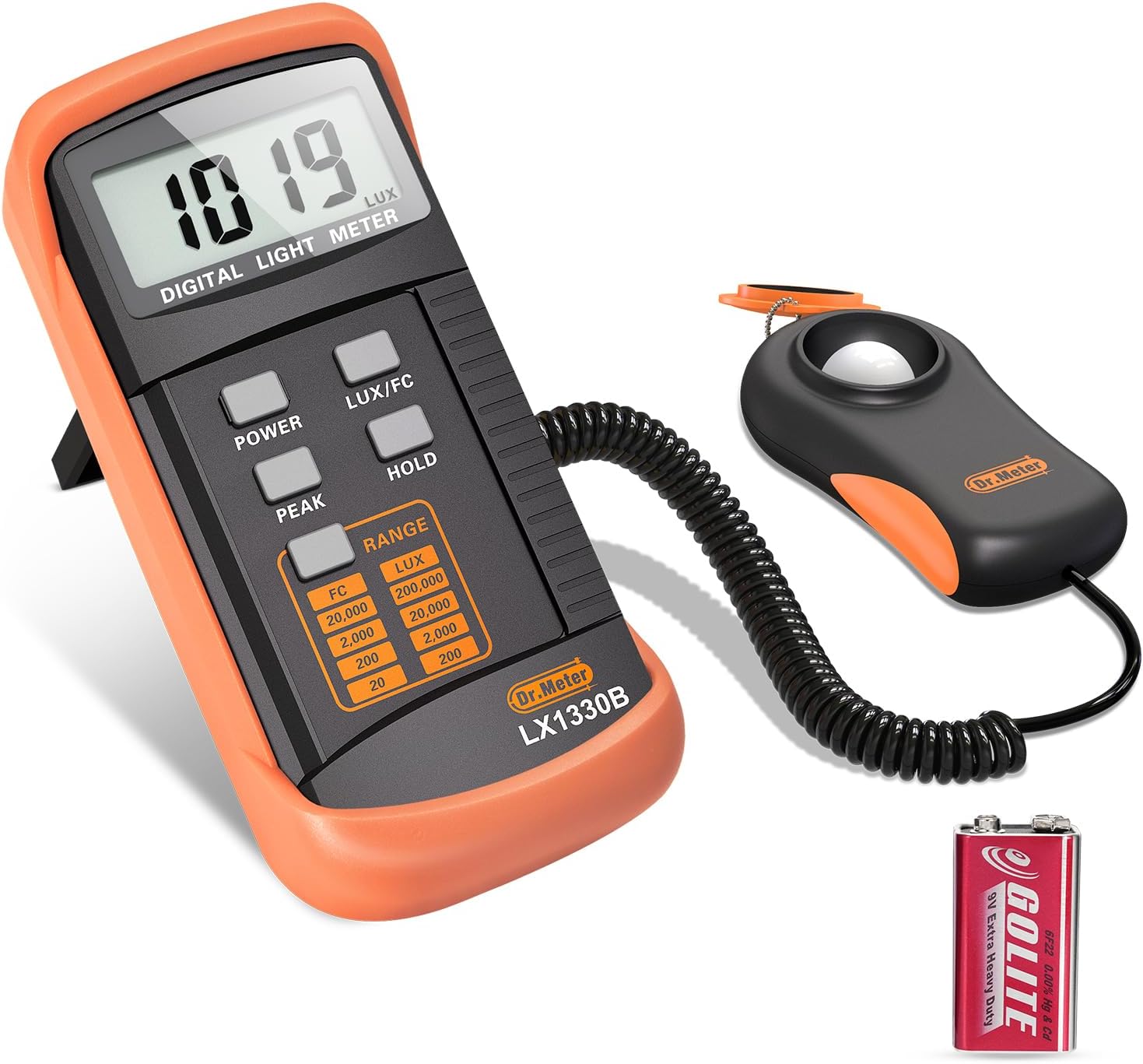
Dr.meter Digital Illuminance Light Meter 0-200,000 Lux Range Lux Meter
Product ID: 76196769
⚡2x/sec lightning-fast readings
📊Peak data lock for max intensity
🔆0-200,000 Lux ultra-wide range
Desertcart purchases this item on your behalf and handles shipping, customs, and support to Iceland.
🔦 Illuminate your world with precision and speed!
The Dr.meter Digital Illuminance Light Meter offers ultra-fast, high-precision light intensity readings up to 200,000 Lux, with easy toggling between FC and LUX units. Featuring peak data capture and low battery alerts, its durable, dust-proof design ensures reliable performance across diverse environments—from studios to greenhouses.


| Asin | B005A0ETXY |
| Batteries | 1 9V batteries required. (included) |
| Battery Cell Type | Zinc Carbon |
| Best Sellers Rank | #2 in Photographic Light Meters |
| Customer Reviews | 4.5 4.5 out of 5 stars (3,137) 4.5 out of 5 stars |
| Date First Available | June 5, 2007 |
| Included Components | 1 x Light Meter |
| Item Model Number | 1330B-V |
| Item Package Quantity | 1 |
| Item Weight | 12 ounces |
| Manufacturer | Dr.meter |
| Material | ABS |
| Measurement System | Metric |
| Part Number | 1330B-V |
| Power Source | Battery Powered |
| Product Dimensions | 4 x 1 x 8 inches |
| Style | Light Meter |
| Voltage | 9 volts |
S**M
This is a Digital Light Meter not a photographic exposure meter
I find this inexpensive meter extremely useful for assessing lighting conditions at venues where I am taking photographs and videos. That said this is not a photographic exposure or flash meter and unfortunately if you are purchasing it as an inexpensive substitute to use for that purpose you will be disappointed. This meter gives you a simple to understand Lux reading corresponding to the brightness in the room. Our eyes are amazing self adjusting optical miracles... they compensate for conditions so much that we often have a difficult time judging just how light or dark conditions really are. Modern cameras and video cameras have sophisticated reflective light meters built into them and if used in an auto or semi-auto mode they will adjust the images we take for overall brightness. They will also predict whether the exposure will be under or over-exposed in manual as compared to a photo that is an even 18% gray. Very few people use traditional exposure meters these days. The problem for most is that if they try to take pictures or video in dimly lit areas without a flash or other external light source the camera (or you) can try to compensate with very slow shudder speeds, very high iso settings, along with the widest aperture your lens has available. It is decision making time as to how you are going to get your best results. Because of improved camera sensor technology this is less important these days than it once was, but this is still a recipe for pictures and videos that have poor image quality. I use the readings that I get from this light meter to help decide how to set up my equipment and/or adjust the lighting for the most satisfactory video of photo taking environment. One could accomplish the same thing by taking sample pictures and videos (which you most the time one has to do also), but I find the meter to be a time saver for initial decision making. I have a much more sophisticated and much more expensive photographic exposure meter. It is more complicated to set up and is overkill for this purpose most of the time, but this is the type of light meter that most photographers are looking for. This meter does only one thing... it measures the brightness of visible light and gives back a number representing either lux or foot candles. There are free android calculators and also charts that one can quickly convert these numbers into exposure settings, but this is not what this meter was designed to do. For novelty I have checked whether the readings are useful for this purpose and have had mixed results as compared to our actual photographic exposure meter. Since this is not what the meter was designed for you have to make adjustments to the results you get and the reflective meter built into the camera is more accurate. A modern photographic exposure meter has many more options in the way that light can be measured and gives it much more flexibility. The one I have has inputs and attachments for spot metering and flash metering. Of course it also automatically calculates recommended exposure settings. In my opinion this is a great meter and for me it has been a big time saver for assessing and adjusting the lighting conditions at an event where one I have set up video or photographic equipment. But... this is NOT a photographic exposure meter. While both are built up from similar sensors they are not the same tool. This cannot accomplish many of the tasks one purchases an exposure meter for such as setting up flash equipment. If you are trying to fine tune the results you get from your camera this is not going to help much if at all. I hope that is a helpful explanation and also explains why people have felt misled and others have said it is not suitable for photography.
P**Y
Easy to use and accurate
I'm a photographer and videographer and shoot in a studio with CFLs in softboxes. I wanted a method of quickly measuring the output of light heads and CFLs. And Dr.Meter seems to be just what the doctor ordered. BUILD quality is good: sturdy plastics, rubberized buttons and a thick rubber bumper. It feels solid and confident in hand. The LCD looks like something from the 1980s (no gray scale or color) and lacks a backlight. The light sensor is under a translucent dome and attached to a coiled cable hardwired to the device. It might be a little too easy to snag the cable on something and damage it. A plug-in/replaceable cable would be preferable. OPERATION: Peel off the rubber bumper, lift off the battery door and install a 9v battery (included). Squeeze the bumper back on and you're ready to rock. Hit power and point the dome at the light source. If it shows "1" on the LCD, that's Dr.Meter speak for "out of range." Press the range button to calibrate to a higher measure value. You have a choice of LUX or FC and can retain/stop metering by pressing the hold button. That's pretty much it. If you plan on comparing or recording a lot of data points, bring a pencil and paper. This is a barebones meter and has no data transmission or memory ability. One thing I learned after metering my lights is manufacturer specs for CFLs are totally whack. In other words, Dr.Meter confirms what my eyes suspected: some 60W bulbs are brighter than 105W bulbs! So I need to balance lights by actual light output and not according to manufacturer specs. The other useful thing about this meter is I can record output of each light head from the subject's position, write it down, and precisely recreate the light balance of the set at a later date. FINAL BLURB: All in a great meter for measuring light levels in studios, offices, stage sets and homes: easy to use, accurate and priced reasonably.
R**T
a worthy meter
I recently received the Mastech meter to monitor the lighting in my nursery. I found it easy to use although the directions might be a bit improved. For instance, putting in the supplied battery it's necessary to remove the rubber casing. The instructions said to slide off the battery cover in the direction of the arrow but there was no arrow and the cover wouldn't securely fit unless the rubber case was on. It took a little practice to figure out the scales since pushing the range button wasn't simply reflected on the LCD, especially on the lower ranges (afterwords it would show 10x,100x, etc.)It would have been nicer had it shown the actual amount on the readout within a particular range rather than having to multiply it by one of the factors. I should emphasize that the above quibbles are very minor and that the meter performs it's functions very well. The meter is well built and the rubber casing and sensor cover afford it excellent protection. Both the sensor and main unit are light weight and easy to grip. The readings I got were consistent time after time.I think that for the money it's an excellent buy and superior to most others on the market in its price range or even some higher priced ones. I would recommend this meter for anyone who wants a reliable meter that covers a great range and is very affordable.
M**N
Good for the price
I have now bought 2 of these illuminance meters (LX1330B). I purchase the first one about a year ago in 2022 Feb and the second in 2024 Jan. I performed a test just now: With the sensors positioned touching each other, sitting on a table under a 20-foot long fluorescent light array, the new meter reads 54.7 fc and the old meter 53.2 fc -- a "quality control" tolerance of 2.8%. (...at least for these two units.) I think it is safe to assume that these units can be used in situations where a tolerance of +/-5% is allowed. However, I would not trust them for any situation needing more accuracy than that. Overall, I think this product is a good deal because the price is low ($35 as of 2024-01-26). If the QC tolerance were any worse, then I would be concerned. I hope the manufacturer does not begin to skimp on "important" internal components of these units, now that they have built up a good following. I did notice that the new unit does not have the inside of the sensor cover painted with opaque paint. Also, the new unit did not come with a storage case like my old unit did. I have to go get a case.
A**M
A DIY Lighting Tool Must-have
This instrument is super easy to use, and an invaluable aid to have at your disposal to better ensure satisfaction with lighting projects. We're designing a full kitchen remodel. We did a relatively deep dive into all the facets, i.e., cabinetry, appliance placements, plumbing moves, etc. In my long experience as a DIY'er I've come to recognize the line between the DIY and the Farmout project. Farmout or not, I've tried to know or educate myself enough to (at a minimum) be conversant with the contractor or trades about the work and especially expectations. Everyone (myself included) can understand & generally do plumbing, carpentry, tiling, flooring (sometimes!), painting, etc. work. Electricity and lighting work--well ... that's a lot different for most. The few brave venture there, but the rest of us--mostly punt. Lighting is even more mysterious. When it came time to look into lighting I hit the internet and did some self-learning. It's a well worth and doable exercise to 'smarten up' here. Because, you don't want to 'ruin' a remodel job when you finally flip the lights & are greeted by under/over-lit, dim areas, glare, etc. Fixes at this point can cost $$$$$. This tool is practically an indispensable aid in lighting design. And you can do yourself a great service by getting a little smart about lighting & acquiring this tool/aid. You'll be able to walk around your house and measure the "light intensity" with this light meter or experiment with bulbs/lamp to get some sense of what lighting levels you would like to achieve (whether it be in a hall, closet, bathroom, over-counters, utility room, bedroom, etc.). Knowing this, you can spec your desired lighting levels and leave it to your lighting designer to ensure an installation capable of meeting your expectations.
C**H
Bad Meter was Quickly Replaced!
Had a problem with the Meter I first received, it worked intermittently, then stoped working all together, it was out of the Return Period, sent a Message to Seller, Dr. Meter contacted me and replaced the Meter, Good Customer Service from Dr. Meter
S**X
Good product at a great price
I bought this so I could test output from flashlights and write reviews. If you’re buying this for camera work, don’t. It’s not designed to be used as a camera light meter. Hopefully this will save you a return if that’s what you had in mind. The item is easy to use. It has a cover for the sensor, comes with batteries, and the included booklet outlines how to use it. I was up and running in just a few minutes. One thing you’ll need to know – the battery compartment is underneath the rubberized wrap. You’ll want to pull it off to access that, but it doesn’t take more than a minute to get everything connected. The battery compartment is a bad design on an otherwise good product. This product is pretty fantastic for the price. For under $40, I was able to consistently able to get good lux readings, so it does its job well. Once I finish building an integrated sphere, I think this product will help me get repeatable numbers. Readings are consistently within the documented range (Accuracy ±3%, Repeatability ±2%). The meter comes with a 1 year warranty, though I hope to never need to try it out. If I do have any issues, I’ll come back and update the review. I am an Amazon Prime customer that enjoys writing reviews as a hobby, so I ask vendors for products I want in exchange for an unbiased review. I strongly believe that’s my only obligation. When reviewing, I consider the items worth as it pertains to its full price. This review reflects my honest opinion of the product.
A**R
Has a few issues
Does not look like the picture on the Amazon page: the cover on the sensor is NOT a circular cap as shown but rather it is a piece of completely removable hard black plastic that is not as convenient as what might be inferred from the picture. (I would upload a photo if I could find the link that Amazon usually has for doing this!) It is kind of annoying to have to keep track of the sensor lid while doing measurements since it is not attached to the unit in any way. The lid is somewhat awkward to remove and then it does not snap on very tightly. I recommend that you pay attention to the reading when the cover is on the sensor to make sure it reads zero when the lid is on the sensor. If it does NOT read 0, there is a recessed screw on the back of the unit where you can make adjustments if you have a small enough screwdriver. The instructions for doing this were very brief and poorly written. Performing this adjustment did seem to make a difference in the measurements. After I adjusted it, the reading I took in a windowless room were different by about 12% compared to before adjusting to zero. The orange piece around the unit is flexible plastic (protection in case of dropping?) and easy to remove. Once it is removed you can get at the battery compartment on back at the bottom. The cover to the battery compartment is held on by a screw. The screw was not screwed in when I took the unit out of the case. Instead, there were 2 small screws supplied in a tiny ziploc. Not sure why there were two screws as I saw the need for only one. Perhaps in case of loss. It came with an uninstalled 9v battery. I have nothing to compare the measurements to, so I cannot vouch for accuracy. There is a sentence in the instruction booklet (under the Maintenance section) that I cannot decipher. It reads precisely as follows: "The reference level, as marker on the face plate, is the tiof thep photo detector globe."
I**G
Working properly, I get reasonable readings for the light intensity.
Working properly, I get reasonable readings for the light intensity.
F**E
Simplicité d'usage
Utile pour mesurer l'éclairage dans les parties communes d'un immeuble ,où des normes d'intensité lumineuses doivent être respectées en fonction de dispositions légales. Instrument utile pour Syndic d'immeuble. J'ai regretté que le mode d'emploi n'explique pas comment mettre les piles: j'ai mis tout un temps avant de comprendre qu'il fallait au préalable retirer la protection périphérique en caoutchouc orange et seulement ensuite dévisser le couvercle du compartiment piles, en partie inférieure du dos de l'appareil.
M**I
Easy handled
Practical, easy handling, accurate
A**R
excellent
good product
N**O
De momento va perfecto
Perfecto para el cultivo
Trustpilot
2 days ago
3 days ago