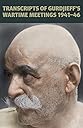
Transcripts of Gurdjieff's Meetings 1941-1946
Product ID: 63244234
With the outbreak of the Second World War, Gurdjieff's American and English students were unable to return to Nazi occupied Paris, nevertheless, Gurdjieff continued to teach despite difficult and dangerous wartime conditions. In 1938, Jeanne de Salzmann introduced her French work group to him, and with this nucleus, Gurdjieff held regular meetings at his Paris flat throughout the occupation. In question and answer format, Gurdjieff answers his students' questions on practical work in daily life and gives specific advice, guidance, and exercises. Among those present in Gurdjieff's company at this time were René Daumal, Luc Dietrich, Jeanne de Salzmann, Tcheslaw Tchekhovich, Henri Tracol and René Zuber. Thirty-three meetings held at 6, rue des Colonels Renard, Paris Second edition with new material Complete and unexpurgated Review: To remember...oneself! - The words of Gurdjieff, wherever genuinely reported like in this book have a much higher and different impact than all other books written by those who came after him. And this is an invitation to read Gurdjieff own books before any other in order to get a better picture. Others have just helped building the frame. Now there are too many frames. A great book to open quite often as to remember! Review: Excellent records of early meetings - This book is only to be recommended to those who are already steeped in Gurdjieff's teachings. The advice contained within the pages is aimed at particular students with particular questions, aims and difficulties. Those untutored in the ideas will gain little from the records and those with experience will still need to be alive to the possibility of inappropriate application of specifically-directed counsel.
| Best Sellers Rank | 3,274,078 in Books ( See Top 100 in Books ) 10,573 in Spirituality (Books) 89,314 in Philosophy (Books) 194,184 in Health, Family & Lifestyle Self Help |
| Customer Reviews | 4.9 out of 5 stars 57 Reviews |
A**S
To remember...oneself!
The words of Gurdjieff, wherever genuinely reported like in this book have a much higher and different impact than all other books written by those who came after him. And this is an invitation to read Gurdjieff own books before any other in order to get a better picture. Others have just helped building the frame. Now there are too many frames. A great book to open quite often as to remember!
S**Y
Excellent records of early meetings
This book is only to be recommended to those who are already steeped in Gurdjieff's teachings. The advice contained within the pages is aimed at particular students with particular questions, aims and difficulties. Those untutored in the ideas will gain little from the records and those with experience will still need to be alive to the possibility of inappropriate application of specifically-directed counsel.
M**N
YES !
If you know about Gurdjieff and are interested in his teaching, you'll enjoy this book. I did.
P**T
This was said to the people who were there...
One of the reviews of this extract from Gurdjieff's works raises the question of understanding and lineage. The review does not say so but it does raise these two important subjects. Gurdjieff said, long ago, that there are two aspects to understanding. One is knowledge, and the other is something which is rarely mentioned in any western writings, that is, being. Knowledge we have plenty. Being we are not so well supplied. Being has to do with capacity and the fulfilment of potential. If for instance a person knows how to build a house but cannot build it, then his knowledge outstrips his capacity. If he knows how to build a house and can build a house, we can say he understands how to build a house. So one aspect of being is to be able to. When someone reads these extracts from Gurdjieff's writings, he was not there when the words were spoken, he does not know the context, he does not experience the atmosphere, and he may not have been through the same experiences as the people who were there at the time. He also may not be able, may not have the capacity, to carry out what is spoken about in these writings. To do all these things he must have worked on himself, and been guided by people who went before him, and are able to convey to him what is being spoken about. If these conditions are not in place in him, then what he reads is simply knowledge. And in this case the knowledge outweighs the being, and there is no understanding. This brings us to the question of lineage. In all crafts, in eastern martial arts such as tai chi and swordsmanship, in learning of many kinds, the question of who teaches you is important. I have decades of experience studying Gurdjieff, and to a lesser extent Tai Chi (Taiji). The question of who teaches or guides one along these paths is important, particularly when it concerns understanding the complex functionings which make up a human man or woman. Among the Chinese for instance, if a person says that he or she studied tai chi or swordsmanship or brushwork or medicine, the first question asked is, "Who was your teacher?" Though not stated, implicit in this question is the matter of have you learned from someone who understood this art or craft because this will indicate the authenticity of what you claim to be able to do. It will in fact be a clue to the possible understanding which you have: the ratio of your knowledge to your being. Today there are many knowledgeable people in the world, some of them with excellent intellects. But their knowledge and intellectual ability is only one part of what is necessary in order to understand. There is so much shouting and noise in the world of New Age Knowledge, to coin a phrase, that a little quiet thought does not go amiss. Sniping, criticism, back biting and all the rest of the noise on websites is not helpful. It wastes valuable time and energy.
R**N
You can almost hear him speak...
These transcripts, now in book form after 62 years, are some of the most authentic we can come across from Mr. Gurdjieff. His own books were translated, edited and re-edited during his life and also after he died. The transcripts are a translation from French and what Mr. Gurdjieff said in these meetings was also during the meetings themselves translated to French. A careful study of these texts can be rewarding. Some years ago I was warned (by a senior member of a respected "official" Gurdjieff organisation) about publishing the texts on my website. (His words were an answer to my question why the transcripts had not been published.) I repeat the warning. He had three main arguments against publishing: * that there are enough authentic writings from Mr. Gurdjieff already available * that those reading the transcripts will think that they have understood something and therefore not make the efforts to work * that what was said was meant for those present and can easily be misunderstood by reading them I don't have to explain why I was truly amazed at this and disappointed! To understand is wrong, to misunderstand is also wrong and to add to the couple of thousand pages already published of authentic material from Mr. Gurdjieff is also wrong! Nevertheless - back to the book: to read anything it is wise to read slowly and like Mr. Gurdjieff advised about reading his main work Beelzebub's Tales to His Grandson (All and Everything): first as one is accustomed to read the newspapers, then as if aloud to oneself and then one can study. This way it is not so much only the head that understands; one of the main messages in the transcripts and the exercises described in it and also in the whole of the Gurdjieff Work. Mr. Gurdjieff said that his mission was "to live and teach so that there should be a new conception of God in the world, a change in the very meaning of the word" (the quote is in the A. R. Orage - A Memoir by Philip Mairet). This is for all of us to discover in the transcripts. When asked how he found his teaching he answered: "Perhaps I stole it!" Perhaps Mr.Gurdjieff "stole Christianity"! How could he do that? There is more material in the book than in the notes that I have been reading and for those who are studying it is therefore a must. It is good to keep in mind that "the head is a luxury and only a policeman". The important question, so aptly put by Reshad Feild is: who is the Gurdjieff of our time?
P**T
Excellent And Uncut
I'd read Patterson's 'Voices in The Dark' which contains transcripts from Gurdjieff's 1940's Paris meetings. And I don't know if you know but it is expurgated (which means matter has been removed thought to be objectionable). I'd figured that out because years ago I met P.L. Travers in 1987 in Chiswick where she used to hold little 'Work' group evenings. She's the lady who wrote Mary Poppins and had been/was a student of Gurdjieff and I tell you she was remembering herself always and everywhere; she had the invisible muscle. Anyway, she gave me a couple of evening's transcripts and I couldn't understand why the best bits (exercises) had been left out of 'Voices'. The 'index' begins. The Foundation or Mr. Patterson thinks it knows what's good for us, which I suppose is sweet in one way. So I bought this book mainly to see if it does the same thing and was delighted to find it is totally uncut. The names of questioners, dates of meetings, controversial passages and important exercises have not been omitted or edited out. The text is complete and intact. Nothing has been added - you get just what the transcriber wrote down on the night and what I really like are all the exercises. If you are a Gurdjieff aficionado/freak like wot I am I can highly recommend this book. Now let's shut up and remember ourselves for the rest of our lives. Mind how you go.
M**Y
Transcripts of Gurdjieff's Meetings 1941-1946
This is one of the best books I have come across yet alluding to methods of the Work in the Fourth Way. Gurdjieff gives clear and definitive instructions in answer to his pupils questions.
L**R
Hearing G's voice
This book gives a real taste of what it was like to exchange words and ideas with G. His delightful sense of humour is often evident. What he is saying is for those people at that time and also the translation goes off the rails at times. Nevertheless those hungry for authentic writing on the Work will be fed.
S**O
Libro da avere se si studia Gudjieff
Libro interessante per chi studia Gurdjieff per chi non lo conosce non è molto interessante
J**.
¡Muchísimas Gracias!
Amazon EEUU: ¡Buen Día! Hoy -05-Octubre-2015-, aproximadamente a las 12.15 P.M.; el libro llegó a su casa -expresión. ¡Muchísimas gracias por ello! Juan R.
ポ**ル
グルジェフ思想最初の一冊
グルジェフの晩年のワーク指導の現場において取り上げられた質疑の トランスクリプトをまとめたものです。 いままではグルジェフワークというと「奇蹟を求めて」からふれるケースが 多いはずです。「奇蹟を求めて」はとても意義のある本ですが、また同時に 諸刃の剣でもあり、むしろワークの観点からは邪魔な観念、思い込みで膨れ 上がらせることになる危険性があり、ほとんどのケースで、まさにそのとおり のことがおきているのが実情です。さらにわるいことにそういった観念を悪用 するケースまで出てきています。 (悪用するケースについてはパターソンの「グルジェフを求めて」に詳しいです。) 「奇蹟を求めて」は、ウスペンスキーができる限り、聞いたことと、自分が 考えたことを分けて書いていますが、ウスペンスキーの編集者としての意図、 思い込み、意識の置き所がどうしても出て偏向しているところがあるのは明らかです。 グルジェフ自身は「ベルゼバブ」を勧めていますが、実践的なことを取り出すこと ができるようになるためにどうしても数年は研究する必要があります。 グルジェフにはじめて触れる人は、「奇蹟を求めて」のような一見 まとまった体系を装った本よりも、こういった質疑のトランスクリプトを 先に、解説者を交えたり、仲介者を持たないで、心読することが有益で あると思います。先入観念を持たないで、虚心坦懐にテキストに向かえば 響きあうものであると思います。 本書はかなり直接的にグルジェフの教え、指導が書かれています。 グルジェフが参加者に伝えた具体的なエクササイズの方法が載っています。 大変貴重な内容です。 言葉は(文法的な問題はのぞいて)明瞭で、的確であり、きわめて 示唆に富んでいますが、その読み取りにはきわめて注意が必要でしょう。
C**N
Succinct, direct advice for his students at the time, assured to edify and possibly raise an eyebrow.
These transcripts, from late in Gurdjieff's life, are helpful to someone "in the Work." Others might find them perplexing. The Gurdjieff "Work" is shown here to be only for those who can stand the sight of their own blood. His replies are always practical, useful and sometimes direct enough to cause the reader to flinch. This book ought not to be the first one reads about, by or of Gurdjieff. From my perspective, having extensively studied the brain, to a lesser extent the body and been a Work practitioner for many years, Gurdjieff was the greatest psychologist ever to set pen to paper. Not only did he understand his students, he pushed each one in a manner especially suited to that person's nature. Many of us, he said, are "candidates for a lunatic asylum" and, in my experience, that statement is truer now than when he regularly repeated it. Gurdjieff centers may or may not reflect his teachings accurately as it is an easy method to distort and to corrupt. Nevertheless, in Beelzebub's Tales, he commends other spiritual paths still available to a true and sincere Seeker. This book provides a more intimate view of him with students, "Working" under less than favorable conditions, to and for their benefit, providing they could manage to assimilate the feedback he provided. He has shown us, clearly, that "man's ego is not his friend" to quote Swami Rama. What we do about that is up to us but, he says, doing something effective is the only way out of our "prison."
C**I
Essential reading for anyone interested in mindful living
The material in this book belongs to all who seek to make sense of themselves and who wish to find a genuine mode of being in modern life.
Trustpilot
1 month ago
1 month ago