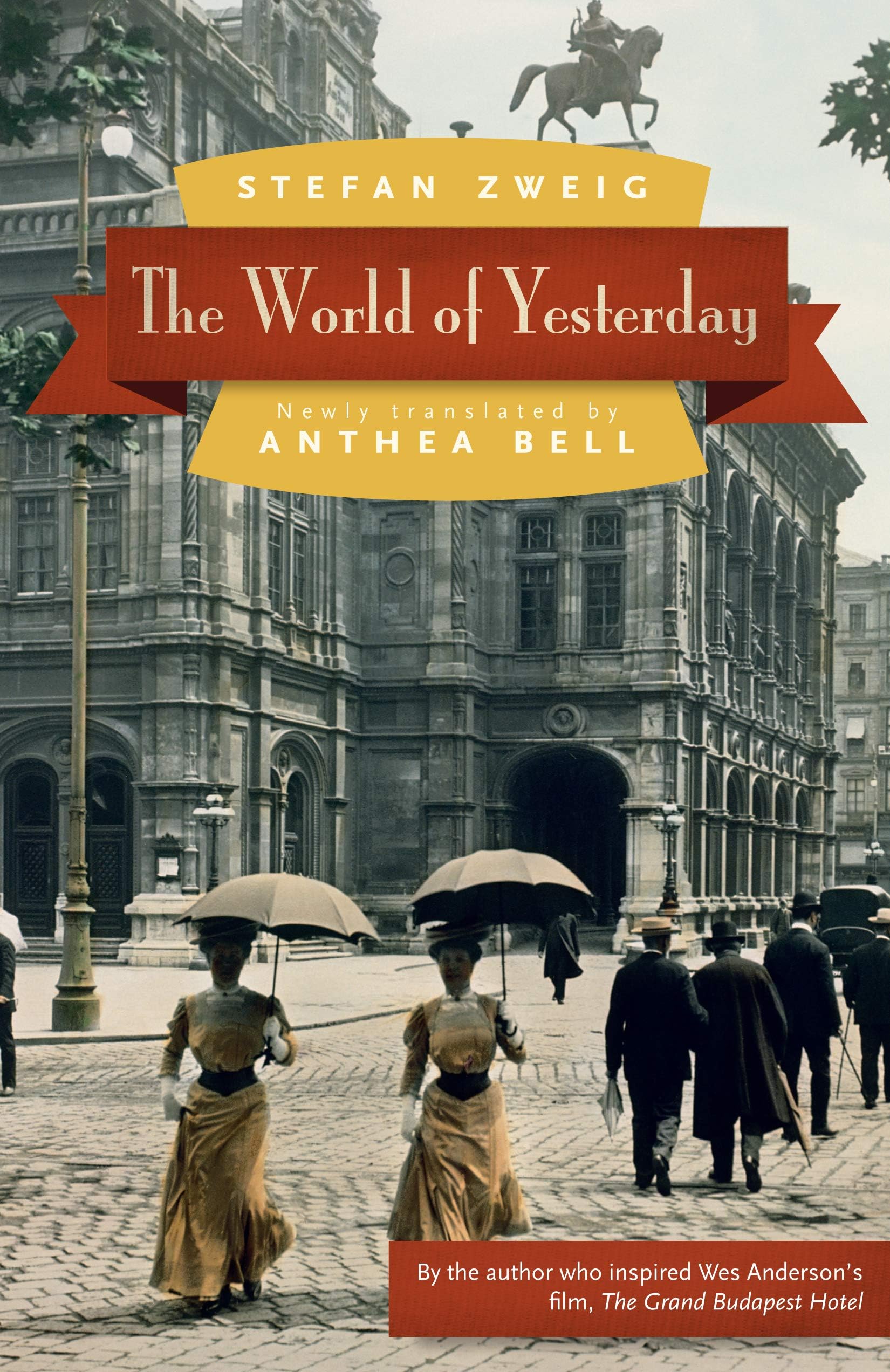
The World of Yesterday
Product ID: 6309949
Desertcart purchases this item on your behalf and handles shipping, customs, and support to Iceland.
By the author who inspired Wes Anderson’s film, The Grand Budapest Hotel Written as both a recollection of the past and a warning for future generations, The World of Yesterday recalls the golden age of literary Vienna—its seeming permanence, its promise, and its devastating fall. Surrounded by the leading literary lights of the epoch, Stefan Zweig draws a vivid and intimate account of his life and travels through Vienna, Paris, Berlin, and London, touching on the very heart of European culture. His passionate, evocative prose paints a stunning portrait of an era that danced brilliantly on the edge of extinction. This new translation by award-winning Anthea Bell captures the spirit of Zweig’s writing in arguably his most revealing work. Review: A window into a lost world - Stefan Zweig was brought to my attention only recently by Wes Anderson's wonderful Grand Budapest Hotel film, whose works the director credited as the inspiration for it. The movie was so successful in recreating the bygone, glamorous era of Central Europe before World War II that I figured the source must be at least as good, so I looked for his works available as ebooks and decided that his memoir, The World of Yesterday, was more likely to provide that look into a lost world than the stories and plays. It was only a few pages into the book that I realized my expectations would be met, and the book would not let go of me until I finished the last of its 440 pages. Covering the period from the authors early youth in Vienna in the 1890s through his life in exile and death by suicide in 1941, Zweig speaks to us from a time and place where a lot of history was being made but he doesn't speak to us as a historian. Instead, we are treated to a first person account of history in the making by someone who was not only extremely bright and perceptive but also a person of wealth and prestige who was very well connected and moved in the most exclusive circles, a socialite without the frivolousness we now associate with the term, who in addition to his native German was also very fluent in English, French, and Italian, the main European languages of his day. We are thus given a close up view of some of the greatest people of the modern era with whom he was acquainted with: poets Hofmannstahl and Rainer Marie Rilke, sculptor Rodin hard at work, composer Richard Strauss, authors Luigi Pirandello and Maxim Gorky, literary critic and Zionism founder Theodore Herzl, Sigmund Freud, and even a young Salvador Dali, among many others. But perhaps the greatest value in this book is that it give us a feel of what it was like to live and be young in the wonderful world of pre World War I Europe, a time of optimism, technological progress (with electricity, the telephone, and the automobile having been recently introduced), rapid economic growth that was lifting all boats, with almost a century of peace behind them and increasing globlalization, where educated people considered themselves citizens of the world and people could travel freely without passports or visas. And then World War I suddenly started, the bubble burst and it was all downhill from there. Though on a smaller scale, it gives a feeling reminiscent of being young in the roaring 1990s, after the fall of communism, during the early days of the Internet and before 9/11 and the dot com crash, and if anything serves as a cautionary tale that progress is not inevitable and nothing we enjoy today can be taken for granted. Two caveats here. First, this is a memoir completed just before the end of Zweig's life, perhaps much of it written after he had lost hope and had decided to kill himself, so the events of the 1930s, especially the rise of Nazism, are given a more detailed, newpaper like kind of treatment, whereas the earlier 1900s are more impressionistic in nature, perhaps embellished a bit, and there are some periods in between that are not covered with the same level of detail. Second, this is an autobiography of his public life. There is no mention of how he met his wife, his children, his father's passing, his second marriage, or even how he was able to make ends meet given his frequent travels and high living. Nonetheless, this is a thoroughly enjoyable, valuable work that like few others make me grateful to the author for having taken the time to write it. Review: A Lucid Odyssey For Our Times - I heard about this book from a podcast and can't recommend it highly enough. The chapter on Eros is worth the price of admission alone. But honestly, every page is worth absorbing. Many lessons for our hyper paranoid, nationalistic times.
| Best Sellers Rank | #19,133 in Books ( See Top 100 in Books ) #75 in Author Biographies #105 in Historical European Biographies (Books) #236 in European History (Books) |
| Customer Reviews | 4.6 out of 5 stars 1,943 Reviews |
D**A
A window into a lost world
Stefan Zweig was brought to my attention only recently by Wes Anderson's wonderful Grand Budapest Hotel film, whose works the director credited as the inspiration for it. The movie was so successful in recreating the bygone, glamorous era of Central Europe before World War II that I figured the source must be at least as good, so I looked for his works available as ebooks and decided that his memoir, The World of Yesterday, was more likely to provide that look into a lost world than the stories and plays. It was only a few pages into the book that I realized my expectations would be met, and the book would not let go of me until I finished the last of its 440 pages. Covering the period from the authors early youth in Vienna in the 1890s through his life in exile and death by suicide in 1941, Zweig speaks to us from a time and place where a lot of history was being made but he doesn't speak to us as a historian. Instead, we are treated to a first person account of history in the making by someone who was not only extremely bright and perceptive but also a person of wealth and prestige who was very well connected and moved in the most exclusive circles, a socialite without the frivolousness we now associate with the term, who in addition to his native German was also very fluent in English, French, and Italian, the main European languages of his day. We are thus given a close up view of some of the greatest people of the modern era with whom he was acquainted with: poets Hofmannstahl and Rainer Marie Rilke, sculptor Rodin hard at work, composer Richard Strauss, authors Luigi Pirandello and Maxim Gorky, literary critic and Zionism founder Theodore Herzl, Sigmund Freud, and even a young Salvador Dali, among many others. But perhaps the greatest value in this book is that it give us a feel of what it was like to live and be young in the wonderful world of pre World War I Europe, a time of optimism, technological progress (with electricity, the telephone, and the automobile having been recently introduced), rapid economic growth that was lifting all boats, with almost a century of peace behind them and increasing globlalization, where educated people considered themselves citizens of the world and people could travel freely without passports or visas. And then World War I suddenly started, the bubble burst and it was all downhill from there. Though on a smaller scale, it gives a feeling reminiscent of being young in the roaring 1990s, after the fall of communism, during the early days of the Internet and before 9/11 and the dot com crash, and if anything serves as a cautionary tale that progress is not inevitable and nothing we enjoy today can be taken for granted. Two caveats here. First, this is a memoir completed just before the end of Zweig's life, perhaps much of it written after he had lost hope and had decided to kill himself, so the events of the 1930s, especially the rise of Nazism, are given a more detailed, newpaper like kind of treatment, whereas the earlier 1900s are more impressionistic in nature, perhaps embellished a bit, and there are some periods in between that are not covered with the same level of detail. Second, this is an autobiography of his public life. There is no mention of how he met his wife, his children, his father's passing, his second marriage, or even how he was able to make ends meet given his frequent travels and high living. Nonetheless, this is a thoroughly enjoyable, valuable work that like few others make me grateful to the author for having taken the time to write it.
L**M
A Lucid Odyssey For Our Times
I heard about this book from a podcast and can't recommend it highly enough. The chapter on Eros is worth the price of admission alone. But honestly, every page is worth absorbing. Many lessons for our hyper paranoid, nationalistic times.
E**D
Beautiful Memoir of a Beautiful Time, Tinged With Tragedy
I must admit that I had only heard of Stefan Zwieg, one of the most important writers of his time, from Rod Dreher’s blog, in context of Zwieg’s memoir capturing the grandeur of Europe pre-Great War, the socioeconomic chaos endured by the losers of that conflict, and the lead up to WWII. The book was published in 1942, the year Zweig and his second wife committed suicide in Brazil, by then nationless and stripped of nearly everything. Although these conflicts are foreshadowed throughout the book, it’s about so much more than that. It’s about European civilization at its heights. Any romantic who imagines sitting in Parisian literary salons, listening to opera in Vienna, or meeting great artists in their turn of the century studios will love this book. It’s filled with many slice of life observations about the mores and manners of people living in that time and place. The list of famous writers, poets, musicians and artists Zwieg rubbed elbows with throughout Austria, Switzerland, Italy, France and England is incredible, a who’s who of the time. Ravel, Toscanini, Rodin, Dali, HG Wells, Freud, Thomas Mann, Theodor Herzl, Richard Strauss, Shaw - this list goes on and on - were his peers, friends and acquaintances. This is a lovely book written by a seemingly lovely man devoted to art and culture and most of all, Europe, which one reads with a constant sense of foreboding, given the two calamities which befell the Continent. Barbara Tuchman’s “Proud Tower” is a masterpiece of history if you wish to learn about the socioeconomic conditions which roiled the Belle Epoch. But if one wants a slice of life, an insight into how so many great artists of the time lived and thought, this book is a must-read.
A**A
Farewell Vienna - Hello Mr. Trump - A Trip Through Time and Back
This is the pre-suicide autobiography of accomplished Viennese writer Stefan Zweig, who lived through the final dissolution of the old Austrian Hapsburg dynasty and ended his life in 1943 before the end of WWII. The original was written in German, which must have been exceedingly difficult to translate adequately, given its complex thought-streams and complicated sentence structure. So first off, an admiring nod to the translator, Anthea Bell, who did a masterful job of conveying the heart and soul of this book to readers of the English language and supplying excellent background in her translator's note which opens the book. Zweig was a man of many faces -- brilliant, yes! and also exceptionally self-aware. The book opens with a fascinating account of his Jewish boyhood in Vienna, his early training in the rigorous and pedantic German schools, and builds to a climax as he reflects on his experiences as a disenfranchised member of the Jewish artistic community during and after the Nazi take-over in Germany and Austria. He was conscious of the deep changes that were undermining the old regime in his native Austria and in Europe, particularly the rise of fascist sympathizers in many places in Europe during his lifetime. The tension was palpable in his haunting descriptions of life on the edge of communal insanity as the Hitler machinery marched through Europe in the late 1930’s and struck down one basic human freedom after another. It was an insidious and covert operation that became obvious to most only after-the-fact. All his books were ultimately banned by the Nazis and he fled the country and lived in exile for several years. He seems to have largely discounted his ultimate success as a major contributor to the historical record of his day while he was living through the process, chagrined that he could do nothing about it except to experience it deeply and shoulder his burden as a super-sensitive soul. In many ways, as I read through this rich and elegant exploration of his life and times in Vienna, Paris, Italy and America, I quietly sympathized with him at the loss of his beloved country to war and hate. I can almost hear his stark voice commenting here that he was much more rooted in literature and philosophy than he was in routine daily life, and that he expected his artistic and scholarly efforts, small as he may have viewed them, to affect or change the course of world history for the better. He had maximum refinement but lacked the common touch at a time when common people were rising and trying to upend the old regime in Austria and in so doing, opening themselves to the Nazi take-over. In light of his imminent suicide shortly after completing this book, it is fair to assume that he felt adrift on this planet as a writer who could no longer grasp what went so terribly wrong all at once -- or how to amend it with all his worldly knowledge and massive literary skills. The realization that his past conditioning was no longer sufficient to sustain him must have been personally wrenching. In his mind, a new day was coming unbidden, and with it a profound shift in mores. In my own life, with the ascent of Trumpism and its blatant disregard for human rights, it felt like deja vu to absorb this book, which is not only a shout-out to our collective past as scholars and thinkers, writers, musicians and artists of the sort who were at home in pre- WWI Vienna, but also a potent reminder that a shift in culture can be ruthless and insane before the “new normal” becomes apparent. It is both a swan song and a warning – and that is primarily why our book club chose to experience this book together. As a sympathetic portrait of a man and a world in acute distress, it is helpful to read it while trying to live through the crude and unconscious political agendas of our own times. It sparked intense debates and fruitful discussion among our group. Take some time to read through it slowly and let it sink in -- it is a complex book of many layers and uncannily prescient.
B**E
Thank you, Herr Zweig!
This is a wonderful, heartbreaking memoir of, first, Vienna before WWI from the viewpoint of a child; then all of literary Europe between the two world wars from the viewpoint of an increasingly successful writer, and finally of a stateless man in England, witnessing the irrepressible forces of the second world war about to overtake everything. During his adulthood, he also visited Russia, India, Argentina, Brazil, and the US, all largely for literary purposes. Two parts I thought were a bit unintentionally funny: early on he goes on at length about how healthy it was for the sexes to have more freedom to commingle, and he states that when young men and women were kept so separate, and sex was so forbidden outside of marriage, pornography was a terrible problem, debasing both sexes. Well, I'm afraid that the increased commingling of the sexes didn't exactly reduce that particular problem... And again, there was a part where he really goes on and on talking about how one of the main reasons his writing was so successful was that he loved to edit out unnecessary or redundant parts of his initial drafts. But that very section of his book is incredibly repetitive! :) And indeed, several sections are -- as if he couldn't resist coming up with yet one more way of saying the exact same thing. However - I wouldn't let this stop anyone from reading the book. It's delightfully written, and it's about such an important period of time in European history. He had intellectual/literary relationships with many important people, from Strauss to Freud, and if for those recollections alone, the memoir is quite valuable.
S**K
A Brilliant Man's Intellectual Journey
This is a remarkable book! I had modest expectations for this 'historical autography,' but found myself spellbound - not so much by his style as by the writers, intellectuals, and accounting of his period of history -- early 20th century Europe. Zweig was a writer and intellectual of unique gifts and talents, at one point one of if not the best selling writers in the world, and a translator unequalled. His friendships with Rilke, Freud, and dozens of other well-known writers, artists, and other leading minds of Europe were staggering. While his name does not usually resonate with the American consciousness now, a century ago he was a prescient intellectual and literary force who opened almost any door in the world. The most disturbing perspective in this autobiography, which is mixed with a heavy account of history, is, however, tainted by what many would see as an ambivalent relationship with the early aspects of Nazi Germany. As an Austrian Zweig, a pacifist, refused to let nationalism rule his thinking -- a worldview that led him to be shunned by friends and others as both World Wars fomented a patriotism that disallowed Zweig's views to be tolerated at all. He felt, understandably, excluded from the acceptance his work had gained, and finally moved to Brazil, where his writing and his position had received much wider respect. He lived there until he and his second wife committed suicide -- the day after he sent the manuscript of this book off to his publisher, a scene depicted with great effect in the film version of the book. The film version is slow-moving, far from plot driven, and is enhanced, of course, by reading the book itself. But I found it affecting and poignant. For those at all interesting in world literature at the end of the 19th century and first half of the 20th century, including events that influenced both World Wars, this is fascinating reading. The reader has to accept Zweig's unique writing style. But I found a certain charm, self-effacing ego, and candid reflection on his unusual 'life journey.'
C**R
‘All the livid steeds of the Apocalypse have stormed through my life –revolution and famine, inflation and terror, epidemics’
Zweig was one of the most popular writers in the world in the 20’s and 30’s (in multiple languages). After reading this work, I can understand why. I just wish I had found him in my youth! “Before the war I knew the highest degree and form of individual freedom, and later its lowest level in hundreds of years; I have been celebrated and despised, free and unfree, rich and poor. All the livid steeds of the Apocalypse have stormed through my life –revolution and famine, inflation and terror, epidemics and emigration.’’ What does Zweig see as the worst poison? “I have seen the great mass ideologies grow and spread before my eyes –Fascism in Italy, National Socialism in Germany, Bolshevism in Russia, and above all else that arch-plague nationalism which has poisoned the flower of our European culture.’’ This polemic against ‘that arch-plague nationalism’ runs throughout. He spends time and effort presenting the overwhelming impact of this new ‘arch-plague’. “To give witness of this tense, dramatic life of ours, filled with the unexpected, seems to me a duty; for, I repeat, everyone was a witness of this gigantic transformation, everyone was forced to be a witness.’’ Zweig pleads with the reader to accept his ‘witness’ of the ‘gigantic transformation’. What was the change? “In its liberal idealism, the nineteenth century was honestly convinced that it was on the straight and unfailing path toward being the best of all worlds. Earlier eras, with their wars, famines, and revolts, were deprecated as times when mankind was still immature and unenlightened. But now it was merely a matter of decades until the last vestige of evil and violence would finally be conquered, and this faith in an uninterrupted and irresistible “progress” truly had the force of a religion for that generation.’’ ‘Faith in irresistible progress’ was a religion! “One began to believe more in this “progress” than in the Bible, and its gospel appeared ultimate because of the daily new wonders of science and technology. In fact, at the end of this peaceful century, a general advance became more marked, more rapid, more varied. At night the dim street lights of former times were replaced by electric lights, the shops spread their tempting glow from the main streets out to the city limits. Thanks to the telephone one could talk at a distance from person to person. People moved about in horseless carriages with a new rapidity.’’ This new faith produced daily miracles! Who wouldn’t believe this more than the Bible? But . . . What happened? “A certain shadow has never quite disappeared from Europe’s once so bright horizon. Bitterness and distrust of nation for nation and people for people remained like an insidious poison in its maimed body.’’ “In spite of the social and technical progress of this quarter of a century between world war and world war, there is not a single nation in our small world of the West that has not lost immeasurably much of its joie de vivre and its carefree existence. It would take days to describe how confiding, how childishly joyous the Italian people once were, even in the depth of poverty, how they laughed and sang in their trattorie, how wittily they derided the bad government and now they march sullenly with their chins thrust forward and wrath in their hearts. Can one still imagine an Austria so lax and loose in its joviality, so piously confiding in its Imperial master and in the God who made life so comfortable for them?’’ “The Russians, the Germans, the Spaniards, not one of them can remember how much freedom and joy the soulless, voracious bogy of the “State” has sucked from the very marrow of their soul. All peoples feel only that a strange shadow hangs broad and heavy over their lives. But we, who once knew a world of individual freedom, know and can give testimony that Europe once, without a care, enjoyed its kaleidoscopic play of color. And we shudder when we think how overcast, overshadowed, enslaved and enchained our world has become because of its suicidal fury.’’ Wow! No wonder Zweig is abandoned, in this world that lives and dies for (worships) nationalism! I ~ The World of Security II ~ School in the Last Century III ~ Eros Matutinus IV ~ Universitas Vitae V ~ Paris, the City of Eternal Youth VI ~ Bypaths on the Way to Myself VII ~ Beyond Europe VIII ~ Light and Shadow over Europe IX ~ The First Hours of the War of 1914 X ~ The Struggle for Intellectual Brotherhood XI ~ In the Heart of Europe XII ~ Homecoming to Austria XIII ~ Into the World Again XIV ~ Sunset XV ~ Incipit Hitler XVI ~ The Agony of Peace Returning to Austria after the war . . . “Children as young as eleven or twelve went off in organized Wandervögel troops which were well instructed in matters of sex, and traveled about the country as far as Italy and the North Sea. Following the Russian pattern “pupils’ councils” were set up in the schools and these supervised the teachers and upset the curriculum, for it was the intention as well as their will to study only what pleased them.’’ ‘Supervised the teachers’! “They revolted against every legitimated form for the mere pleasure of revolting, even against the order of nature, against the eternal polarity of the sexes. The girls adopted “boyish bobs” so that they were indistinguishable from boys; the young men for their part shaved in an effort to seem girlish; homosexuality and lesbianism became the fashion, not from an inner instinct but by way of protest against the traditional and normal expressions of love.’’ “The general impulse to radical and revolutionary excess manifested itself in art, too, of course. The new painting declared all that Rembrandt, Holbein, and Velasquez had created as finished and done for, and set off on the most fantastic cubistic and surrealistic experiments. The comprehensible element in everything was proscribed, melody in music, resemblance in portraits, intelligibility in language.’’ In the 20’s? Here we are hundred years later and now it describes whole world, not just Austria! Zweig writes in the manner of the nineteenth century German academic. Dense, detailed, filled with metaphors and literary allusions. Not philosophically obscure, nevertheless requires serious concentration and thought. On the other hand, reader can unearth treasures that shallow digging would miss. Compelling! (See also: “1917: Lenin, Wilson, and the Birth of the New World Disorder’’ by Arthur Herman. New book that complements Zweig’s insights.)
D**W
What use is an artist?
There are two stories near the end of Zweig’s book that stood out in their sadness and frustration. The first involved his attending a debate between George Bernard Shaw and H.G. Wells. Zweig, who is not a native English speaker, listens in to these aging intellectuals as they debate something, the theme of which he can’t quite figure out. He knows there is something brewing between those two minds, but he’s a stranger before them. The other story is of his elderly mother and how she was no longer able to rest during her walks on the public benches in Austria because Hitler stripped Jews of this basic right. The story of how Zweig, and all of Europe got to the point where he was no longer part of the conversation and Jews were humiliated is what this book is about. We do not get the why, however. Zweig begins the account of his beloved Austria and Europe as a child living in the strict and ordered German society that only the old were truly allowed to master. Even someone just turned 40 was still considered, in those days, to be too young to be really trusted with important work. A person had to spend their whole life working at a set pace, each year or decade moving up the ladder as if there was a checklist. But society was secure, there was safety, reliability, predictability in everyday life. Even the unpredictable could be managed with insurance and savings. But Zweig had an artist’s mind and an artist’s youthful enthusiasm. He longed to break through those solid walls that had been mortared up generation after stoic generation, he wanted to be free, free to study art and music and think freely. And for much of his life he did. He rubbed shoulders with nearly every influential artist and thinker of his day. The book is an encyclopedia of who’s who. But what we don’t get, and what he never saw, was what was happening off stage. While he was reading poetry, young people in the Balkans were planning the assassination of Archduke Ferdinand. Everywhere there was injustice and poverty, only a select few, like Zweig, could really enjoy the lifestyle he so loved and longed for. When WW1 breaks out it’s almost a surprise for him and he is nearly ignorant of the suffering world: "Why should we be concerned with these constant skirmishes with Serbia which, as we all knew, arose out of some commercial treaties concerned with the export of Hungarian pigs?" But I’m not going to be too harsh on Zweig because though he was thoughtless, he was naive in a good-natured way. His life was art, and thinking, and all that is good in the world. Were everyone only concerned with poetry and coffee shops how magical would the world be? How free of pain and suffering? Yet the real world does not take artists very seriously. Someone might make a few headlines with a propaganda poem, such as Ernst Lissauer's "Hymn of Hate", but then have to flee after the war because nobody wants to associate with and are ashamed of such hateful rhetoric. Maybe this is a reason why he killed himself (his wife too, though she is barely mentioned more than four times in the book so her story is obscure)? Maybe he saw himself like the old woman who once lived above him, a woman who once knew Goethe, but the link between them is ephemeral, dry, and dying. She was an old woman dying in her room and he only saw the link between her and a great artist. What of her? What of her suffering? We learn nothing. So perhaps his blindness to the greater evils of the world was what did him in. Maybe he knew that his silence on politics was a mistake, but he might have also known it wouldn’t have mattered anyway for who could have stopped either war? Who could truly oppose Hitler and those who followed him? And this is why I wanted to read this book now, because of the current political climate here in America, specifically with the candidacy of Donald Trump. Someone like myself who tries to stay away from politics, who sees that man as a buffoon, is reminded how Zweig saw the rise of Fascism. He saw it and was unable to do anything about it until he had to flee his country where he becomes a stranger and outsider everywhere and leaves his elderly mother behind to be humiliated by not even being allowed to sit on a park bench. All of it is absurd, really. From him sitting in Switzerland with food but drink not 5 minutes away from Austria where everyone starves, to the Belgians using dogs to pull guns on little carts, to men drinking all the beer in one country because it was cheaper than in another and they’d become so drunk they had to practically be rolled back across the border, and where in a war economy when cakes of soap are more valuable than real estate. And after the first World War he could see how the world had been fractured, where artists like Dali and Joyce rewrite the way we interpret the world through art, where instead of free passage between nations one needs passports and fingerprints and interrogations just to move across a line on a map. The world went mad, and then went even madder when Hitler began his march. Zweig had become an alien, not just from his country, but from all humanity. He might have as well been from another planet considering how much the world had changed from when he was born. From beautiful, ordered Vienna, to the crazed heat of Brazil as the world tried to blow itself up once more across both oceans. And the worst part is to be helpless. What good can art do against such forces? Where in the world is there a place for music and literature and the visual arts? How many mouths can an oil painting feed? How much clean water is a poem worth? How many books can save an infant from dying of disease? And so now we stand on the other side of this question where engineering and practicality and a total lack of empathy for ‘those people over there’ is considered a virtue. Entertainment is ok, but not art, art is a waste of time. Artists should be put to the factories to make computers and ring cash registers. And I can’t say I disagree with Zweig in not wanting to live in a world where function reigns over art, where a mind must conform to only one way of thinking and that energy is only directly applied to utility. So where do we go from here, those of us who have lived on after Zweig? What is left for us? What good can art do? What use is an artist? I hadn’t intended to grow so pessimistic by the end of my review, but it does parallel Zweig’s feelings on the state of the world. And while I have no intention of doing myself in, I do have a great sadness for his world of yesterday, too.
M**D
High recommend read
Fantastic and very moving account of a critical time and place in history. Makes me fear that this time isn’t different and that history unfortunately does in fact repeat….
E**N
Um mundo que não existe mais
É a história de um mundo que morreu. Um mundo de estabilidade. Um mundo que acreditava do Estado e no Imperador. Que inflação era uma coisa inexistente. No qual os pais determinavam a carreira dos filhos assim que eles nasciam. É claro que isso é um pouco distópico, mas uma distopia diferente da que vivemos atualmente. Vale a pena conferir.
R**D
A great book by Stefan Zweig
Excellent book. I would recommend it.
S**R
Good read
Good read. Very differently presents the history of Europe during world wars. Kept me engaged through out. Highly recommend for anyone wanting to understand people's state during world wars
C**S
The World of Yesterday
I am a great fan of Stefan Zweig and consider him one of the finest writers of the last century. This book is the last he wrote before committing suicide with his wife in 1942. It's a very personal story of the world before both World Wars and the astonishing creative and cultural dynamic that existed then. I felt swept up by his stories, imagery, and writing, which described a world so far removed from what we have created now and yet is so near in time. I think it's a book we should all read as it gives so much perspective to the lives we have now.
Trustpilot
1 week ago
1 month ago