Some deliveries may take a little longer than usual due to regional shipping conditions.

DOWNLOAD THE APP


Customer Services
Copyright © 2025 Desertcart Holdings Limited
DOWNLOAD THE APP
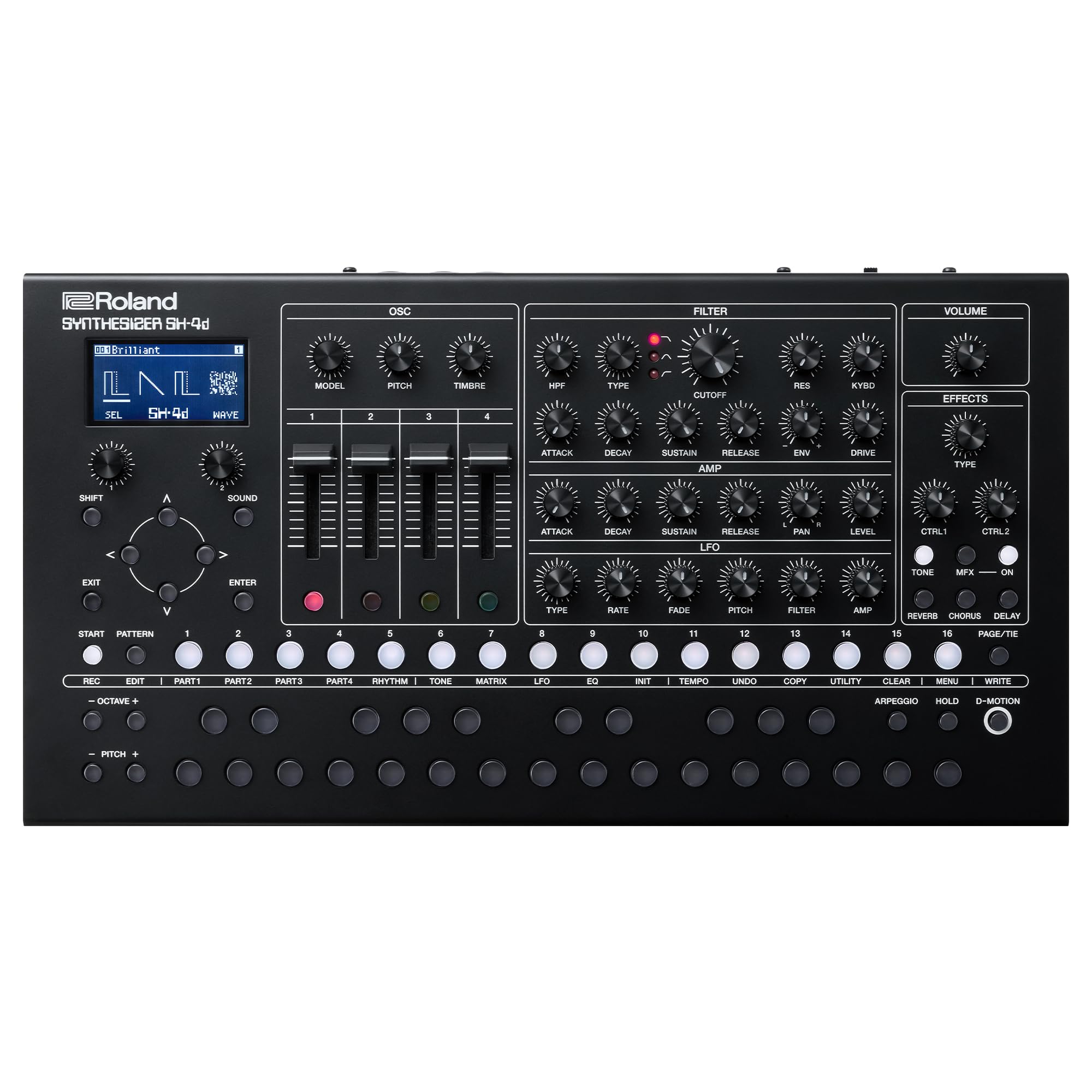
🎹 Elevate your sound game—where studio precision meets stage-ready spontaneity!
The Roland SH-4d is a compact desktop synthesizer featuring 11 oscillator models, 60-voice polyphony, and a 128-pattern multitimbral sequencer. Designed for professional sound design, it offers a fully loaded control panel with 32 knobs and 4 sliders, extensive onboard effects, and an integrated USB-C audio/MIDI interface for direct DAW recording. Lightweight and versatile, it’s perfect for studio, stage, and travel.


| Item weight | 2.55 kg |
| Body material | Alloy Steel |
| Included components | Integrated USB-C audio/MIDI interface, PHONES jack, OUTPUT jacks, MIX IN jack, EXT CLK IN jack, MIDI connectors |
| Manufacturer | Roland |
| UPC | 761294519554 |
| Product Dimensions | 42.42 x 24.89 x 13.97 cm; 2.55 kg |
| Item model number | SH-4D |
| Batteries Required? | No |
| Batteries Included? | No |
| Material Type(s) | Plastic |
| Color | Black |
| Release date | 23 February 2023 |
| ASIN | B0BVBZ5L7D |
M**S
Great sounds with an easy interface. good quality build and each buttons feels solid. You got an arpeggiator, sequencer and several fx available (reverb, delay, chorus...). Editing is easy and sounds cover a wide range of electronic music style. A must have for me.
S**1
When I learned about the Roland SH-4d in early 2023, I was immediately intrigued by this product that was part synthesizer, part drum machine, and part groovebox. Over the past few years, I had been buying pieces of this device in the from of Korg Volcas, the Roland AIRA minis (T-8, S-1, etc.) and similar gear priced at $200 or less. The optimistic view of the SH-4d was that it was a “greatest hits” compilation of classic Roland sounds in a compact, portable device. However, the pessimist’s view was that this was simply another Roland repackaging of digital VST’s at a “street price” of $650.00. Not “expensive” for what it does, but also not quite affordable enough to be considered an “entry-level” device for a hobbyist. However, the SH-4d has started to go on sale on occasion, and when it dropped $150, I decided it was time to give it a go. Here are my impressions as a new owner of the SH-4d: PROS: The SH-4d is well-built and intelligently laid out. The top and back are metal, and it has all the I/O features I needed. This includes 1/4" jacks for the inputs, outputs, and headphone jack, plus full-sized, 5-pin DIN MIDI jacks (for hooking up an external keyboard). Even better, it can be powered off a 5V USB-C cable (using a portable battery or phone charging adapter), or it can run for about 4 hours off 4 “AA” alkaline or rechargeable batteries. Excellent. In terms of sound models and sound design, I won’t go on too long other than to say that it sounds like excellent and will be very familiar to fans of the SH-101, JUNO-106, and samples from other Roland classics like the TR-808 and TR-909. Those have been offered ad naseum in other “budget” devices (or even cheaper in VST’s or iPad apps), but here assembled in essentially a groovebox ecosystem with 4 tracks (“parts”) plus a fifth track for Rhythm If you want to get straight to work, there are probably around 1,000 presets across the 11 tone models, though some models didn’t have as many as I would have liked. If you want to create your own sounds, there is a very handy INIT command to create an initialized patch by pressing just two buttons. You can then save them to (I believe) one of 256 preset slots, though it would have been nice to have more storage, given the amount of potential here. Also, the device has impressive polyphony – they claim it is up to 60 “voices”, but that is across all 4 tracks, and multi-oscillator sounds, for example, may use multiple “voices” per “part”, so it’s a little deceiving. The layout and interface actually make pretty good sense once you get used to it. Roland is known for relying too much on menu diving, but most of the core features for the oscillator, filter, amp, and LFO sections have 1:1 knobs. There is also an impressive array of effects that can be applied, though it is occasionally confusing as to whether these refer to the “master” sound or specific parts. CONS: The SH-4d certainly has some shortcomings, and while most of these are not “deal-breakers” for my needs, they definitely need to be pointed out. The sequencer is a mixed bag – it only goes to 64 steps, and all recording is quantized. You can change the resolution of those steps, and there is a swing control for tempo, but you cannot record live, unquantized content, which is strange. A lot of people have also noted that the procedure for saving sounds and patterns is sort of a convoluted mess. There’s a multi-step button process that gets better with muscle memory, but you’ll still find yourself losing your work or (even worse) overwriting sounds that then impact the sound of other patterns that rely on those sounds. To put it another way, the device does not “auto-save” changes in the way you might be used to on other machines. Finally, the SH-4d stores only 64 patterns and, incredibly, does not have a song mode. So this really limits the usefulness of the device as a full groovebox. There are workarounds, of course. You can set a bunch 4-bar patterns next to each other and then trigger them for live performance. But it arguably renders this more of a “sketchpad” than a full “compositional” tool. SUMMARY: Despite the drawbacks, there’s a LOT here for the price, and what’s offered sounds great. Yes, it’s a digital (or perhaps “virtual-analog”) synth instead of a true analog recreation of classic synths, but digital has a lot of advantages over that classic gear, including tuning stability and higher polyphony. I also doubt the vast majority off users could tell the difference in a blind test. For me, the SH-4d seems to be a solution for the problem of collecting endless “cheap” gear (Volcas, Liven series, Pocket Operators, AIRA). Those devices are fine by themselves, but if what I really want to do is put together a simple composition with a drum beat, a bass line, and maybe a pad and a lead…good luck getting that to all sync out with MIDI cables, mini-MIDI adaptor jacks, click/pulse tracks, and so on. In the SH-4d, all of those sounds are just HERE, and I can quickly get to work. It can be a very simple device with presets, or it can be a sound tweaker’s paradise with endless possibilities. Time to sell a bunch of my old “budget” gear that suddenly became redundant and impractical!
C**N
Es un gran sintetizador, digital, sí pero la diferencia podría ser imperceptible, francamente. Es un sintetizador que tiene la mayoría de los mejores sonidos de sintetizadores clásicos de Roland. Cuenta con un sin fin de perillas para modificar tres partes: filtro (con cutoff, resonancia, ADSL, etc), amplificador y un LFO además de efectos por nota o en general (gran aspecto, por cierto). Cuenta con entrada y salida MIDI porsi quieres controlarlo con un teclado, por ejemplo. PROS: 1. Gran variedad de sonidos; puedes escoger uno para cada uno de los 4 tracks o pistas que tiene, son casi infinitos si consideras que cada uno puede modificarse con osciladores, filtros, amplificadores, LFO y efectos (Reverb, Chorus y Delay además de un banco de presets ajustables muy bueno). 2. La quinta pista o track es para caja de ritmos (drum machine) otro mundo de edición de sonido en cuanto a beats y percusiones con decenas de sonidos que también pueden ser modificados. 3. Además de que pasarás mucho tiempo divirtiéndote en estos primeros dos aspectos. Tiene un modo mixer que es lo más similar que tiene a un modo "canción" aquí puedes modificar volúmenes, hacer modificaciones al sonido con las perillas, en vivo, y silenciar lo que tú quieras. 4. Tiene integración midi con el USB además de que también envía audio por el USB, puedes llevar tus sonidos a tu DAW favorito, yo lo utilicé con Ableton. 5. Tiene 4 horas de autonomía con baterías y puede encenderse si está conectado al cable USB con una pila o cualquier "cuadrito" para USB conectado a la corriente. 6. El audio es muy bueno, hay que reconocerlo, y las salidas de audio que tienen se ven de calidad y se escuchan muy bien. 7. Tiene entrada plug 3.5 para coordinar tempo (CLK IN) así como un "Mix in" también de 3.5 para escuchar audio externo, aunque este es solo para referencia porque no podrás grabarlo o modificarlo. CONTRAS: 1. La estructura de guardado (saving) de tu trabajo es simplemente confusa, necesitarás paciencia para tu curva de aprendizaje. Al principio tendrás MUCHO riesgo de sobreescribir modificaciones a sonidos que tienes en otros patrones (patterns) o bien, de modificarlos por completo. Te recomiendo usar tus propios nombres tanto para los sonidos (Parts) como para las percusiones (Rythm part). Así evitarás las confusiones. Otra sugerencia, como en WORD, guarda cada uno de los pasos o modificaciones que hagas, te ahorarás pesadillas, lo más sencillo es guardar con SHIFT+WRITE y luego la opción OVERWRITE. La memoria que tienes para grabar sonidos editados o patterns completos es, digamos, no mala pero básica: apenas 128 slots. 2. No admite samplers, los sonidos son presets de Roland. Aunque una vez que encuentres un sonido que te guste, puedes editarlo casi infinitamente. 3. El secuenciador no es malo pero es básico, limitado a 64 pasos (steps) por patrón (pattern). Si trabajas con 8,16,32 o 64 pasos, queda bien pero tienes que estar presionando el botón (PAGE) que solo se activa desde la pantalla del menú para ver en qué página del secuenciador va tu "canción". Es un poco molesto. Seguramente con un upgrade Roland resolverá esto porque tiene muchas quejas. 4. Aunque yo no lo uso, para mucha gente es útil que las notas puedan desajustarse al paso del secuenciador es decir, no existe una opción "UNQUANTIZE", todo está Quantized de forma automática. 5. El manual muchas veces deja dudas, es un largo manual de más de 200 páginas que muchas veces ayuda pero otras tantas deja muchas dudas a resolver en tutoriales de YT. En general es un sinte extraordinario con algunas contras, pero otra ventaja es que dejas de comprar aparatos más baratos para "llenar" cada una de las pistas, por ejemplo el TR6S para ritmos, los Volca Korgs y Behringer para bajos o sonidos que sin temor a equivocarme puedes encontrar ya en el SH-4D. Si tienes dudas, hay dos grupos en redes sociales (FB) de usuarios que se ayudan a resolver las dudas que tengas.
V**R
This is a versatile synth for the money, its like a mini electronica band you can jam with, and its portable to boot! I bought it for the signature bright and happy electronica Roland is famous for but found its much more. Its really easy to use and figure out while also being versatile, and the combination results in something special. Its perfect as a part of a bedroom studio or as a gift for a junior/senior high schooler interested in making music. I would guess it could even be a prototype of groove box to bring the groove to school music classes. First, what makes this synth so special is how easy it is to use. I was able to figure out the sequencer and how to make songs with multiple instruments and drums too in less than an hour of having fun just just playing around with it, no manual needed because its all intuitive and laid out in front of the user. I even brought it with me to work and everyone loved it because people could just play with the knobs to make funky noises and the braver ones could jump in on the factory preset patterns to make their own live mix using the built-in keys. One other note, the battery use is surprisingly good. I use a USB phone charger battery when mobile and it seems to use about what an iPhone in use does.
G**Y
The premade sounds are very, very nice and if you use it for that you are gold. If you want to delve deeper the sounds are also very good, but the controls can be a little daunting as some buttons do different things depending on what you are trying to do. This can lead to confusion. But once you work it out user made sounds can be amazing. So read the manual, and hit some tutorials and that will get up up to speed.
Trustpilot
1 month ago
3 weeks ago