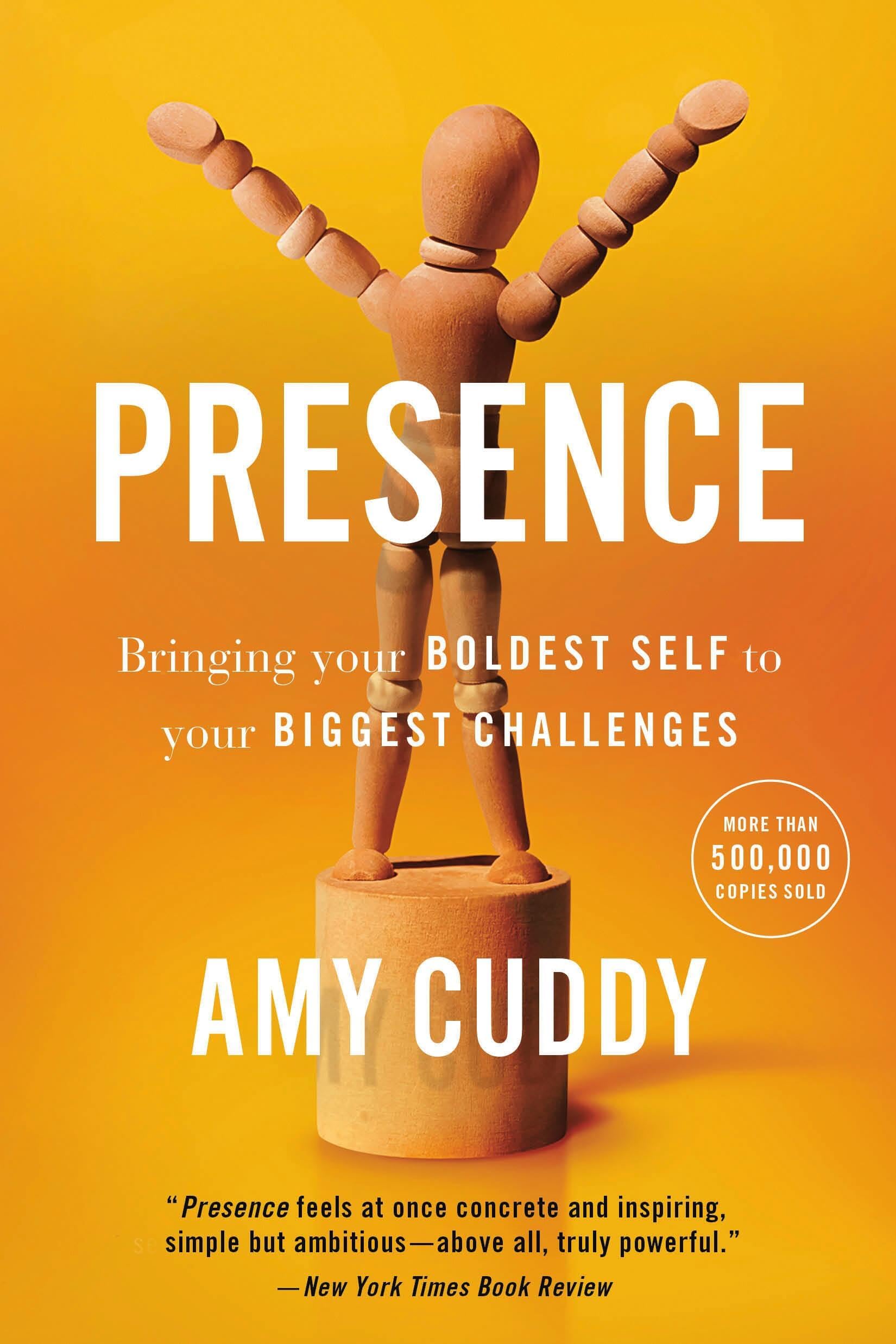
Presence: Bringing Your Boldest Self to Your Biggest Challenges
Product ID: 60356548
Desertcart purchases this item on your behalf and handles shipping, customs, and support to Iceland.
Harvard psychologist and TED star Amy Cuddy reveals how to unleash your boldest self to heighten your confidence, influence others, and perform at your peak. Have you ever left a nerve-racking challenge and immediately wished for a do over? Maybe after a job interview, a performance, or a difficult conversation? The very moments that require us to be genuine and commanding can instead cause us to feel phony and powerless. Too often we approach our lives' biggest hurdles with dread, execute them with anxiety, and leave them with regret.By accessing our personal power, we can achieve "presence," the state in which we stop worrying about the impression we're making on others and instead adjust the impression we've been making on ourselves. As Harvard professor Amy Cuddy's revolutionary book reveals, we don't need to embark on a grand spiritual quest or complete an inner transformation to harness the power of presence. Instead, we need to nudge ourselves, moment by moment, by tweaking our body language, behavior, and mind-set in our day-to-day lives. Amy Cuddy has galvanized tens of millions of viewers around the world with her TED talk about "power poses." Now she presents the enthralling science underlying these and many other fascinating body-mind effects, and teaches us how to use simple techniques to liberate ourselves from fear in high-pressure moments, perform at our best, and connect with and empower others to do the same. Brilliantly researched, impassioned, and accessible, Presence is filled with stories of individuals who learned how to flourish during the stressful moments that once terrified them. Every reader will learn how to approach their biggest challenges with confidence instead of dread, and to leave them with satisfaction instead of regret. " Presence feels at once concrete and inspiring, simple but ambitious—above all, truly powerful." — New York Times Book Review Review: Required, life-altering reading for all performers, students, teachers, parents, employees, bosses. Everyone really. Even horses - What would you say if I told you that there was an essential life skill that could make you a better speaker, help you nail job interviews, get you better dates, improve your performance, and make you a better partner and parent? What if I told you that no one has ever bothered to teach you this skill, mostly because we didn't even know what it was? That secret skill is presence, "the state of feeling connected with our own thoughts, values, abilities, and emotions, so that we can better connect with the thoughts, values, abilities, and emotions of others." And Amy Cuddy's book can teach this state of "self-assured enthusiasm" to you and a whole lot more. For example, just last month, my professional singer friend Valerie was terrified of her upcoming auditions because of crippling stage fright. Right about that time, I was fortunate to attend a talk by Amy Cuddy on her new book. Valerie couldn't attend, so I gave her an advance copy of "Presence" that Amy had kindly given us. Valerie watched Amy's TED talk, read half of the book, executed the "power pose" (i.e. expansive body postures like the 'Wonder Woman' and the 'Usain Bolt' held for 2min) and "self-affirmation of core values" techniques right before her auditions, and nailed 'em: three auditions, three jobs booked. And it all worked *that* fast. People -- this is life-changing stuff. As a therapist and speaking coach, I've been teaching Amy's material to to students and clients for a few years, so I was thrilled to hear that she's putting her knowledge into book form. If there were a central premise to the book, it would be this: "The lesson is clear: focus less on the impression you’re making on others and more on the impression you’re making on yourself. The latter serves the former, a phenomenon that should become clearer and clearer throughout this book." Here are some of the things I like about it: -- Ample illustration of the concepts with real-life stories of folks from all over the world who have overcome huge challenges using the "Presence" techniques -- all the way from grade-school kids, to people stuck in bad relationships, to Icelandic show horses (really) -- The author's generosity and vulnerability in sharing of her own stories, e.g her painfully slow recovery from a brain-damaging college car accident and her own struggle with Impostor Syndrome -- It's a fantastic compendium of the relevant science on how the body affects the mind, all in jargon-free, highly accessible form, from the leading scientists of the day. Of course, the main reason I read a book is to learn cool new useful stuff. And even though this book is smack-dab in my own field of work, I still learned a ton (took 19 pages of notes!). Here are some tidbits I particularly appreciated: -- The cortisol-testosterone dual hormone hypothesis: you're most effective when you have high testosterone and low cortisol -- We usually think that confidence leads to decisions and thoughts drive behavior. But a surprising amount of the time, it's the other way around: decisions create confidence and behavior creates thoughts. -- 80% of all fibers from the vagus nerve go from the body to the brain, not the other way around. Body changes mind! -- The more people use the word "I", the less powerful and sure of themselves they are likely to be. -- "Ultimately, participants’ speaking rate had an inverse relationship with how powerful they felt. That is, the more slowly they read the sentences, the more powerful, confident, and effective they felt afterward." Speak slowly to feel powerful! -- Hunched over posture of staring at smartphones ("iPosture") kills both your mood and your productivity. -- Why new year’s resolutions don’t work -- Loved the section on self-nudges: little, incremental ways to change our behavior for the better. -- "The three most important things to understand about the self, particularly as it relates to presence. The self is: 1. Multifaceted, not singular. 2. Expressed and reflected through our thoughts, feelings, values, and behaviors. 3. Dynamic and flexible, not static and rigid." But wait: there's a bonus to Valerie's story. Now that she's back home for Christmas, Valerie's newfound adoption of more empowering posture is transforming her relationship with her sometimes difficult mother (which I'm sure none of you have, but just in case). Applying the teachings of this book can directly affect your relationships, performances, credibility, work, interviews, impostor syndrome, lie detection abilities, and overall mood. That's some important stuff, and "Presence" offers simple, practical, effective solutions to challenges in those areas of life. That's why I'm telling everyone about this book and buying a stack of 'em to press into the hands of my friends. It's quite possible that you, too, will feel compelled to give your friends the gift of a core skill for success after reading "Presence." -- Ali Binazir, M.D., M.Phil., Happiness Engineer, author of The Tao of Dating: The Smart Woman's Guide to Being Absolutely Irresistible , the highest-rated dating book on desertcart for 4+ years Review: Book of brillance - I found it. I found the book that I have been searching for over the years. Practically written upon the base of sound academic research and knowledge, Cuddy manages to clearly and succinctly lead the reader into the world of "Presence"; so much so that it is becoming an entity in its own right. The book that so inspired myself, lead me to mind-map it, study it, and then continually share the learnings with my team. I have found that the knowledge in this book does not only improve myself, but so too my team. The entity of Presence has become our theme against which we manage our company of over 200 people with an annual turnover of USD30 million. Driving Cuddy's exhortation on self-affirmation, we have found a proverbial tool to up the motivation levels, build confidence and create a team of engaged people. Something that is in need in today's economies. Using Cuddy's description of "fake till you make it", or "fake it till you become it", has resonated well with my team leaders and managers. It has become a "saying", an exhortation that is driven with new recruits or those new in management or leadership positions, and those who clearly lack confidence. But "fake it till you become it" is cemented with self-affirmation enablers. As Cuddy explains, those enablers where people have internalised their signature strengths, abilities and positive attributes about themselves. This has built the managers and leader's confidence levels to such an extent that the way in which they manage and lead their people has evolved in a very positive way. In fact, through body language, their postures have even improved! People are starting to have fun at work now that they have connected with their authentic best selves. I have seen passive aggression towards others subside, disengagement migrate to engagement and team work improve. Those who are pondering how to improve themselves, increase success, engage their teams, or to increase individual work engagement must read this book. We share the learnings and knowledge of Cuddy generously throughout our company and the results are surprising and very positive.


| Best Sellers Rank | #28,552 in Books ( See Top 100 in Books ) #15 in Running Meetings & Presentations (Books) #58 in Popular Social Psychology & Interactions #73 in Communication Skills |
| Customer Reviews | 4.5 out of 5 stars 3,875 Reviews |
D**R
Required, life-altering reading for all performers, students, teachers, parents, employees, bosses. Everyone really. Even horses
What would you say if I told you that there was an essential life skill that could make you a better speaker, help you nail job interviews, get you better dates, improve your performance, and make you a better partner and parent? What if I told you that no one has ever bothered to teach you this skill, mostly because we didn't even know what it was? That secret skill is presence, "the state of feeling connected with our own thoughts, values, abilities, and emotions, so that we can better connect with the thoughts, values, abilities, and emotions of others." And Amy Cuddy's book can teach this state of "self-assured enthusiasm" to you and a whole lot more. For example, just last month, my professional singer friend Valerie was terrified of her upcoming auditions because of crippling stage fright. Right about that time, I was fortunate to attend a talk by Amy Cuddy on her new book. Valerie couldn't attend, so I gave her an advance copy of "Presence" that Amy had kindly given us. Valerie watched Amy's TED talk, read half of the book, executed the "power pose" (i.e. expansive body postures like the 'Wonder Woman' and the 'Usain Bolt' held for 2min) and "self-affirmation of core values" techniques right before her auditions, and nailed 'em: three auditions, three jobs booked. And it all worked *that* fast. People -- this is life-changing stuff. As a therapist and speaking coach, I've been teaching Amy's material to to students and clients for a few years, so I was thrilled to hear that she's putting her knowledge into book form. If there were a central premise to the book, it would be this: "The lesson is clear: focus less on the impression you’re making on others and more on the impression you’re making on yourself. The latter serves the former, a phenomenon that should become clearer and clearer throughout this book." Here are some of the things I like about it: -- Ample illustration of the concepts with real-life stories of folks from all over the world who have overcome huge challenges using the "Presence" techniques -- all the way from grade-school kids, to people stuck in bad relationships, to Icelandic show horses (really) -- The author's generosity and vulnerability in sharing of her own stories, e.g her painfully slow recovery from a brain-damaging college car accident and her own struggle with Impostor Syndrome -- It's a fantastic compendium of the relevant science on how the body affects the mind, all in jargon-free, highly accessible form, from the leading scientists of the day. Of course, the main reason I read a book is to learn cool new useful stuff. And even though this book is smack-dab in my own field of work, I still learned a ton (took 19 pages of notes!). Here are some tidbits I particularly appreciated: -- The cortisol-testosterone dual hormone hypothesis: you're most effective when you have high testosterone and low cortisol -- We usually think that confidence leads to decisions and thoughts drive behavior. But a surprising amount of the time, it's the other way around: decisions create confidence and behavior creates thoughts. -- 80% of all fibers from the vagus nerve go from the body to the brain, not the other way around. Body changes mind! -- The more people use the word "I", the less powerful and sure of themselves they are likely to be. -- "Ultimately, participants’ speaking rate had an inverse relationship with how powerful they felt. That is, the more slowly they read the sentences, the more powerful, confident, and effective they felt afterward." Speak slowly to feel powerful! -- Hunched over posture of staring at smartphones ("iPosture") kills both your mood and your productivity. -- Why new year’s resolutions don’t work -- Loved the section on self-nudges: little, incremental ways to change our behavior for the better. -- "The three most important things to understand about the self, particularly as it relates to presence. The self is: 1. Multifaceted, not singular. 2. Expressed and reflected through our thoughts, feelings, values, and behaviors. 3. Dynamic and flexible, not static and rigid." But wait: there's a bonus to Valerie's story. Now that she's back home for Christmas, Valerie's newfound adoption of more empowering posture is transforming her relationship with her sometimes difficult mother (which I'm sure none of you have, but just in case). Applying the teachings of this book can directly affect your relationships, performances, credibility, work, interviews, impostor syndrome, lie detection abilities, and overall mood. That's some important stuff, and "Presence" offers simple, practical, effective solutions to challenges in those areas of life. That's why I'm telling everyone about this book and buying a stack of 'em to press into the hands of my friends. It's quite possible that you, too, will feel compelled to give your friends the gift of a core skill for success after reading "Presence." -- Ali Binazir, M.D., M.Phil., Happiness Engineer, author of The Tao of Dating: The Smart Woman's Guide to Being Absolutely Irresistible , the highest-rated dating book on Amazon for 4+ years
L**E
Book of brillance
I found it. I found the book that I have been searching for over the years. Practically written upon the base of sound academic research and knowledge, Cuddy manages to clearly and succinctly lead the reader into the world of "Presence"; so much so that it is becoming an entity in its own right. The book that so inspired myself, lead me to mind-map it, study it, and then continually share the learnings with my team. I have found that the knowledge in this book does not only improve myself, but so too my team. The entity of Presence has become our theme against which we manage our company of over 200 people with an annual turnover of USD30 million. Driving Cuddy's exhortation on self-affirmation, we have found a proverbial tool to up the motivation levels, build confidence and create a team of engaged people. Something that is in need in today's economies. Using Cuddy's description of "fake till you make it", or "fake it till you become it", has resonated well with my team leaders and managers. It has become a "saying", an exhortation that is driven with new recruits or those new in management or leadership positions, and those who clearly lack confidence. But "fake it till you become it" is cemented with self-affirmation enablers. As Cuddy explains, those enablers where people have internalised their signature strengths, abilities and positive attributes about themselves. This has built the managers and leader's confidence levels to such an extent that the way in which they manage and lead their people has evolved in a very positive way. In fact, through body language, their postures have even improved! People are starting to have fun at work now that they have connected with their authentic best selves. I have seen passive aggression towards others subside, disengagement migrate to engagement and team work improve. Those who are pondering how to improve themselves, increase success, engage their teams, or to increase individual work engagement must read this book. We share the learnings and knowledge of Cuddy generously throughout our company and the results are surprising and very positive.
C**R
Very practical and interesting book that hits home
This review was written for a graduate class assignment. Throughout my time in the classroom and now as an administrator, I have struggled to not sell myself short and to have confidence in my philosophies and ideas. As soon as I saw the tag line, “Bring your Boldest Self to Your Biggest Challenges,” I knew I needed to take the time to read this book. In just 303 pages, Amy Cuddy shares not only her own personal journey with self-confidence, but copious amounts of psychological studies and research to support her hypothesis that the “body shapes the mind” (Cuddy, 2015, pg. 193). In the first half of her book, Cuddy focuses on presence; discussing what it is and how one can develop a strong sense of presence. Throughout the first few chapters, Cuddy shares quotes from individuals that wrote to her about what they thought the definition of presence was. The best definition of presence that resonated me with was shared with Cuddy by a gentleman named Rohan. He wrote, “Presence is confidence without arrogance” (Cuddy, 2015, pg. 26). Cuddy followed this by encouraging her readers to “focus less on the impression you’re making on others and more on the impression you’re making on yourself” (Cuddy, 2015, p. 32). She shared that when we spend so much energy during a presentation or interview worrying about how others are judging us that we don’t have enough energy to focus on what we truly believe and are sharing. In the next two chapters, Cuddy goes into further detail on how to have confidence which requires individuals to analyze what they value most. Cuddy believes “your boldest self emerges through the experience of having full access to your values, traits, and strengths” (Cuddy, 2015, pg. 50). The focus is being authentic and honest and how by truly showing up and being present, we can better connect with others. So much of what we do in education is based on relationships. From when I was a classroom teacher trying to connect with students to now working with teachers in an instructional coaching relationship, I have witnessed that being vulnerable and honest creates a solid foundation for building relationship. One thought that Cuddy shared that resonated with me was, “Presence doesn’t make you dominant in an alpha sense; it actually allows you to hear other people…And for them to become present. You can help people feel more powerful even when you can’t give them formal power” (Cuddy, 2015, p. 64). I thought this was so insightful and so true. Many times, when working with teachers, I am very aware that some may have preconceived notions that since I am an administrator I am trying to demonstrate my own power and control which is not conducive at all to forming the relationship needed in a coaching situation. By being aware of this and using some of the ideas Cuddy shared, I hope to be able to do a better job of being present in order to help the teachers I am working with to be present. Cuddy also does a fantastic job of discussing Imposter Syndrome. Cuddy shares successful individuals who have discussed Imposter Syndrome and how this can impact your presence. It supports the ideas she discussed early in the book in that it causes individuals to “overthink and second-guess. It makes us fixate on how we think others are judging us” (Cuddy, 2015, p. 89). What I appreciated most about this chapter was that she not only discussed Imposter Syndrome, but shared a practical approach in dealing with it and shared, “the more we are aware of our anxieties, the more we communicate about them, and the smarter we are about how they operate, the easier they’ll be to shrug off the next time they pop-up” (Cuddy, 2015, pg. 108). Cuddy starts to transition from discussing presence to how the body shapes the mind by introducing the ideas of power and powerlessness. The primary focus of this chapter was the spotlight effect. Similar to her message in the previous chapters regarding spending too much energy thinking about how others are perceiving and judging us, the spotlight effect describes the idea that we think people pay more attention to us than what they actually are. In the last half of the book, Cuddy focuses more on the human body and how this can impact confidence and presence. I didn’t enjoy the second half of the book as much as the first. Cuddy includes many psychology studies to support her hypothesis. While I understand the need to prove her hypothesis, I do think it made it a much slower read the second half of the book. Cuddy has proved that “expanding your body language – through posture, movement and speech – makes you feel more confident and powerful, less anxious and self-absorbed, and generally more positive” (Cuddy, 2015, pg. 216). Cuddy shared power poses that can be held for two minutes prior to an important event such as a presentation or a test. Performing the power poses will improve presence. Cuddy ends the book by sharing many personal witnesses to how power poses have helped individuals with many different situations in life and ends solidly with the idea that we cannot do a major overhaul and change ourself overnight and that we need to “self-nudge” or make “tiny tweaks to lead to big changes” (Cuddy, 2015, p. 249). I completely agree with Cuddy that the large goals set individuals up for failure and that making baby steps towards an end goal tends to be much more effective. After reading this book, I would definitely recommend it to colleagues, other teachers, and I honestly wish I would’ve been introduced to the idea as a senior in high school or an undergraduate in college. So many of our students struggle with confidence, and many of us are still struggling with self-confidence as adults. At a reasonable price of $12.49, this book would make for a great book study with a group of students or teachers. The fact that this book was published by Hachette Book Group in 2015 makes this a relevant and recently published book that does a good job of covering years of research in supporting the idea that the body truly can shape the mind. At the very least, I would recommend having high school students watch Cuddy’s TED Talk which provides a good summary of the ideas she shares in this book.
T**Y
bringing your boldest self
Review for Amazon by Jerry Woolpy of Presence: bringing your boldest self to your biggest challenges by Amy Cuddy We now know that our body postures feedback to the emotional controls in our brains to make us feel more positive or alternatively to feed our depression. Chest out, back straight, belly in, knees up, feet wider than hips, arms up give us the courage to present our best self. Win or lose, with a positive posture we maximize our capabilities. Alternatively shoulders forward, back bend forward, arms close to our bodies or crossed, hands covering part of our faces support our contracted self-image and limit our performance. When we assume bad posture it supports our sense of being an imposter—having been mistakenly promoted, or just lucky. With case histories and controlled studies this book persuades us to shine in interviews, public speaking, and in our relationships. But it cautions against being too positive when we need to meet others less aggressively. This is advice we need not follow all of the time. It is to have in our repertory when called upon. ps on second reading: Presence: bringing your boldest self to your biggest challenges by Amy Cuddy reviewed by Jerry Woolpy Just as the posture of a person speaking to you effects your posture, so too your posture affects them. A person towering over you with their hands on their waste is likely to make you assume a submissive posture with elbows into your body and hands to your face or neck. The documented thesis of this book is that these body language interactions carry more meaning than what either of you say to each other. Like the chest beating of an alpha gorilla, the tail waving threat of a squirrel, or the dog on his back with his tail between his legs, this form of communication predates human evolution and is more fundamental than spoken language. For the most part we do it without thinking. But what if we consciously controverted our feelings of powerlessness with powerful body language. In other words, what if we faked power even when we were most fearful? What if we stood in the closet, feet a little more than hip width apart, hands on hips, and elbows spread wide like Wonder Woman. And we did this for two minutes before going on stage to give a speech the prospect of which frightened us. It turns out that this procedure not only improves performance, but provides enormous confidence and the likelihood of self-realization so that you can project your best self. If you do this, chances are you will feel good about it no matter how it comes out. It isn’t whether you win or lose as a consequence. It’s how you will feel about your performance after it is over. You won’t be likely to say, “Oh I wish I had…”. Moreover, if you preface important confrontations with power postures, eventually you are likely to begin to become actually excited by the prospect rather than fearful. But this is not to recommend that you ought to dominate all interactions—certainly not. Sometimes this would not be the feeling you would want to engender in your audience or partner. What you want to project is your true feelings and your best self and you want to eliminate the self-effacing literal covering of your face associated with the protection and hiding of who you really are. Amy Cuddy provides experimental evidence and personal accounts of how this works. And she adds a history and comparative behavioral analysis of the phenomenon. A TED talk summary is available online.
M**M
Great read & more prepared for future
I first saw and heard about Amy Cuddy during a short interview on Sunday Morning news program, which is one of my favorite Sunday morning past time activities. During this interview I was captivated by Amy's approach and explanation of how to mentally and physically prepare before going into a stressful situation. I looked up her TED talk and both her personal story and how she came to understand this physical and mental phenomenal was very intriguing to me and I decided I had to read her book. I received the kindle edition of her book and reading the first few chapters really resonated with what I had experienced previously. I examined my past experiences where during situations, such as a job interview or making a sales pitch or presenting a highly technical solution to a handful of non-technical people, I either came out as a complete winner or a total loser. Examining these previous moments and reading more of this book made sense to me how I became completely successful or failed completely. There were times that I would walk out completely frustrated on what I should have said and did not or why I didn't think of the correct response when I had the answer all along. The anxiety I was experiencing in each of these circumstances, that I can recall, were completely explained in this book and now I feel more prepared and have a better understanding how to control upcoming events such as these. I highly recommend this book to anyone dealing with anxiety and stressful situations who might have previously experienced a mix of failures or successes.
K**N
Another template self-help book
This book started off promising, talking about ways in which presence equates to confidence and charisma. A lot of the personal experience the author shared really resonated with me and I was dying to find out how she overcame these problems of shyness and getting too into her head. However, the book dragged on, and the author never really broke down what presence was. When the author made the logical leap of equating presence to power, I was completely lost. At that point I might as well be reading "48 laws of power" or any other business school cookie cutter book. There isn't much in the way of new advice here. In fact she spends an obscene amount of time (like 4 / 10 chapters!!) on physical posing for power. (See: power, not presence). The synopsis of half -- literally half -- the book is: spread your arms like a starfish a lot to feel good (See: feel good, not feel present). Her anecdotes not of her own are very dry and un-relatable. And it seems like a pretty severe contortion when she tries to use these anecdotes to prove her points. The volume of these non-personal anecdotes is infuriatingly large, and detracts from the readability of this book. To the point where I was getting into a permanent state of eye-rolling and skepticism. So in conclusion, this is just another templated self-help book made for best-selling. - Starts off relatable, promising. - Inspiring quotes at the beginning of each chapter to entice you. (These quotes alone are probably worth more than the book.) - Lengthy, lengthy anecdotes that are much too long for the point the author tries to make - Chapters drop in quality towards the end - Un-proven psychological phenomena, specifically her assumption that there exists personal power vs. social power. I do like her recommendations on doing yoga and her citation of the science behind it. So bumping from 2 stars to 3 stars because it's actually slightly helpful.
M**T
If you want to understand how to use your body to change your brain, there’s no better place to start than Presence.
Amy Cuddy has written a book that has both heart and brains. We have been friends and colleagues for several years, so I am not a completely objective reader. With that in mind, here are a few reflections on why Presence is an important and worthwhile book. First, she wrestles with the paradoxes surrounding presence. She shares an insight voiced by actress Julianne Moore, which is that people feel the least present when they don’t feel seen by others. This brings her to the linkage between presence and power. The dimension that interests her is "power to control our own states and behaviors,” not power over others. This is the central challenge of the book: how can we learn to exercise that power so we can be confident enough to open ourselves to others? As millions who have seen her TED talk now know, she has researched the mind-body connection that enables us to feel more powerful simply by holding expansive poses typical of people who have just triumphed. Presence goes well beyond her own work to explore complementary research related to the voice and breathing, to name just a few areas she explores. She admits her own skepticism along the way (“I’m not a yoga person.”), but as a researcher she puts the evidence before her personal biases. Ultimately she concludes that William James was right: “Our bodies speak to us. They tell us how and what to feel and even think.” If you want to understand how to use your body to change your brain, there’s no better place to start than Presence.
M**E
Might be Four Stars, but Feels So Much Like Five
I was not sure about reading this book, but it was highly reviewed on Amazon, and I remember watching the TED talk on the topic. So I thought, I would give it a go. I think all of us struggle sometimes with confidence, and feel intimidated by some of the situations were face in life, so this book promised to help. And I believe it did. There is plenty of information about how the book can help, and sometimes this is where these type of books leave you, full of knowledge, but empty of practical application. These type of books will promise much, and deliver great insights, but little in making a change. This book overcome this. The book is full of little hints that can help you to own a situation. It could be the narrative you tell yourself, or the body language you use before a meeting, or a speaking engagement. I really liked how the book helps you to quiet the doubts in your mind, so that you can have full presence for the situation you are facing. Instead of managing the situation, you have to trust yourself, and have confidence that you will do fine, because in the end, you is all you have. The book helps you to feel comfort in that role. Over and over again, there will be excellent insights like "self esteem and self confidence are not synonymous." Learning to be in the tense moment, and really hearing those who disagree and perhaps attack can be hard, but if you can learn presence, these times are less severe. I like the idea of believing your own story. Also, you realize that you are not one person in every situation, and being fine with that. Too often, people have a static view of themselves. Overall, this was an excellent book, one that caused me to think deeper about myself, provided a lot of healing and help for the future. I am not sure it is a five star, mostly because of the length, but it is a strong 4 star, because it will help and was insightful.
J**.
Life changing
Once I started reading, I couldn't stop. This book explains the strong correlation between physical behaviour and emotions/thoughts/self-belief/authentic-self. A variety of strategies were clearly explained, with excellent supportive evidence, to enable me to nudge myself into making realistic changes in my behaviour and how I live my life. I am more aware of the physical forms I make with my body, and am now making choices about who I am and how present I am. Many things I have thought about doing for years, such as daily writing journal entries and doing yoga poses, are actually now happening. The written style is personal and also academic. An easy page-turning read. I highly recommend this book. Life changing! Spread the word. Hold a power pose now.
K**N
Ein Buch mit echtem Mehrwert über Präsenz, Körper und Wirkung
Ich habe Presence gelesen, weil die Autorin durch ihren bekannten TED-Talk schon vorher aufgefallen ist und mich das Thema direkt angesprochen hat. Das Buch ist auf Englisch, lässt sich aber gut lesen und folgt einer klaren Struktur, die den Inhalt angenehm nachvollziehbar macht. Besonders gelungen fand ich die Einleitung, in der Amy Cuddy erklärt, warum sie dieses Buch geschrieben hat und welchen Gedanken sie damit verfolgt. Danach geht es in einem gut aufgebauten Mittelteil um Studien, wissenschaftliche Erkenntnisse und praktische Beispiele. Gerade das hat dafür gesorgt, dass das Buch für mich nicht wie ein typisches Selbsthilfe- oder Guru-Buch wirkt, sondern wie ein ernst gemeinter, fundierter Ansatz mit Substanz. Inhaltlich geht es unter anderem um die Verbindung zwischen Körper und Geist, um die Wechselwirkung beider Bereiche und darum, wie man in schwierigen Situationen mehr Präsenz entwickeln kann. Auch das Thema Power Posing wird behandelt, wobei das Buch nicht nur Ideen liefert, sondern auch konkrete Ansätze, wie man das Gelernte im Alltag anwenden kann. Mir hat besonders gefallen, dass das Buch nicht nur theoretisch bleibt, sondern am Ende auch einen praktischen Nutzen vermittelt. Es regt dazu an, bewusster mit der eigenen Haltung, Wirkung und inneren Verfassung umzugehen. Genau das macht Presence für mich lesenswert. Ich würde das Buch klar mit 5 von 5 Sternen bewerten und kann es vor allem allen empfehlen, die sich für Auftreten, Selbstwahrnehmung und die Verbindung von Körper und Geist interessieren
M**L
Excellent and motivating
Everyone can get the best of themselves, self confidence, and the power of leaving without fears. Start believing of great things can be done by every person and living the freedom of been a big actor not only a viewer of life.
J**N
Very inspiring
Amazing book! Very inspiring. I recommend to anyone interested in human behavior.
A**E
Helped me to deal with PTSD and to know my true self
It doesn't just repeat the TED Talk. An incredibly huge amount of studies make this book delve much deeper than just "pose for power". It reaches various different psychological approaches to different situations – such as the power of self-affirmation, how to establish confidence with other people, impostor syndrome, social vs personal power, body language from an evolutionary perspective, scientifically proven connections between body and mind, how disabled people can strike power poses within their minds, and finally, how posing can improve our well-being. All those chapters before the final conclusion managed to add something to how I saw myself and my life. And thankfully, questions I had from the TED Talk were answered: such as "does maintaining a better posture during work time affects my mood?" or "does the position I sleep in/wake up in make a difference?". If you are wondering the answer: it is yes. Incorporating those small changes such as no longer sitting in an "ankles wrapped" position or stretching a power pose upon waking up made big changes in my day, since I tended to fall into powerless poses very often. I have some very light criticisms about the book, though. One of them is how the author is skeptical of mindfulness, which is a missed opportunity. Recent books such as Brewer's Unwinding Anxiety scientifically show how mindfulness meditation is very effective for anxiety and other disorders. Cuddy's perspective on presence is, at least from my experience, very closely related to mindfulness. But instead of working on this relation, Cuddy argues that in order to reach a mindful state, one would have to "turn off thoughts". However, according to the actual description of Mindfulness from books such as Kabat-Zinn's Mindfulness for Beginners, the technique is about relating differently to your thoughts, not shutting them down. While Cuddy gives mindfulness advice such as "looking at thoughts/anxiety, realizing it is there and then moving on", she dismisses the relation to mindfulness by judging it as a "transcendental eternal now". I think her philosophy and science would benefit a lot from a less biased view towards mindfulness - which is ironic, since in the last chapters she advocates for yoga, a practice that heavily incorporates mindfulness. Another biased view, perhaps wrapped in good intentions, is how she describes the difference between men's and women's body language as "almost entirely a social phenomenon". This of course has to do with the current bias of social sciences to label everything as "social" and ignore everything "biological". For instance, other primate societies, such as the ones described in Robert Ardrey's famous book African Genesis, also deal with less power-posing females. The reason is simply that they don't have to fight for territory nor display dominance - while monkey males fight to dominate and protect territories, females take care of children. Of course, in the nowadays human world, everything is drastically different: females have the same roles as men and should empower themselves to do big things - but it's kind of not scientific to dismiss our well-documented monkey-like tendency, namely the male tendency to aggressiveness and dominance, just because it is not at all pleasant. But leaving out these and other small flaws which derive from the sad current reality of the social sciences, it is an incredible, life-changing book, which proves itself as a great tool to deal with lots of mental issues.
Trustpilot
2 months ago
4 days ago