We remain fully operational. Our teams are working around the clock to ensure your deliveries continue safely.

DOWNLOAD THE APP


Customer Services
Copyright © 2025 Desertcart Holdings Limited
DOWNLOAD THE APP

🛡️ Stay ahead of invisible threats with the smartest radiation detector on the market!
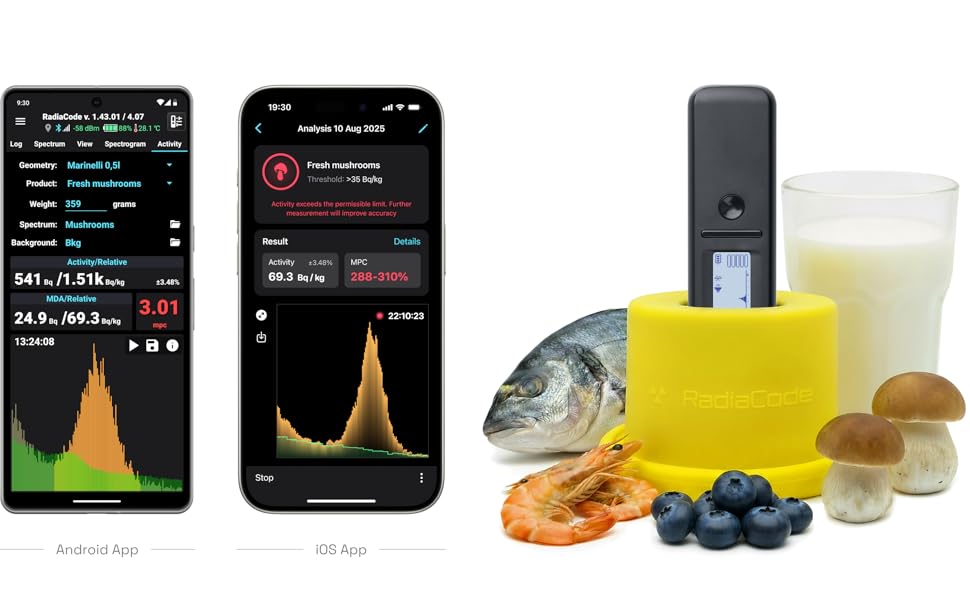
The Radiacode-103 Smart Geiger Counter is a compact, scintillator-based radiation detector offering 20x faster detection than typical Geiger counters. It uniquely identifies radioactive isotopes through spectral analysis and provides real-time GPS radiation mapping via a free multi-platform app. With seven customizable alarm modes and a transflective blue-backlit display, it’s designed for professionals and enthusiasts who demand precise, actionable radiation data on the go.



| ASIN | B0CSFYTDWK |
| Batteries | 1 Lithium Polymer batteries required. (included) |
| Best Sellers Rank | #20,445 in Industrial & Scientific ( See Top 100 in Industrial & Scientific ) #4 in Lab Geiger Counters |
| Date First Available | February 20, 2024 |
| Item Weight | 2.36 ounces |
| Item model number | RC103 |
| Manufacturer | Radiacode |
| Product Dimensions | 4.88 x 1.38 x 0.71 inches |
M**S
Gamma spectrometer in a convenient package
This is an interesting device. I've had a bit of time to tinker with it and have taken it out in the field. It's not a geiger counter. A geiger counter uses a geiger-mueller tube. A typical thin-walled geiger tube can only really register beta and pick up that there is radiation present, not its energy. It's basically numbers of clicks of ionizing radiation without being able to tell you anything about it. This is a scintillator that mostly picks up gamma and tracks voltage of counts in kev. It tracks these counts in spectra, spectrograms over time, and location. It's not quite a lab-grade device, but it puts this sort of monitoring and tracking into an affordable device. It's the kind of device you can carry with you and track radiation levels and doses around your location. You can put it next to an emitter, take a spectrum and identify the type of emitter. If you have an alpha or beta source, like uranium or thorium, it doesn't necessarily read it directly, but records the gamma emissions of decay chain products to identify the source. It's very sensitive to these types of sources in a way that a cheaper geiger tube device usually isn't. I think that the intended "killer ap" would be using it to monitor food sources down wind of Chernobyl. It's a European product in that way. That's not as much of a concern for me. For me, it can be a bit of a toy where I can take spectra of common emitters, like uranium glass, vintage dishes, lantern mantles. I've figured out that my downtown areas is slightly more radioactive than where I live. However, it's not a toy. It's a pretty serious device. There's a feature in the app that lets you identify emitter types through the differing peaks on a spectrum. You can take a baseline background reading and subtract it from your spectra to really make the source type more clear. It really does do a lot for the money. I use it as a safety device when I replace smoke detectors for people. I can check them for radiation emitters before disposing of them so i don't expose myself and others. As well, I run a desert education group and it helps in identifying minerals in the field. I found out one of my camera lenses is a beta emitter (thorium glass) which doesn't change much, but I'm happy that I know not to carry it in my vest pocket for 12 hours a day. My heads up is that the Android app is much more mature than the iOS app. The iPhone app is missing a lot of features, but it seems like they are updating about once a month. As of February 2024, the tracks feature works and the radiation level and dose rate features are working. You can take spectra but can't save them yet. I hope this gets fixed quickly, since this is maybe the best feature for me. The android app has pretty modest requirements, so I borrowed an old Android phone to save spectra and do background subtraction until these features are added. I don't think this is a deal killer. Also, the Android app has some odd English locutions so it might take some time to figure out what these features are, and you might need to refer to the documentation a few times before getting comfortable. So far, the iOS app is much more intuitive, though it is a work in progress.
J**N
Great Radiation Detector / Gamma Spectrometer
This little gadget isn't very big (about the size of a snickers bar), but it's about 20x more sensitive to gamma radiation than a typical geiger counter. This is because it uses a scintillation crystal detector instead of a tube of low pressure gas. The crystal is far denser than the gas, so gamma photons are much more likely to interact with the crystal than the gas as they pass through. But the greatest benefit of using a scintillation crystal isn't the extra sensitivity, it's the ability to measure the energy of detected gamma photons. That enables you to identify the isotope(s) emitting the radiation. By looking at the distribution of the peaks in the spectrum data, you can distinguish between naturally occurring uranium and thorium and K-40, and manmade fission products like Cs-137 and I-131. You can use it to definitively comfirm whether or not an area has been contaminated with fallout from a bomb or a nuclear accident, a lost or misplaced industrial radiation source, or natural radioactive sources, and accurately assess radiation hazards. By itself, it makes a great portable detector, but the small screen makes the spectrometer function a little difficult to use. But it has Bluetooth that can connect to a phone app, and the app makes displaying and interpreting spectra fairly easy. The app has a built-in library of gamma sources, so you can click on a spectrum peak and see isotopes that have emission lines in that area. When you have multiple emission lines that match multiple spectrum peaks, you have a positive ID of the radiation source. The app logs the detected radiation level over time, and can combine that log with GPS mapping to locate areas with high radiation levels. The app can also calculate how contaminated food or other materials are if you buy a marinelli container for testing. That feature can be used to verify whether food is safe to eat if there is a concern about contamination. Battery life is a little over a week, depending on screen backlight use, click volume, etc. It has a standard USB C port for charging or connecting to your computer, so that's hassle-free. Overall I really like mine, and think it's a great thing to have for emergency preparedness and learning about radioactivity. It's not just educational, it could save your life!
J**N
Super Useful Tool!
This is my second Radicode 103. What really makes these units stand apart is the fact that they use a scintillation crystal and a photo multiplier rather than the run of the mill Geiger Muller tubes that you see in all of the <$100 units. Don't get me wrong, the tube-based units are good for telling you that there is radiation. But, they cannot tell you what the source of the radiation is. This is where a meter like the Radiacode comes into play as it is not a simple Geiger counter, it is a gamma spectrometer (it measures the energy levels of the particles to tie them to their source isotopes). Add in the Bluetooth connectivity and an application to download and interpret the data and it just makes this meter all that more useful (apps for iPhone, Droid and PC). The meter itself is compact and easy to carry with a long life on the battery that charges quickly when plugged in. I do highly recommend the silicone case to protect your investment, the meter well built, but a little extra protection never hurts.
C**O
Ich habe das Gerät von einem Praktikanten gezeigt bekommen. Weil ich selbst Mineralien sammle mit Schwerpunkt UV-Mineralien und darunter auch strahlende sind, ist das handliche Instrument ein hervorragender Begleiter. Zudem macht es radioaktive Strahlung neben hörbar sichtbar und das auch im grafischen Sinn mittels der Smartphone-App. Leider sind die Erklär-Videos in Englisch gehalten und die grafischen Funktionen etwas komplex, so dass es durchaus von Vorteil ist, sich etwas intensiver damit zu beschäftigen. Zudem gibt es viel Material auf der Homepage im Internet mit u. a. Erläuterungen zu den vorhandenen radioaktiven Isotopen. Wie mit dem Gerät deren Spektrum bestimmt werden kann, erschließt sich mir leider nicht. Die Bedienung des Radiacode selbst hat sich mir intuitiv erschlossen. Vorteilhaft ist, dass es sich um einen Szintillationszähler handelt, der empfindlicher reagiert als ein Zählrohr und weniger Strom verbraucht. Der USB-C-Anschluss mit Ladefunktion gefällt mir auch.
D**X
The Radiacode 102 stands as a remarkable achievement in engineering, showcasing state-of-the-art electronics and software clearly designed by a small team of passionate experts. Their dedication to creating the best possible product within budget constraints is evident, as is their enthusiasm, reflected in their active engagement with users on forums like Geigerzählerforum. This advanced yet user-friendly device revolutionizes the consumer market for radiation detection, making gamma spectroscopy accessible to a broad audience, including young physics enthusiasts. Its combination of affordability, performance, portability, and ease of use opens up fascinating opportunities to explore radioactivity using common sources such as thoriated gas lamp mantles, thoriated welding rods, uranium glass, and radioactive minerals like thorite and uraninite. The Radiacode 102 serves practical purposes too, quickly alerting users to increased gamma radiation levels during potential nuclear incidents, and capable of measuring weak radioactive contamination in environmental samples, though this requires extended measurement periods and lead shielding. As a scintillator detector, it not only measures radioactive radiation with high sensitivity but also identifies its origin, boasting approximately 7 times more sensitivity for gamma radiation than the Mazur PRM 9000 pancake Geiger counter and 20 times more than the GammaScout. However, it's less sensitive than Geiger counters for beta and especially alpha radiation detection. The device comes with versatile software options, including mobile apps for Android and iPhone, a Windows application (currently limited to USB connectivity), and compatibility with third-party software like BecqMoni for easy Bluetooth connectivity. It can also function independently, storing data in internal memory. In terms of performance, my unit achieves 9.8% resolution for Cs-137, sufficient for isotope identification, though it can't match the sensitivity and resolution of larger, more expensive scintillators. For highly sensitive measurements, such as detecting Cs-137 in food, I employ a NaI(Tl) detector with 50 times larger crystal from GammaSpectacular and a lead shield to suppress the background radiation. Overall, the Radiacode 102 represents a significant advancement in consumer-grade radiation detection technology, proving invaluable for both amateur enthusiasts and professionals in the field of radiation detection and analysis. I attach some spectra measured with the Radiacode-102 and the Android app: Radium 226, Thorium 232, Lutetium 176, Potassium 40, Cesium 137, Cobalt 60, Americium 241 and the beta emitter Strontium 90.
C**N
Muy interesante como gadjet científico. No tengo idea de como funciona el modo espectrograma.
R**S
Excellent. Instruction videos very good.
P**P
Following a minor issue with the item, the seller demonstrated exemplary commitment to resolving it with the level of professionalism and rigor one expects from a product of such inherent quality. The replacement unit was delivered in pristine condition, and the reverse logistics were handled with precision—using reusable packaging, clear documentation, and timely coordination. Communication remained consistently courteous, efficient, and solution-driven throughout. This experience reflects a supplier with operational maturity, technical accountability, and a genuine focus on customer assurance. Highly recommended for those who value excellence not only in instrumentation, but in the integrity of the service behind it.
Trustpilot
4 days ago
1 day ago