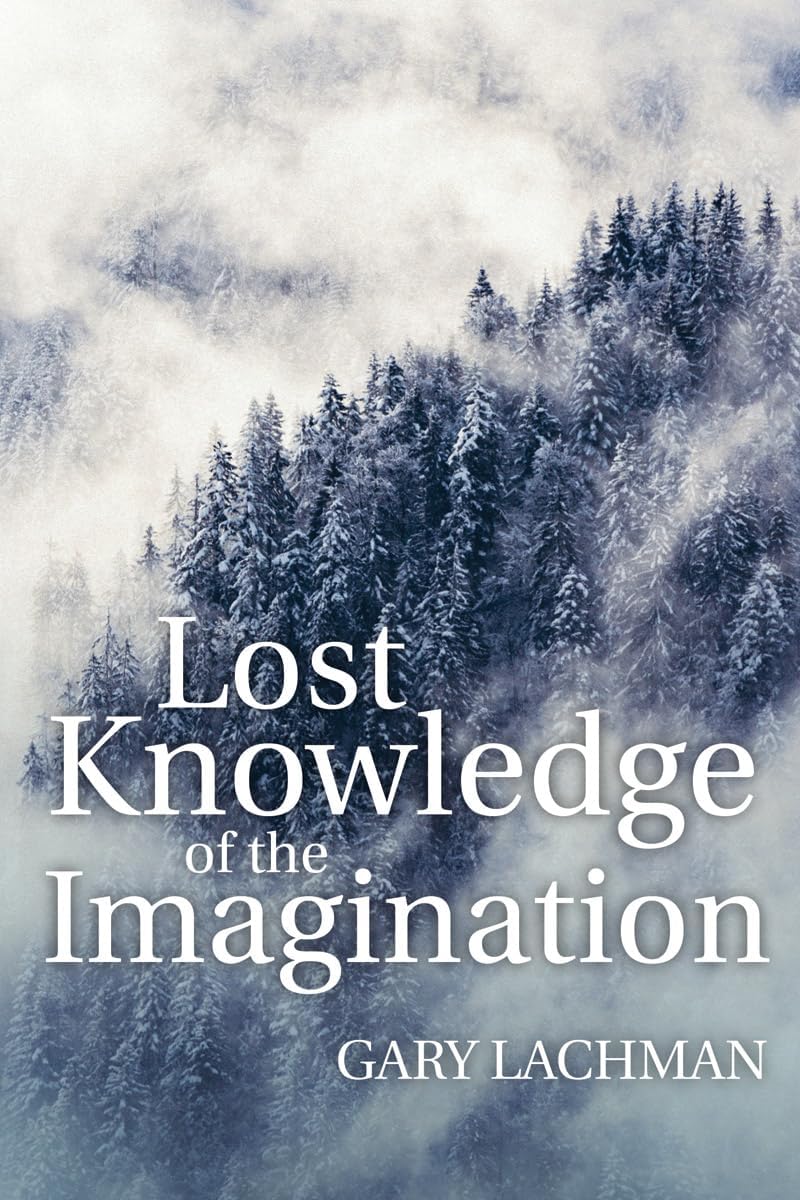
Lost Knowledge of the Imagination
Product ID: 59183214
Desertcart purchases this item on your behalf and handles shipping, customs, and support to Iceland.
Lost Knowledge of the Imagination [Lachman, Gary] on desertcart.com. *FREE* shipping on qualifying offers. Lost Knowledge of the Imagination Review: Imagination Lost & Found - Let me begin my review by sharing some thoughts that I held about imagination before first reading this book. Imagination is one of those terms, such as freedom or love, that we can’t conclusively define, but which we can’t do without. Imagination, however, seems to have fallen out of favor in comparison to the more widely used contemporary term, “creativity.” Creativity, however, strikes me a much shallower concept. To my mind, creativity denotes more of a surface ingenuity, a clever retelling or reworking of existing schemes, structures, or stories. A typical example of this sense of creativity comes from contemporary public art, which often runs from the whimsical or merely clever (in the American sense) to the disjointed, if not merely dull or ugly. Imagination, on the other hand, exists at deeper—one might even say archetypal—level. By going deeper, below the surface, it goes beyond the common human trait of reworking the surface of things by recognizing the deep structures of reality and how they may be contemplated and explored. It is from within the depths of the human mind that imagination springs. Thus, my sense of the distinction between creativity and imagination and where I find much of our contemporary infatuation with creativity misses the mark. In times of trouble, in which we certainly live, we need to move beyond creativity and into the deep wellsprings of imagination. It was with the frame of mind described above that I eagerly dove into Gary Lachman’s Lost Knowledge of the Imagination. As I’ve come to expect from Lachman’s books, he’s gone before me to explore and give voice to thoughts that I often held as no more than intuitions. And when someone says something that you’re inclined to think in any event (and you can overcome the envy in realizes the other’s superior talent and effort), you quickly are taken in by a book or argument, as I was with this book. Lachman entitles his opening chapter “A Different Way of Knowing,” and he had me there. Lachman explores the profound shift in ways of knowing that came to fruition in the Scientific Revolution of the 17th-century with its emphasis on empirical observations and mathematical-logical thinking that emphasized the role of quantity. This, Lachman writes, was not a slow shift, but a sharp break with tradition, although essential thinkers of the era, such as Pascal, realized that this new method was an addition to older ways of thinking, not a full replacement. Lachman quotes Jacques Barzun (referencing Pascal): “the spirit of geometry ‘works with exact definitions and abstractions in science or mathematics’, while the spirit of finesse ‘works with ideas and perceptions not capable of exact definition’”. Lachman, Gary. Lost Knowledge of the Imagination. Floris Books. Kindle Edition. But not all of Pascal’s contemporaries, nor Barzun’s in our own time, appreciate and realize this distinction. Lachman goes on to explain some of the ramifications of failing to appreciate this distinction: “The drawback here is that because the lack of definition is rooted in its subjects themselves, and not due to insufficient information or ‘facts’ about them – when will we have all the facts about love or freedom? – those who follow the spirit of finesse find it difficult, if not impossible, to explain how they know what they know. There are no steps 1, 2, and 3; it just hits them and it is obvious, self-evident. We hear a sonata by Beethoven and we know it is beautiful and meaningful; we do not arrive at this knowledge through a series of logical steps. We do not say to ourselves, ‘Well, it has x number of notes in this passage, which means that …’ and so on. But if asked how we know it is beautiful and meaningful, and even worse, if we can prove it, we draw a blank. The spirit of geometry can take us by the hand and lead us from definition, theorem, and axiom to the goal. But the process is mechanical, practically tautological, as each definition is merely another way of stating the same thing (4 is only another way of saying 2 + 2). And it works best with practical, utilitarian things, not with those that have a purchase on our emotional being.” Id. Lachman goes on to discuss others who’ve arrived at very similar insights, from the 20th-century German thinker Ernest Junger to Michael Polanyi, Alfred North Whitehead, and the contemporary literary scholar-turned-neuroscientist, Iain McGilchrist. These thinkers—and many others—have described and appreciated the distinctions between these different modes of thought, while much of the broader culture clings to a simplistic emphasis on the abstractness (and resulting barrenness) of the "scientific method.” To be clear, Lachman isn’t rejecting the scientific method or the value of science, only “scientism,” which recognizes the abstractions and conclusions of natural science as the only means of knowledge and arriving at “truth.” From this foundation in the history of Western thought, Lachman proceeds to establish the value of the ways of knowing that have been mostly (although not entirely) lost. He describes his project: “This book is about this ‘lost’ knowledge of the imagination. Yet, while this may give us a handy phrase under which we can put examples of the other kind of knowing I have been speaking about, it is not immediately clear what we mean by ‘imagination’. Imagination is one of those things which we all know intimately but which we would find difficult to pin down exactly. It is one of those things that, as Whitehead said, are ‘incapable of analysis in terms of factors more far-reaching than themselves’. . .. Memory, self-consciousness, thought, perception: all inform and are informed by imagination and are difficult, if not impossible, to pry apart from it or each other. This should not be surprising. Imagination does not follow the clear axioms and definitions of the spirit of geometry, but the wayward, vague, surprising insights of the spirit of finesse.” Id. Lachman, having set the terms of his project, moves on to explore a variety of thinkers who have developed and explored insights into this different way of knowing. For instance, he explores the towering figure of the German Enlightenment and Romanticism, Goethe, and the (underappreciated) 20th-century British thinker, Owen Barfield. And, I must add, Samuel Taylor Coleridge, about whom Barfield wrote a book-length study. I must pause here because of what I wrote about at the opening of this review about my distinction between “creativity” and “imagination.” As is inevitably the case, someone arrived at 'my' keen insight long before I did—in this case, no mean figure: Samuel Taylor Coleridge. Lachman writes, “[T]he distinction that the poet Samuel Taylor Coleridge made between fantasy and imagination, with fantasy doing collage work, and imagination creating something that is truly ‘new’. For Coleridge a unicorn or a flying pig is a product of fantasy, of putting together different bits and pieces of our snapshots. True imagination is something else.” Id. Like I said. Lachman goes more deeply into Coleridge’s perspective by tying his insight with that of Goethe’s work on plants and Goethe’s imaginative insight about what the first plants must have looked like: The non-existing plants that Goethe could hypothetically create would not be monsters in the original sense of the word – aberrations of nature – but in perfect keeping with Nature’s designs. This is because Goethe had matched the ‘unknown law’ in the outer world, Nature, with the ‘unknown law’ in his inner one, his imagination. As I mentioned, these ‘unknown laws’ are what Coleridge called ‘facts of mind’, necessities of the imagination, that must be met in order for it to be something more than a ‘madman’s cornerstone’. Failing this, imagination sinks to being merely what Coleridge called ‘fancy’, which is nothing more than ‘a mode of Memory’, a way of re-arranging elements obtained through the senses (‘flying pigs’), which is all the ‘blank slate’ school of psychology will allow us. Or worse, it becomes a distortion of reality, Paracelsus’s ‘madman’s cornerstone’ or the kinds of images being produced by much of modern art that Barfield found indicative of a spiritual bankruptcy and which, with something like Yeats’ warning in mind, he feared could eventually produce a ‘fantastically hideous world’. Id. Do we live in a “fantastically hideous world”? As, no doubt, the world has always been, it’s a mixed lot. But much of what passes for imagination today we can more accurately describe as (at its best) mere creativity or fancy, and at its worst, a nightmarish parody of reality, where fake and real become interchangeable and indistinct. Lachman discusses (and greatly appreciates) the work of the 20th-century British poet and essayist Kathleen Raine, and in exploring her work in “the Tradition.” He writes Decades before its popularity, Raine predicted the rise of ‘reality TV’, pointing out that what is on the screen is often no different from the lives of those watching it. ‘Viewers and viewed’, she observed, ‘could change places and nothing would be altered’. If a work of imagination had once been a ‘magic glass in which we discover that nature to which actuality is barely an approximation’, it had become in our time a kind of brightly lit bathroom mirror, in which all the blemishes and wrinkles of ‘real life’ were magnified a hundredfold. Id. I can only add that in the U.S., in the era of the reality-TV president, we need more from our imaginations that ever. I haven’t addressed many other themes and thinkers explored in this wonderful work. “Imagination” is one of those significant terms that one could explore almost endlessly (and I hope to explore the topic further). There are many works and thinkers to reference in such a project. But it’s hard to—imagine?—a better book with which to begin such a quest. In fact, there is so much that Lachman covers in this (relatively) short work that I’ve not mentioned that I feel guilty leaving so much out, but the best way to alleviate my shortcoming (my guilt is my own stuff) is the read this outstanding work. Review: Godsend for Daydreamers - I’m an artist who is interested in the imaginative world, and have been mildly embarrassed most of my life by how powerful my experience of the imagination has been. People have always accused me of drug use, but I’m as sober as a judge. I’d say things that seem obvious to me, like: “if you don’t think of words before you say them, then who is talking, it can’t be you.” If you can identify with that statement, then you MUST read this book. I’ve compared the thrill people feel on the descent of a roller coaster to how it feels for me to go for a walk in the woods and go deep into the interior. In this book I loved being reminded of the way Jung considered the imagination to be impersonal, and feel like Jung anticipated the new theory of the modular mind. Learning about the large variety of people who have taken the imagination very seriously is exciting, reassuring and edifying. This book resembles a more academic version of Mitch Horowitz’s (who I think Lachman knows) great books, and if you have a background with a little psychology and/or a little philosophy then Lachman’s slightly more emphasis on research and his accessible yet academic style is a completely engaging and a worthwhile read. I found out about Lachman when he did an interview with Nikita Petrov on “MeaningofLife.tv” on YouTube.


| Best Sellers Rank | #1,167,797 in Books ( See Top 100 in Books ) #1,316 in Consciousness & Thought Philosophy #1,324 in Medical Cognitive Psychology #2,124 in Cognitive Psychology (Books) |
| Customer Reviews | 4.5 4.5 out of 5 stars (171) |
| Dimensions | 6.1 x 0.5 x 9.1 inches |
| ISBN-10 | 1782504451 |
| ISBN-13 | 978-1782504450 |
| Item Weight | 2.31 pounds |
| Language | English |
| Print length | 168 pages |
| Publication date | January 15, 2018 |
| Publisher | Floris Books |
S**F
Imagination Lost & Found
Let me begin my review by sharing some thoughts that I held about imagination before first reading this book. Imagination is one of those terms, such as freedom or love, that we can’t conclusively define, but which we can’t do without. Imagination, however, seems to have fallen out of favor in comparison to the more widely used contemporary term, “creativity.” Creativity, however, strikes me a much shallower concept. To my mind, creativity denotes more of a surface ingenuity, a clever retelling or reworking of existing schemes, structures, or stories. A typical example of this sense of creativity comes from contemporary public art, which often runs from the whimsical or merely clever (in the American sense) to the disjointed, if not merely dull or ugly. Imagination, on the other hand, exists at deeper—one might even say archetypal—level. By going deeper, below the surface, it goes beyond the common human trait of reworking the surface of things by recognizing the deep structures of reality and how they may be contemplated and explored. It is from within the depths of the human mind that imagination springs. Thus, my sense of the distinction between creativity and imagination and where I find much of our contemporary infatuation with creativity misses the mark. In times of trouble, in which we certainly live, we need to move beyond creativity and into the deep wellsprings of imagination. It was with the frame of mind described above that I eagerly dove into Gary Lachman’s Lost Knowledge of the Imagination. As I’ve come to expect from Lachman’s books, he’s gone before me to explore and give voice to thoughts that I often held as no more than intuitions. And when someone says something that you’re inclined to think in any event (and you can overcome the envy in realizes the other’s superior talent and effort), you quickly are taken in by a book or argument, as I was with this book. Lachman entitles his opening chapter “A Different Way of Knowing,” and he had me there. Lachman explores the profound shift in ways of knowing that came to fruition in the Scientific Revolution of the 17th-century with its emphasis on empirical observations and mathematical-logical thinking that emphasized the role of quantity. This, Lachman writes, was not a slow shift, but a sharp break with tradition, although essential thinkers of the era, such as Pascal, realized that this new method was an addition to older ways of thinking, not a full replacement. Lachman quotes Jacques Barzun (referencing Pascal): “the spirit of geometry ‘works with exact definitions and abstractions in science or mathematics’, while the spirit of finesse ‘works with ideas and perceptions not capable of exact definition’”. Lachman, Gary. Lost Knowledge of the Imagination. Floris Books. Kindle Edition. But not all of Pascal’s contemporaries, nor Barzun’s in our own time, appreciate and realize this distinction. Lachman goes on to explain some of the ramifications of failing to appreciate this distinction: “The drawback here is that because the lack of definition is rooted in its subjects themselves, and not due to insufficient information or ‘facts’ about them – when will we have all the facts about love or freedom? – those who follow the spirit of finesse find it difficult, if not impossible, to explain how they know what they know. There are no steps 1, 2, and 3; it just hits them and it is obvious, self-evident. We hear a sonata by Beethoven and we know it is beautiful and meaningful; we do not arrive at this knowledge through a series of logical steps. We do not say to ourselves, ‘Well, it has x number of notes in this passage, which means that …’ and so on. But if asked how we know it is beautiful and meaningful, and even worse, if we can prove it, we draw a blank. The spirit of geometry can take us by the hand and lead us from definition, theorem, and axiom to the goal. But the process is mechanical, practically tautological, as each definition is merely another way of stating the same thing (4 is only another way of saying 2 + 2). And it works best with practical, utilitarian things, not with those that have a purchase on our emotional being.” Id. Lachman goes on to discuss others who’ve arrived at very similar insights, from the 20th-century German thinker Ernest Junger to Michael Polanyi, Alfred North Whitehead, and the contemporary literary scholar-turned-neuroscientist, Iain McGilchrist. These thinkers—and many others—have described and appreciated the distinctions between these different modes of thought, while much of the broader culture clings to a simplistic emphasis on the abstractness (and resulting barrenness) of the "scientific method.” To be clear, Lachman isn’t rejecting the scientific method or the value of science, only “scientism,” which recognizes the abstractions and conclusions of natural science as the only means of knowledge and arriving at “truth.” From this foundation in the history of Western thought, Lachman proceeds to establish the value of the ways of knowing that have been mostly (although not entirely) lost. He describes his project: “This book is about this ‘lost’ knowledge of the imagination. Yet, while this may give us a handy phrase under which we can put examples of the other kind of knowing I have been speaking about, it is not immediately clear what we mean by ‘imagination’. Imagination is one of those things which we all know intimately but which we would find difficult to pin down exactly. It is one of those things that, as Whitehead said, are ‘incapable of analysis in terms of factors more far-reaching than themselves’. . .. Memory, self-consciousness, thought, perception: all inform and are informed by imagination and are difficult, if not impossible, to pry apart from it or each other. This should not be surprising. Imagination does not follow the clear axioms and definitions of the spirit of geometry, but the wayward, vague, surprising insights of the spirit of finesse.” Id. Lachman, having set the terms of his project, moves on to explore a variety of thinkers who have developed and explored insights into this different way of knowing. For instance, he explores the towering figure of the German Enlightenment and Romanticism, Goethe, and the (underappreciated) 20th-century British thinker, Owen Barfield. And, I must add, Samuel Taylor Coleridge, about whom Barfield wrote a book-length study. I must pause here because of what I wrote about at the opening of this review about my distinction between “creativity” and “imagination.” As is inevitably the case, someone arrived at 'my' keen insight long before I did—in this case, no mean figure: Samuel Taylor Coleridge. Lachman writes, “[T]he distinction that the poet Samuel Taylor Coleridge made between fantasy and imagination, with fantasy doing collage work, and imagination creating something that is truly ‘new’. For Coleridge a unicorn or a flying pig is a product of fantasy, of putting together different bits and pieces of our snapshots. True imagination is something else.” Id. Like I said. Lachman goes more deeply into Coleridge’s perspective by tying his insight with that of Goethe’s work on plants and Goethe’s imaginative insight about what the first plants must have looked like: The non-existing plants that Goethe could hypothetically create would not be monsters in the original sense of the word – aberrations of nature – but in perfect keeping with Nature’s designs. This is because Goethe had matched the ‘unknown law’ in the outer world, Nature, with the ‘unknown law’ in his inner one, his imagination. As I mentioned, these ‘unknown laws’ are what Coleridge called ‘facts of mind’, necessities of the imagination, that must be met in order for it to be something more than a ‘madman’s cornerstone’. Failing this, imagination sinks to being merely what Coleridge called ‘fancy’, which is nothing more than ‘a mode of Memory’, a way of re-arranging elements obtained through the senses (‘flying pigs’), which is all the ‘blank slate’ school of psychology will allow us. Or worse, it becomes a distortion of reality, Paracelsus’s ‘madman’s cornerstone’ or the kinds of images being produced by much of modern art that Barfield found indicative of a spiritual bankruptcy and which, with something like Yeats’ warning in mind, he feared could eventually produce a ‘fantastically hideous world’. Id. Do we live in a “fantastically hideous world”? As, no doubt, the world has always been, it’s a mixed lot. But much of what passes for imagination today we can more accurately describe as (at its best) mere creativity or fancy, and at its worst, a nightmarish parody of reality, where fake and real become interchangeable and indistinct. Lachman discusses (and greatly appreciates) the work of the 20th-century British poet and essayist Kathleen Raine, and in exploring her work in “the Tradition.” He writes Decades before its popularity, Raine predicted the rise of ‘reality TV’, pointing out that what is on the screen is often no different from the lives of those watching it. ‘Viewers and viewed’, she observed, ‘could change places and nothing would be altered’. If a work of imagination had once been a ‘magic glass in which we discover that nature to which actuality is barely an approximation’, it had become in our time a kind of brightly lit bathroom mirror, in which all the blemishes and wrinkles of ‘real life’ were magnified a hundredfold. Id. I can only add that in the U.S., in the era of the reality-TV president, we need more from our imaginations that ever. I haven’t addressed many other themes and thinkers explored in this wonderful work. “Imagination” is one of those significant terms that one could explore almost endlessly (and I hope to explore the topic further). There are many works and thinkers to reference in such a project. But it’s hard to—imagine?—a better book with which to begin such a quest. In fact, there is so much that Lachman covers in this (relatively) short work that I’ve not mentioned that I feel guilty leaving so much out, but the best way to alleviate my shortcoming (my guilt is my own stuff) is the read this outstanding work.
W**N
Godsend for Daydreamers
I’m an artist who is interested in the imaginative world, and have been mildly embarrassed most of my life by how powerful my experience of the imagination has been. People have always accused me of drug use, but I’m as sober as a judge. I’d say things that seem obvious to me, like: “if you don’t think of words before you say them, then who is talking, it can’t be you.” If you can identify with that statement, then you MUST read this book. I’ve compared the thrill people feel on the descent of a roller coaster to how it feels for me to go for a walk in the woods and go deep into the interior. In this book I loved being reminded of the way Jung considered the imagination to be impersonal, and feel like Jung anticipated the new theory of the modular mind. Learning about the large variety of people who have taken the imagination very seriously is exciting, reassuring and edifying. This book resembles a more academic version of Mitch Horowitz’s (who I think Lachman knows) great books, and if you have a background with a little psychology and/or a little philosophy then Lachman’s slightly more emphasis on research and his accessible yet academic style is a completely engaging and a worthwhile read. I found out about Lachman when he did an interview with Nikita Petrov on “MeaningofLife.tv” on YouTube.
L**S
Locke sank into a swoon ...
In writing this book, the author had to deal with two burdens. First, he had to assume that a substantial number of his readers would not know anything about his prior work, and would be newcomers to the issues he addresses; as a result, he had to begin once more at the beginning. Second, a book for general readers had to be brief rather than nuanced, and simplified, or even over-simplified, rather than extensive. He deals with these difficulties rather well. In six readable chapters he distinguishes and delineates two major modes of knowledge (the imaginal and the analytic/Cartesian); describes the triumph of the analytic mode since the 17th Century; develops arguments for the inadequacy of a solely analytic approach to grasping the world; delineates the counter-current that has persisted through the increasing dominance of the analytic; proposes the development of a more balanced mode of knowing in which both modes are active; and, finally, warns about the problems arising from an irresponsible use of imaginative knowing, and emphasizes the need for responsible use of the imagination. The need to simplify and abbreviate leads to some significant omissions: it doesn't really let him trace the development of the analytic mode through the history of the natural sciences of the Middle Ages. It also leads to some odd and hasty judgments – for example, dismissing Marshall Mcluhan as an "intellectual demagogue", rather than as himself a reflective participant in the stream of imaginal knowing (who received inspiration from the Virgin Mary). And finally, it means that he must omit almost completely any consideration of the Buddhist analyses of the constructive role of perception in giving rise to the manifest world (though he does refer offhandedly to Alexandra David-Neel's experience with generating a tulpa). Addressing this would require quite a bit of work: although the problem-situation addressed in Buddhist analyses, especially the Madhyamika, is very much like that of the Parmenidean-Platonic-Neoplatonic tradition, it tends, so to speak, to reverse all the values, starting with a denial of the Parmenidean Real. These are relatively small points: to write, after all, is to omit. There is one very large point that he does not address, despite its immediate relevance to his call for responsible imagination. I will try to provide a brief sketch of the issue. In some ways the author locates the initial sidelining of imaginal knowledge with that naughty old sourpuss, the Church, which rushed around with its omnipresent Church Police putting the kibosh on the poetic imagination (as well as on the sciences). This anachronistic oversimplification has some validity, in that the Church in medieval western Europe was the guarantor of a vision of order, that is, of meaning, precisely the kind of imaginal hierarchical vision the author otherwise admires. Challenges to this vision of order were not just good clean fun: they were potentially highly disruptive political acts – they easily became assertions of alternative centers of meaning and political power. As was common almost everywhere (compare, for example, the Yellow Turban rebellion in China, or the fate of Suhrawardi, for that matter) this meant that these alternatives were suppressed – when they could not be coopted or otherwise re-integrated. (Societies can afford disorder only to the extent that they are rich enough to have resources to waste.) In Europe, this order broke down, under the repeated assertions of alternative visions of order, which "went kinetic", over and over again, at great cost in in suffering and in lives. Voltaire's remark that there is no sect in geometry represents a turn away from the visionary or imaginal not simply because the analytic is more useful, but because (at the time) it seemed likely to be less murderous. The hope was that an analytic, managerial, secular society could find a place for the visionary and imaginal, tamed precisely because they were "just" art or entertainment, and not something to take seriously. The history of the 20th century did not fulfill this hope: it turned out that visions of order may be secular, managerial, atheistic and bureaucratic, and no less lethal than their sectarian precursors. Karl Popper fought a vigorous battle with the whole idea of visionary order, from Plato through Marx, but even his austere laïcité has been hijacked to sectarian ends. There is nothing internal to the imaginal mode of knowing that guarantees its sanity, much less its non-lethality. Sylvia Nasser's biography of John Nash quotes him as saying that he took his delusions seriously because they seemed to come from the same place as his mathematical insights. Our author recognizes this problem, and in his final chapter calls for "tradition" to protect imagination from the monsters that may arise from the sleep of reason. But what this can possibly mean (whose tradition? who are the Guardians? what could this look like in practice?) is left quite undefined. In an important sense, the book stops where it finally was ready to begin. Nevertheless, the book provides a very clear and readable survey of the issue of the two modes of knowing, with a very useful introduction to major figures in the imaginal current, and their writings. It ends with an excellent reading list, which will take the interested reader quite far into the subject. For anyone who is not already very familiar with the primary sources, this book will provide very helpful orientation and access to them. It would also be very useful ancillary reading for undergraduate survey courses.
D**E
In Lost Knowledge of the Imagination, Gary Lachman has crystalised his essential philosophical ideas. A short book, at 139 pages, it is nevertheless a highly concentrated and no less comprehensive survey, and like his earlier books it serves a dual purpose. Firstly, it serves as a general overview of various philosophers, authors, psychologists, occultists and mystics, many of whom have been unduly neglected, or have come to represent systems of ‘rejected knowledge’. In each case, Lachman elucidates and clarifies these unique systems of knowledge and their respective originators, allowing both to speak for themselves. Secondly, by placing these various systems and ideas side-by-side, Lachman shows that they are not as unrelated as one might think, and taken collectively they are seen to have a remarkable inner-consistency, and have also been adhered to by some of mankind’s greatest thinkers and artists. It is for this reason that an open-minded reader will perceive a vision of the world that is unduly ignored, but is nevertheless profound and enriching. In a world increasingly orientated towards the outer at the expense of the inner, Lachman sees the value of esotericism precisely for its emphasis on this inner world of meaning, purpose and, in short, our sense of values. The occult and esoteric has become, in a sense, the culture’s repressed unconscious, which occasionally bursts forth in fin-de-siecle counter-cultures, as it did with the 1960s ‘occult revival’ and again in the 1990s, with its obsession with shamanic hallucinogens and tribal rave culture. Indeed, Lachman writes about these subjects – sometimes obscure and arcane – in a style that is accessible, intelligent and level-headed; traits often sadly lacking in the genre. There is, in his increasing oeuvre, a manifest degree of discernment and – where deserved – sympathy that is strengthened by what his fellow historian of the occult, Mitch Horowitz, called a ‘gentle but assertive purpose’. Now, if one were to classify the true philosopher as someone concerned with ‘truth, beauty and justice’, then this new book is Lachman’s pursuit of the importance and essential dynamism at the heart of beauty, with its immense role in the revival of a culture that has placed it dangerously low on its hierarchy of values. One could say that Caretakers of the Cosmos (2013) was a call for a creative actualisation of these values, and more importantly putting them into practice, ‘doing the good that you know’. And, his forthcoming book, Dark Star Rising: Magick and Power in the Age of Trump (2018) looks to be a direct address on the state of world justice; an attempt to understand the streams and convergences of magical and esoteric streams in recent times and their role in a world of ‘post-truth’, and . . . well, post-everything hysteria. Nothing in Lachman’s oeuvre is unrelated; it is all part of a deeper realisation that was already present in his earlier work. Each work is essentially informed by this vision and recognition of the importance of esoteric knowledge, particularly its psychological dimensions and its acknowledgement of an ultimately meaningful cosmos. Indeed, one of his central influences is the late encyclopedic writer and optimistic ‘new existentialist’, Colin Wilson, on whom Lachman has written the definitive biography, Beyond the Robot: The Life and Work of Colin Wilson (2016). Lachman, in the spirit of Wilson, is also addressing the essentially pessimistic premise on which contemporary culture has dangerously rooted itself. And with a world bereft of the very values found in this ‘rejected’ knowledge, we are left with a fragmentary and deconstructed world of matter without any larger meaningful context. Humanity also increasingly sees itself as a part of this context-free void, therefore denying the very value of meaning (merely subjective), and therefore diminishing its own stature in a materialistic cosmology that rejects, ultimately, all values. Again, driving both philosophers is a recognition that we live in world of deteriorating values, with an ‘anything goes’ attitude that effectively strips us of any real motive for freedom – or even an inspiring concept of freedom itself. The question is now: freedom for what? Lachman, in surveying many systems that recognise that freedom is something earned, and is moreover, is an urgent reminder of the value of being, offers a new orientation that includes both value and purpose. One gets from reading both writers, Wilson and Lachman, a sense that this is a crucial and important corrective for our postmodern age – an active recognition and renewal of our ability for discernment in a world dislocating itself from any centre. Postmodernism and post-structuralism, caught in the trap of ‘object-relations’, cannot wrench itself out of its own swirling, linguistic orbit, in which, for philosophers like Jacques Lacan, we merely ‘ex-ist’ rather than exist. The philosopher Richard Tarnas, The Passion of the Western Mind (1991), described the outcome of these philosophical developments, which in turn led to a general belief that the ‘nature of truth and reality, in science no less than in philosophy, religion, or art’ became ‘radically ambiguous’ – or radically subjectivised. He continues by saying that man, unable to ‘transcend the manifold predispositions of his or her subjectivity’ becomes trapped in a ‘fusion of horizons’, which leads to a form of nihilistic solipsism – or, in other strains, it becomes too unbounded, leading to a paradoxically flattening form of relativism. This loss of centre, as it were, results in an atmosphere that permeates our culture – affecting the arts and their previous attempts to reflect values beyond themselves – in which our individual and existential sovereignty is so abstracted that it is often reduced to algorithmic, or even algebraic, formulations in much of postmodernism and – chillingly – in the world of social media and even, more dangerously, politics. The great esoteric scholar, Manly P. Hall called this our problem of ‘orientation disorientation’ – we have lost our way, so to speak. And not only in ourselves, for this clearly reflects in our culture, flattening it to a husk of hyper-politicisation and is reflected in our crisis of identity. Timeless, objective, reliable value systems have been replaced with a liquid, amorphous mass uprooted from any healthy, cosmological and psychological reality; our choice, effectively, is to face our arbitrary existence in a universe indifferent to the strivings of our very being, or merely improvise with the equivalent of flimsy props in a theatre of unreality. We are, as Lachman argues, fundamentally adrift from the origin of meaning itself. And it is this loss of origin that led to the forgetfulness of the imagination’s essential role in grasping both meaning and reality – both culturally and individually. Indeed, is it any wonder why we have lost our ability to discern our values? Freedom, in this relativistic atmosphere, becomes an ironic freedom – and irony, moreover, becomes the only cosmological constant that informs the world of contemporary art. An atmosphere of self-referential pointlessness permeates our culture, and the only way to temporarily satiate its bitter flavor is through often stark and ill-contrasting brutality; visceral ‘shocks’ aimed solely at our baser, more automatic instincts. Addressing this universal crisis of meaning, Lachman’s book stands in the tradition of classics like Maurice Nicoll’s Living Time (1952) and E.F. Schumacher’s A Guide for the Perplexed (1977). These two genre-defying books proposed radically new cosmologies, incorporating in their brilliant synthesis both the unification of rationality and intuition, in an attempt to resolve the modern psyche’s widening chasm between meaning and matter. Lachman’s book, alongside these, place their emphasis on the verticality of meaning, that is, their evolutionary and convergent purposes towards higher degrees of spiritual and psychological integration. It is in direct contrast to the pervasive atmosphere of value relativism and materialistic reductionism, and instead offers a logical alternative to the manifestly problematic arrangement of our priorities. In approaching the difficult subject of the imagination, plagued as it is by its very evanescence and vague character, Lachman nevertheless proceeds with great authority, firmness of purpose, and with many insights that transmutes knowledge of the imagination into something palpably and urgently real. He shows us that the imagination is not a mere ‘flight of fancy’, but has its own epistemology, its own disciplines and masterful practitioners. The Lost Knowledge of the Imagination explores various thinker’s, artist’s and poet’s excursions into this important other ‘half’ of our existence – precisely the half that needs to be integrated in a world fraught with increasing polarization and dis-integration. And importantly, he unearths the knowledge they bought back with them. The imaginative source, that ‘intuitive glue’ which binds together our view of the cosmos, is called upon as a means to repair the rift between two worlds that were once complimentary; it is a call, moreover, towards an active phenomenological understanding of the true origin of meaning. Being one of the true practitioners and teachers of the imagination, the poet Samuel Coleridge is an important figure in Lachman’s book. For this poet, who contemplated the ‘objects of Nature’, was able to entwine two worlds, both inner and outer, into a state which allowed him visions of the eternal dynamism between meaning, consciousness and matter. Colerdige, in his own words, entered a new world redolent with ‘symbolic language . . . that already and forever exists’ – a world, in short, where the knowledge of the imagination reigns supreme – presaging, for the poet, a ‘dim Awakening of a forgotten or hidden Truth of my inner Nature’, which Coleridge referred to as both the Creator and, importantly in light of this essay, ‘the Evolver!’.
S**E
Magnificent
L**V
Imagination, Creativity, Intuition are the best friends of humanity. Happiness and Purpose are the consequence of Creativity. Acceptable book. Good.
A**R
This book has changed the way I think about myself and the world. It's not a effortless read as in, to get value out of it you have to read carefully and sometimes back up a little, stop and think, Google for context on the side. Eager to read more from this author
G**S
A truly wonderful book. In imagination we shall find the inspiration to figure out the problems humanity faces. Here's a great resource!
Trustpilot
1 week ago
3 weeks ago