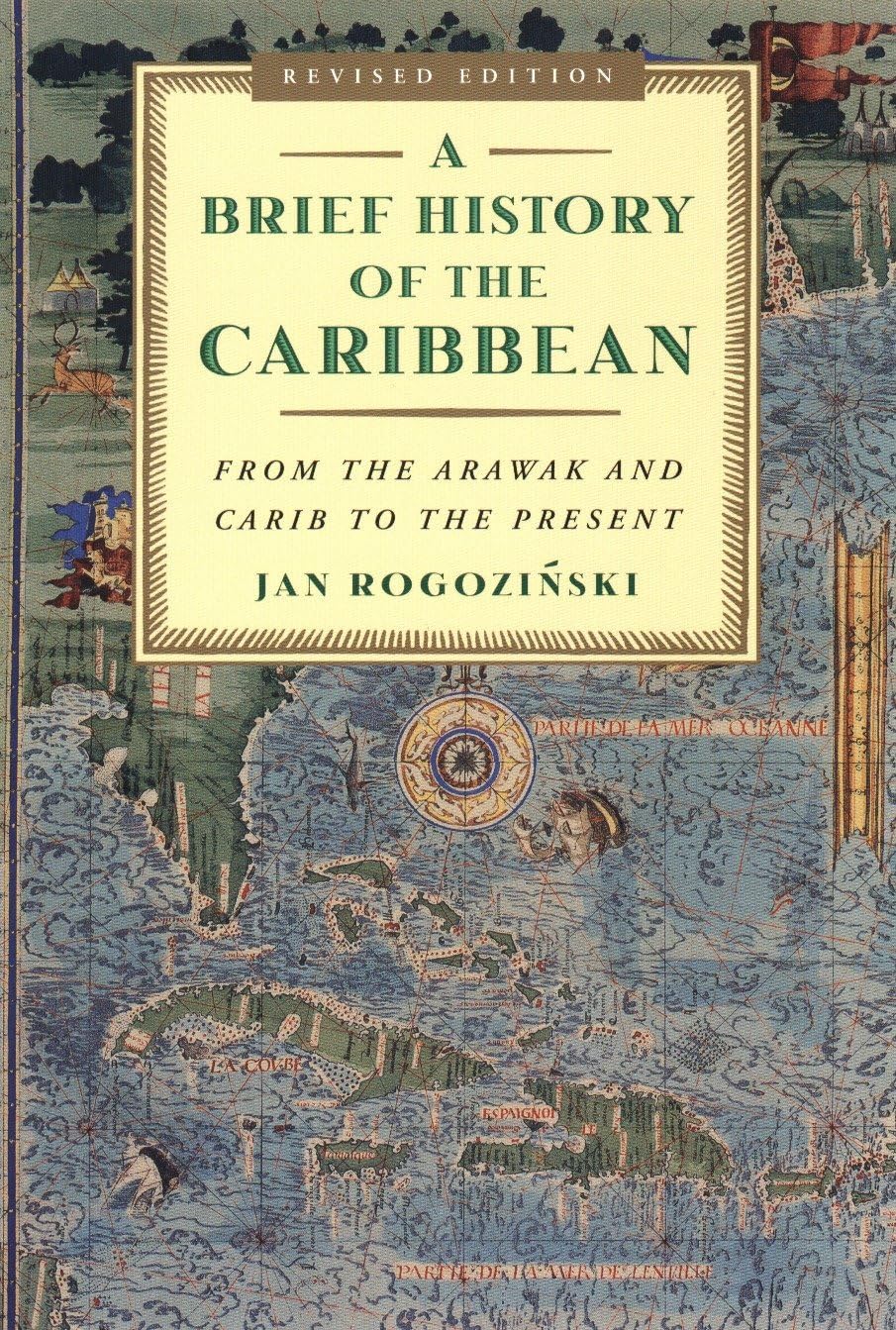
A Brief History of the Caribbean: From the Arawak and Carib to the Present
Product ID: 5804954
Buy anything from 5,000+ international stores. One checkout price. No surprise fees. Join 2M+ shoppers on Desertcart.
Desertcart purchases this item on your behalf and handles shipping, customs, and support to Iceland.
This comprehensive volume takes the reader and student through more than five hundred years of Caribbean history, beginning with Columbus's arrival in the Bahamas in 1492. A Brief History of the Caribbean traces the people and events that have marked this constantly shifting region, encompassing everything from economic booms and busts to epidemics, wars, and revolutions, and bringing to life such important figures as Sir Francis Drake, Blackbeard, Toussaint Louverture, Fidel Castro, the Duvaliers, and Jean-Bertrand Aristide. This superbly written history, revised and updated, with new chapters that reflect the islands' most recent social, economic, and political developments, is a work of impeccable scholarship. Featuring maps, charts, tables, and photographs, it remains the ideal guide to the region and its people. Review: A Good In-Depth History - Even though the title is called "A Brief History..." it's really much in-depth of the area. Remember the Caribbean is made of many, many islands and Dr. Rogozinski covers them all. He starts well back when just the Indigenous People were around and their encounter with Columbus. Speaking of whom, is the reason WHY I picked this book up. I do have some family history from the Caribbean, and I have much from Europe, but I have a present day conflict with those people who despoil Columbus and his legacy. This was the main reason I got this book. And it didn't disappoint. I learned so much about the islands and those who came and staked a claim (Spain Conquistadors), just because they could. I learned how they applied Spanish Laws & Mandates that people knew in Europe, but had no clue of in the New World. I learned how they changed hands, why they changed hands, who lost and who won the islands, and why they have the flavor they have now. I learned of the natives, the conquerors, the pirates, the settlers, the unreformed and escapees. I learned about world markets and what was valued and when. That the islands were once full of wonderful greenery that were cleared for sugar cane. And the coup d'tats that happened on several islands in modern times. The book goes from that early time of 1492, just short of touching on 1992. That's 500 years. That's not brief. I got a nice hardcover version. There are maps in the back so you can follow actions and get a sense of the lands, tables for stats, photos and footnotes. As well as suggested further reading. Despite all that, Dr. Rogozinski writes in way that the reading is not difficult. Highly recommend this if the subject interests you. Review: Scholarly and Accessible - This is a densely documented chronicle that will be of interest to the general reader for its explanation of how the distinct Caribbean island cultures developed from their popular discovery in 1492 to the present. More serious students of the subject will find a veritable library of reference material in the appendix of suggested readings. Visitors to the region will have a better understanding of the similarities and differences of these island communities based on the historical specifics of their political and social history. Today the importance of tourism, offshore banking, "assembly" factories, and indeed the drug trade are evident. But in the beginning it was a lust for gold that mesmerized Spanish explorers. The "Black Legend" that was Spanish settlement brought inhumanity and disease and wiped-out the idigenous peoples. The envy of the English, French, and Dutch helped launch the age of buccaneers who acted more and sometimes less on their behalf to steal Spanish plunder. With a greater European commitment sugar plantations took hold requiring the cheapest form of labor - slavery. Dutch business acumen in international trade, specifically in the crucial areas of lending, insurance, and marketing, enabled them to establish the infrastructure of an industry. The gradual abolition of slavery began in Great Britain, and here organized religion gets credit for bringing credible pressure on the government. Rogozinski's commentary on current issues in the Caribbean basin is just as helpful, as say, in the matter of Cuba. There is little to explain Fidel Castro's early, consistent, deep-rooted enmity towards the United States in these pages. What does seem clear is that U.S. foreign policy towards Cuba was inconsistent and stumbled dreadfully from the Bay of Pigs fiasco to total disorientation during the Jimmy Carter administration: "The Carter administration approved of some marxist [sic] regimes in the 'Third World' countries and supported some groups claiming to be revolutionary. Andrew Young, U.S. ambassador to the U.N., praised Cuban intervention in Angola. George McGovern and Frank Church, influential Democrat senators, traveled to Cuba and extolled Castro's regime" Rogozinski's history of the region suggests that Cuba's totalitarian regime is an aberration destined to change with Castro's eventual passing. Forceful, charistmatic leaders are common in Caribbean politics. But ideology, atheism, political repression, and a centrally controlled economy are not.
| Best Sellers Rank | #825,069 in Books ( See Top 100 in Books ) #62 in Haiti Caribbean & West Indies History #395 in Colonialism & Post-Colonialism #428 in Caribbean & Latin American Politics |
| Customer Reviews | 4.3 out of 5 stars 107 Reviews |
T**A
A Good In-Depth History
Even though the title is called "A Brief History..." it's really much in-depth of the area. Remember the Caribbean is made of many, many islands and Dr. Rogozinski covers them all. He starts well back when just the Indigenous People were around and their encounter with Columbus. Speaking of whom, is the reason WHY I picked this book up. I do have some family history from the Caribbean, and I have much from Europe, but I have a present day conflict with those people who despoil Columbus and his legacy. This was the main reason I got this book. And it didn't disappoint. I learned so much about the islands and those who came and staked a claim (Spain Conquistadors), just because they could. I learned how they applied Spanish Laws & Mandates that people knew in Europe, but had no clue of in the New World. I learned how they changed hands, why they changed hands, who lost and who won the islands, and why they have the flavor they have now. I learned of the natives, the conquerors, the pirates, the settlers, the unreformed and escapees. I learned about world markets and what was valued and when. That the islands were once full of wonderful greenery that were cleared for sugar cane. And the coup d'tats that happened on several islands in modern times. The book goes from that early time of 1492, just short of touching on 1992. That's 500 years. That's not brief. I got a nice hardcover version. There are maps in the back so you can follow actions and get a sense of the lands, tables for stats, photos and footnotes. As well as suggested further reading. Despite all that, Dr. Rogozinski writes in way that the reading is not difficult. Highly recommend this if the subject interests you.
D**B
Scholarly and Accessible
This is a densely documented chronicle that will be of interest to the general reader for its explanation of how the distinct Caribbean island cultures developed from their popular discovery in 1492 to the present. More serious students of the subject will find a veritable library of reference material in the appendix of suggested readings. Visitors to the region will have a better understanding of the similarities and differences of these island communities based on the historical specifics of their political and social history. Today the importance of tourism, offshore banking, "assembly" factories, and indeed the drug trade are evident. But in the beginning it was a lust for gold that mesmerized Spanish explorers. The "Black Legend" that was Spanish settlement brought inhumanity and disease and wiped-out the idigenous peoples. The envy of the English, French, and Dutch helped launch the age of buccaneers who acted more and sometimes less on their behalf to steal Spanish plunder. With a greater European commitment sugar plantations took hold requiring the cheapest form of labor - slavery. Dutch business acumen in international trade, specifically in the crucial areas of lending, insurance, and marketing, enabled them to establish the infrastructure of an industry. The gradual abolition of slavery began in Great Britain, and here organized religion gets credit for bringing credible pressure on the government. Rogozinski's commentary on current issues in the Caribbean basin is just as helpful, as say, in the matter of Cuba. There is little to explain Fidel Castro's early, consistent, deep-rooted enmity towards the United States in these pages. What does seem clear is that U.S. foreign policy towards Cuba was inconsistent and stumbled dreadfully from the Bay of Pigs fiasco to total disorientation during the Jimmy Carter administration: "The Carter administration approved of some marxist [sic] regimes in the 'Third World' countries and supported some groups claiming to be revolutionary. Andrew Young, U.S. ambassador to the U.N., praised Cuban intervention in Angola. George McGovern and Frank Church, influential Democrat senators, traveled to Cuba and extolled Castro's regime" Rogozinski's history of the region suggests that Cuba's totalitarian regime is an aberration destined to change with Castro's eventual passing. Forceful, charistmatic leaders are common in Caribbean politics. But ideology, atheism, political repression, and a centrally controlled economy are not.
J**O
IT IS WHAT ITS TITLE SAYS IT IS...
This is a well-written and fast-paced history of the Caribbean. It does it's job admirably well. It begins with a topographical overview of the islands - what type of islands they are, what their climate and soil is like. It then takes the reader on a trip through time, beginning with the Native American peoples, through Columbus's discovery of the islands (yes, I wrote "discovery" - the concept of which is dealt with in a sidebar), to colonization. Now, any history of the Caribbean is going to deal primarily with three things: sugar, slavery, and piracy. Of these three, piracy is the most fun to read about. Of course, there is the perfunctory disdain of the role of the tourist in the Caribbean, which may or may not be true (it all depends on the tourist). The book is supplemented with useful charts, maps, and pictures from the islands. If there is any fault with the book, it's just that it is an overview book. It is prone to the dangers of the genre - it deals with its subjects in broad strokes in order to tell THE ENTIRE STORY. Rogozinski is honest in pointing this out. Many of the really fun history books focus on a particular incident in history and focus on it in great detail. Personally, I was less interested in the coverage of recent politics on the islands. (Although the sections on Haiti and Cuba were fascinating.) I love the Caribbean and I love learning about it. This is a fine place to start.
G**9
Very informative; well researched book!
My daughter-in-law is an "Arawak Indian" and I bought this book to educate myself. This book is very informative on how humble and wonderful people the Arawak Indians were. The history of the Arawaks is well written. I learned a log and thoroughly enjoyed it.
R**K
This book is well worth the time and money if ...
This book is well worth the time and money if you're interested in the subject. It moves quickly and has plenty of maps (the maps alone are worth a star). Some of the other reviews claimed that there was bias but I didn't see it.
E**9
Excellent Book
Amazing book with interesting details. I’ve only spotted one error so far. Jost Van Dyke is spelled Josh. Other than that it’s a sharp, comprehensive read. I especially appreciate how non-partisan it is. So many history books today are leaking with opinions and author motives. This is raw, concise, and charming.
N**Z
A Brief History of the Caribbean: From the Arawak and the Carib to the Present
Well written account of Caribbean history covering the basics and not being to exhaustive for the average reader. Historical subjects are covered with sensitivity to the current state of the Caribbean self identity.
S**E
Five Stars
Very educational
A**Y
Caribbean History
Fine brief guide to Caribbean History
S**S
GREAT PURCHASE
PERFECT CONDITION OF ITEM. ON TIME DELIVERY. THANKS
S**G
An excellent companion to a good Caribbean guidebook
I was lucky enough recently to take a long cruise around the Caribbean. This book, along with Kay Showker's excellent 'Caribbean Ports of Call, Eastern and Southern Regions' were the books I took along for the journey. A commonly sold T-shirt in the Caribbean states 'Same S**t, different Island'. This book does a great deal to differentiate between the islands and to identify their common and different histories. It paints a tale of how the peaceful Arawak, and more warlike Carib, were virtually wiped out as the islands were turned over to commerce and slavery. Of a horrific slave trade in which an estimated 5+ million people had their life choices removed (that number excludes the approx 5 million slaves sent to other parts of the Americas). Of how Sir Francis Drake was perhaps the most successful of 'pirates'. Of disease and death for early white settlers. Suddenly, its no longer same s**t, different island as the different histories of the region are outlined chronologically. One starts to appreciate Cuba's strategic position (250 times the size of Barbados and dominant in its location oppostite Florida; the importance of Dominica as a refuge to the largest surviving Carib population; of the Maroon (free slave) groups that lived on Jamaica and some other islands. That the islands are volcanic and from time to time kill people. Of the terrible hurricanes, including one in 1780 which swept from Barbados to Puerto Rico and killed 22,000. Of states gaining independence relatively recently. Of the 1983 US military invasion of Grenada. The region ceases to be a series of beautiful beaches separated intermittently by sea, instead a rich tapestry of nations with differing backgrounds and current economic strengths. The book isn't a page turner, but it is a well written, informative read that sits well alongside a good guidebook for anyone wanting to know more about this facinating region.
A**R
Needs colour pages
So far really interesting and easy to read. Downside is the cheap(er) publication that means no colour photos. A book about the Caribbean needs colour! All pictures are hazy black in white(ish) paper.
B**E
A Caribbean Journey into the Past.
This is a book that is both informative and also interesting. Jan Rogozinski is a writer who paints a clear and at times disturbing picture of the history of the islands from the trafficking in slavery to the wars between the French and British and Dutch and Spanish over trade routes and spices like, cinnamon, nutmeg , cloves and ginger. The book is written in formal and clinical style that takes getting used to but is worth pursuing as it provides a wealth of information. Blade
Trustpilot
1 month ago
4 days ago