We remain fully operational. Our teams are working around the clock to ensure your deliveries continue safely.

DOWNLOAD THE APP


Customer Services
Copyright © 2025 Desertcart Holdings Limited
DOWNLOAD THE APP
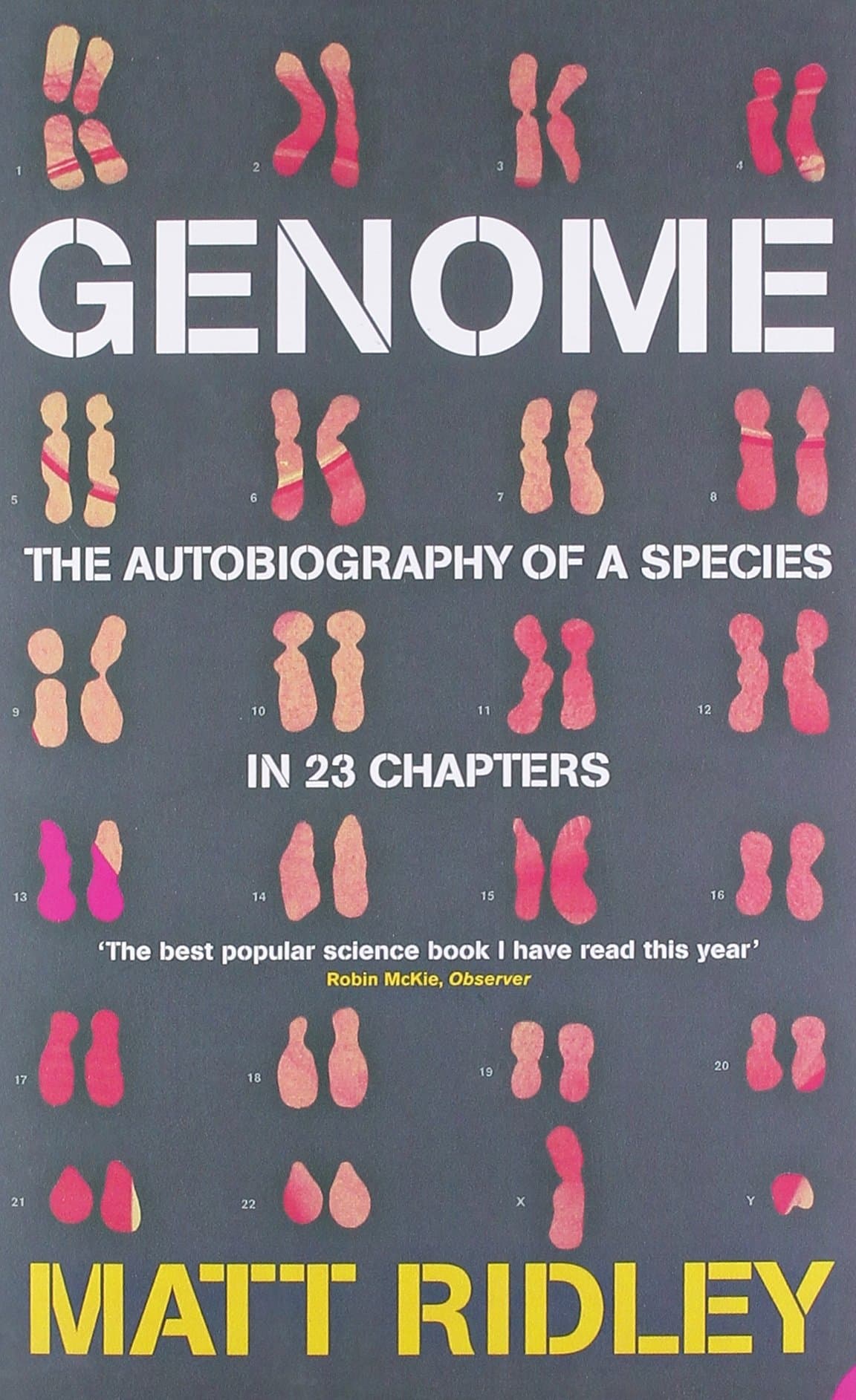
Buy Genome: The Autobiography Of Species In 23 Chapters Reprint by Ridley, Matt (ISBN: 9781857028355) from desertcart's Book Store. Everyday low prices and free delivery on eligible orders. Review: Fascinating insight into genes and genetic engineering - This fascinating account of human inheritance has an elegant structure. Various genetic phenomena are discussed, each in one of 23 chapters: each one named (= numbered) after the chromosome pair which is most relevant to that particular subject. So we are guided through the genetics of intelligence, personality, immunity, and the gene-level basis of heart disease, cancers, Alzheimers, and other `partially inherited' diseases. Ridley, as ever, does his research thoroughly, and presents it with brilliant clarity. I found the account of apoptosis (cell suicide), effected by genes `for the good of the body', to be an informative evolutionary basis for better understanding cancer. In another chapter, he discusses the biological benefits of autonomy, comparing (admittedly generalising) the high status, in control, `high serotonin' state with the anxious, impulsive, atherosclerotic, suicidal, `low serotonin' scenario. New snippets of the evolutionary story are revealed. Head-tail and back-front differentiation genes are very similar throughout the animal kingdom, implying a common ancestry. Infidelity is a highly prevalent behaviour in many species.Genes from different animals (including humans) are to a surprising extent actually interchangeable. We glean further insights into the nurture/nature interplay. Environmental triggers can actually switch genes on and off; genes in turn can make us more or less sensitive to our environment. Ridley relates how, with age, as we often become increasingly able to select our own influences, the `genetic' proportion of our intelligence thus tends to increase. In another chapter again, he explores the construction of intricate `genetic geography' which reveal some racial `characteristics'. Conundrums are explored: why do inherited diseases persist in the gene pool? Because gene mutations (changes in the base sequence) often have two separate effects, one beneficial and one harmful. What is the function of all the `junk' (seemingly useless) DNA? A lot of it is random, `phenotype-free' : `hitch-hiking' a ride from generation to generation, on the back of the genes that bother to make the survival machines(bodies)that serve to reproduce DNA so effectively. What you learn depends on what you already knew; but there'll certainly be something for everyone here. I found most gripping the sections towards the end, as we become gradually more aware of the fantastic possibilities of genetic engineering. The account of the (gene-carrying) retrovirus therapy and other genetic `engineering' tricks was riveting. The principles of what had seemed a highly esoteric field became much clearer and more straightforward. He extends his discussions into philosophical areas also. I discovered that many countries - including the US and the UK - took significant steps towards developing and supporting eugenic customs and laws in the 20's and 30's. In another section Ridley briefly discusses the relationship between behavioural genetics and the problem of free will - does chaos theory have a relevance here, explaining the smaller scale unpredictabilities in our decisions ? Overall, this is a key modern topic to obtain some kind of grasp of, and Ridley's book must be as good a way as any of achieving that. Review: Gene stories - Surprised to enjoy the book which is a bit of a whodunnit among genes. Lots of explanations for all manner of interesting human foibles. Very well written, flows along nicely, at a good pace, never mind you down with trivia - a refreshingly easy read. It is scientific but never that deep in science that you get lost. All in all, a book I'm well glad to have found and read.


| Best Sellers Rank | 97,176 in Books ( See Top 100 in Books ) 26 in Genetics in Popular Science 158 in Biological Evolution 206 in Basic Medical Science (Books) |
| Customer reviews | 4.4 4.4 out of 5 stars (1,796) |
| Dimensions | 13 x 2.24 x 19.71 cm |
| Edition | Reprint |
| ISBN-10 | 185702835X |
| ISBN-13 | 978-1857028355 |
| Item weight | 294 g |
| Language | English |
| Print length | 352 pages |
| Publication date | 16 Mar. 2000 |
| Publisher | Fourth Estate Ltd |
A**A
Fascinating insight into genes and genetic engineering
This fascinating account of human inheritance has an elegant structure. Various genetic phenomena are discussed, each in one of 23 chapters: each one named (= numbered) after the chromosome pair which is most relevant to that particular subject. So we are guided through the genetics of intelligence, personality, immunity, and the gene-level basis of heart disease, cancers, Alzheimers, and other `partially inherited' diseases. Ridley, as ever, does his research thoroughly, and presents it with brilliant clarity. I found the account of apoptosis (cell suicide), effected by genes `for the good of the body', to be an informative evolutionary basis for better understanding cancer. In another chapter, he discusses the biological benefits of autonomy, comparing (admittedly generalising) the high status, in control, `high serotonin' state with the anxious, impulsive, atherosclerotic, suicidal, `low serotonin' scenario. New snippets of the evolutionary story are revealed. Head-tail and back-front differentiation genes are very similar throughout the animal kingdom, implying a common ancestry. Infidelity is a highly prevalent behaviour in many species.Genes from different animals (including humans) are to a surprising extent actually interchangeable. We glean further insights into the nurture/nature interplay. Environmental triggers can actually switch genes on and off; genes in turn can make us more or less sensitive to our environment. Ridley relates how, with age, as we often become increasingly able to select our own influences, the `genetic' proportion of our intelligence thus tends to increase. In another chapter again, he explores the construction of intricate `genetic geography' which reveal some racial `characteristics'. Conundrums are explored: why do inherited diseases persist in the gene pool? Because gene mutations (changes in the base sequence) often have two separate effects, one beneficial and one harmful. What is the function of all the `junk' (seemingly useless) DNA? A lot of it is random, `phenotype-free' : `hitch-hiking' a ride from generation to generation, on the back of the genes that bother to make the survival machines(bodies)that serve to reproduce DNA so effectively. What you learn depends on what you already knew; but there'll certainly be something for everyone here. I found most gripping the sections towards the end, as we become gradually more aware of the fantastic possibilities of genetic engineering. The account of the (gene-carrying) retrovirus therapy and other genetic `engineering' tricks was riveting. The principles of what had seemed a highly esoteric field became much clearer and more straightforward. He extends his discussions into philosophical areas also. I discovered that many countries - including the US and the UK - took significant steps towards developing and supporting eugenic customs and laws in the 20's and 30's. In another section Ridley briefly discusses the relationship between behavioural genetics and the problem of free will - does chaos theory have a relevance here, explaining the smaller scale unpredictabilities in our decisions ? Overall, this is a key modern topic to obtain some kind of grasp of, and Ridley's book must be as good a way as any of achieving that.
M**N
Gene stories
Surprised to enjoy the book which is a bit of a whodunnit among genes. Lots of explanations for all manner of interesting human foibles. Very well written, flows along nicely, at a good pace, never mind you down with trivia - a refreshingly easy read. It is scientific but never that deep in science that you get lost. All in all, a book I'm well glad to have found and read.
M**S
A fantastic tour of the human genome
Informative, accessible and a really good read! Everything ypu wanted to know about the code that makes you up, but we're afraid to ask. Go pick up a copy and read it!
B**G
Very approach introduction to the human genome that hasn't dated much at all
The output of the human genome project is a heavy duty subject – just understanding what’s involved in the process is not easy; interpreting the results operates at a whole different level. As for writing about the human genome in an accessible and enjoyable way – this is a particularly drastic challenge. Ridley not only succeeds but does so in a rather cute fashion. This is ‘an autobiography of a species in 23 chapters’. The number 23 is no random selection – it corresponds to the number of chromosome pairs we have, and Ridley picks out a gene to feature from each chromosome pair in each chapter. This approach enables his book to be far reaching, looking at our relationship to other owners of the gene, from bacteria to great apes, spanning from the earliest forms of life to the genes that could be responsible for intelligence and language. Evolutionary theory, biology’s great triumph, is put across very effectively alongside good background material on genetics, and of the many books around the human genome, this has to be one of the best. Particularly attractive is Ridley’s style – effortlessly informative, yet light enough to almost always be enjoyable. If there’s anything to criticize it is an over use of something to the effect of “to go through all of this would bore you to tears, but I just want to show you this little bit because…” – but that is a very minor moan. This reviewer has a physics background and expects biology-based popular science to often be an necessary chore rather than a pleasure – this is a definite exception! It’s interesting to read it alongside Andrew Brown’s In the Beginning was the Worm.
T**H
Very readable for a novice like me
Well written, with some anecdotal smatterings which always lighten the mood in popular science books as long as they are not overdone. I wanted a basic intro to genome stuff and from my reading this does the trick for me although the experts and some purists out there may argue otherwise. However for me it laid the groundwork and primed me to want to know more, so I'm now looking for the next step in reading about this important and interesting topic.
R**P
A fascinating insight to this new and evolving science
I found This book to be a relatively easy read given the complexity of the subject. This was made easy by the style and organised manner of Matt Ridley’s writing. Thoroughly enjoyable! My only criticism is aimed at Amazon. When I bought the book, I did so on the understanding that it was published in 2017, therefore relatively recent. In fact this book was written 20 years earlier! And I only found that out when reading it (use of the term World Wide Web is a clue)
B**L
Well worth reading again - history of eugenics was alarming
The historical references, and how early ideas have been superseded, placed current knowledge in good perspective. The many references and bibliography are a valuable inclusion. The chapter "Chromosome 22 - Eugenics" started with a discussion on Down-syndrome babies and that some choose to terminate such pregnancies. That led, logically for me, onto the subject of the chapter, eugenics. There were some surprises there and some shocks too when I learned of some well-known names that favoured or supported eugenics. A book I shall read again.
J**E
I've read this book cover to cover three times over the last time years. It's my go-to guide for understanding the human blueprint. What's a gene? What's a chromosome? Why does it matter? This book will answer your questions.
M**A
Si quieres saber más sobre el cuerpo humano te pasanionara. Has de saber algo sobre hormonas, sistema hormonal etc...antes de leerlo.
Y**I
Se você quer saber a quantas andam as pesquisas sobre biologia molecular, recomendo este livro. Ideias claras numa linguagem fácil tornam a leitura deliciosa do comeco ao fim.
J**N
The printing quality of the book is pretty low
J**E
This is a wonderful read as: science, non-fiction generally, and as a primer on our genes, what they do, and how they work. I find Ridley to be one of the best science writers for the general public and this book is no exception. Ridley leads us on an interesting and informative tour of some of the aspects of our genes. He touches on the junk DNA, mechanisms for changes in the chromosomes, how genes express them selves in proteins and the phenotype, some genetic diseases (he opines how we know most genes by the diseases that result from their malfunction and reiterates that genes are not for diseases), some of the latest ideas on how our chromosomes came to the shape they are in, and the role of RNA, among many other things. RNA is rapidly rising up as the candidate for the "original replicator" (at least for the world of nucleic acid replicators, maybe there was something before that does not survive) since it can and does act in many different roles throughout the cell including as genetic replicating code (apart from DNA) and catalysis like proteins. His discussion of junk DNA and sequence repetitions and how they occur in some cases was fascinating. His discussions of how certain gene sequences were actually discovered by scientists was too. I would note that the discoveries of modern genetics are consonant with the "Selfish Gene" view of evolution. They are not explicable by other proposed levels of evolutionary selection nor are they explicable by design (though an ad hoc application of magic certainly can give a superficial and false "explanation" for just about anything.) Ridley does let his political/social ideas come through fairly strongly in a few places (only a few places.) My recommendation is simply to take them for what they are: one man's opinion. They didn't detract from the book at all for me. One's political stance does not imply anything about the data you present. This is not an exhaustive map or discussion of our genes. Such a book would be huge and probably not readable. This is an overview with some interesting details and side trips. I strongly recommend it to you. I also recommend: Ridley's The Origins of Virtue, Dawkins' The Selfish Gene and The Ancestor's Tale, Neil Shubin's Your Inner Fish, Zimmer's Parasite Rex, Nesse and Williams' Why We Get Sick, and Diamond's The Third Chimpanzee
Trustpilot
2 months ago
1 month ago