Buy anything from 5,000+ international stores. One checkout price. No surprise fees. Join 2M+ shoppers on Desertcart.
Desertcart purchases this item on your behalf and handles shipping, customs, and support to Iceland.
๐ค Elevate your sound game with Kxable โ where pro-grade durability meets studio-quality clarity!
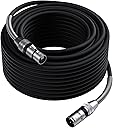
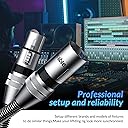
The Kxable XLR Microphone Cable is a 200-foot, professional-grade balanced mic cable featuring a robust 22AWG pure copper conductor for superior sound fidelity. It boasts dual-layer copper braided and aluminum foil shielding to eliminate interference, zinc alloy self-locking connectors for secure connections, and a flexible, durable PVC jacket with metal spring strain relief. Ideal for recording studios, podcasts, live sound, and professional audio setups, it ensures reliable, noise-free performance with a one-year warranty and multiple length and pack options.
| ASIN | B0BGHZXKJ6 |
| Item model number | KXXLR-HQ-200F-BK |
| Manufacturer | Kxable |
| Package Dimensions | 30.61 x 28.5 x 10.31 cm; 3.42 kg |
R**N
The Kxable mic cable is pretty good. The cable stock looks to be of good design. Double shielded, copper over foil, with additional strengthening fibers inside. The soldering skill is decent, with no cold or dirty joints. The cable assembler tied the XLR Shell to Pin1, which is generally a no-no for analog audio. XLR shells should almost always be floating relative to the cable, so that they may ground to the chassis at the device. In a "properly" designed device, either Pin1 and the shell will tie to chassis at the same point local to the connector, or the shell directly to chassis at the connector and Pin1 to a low-impedance bus bar and then to chassis. Unfortunately, many improperly designed devices will tie Pin1 to the circuit ground on the PCB, which then ties to chassis far away, often near the power input, injecting shield noise across the PCB. Having Pin1 tied to shell in a cable plugged into a device like that now means that there are multiple paths from circuit ground to chassis ground. The main time I can think where you might want shells terminated inside the cable is for digital cables that are intended to be daisy-chained. In that scenario, it creates a continuous shield around the "splice". You'll still need to be sure that the devices on both ends terminate Pin1 directly to the chassis as close to the connector as possible. It would be easy enough to just snip the connection inside the XLR connector, except on one of the connectors the assembler brought the shield conductor to the shell tab first, then to Pin1, so snipping it would lift Pin1 on that end, which depending on specific application you might want or not. Not a big deal, there's plenty of conductor length to desolder it from the tab and move it over.
D**J
Sometimes too much of a good thing isn't better. What was I thinking??? ... 200 ft of XLR cable is about 150 ft of XLR cable more than I needed :) I can tell that KXABLE cables are definitely made with high quality materials for my microphone needs, but do I really need to be 200ft from my PA at any time??? ... well, not now, and if I do, at that point wireless may be the best option. So, I'll happily use it now, but I just hope I don't trip over my cable. :) Not much more to say, other than it is now time to test it's durability. I hope the cable is as strong and sturdy as it looks and feels.
M**L
I was surprised that this 200ft cable sounded ever so slightly better with my desk setup than my normal use 10ft cable. I use a shure mv7 with the bheringer um2. Can't wait to use it for it's intended purpose!
C**C
Hi quality cable had no interface from any source while using these cables in my home studio. They're are really REALLY thick, gold plated, and constructed really durable. These are the best XLR cables I own hands down!
Trustpilot
2 months ago
2 months ago