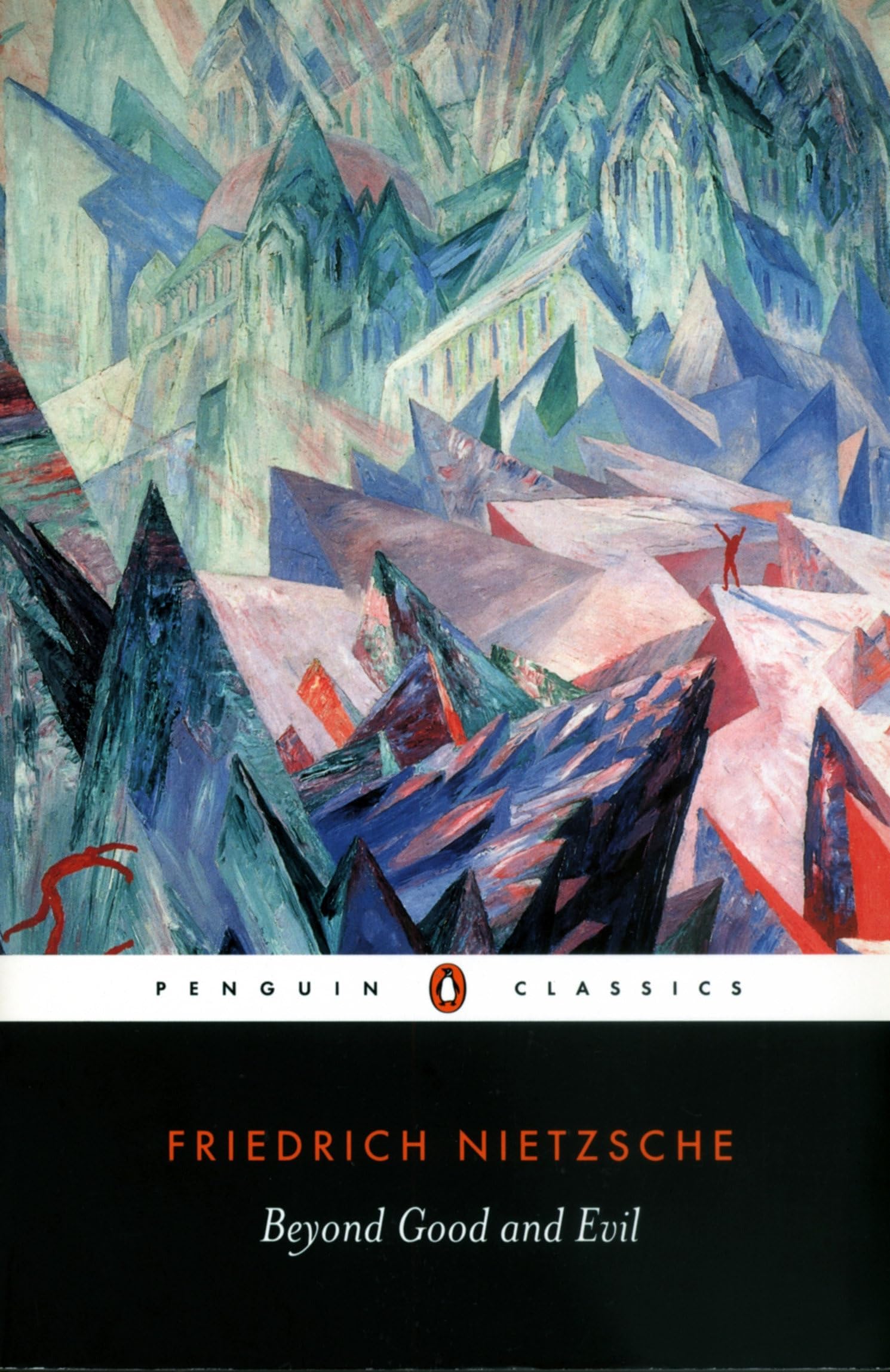
Beyond Good and Evil (Penguin Classics)
Product ID: 50045045
📚New mint condition guaranteed
📦Same-day dispatch before noon
🔄No-quibble returns
Desertcart purchases this item on your behalf and handles shipping, customs, and support to Iceland.
📖 Unlock the mind that reshaped philosophy—don’t just read it, live it.
Beyond Good and Evil by Nietzsche, translated by R.J. Hollingdale, is a cornerstone of modern philosophy that dismantles traditional Western values and champions individual willpower. This Penguin Classics edition features a concise introduction by Michael Tanner and comprehensive commentary, offering readers both context and critical insights. With a 4.5-star rating from over 4,300 reviews and top rankings in philosophy categories, this mint-condition book ships same day if ordered before noon, backed by guaranteed packaging and hassle-free returns.


| Best Sellers Rank | 6,305 in Books ( See Top 100 in Books ) 3 in Philosophy of Theology 8 in Religious Philosophy (Books) 16 in Philosopher Biographies |
| Customer Reviews | 4.5 out of 5 stars 4,311 Reviews |
A**D
Michael Tanner, you have overcome yourself!
What I want to draw attention to in my brief review is to this particular edition of Beyond Good and Evil (BGE). R J Hollingdale did the translation work, so top marks there, even though I tend to favour certain more recent translators simply as matter of weight (see my review of On the Genealogy of Morals translation by Douglas Smith). This edition contains two extra goodies worth a mention. The first is an introduction by Michael Tanner. Tanner and I have form (he said, flattering himself). I reviewed his book on Nietzsche and flung it a mere two stars. That book was about a hundred pages long; this introduction is twenty. It seems that less is more after all. Tanner not only provides a workable context for a reading of BGE, he uses it as a launch pad to fire off illuminating flashes in the direction of Nietzsche's thought as a whole. Such as? "Nietzsche regards all of us, insofar as we subscribe to a system of values, as being philosophers." (p.11) "So, in Nietzsche's view, we inevitably do create values, whether we want to or not...Value is not something that we discover, it is something that we invent...Values are dependent on one kind of fact - the nature of those doing the valuing." (p.20) Tanner also makes insightful comments on Nietzsche's "much misunderstood" doctrines of persprctivism (p. 19) and particularly the Superman (ps. 17, 21), whose task it is to overcome decadence by turning every event in into an affirmation, carrying "self-sufficiency to a degree which virtually meant total exile from society." He is "self-important in the best sense of that term" and delights in his "sense of being different from others". At last, some meat on the bones of steel! Of course, Tanner being Tanner has to inject a few choice opines into the mix. Taking on the mantel of an average reader (?) Tanner states that Nietzsche's questioning of truth's value "seems provokingly silly" and that his account of master morality might read as "a repulsive general view of things". However: "It becomes clear that Nietzsche is trying to formulate the conditions under which we may hope to recover a conception of greatness, above all of that kind of greatness which we associate with creativity, at least before that term was so debased by pop psychologists and educational theorists." (p. 22) As much as I would love to digress into a defence of creativity techniques, I will instead point to the only real issue I have with Tanner's Nietzsche, one that he seems to share with the rest of the Nietzsche scholars. He quotes BGE: 209 where Nietzsche mentions Napoleon and Goethe as historical exemplars of master morality and enemies of the "legalization of life". Then, forgetting Napoleon, Tanner asserts that for Nietzsche art was the "the peak human activity", the field of greatest risk and importance, "the realm in which man can celebrate existence most completely" (25). Really? So why does Nietzsche refer to Julius Creaser as often as Leonardo Di Vinci (BGE: 200)? How can he dare mention Cesare Borgia at all (BGE: 197)? Or why does he, in the same chapter, decry "feminine" traits (BGE: 202) along with "socialists dolts and blockheads" (BGE: 203). Why does he equate the aristocratic spirit with the military spirit (BGE: 239)? Are we to take his book-long polemic against pity sentimentality (e.g. BGE: 293), and for cruelty and wildness as anything other than seriously meant? Speaking of Cesare Borgia, I also need to mention the excellent commentary at the back of this Penguin edition. Some of the comments are fairly basic in terms of philosophical definitions and explanations. However, what impressed me is that in several places, where Nietzsche mentioned something requiring reference in the text, the commentary as gathered together other references to the same subject in his other works. For instance, we have Nietzsche's main comments on Epicurus (p. 226), anti-teleology (p. 277), the French Revolution (p. 288), cruelty and 'de capo' (p. 229), Jewry and Borgia (p.231), Napoleon and fear (p. 232), Homer (p. 233), Wagner (p. 234), Jesus (p. 236), and laughter (p. 237). May I conclude by suggesting you read Nietzsche's comments in 56 and 58 (plus maxim 94) where he equates life-affirmation with the concepts of play and game? Relevance to review? Not much really. Only this. Don't they apply to all areas of life, not just art? And not excluding war? Counter-cultural, yes. But 'evil' for that? Or should that be 'bad'? PS BGE should be the second work of Nietzsche's a noob should tackle after GOM IMHO.
K**R
Amazing Book
Great and dagerous book is misread . This book as opened my mind on on how I see myself. I reccommend the book
W**H
Entrancing, enjoyable and expansive, but its teachings could turn you into a prick.
This is a bit more of what I was expecting from a philosophy novel. Aware of philosophy, broadly speaking, I never investigated it further until just recently, an adverse effect from reading ‘The Red Book’ by C.G Jung. I expected the books themselves to be smaller, more interesting textbooks and this is exactly what ‘Beyond Good and Evil’ was, but with a great deal of energy and wit included throughout it. I had introduced myself to Nietzsche through ‘Thus Spoke Zarathustra’ but as I bought all three books (the third was ‘Twilight of the Idols and the Anti-Christ’) at once I figured I would read them in linear order. Having not been blown away by Zarathustra, though interested in what Nietzsche was trying to say in it (apparently the subsequent books were elaborations on Zarathustra) I had to persuade myself to read this one, and I was pleased I did. This book is far more clear in its ideas than Zarathustra was (or maybe I’m just thick and it was slightly beyond me, but anyway…) and the tone of it was almost as if you were hearing someone ranting in a pub, but occasionally making good points that do in fact make you think intently about what’s being said. (Though Nietzsche blamed alcohol almost as much as Christianity for the suppression of the ‘Superman’, so he ever being in a pub to rant after a few pints is highly unlikely). This is the more popular one of his books, as far as I’m aware, as my friends who have read Nietzsche have all read this one and it changed their view of life. Unfortunately it didn’t change my life... yet, but I can see me getting angry in a few years with the mundanity of work and referring back to it for guidance if things don’t go my way between now and then. It has sowed a seed that makes me question why does it matter in the end? Which is quite a worrying concept when you think about it. Also it’s quite anti-socialist and with its anger directed at Judaism and Christianity for creating a religion and race of slaves, I can see how The Nazi’s took aspects of it to further their cause and persecute the different groups already mentioned, though technically they were Christians, I guess. This could be deemed as a dangerous book, if you are an angry person filled with prejudice and intolerance it might indeed fuel your desire to do what you want, regardless of who it hurts however, if you’re an open-minded person anyway, it can be a liberation from the mundanity of working to live day in, day out, then feeling ashamed when we do, say or think something ‘bad’ which has been ingrained in our consciences since birth, taught in our childhood, continued through school and then beat in again through work. We are slaves to what we think we should do, rather than slaves to what we want to do. Perhaps Bob Proctor and other lifestyle Gurus over the years have taken some hints here with their paradigm shifts. Though I’m sure Bob Proctor believes firmly in a God and this book questions that belief. To be clear, not so much the belief of a God, as apparently ‘God is Dead and We Killed him’ which suggests there was one, but the translation of Morality through scripture and religious teachings. Either way this book had more urgency than Zarathustra, was more direct with its questions and answers, or lack there-of and had a fire and passion throughout it that was quite entrancing, yet informative. It has lasted with me and has made me think harder about why we should accept these restrictions upon our very being- and with this mention of being- it has expanded my philosophical outlook to Heidegger and Sartre’s works, which can only be a good thing, right? An easy four stars, four and a half if I could give it.
A**!
Nice cheap paperback classic
Always been a huge fan of the author. This is a nice paperback book and will loll goof in my collection
G**K
Elegant and beautiful.
Beyond Good And Evil is an awesome treatise, Nietzsche’s command of language is so strong, his writing is so beautiful and articulate. By reading Nietzsche you learn many things and some of his writing genius rubs off on us and inspires us greater heights and depths of vocabulary and language. I highly recommend Beyond Good And Evil, but most especially I recommend any of Friedrich Nietzsche’s works, his entire philosophy is profound, provocative and truly amazing!
R**I
impressive
This was the first book I read of Nietzsche and I was very impressed by it. I am a bit angry with myself for not reading him earlier. For anyone with a interest in philosophy it is definitely a must.
F**N
Small
The print is too small, but otherwise a good book.
I**N
Quick delivery. Great quality.
The item arrived even before the estimated delivery time slot. The book was very cheap and in excellent condition.
S**D
Great book
Great book, every philosophy oriented reader should have in his life and in his library.
J**E
Good read
Good read
F**Y
worth of money ,good product
Beyond Good and Evil" by Friedrich Nietzsche is a powerful and thought-provoking exploration of morality, truth, and individuality. Nietzsche challenges traditional values and urges readers to question societal norms, embrace intellectual freedom, and create their own values. His poetic and bold writing style, combined with deep insights, makes this a timeless philosophical masterpiece that continues to inspire and provoke thought. A must-read for anyone seeking to break free from conventional thinking!
T**A
Legal
Bom livro
V**V
Print quality is very poor! UNREADEBLE!
Hi, this is more about this particular print of the book. The quality of paper, printing, fonts, and spacing is extremely poor. I highly do not recommend exactly this print. Choose some other publisher.
Trustpilot
5 days ago
2 weeks ago