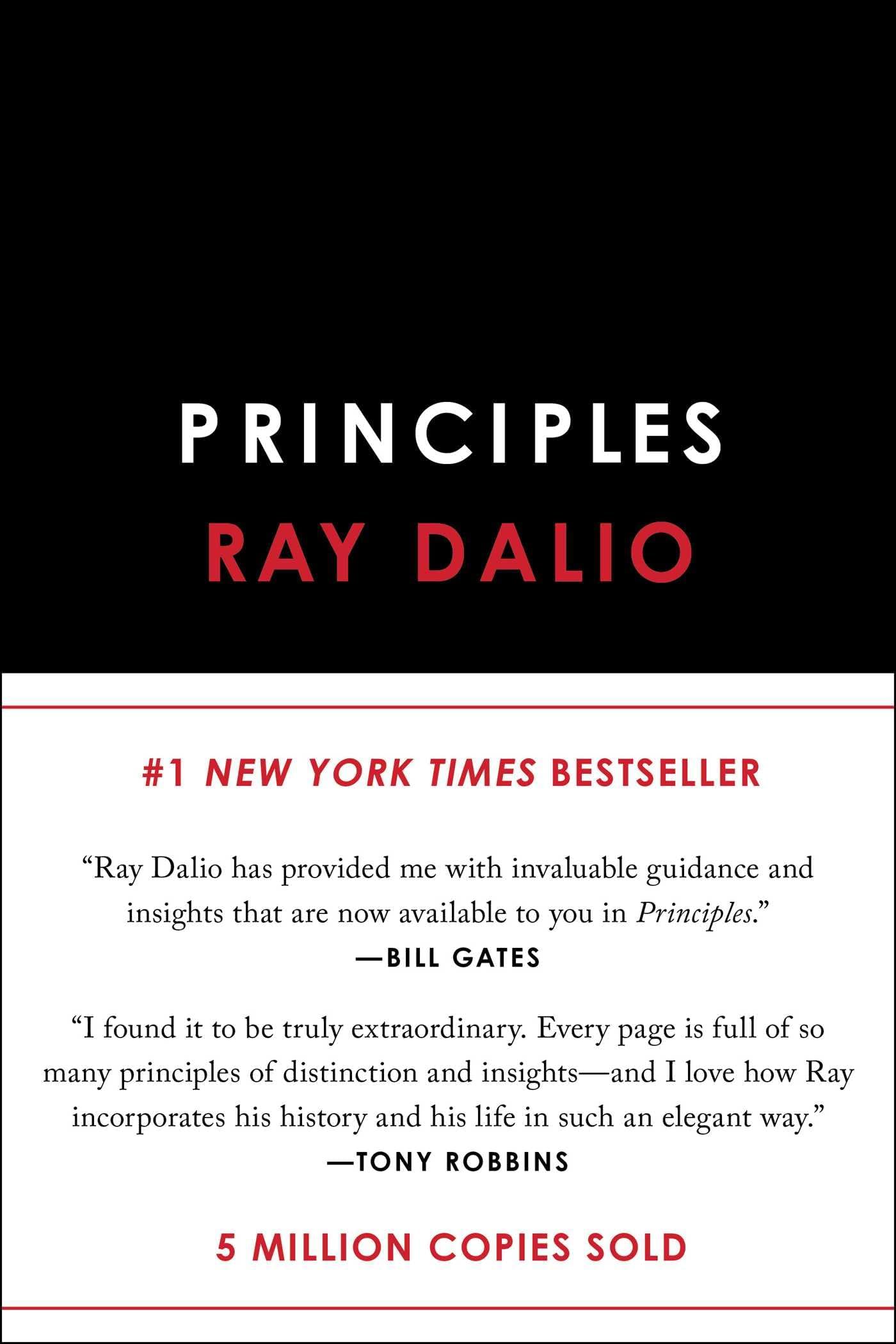
Principles: Life and Work
Product ID: 47943605
Buy anything from 5,000+ international stores. One checkout price. No surprise fees. Join 2M+ shoppers on Desertcart.
Desertcart purchases this item on your behalf and handles shipping, customs, and support to Iceland.
#1 NEW YORK TIMES BESTSELLER * 5 MILLION COPIES SOLD “Significant...The book is both instructive and surprisingly moving.” — The New York Times Ray Dalio, one of the world’s most successful investors and entrepreneurs, shares the unconventional principles that he’s developed, refined, and used over the past forty years to create unique results in both life and business—and which any person or organization can adopt to help achieve their goals. In 1975, Ray Dalio founded an investment firm, Bridgewater Associates, out of his two-bedroom apartment in New York City. Forty years later, Bridgewater has made more money for its clients than any other hedge fund in history and grown into the fifth most important private company in the United States, according to Fortune magazine. Dalio himself has been named to Time magazine’s list of the 100 most influential people in the world. Along the way, Dalio discovered a set of unique principles that have led to Bridgewater’s exceptionally effective culture, which he describes as “an idea meritocracy that strives to achieve meaningful work and meaningful relationships through radical transparency.” It is these principles, and not anything special about Dalio—who grew up an ordinary kid in a middle-class Long Island neighborhood—that he believes are the reason behind his success. In Principles, Dalio shares what he’s learned over the course of his remarkable career. He argues that life, management, economics, and investing can all be systemized into rules and understood like machines. The book’s hundreds of practical lessons, which are built around his cornerstones of “radical truth” and “radical transparency,” include Dalio laying out the most effective ways for individuals and organizations to make decisions, approach challenges, and build strong teams. He also describes the innovative tools the firm uses to bring an idea meritocracy to life, such as creating “baseball cards” for all employees that distill their strengths and weaknesses, and employing computerized decision-making systems to make believability-weighted decisions. While the book brims with novel ideas for organizations and institutions, Principles also offers a clear, straightforward approach to decision-making that Dalio believes anyone can apply, no matter what they’re seeking to achieve. Here, from a man who has been called both “the Steve Jobs of investing” and “the philosopher king of the financial universe” ( CIO magazine), is a rare opportunity to gain proven advice unlike anything you’ll find in the conventional business press. Review: Great book, important for all entrepreneurs - Grade- B Difficulty Level- moderate, plus 555 pages Principles is split into 3 sections. Part 1 is an autobiography of Dalio’s life, Part 2 is life principles, and Part 3 is work principles. What makes this book extra special is not just the fact that its an autobiography and a personal development book of a hyper-successful entrepreneur, but also that Principles was written toward the end of Dalio’s career, so is full of entrepreneurial wisdom, lessons and insights that help with each stage of an entrepreneur’s journey. However, the book could have been shorter, and I didn’t find the life principles section as useful as his autobiography & work principles. Overall, im glad I read this book. It taught me a variety of lessons- from life, finance & economics, running a successful company & its challenges, politics & more. Been on my list for a while so definitely happy to have completed it. Review: Superb. And for the audio version of the book - 16 hours of your time well invested. - I first came across Principles in 2012, right after they were made available on Bridgewater Associates website. They are excellent - no-nonsense, thought-provoking, clearly deliniated and very, very hard to live by. This, I suppose, is a true challenge - looking in the mirror every day and checking how you have measured up. One does not need to agree with Ray Dalio's views (in fact, he starts with asking the reader or listener to think hard and to create principles of their own) to appreciate his call for transparency, integrity and search for truth. In an increasingly interconnected world, where technologic advances outpace progress of human morale, developing these qualities is a must if we are to survive as species. The principles aim, no more, no less, to transform the way we view and conduct ourselves and interact with others. The real treat, for me, is the audio version of the book, most of which is read by Dalio himself (note that some of the chapters are read by Jeremy Bobb). Under what other circumstances would I get 16 hours of what could be considered one-on-one time with one of the world's best thinkers and asset managers?. Equally unique, given the demands on his time, is that Dalio has invited readers to discuss what they think of the Principles on his LinkedIn page and has been actively monitoring the posts and responding to their points. Finally, It is important to mention that principles in the book are arranged somewhat differently vs. how they have been presented originally. To Dalio's credit, the summary of the initial list remains available on Bridgewater website. And those, who want to track a memo-to-book evolution, can still find a PDF of the full, 106-page original version elsewhere on internet.


| Best Sellers Rank | 6,596 in Books ( See Top 100 in Books ) 14 in Personal Financial Investing 30 in Business Life (Books) 31 in Professional Finance |
| Customer Reviews | 4.6 out of 5 stars 18,684 Reviews |
O**I
Great book, important for all entrepreneurs
Grade- B Difficulty Level- moderate, plus 555 pages Principles is split into 3 sections. Part 1 is an autobiography of Dalio’s life, Part 2 is life principles, and Part 3 is work principles. What makes this book extra special is not just the fact that its an autobiography and a personal development book of a hyper-successful entrepreneur, but also that Principles was written toward the end of Dalio’s career, so is full of entrepreneurial wisdom, lessons and insights that help with each stage of an entrepreneur’s journey. However, the book could have been shorter, and I didn’t find the life principles section as useful as his autobiography & work principles. Overall, im glad I read this book. It taught me a variety of lessons- from life, finance & economics, running a successful company & its challenges, politics & more. Been on my list for a while so definitely happy to have completed it.
M**K
Superb. And for the audio version of the book - 16 hours of your time well invested.
I first came across Principles in 2012, right after they were made available on Bridgewater Associates website. They are excellent - no-nonsense, thought-provoking, clearly deliniated and very, very hard to live by. This, I suppose, is a true challenge - looking in the mirror every day and checking how you have measured up. One does not need to agree with Ray Dalio's views (in fact, he starts with asking the reader or listener to think hard and to create principles of their own) to appreciate his call for transparency, integrity and search for truth. In an increasingly interconnected world, where technologic advances outpace progress of human morale, developing these qualities is a must if we are to survive as species. The principles aim, no more, no less, to transform the way we view and conduct ourselves and interact with others. The real treat, for me, is the audio version of the book, most of which is read by Dalio himself (note that some of the chapters are read by Jeremy Bobb). Under what other circumstances would I get 16 hours of what could be considered one-on-one time with one of the world's best thinkers and asset managers?. Equally unique, given the demands on his time, is that Dalio has invited readers to discuss what they think of the Principles on his LinkedIn page and has been actively monitoring the posts and responding to their points. Finally, It is important to mention that principles in the book are arranged somewhat differently vs. how they have been presented originally. To Dalio's credit, the summary of the initial list remains available on Bridgewater website. And those, who want to track a memo-to-book evolution, can still find a PDF of the full, 106-page original version elsewhere on internet.
R**K
Codyfing your learning curve is essential for success
“Messy” will tell you that rules don’t work. Particularly in a very dynamic environment. The only thing that works are guiding principles. Hence “Principles: Life and Work” by Ray Dalio. Ray Dalio is the founder of Bridgewater. Principles Principles are fundamental truths that serve as the foundations for behaviour that gets you what you want out of life. People who have shared values and principles get along. The principles you choose can be anything you want them to be as long as they are authentic—i.e., as long as they reflect your true character and values. Principles should be informed by live lessons and the lessons learned from the decisions you make. Which means you need to become aware of why you make decisions. A workman like approach to Kahneman’s stage 2 thinking. Do you know how you make decisions? Do you write down decision-making criteria before you make a decision? Do you systemize your decision making? Do you know what you want? Do you know what is true? Do you know what you are going to do to do to achieve your goals? As Ray says: “Time is like a river that carries us forward into encounters with reality that require us to make decisions. We can’t stop our movement down this river, and we can’t avoid those encounters. We can approach them in the best possible way.” Over the course of our lives, we make millions and millions of decisions that are essentially bets, some large and some small. Isn’t it interesting? Do even know how you make decisions? Do you look at the patterns? We are all born with different thinking abilities, but we aren’t born with decision-making skills. We learn them from our encounters with reality. The techniques There are several techniques. Self-awareness helps. Meditation helps. Watching yourself think. Learning from others helps (books!). Understanding history helps. Understanding that every action creates an equal reaction helps. Seeking out people that disagree with you helps. Developing, testing and systemizing timeless and universal principles helps. That becomes stage 1 thinking. Learning from mistakes helps too. Have you systemized your learning from mistakes. Do you even have a list of the mistakes you made? Bridgewater did that. They adopted an issue log where mistakes are logged. At Bridgewater, if a mistake happened and you logged it, you were okay. If you didn’t log it, you would be in deep trouble. Ray Dalio believes strongly that you should bring problems and disagreements to the surface to learn what should be done to make things better. Which means that it is essential that people in relationships must be crystal clear about their principles for dealing with each other. Bridgewater began a decades-long process of putting their principles into writing, which evolved into the Work Principles. They created sixty Work Principles Work principles It goes to far to mention all sixty, but it is worthwhile looking at them. No need to reinvent the principles. Here are a few: Deep understanding of each other’s thinking styles, which include creating baseball cards with their working styles, traits, personality, likes, dislikes, thinking style, etc. All these were scientifically tested. You need to understand how you and other people are wired. Understand the power that comes from knowing how you and others are wired. Many of our mental differences are physiological. Our brains are innately different in ways that set the parameters of what we are able to do mentally. Everyone is like a Lego set of attributes, with each piece reflecting the workings of a different part of their brain. All these pieces come together to determine what each person is like, and if you know what a person is like, you’ll have a pretty good idea of what you can expect from them. Radical transparency. All meetings are recorded and made available to everyone. Extreme truthfulness. Idea-meritocratic decision making is better than traditional autocratic or democratic decision making in almost all cases. Intellectual Navy Seals New hires typically go through an acclimation period of about eighteen to twenty-four months before becoming comfortable with the truthfulness and transparency that is such an essential part of the Bridgewater culture—especially accepting one’s mistakes and figuring out how to deal with them. Joining Bridgewater is a bit like joining an intellectual Navy SEAL. Which is why they put a lot of thinking in their recruitment. The lessons Remember that people typically don’t change all that much. Pay attention to people’s track records. Find out if they did the thing you want them to do successfully at least three times? Recognize that performance in school doesn’t tell you much about whether a person has the values and abilities. Beware of the impractical idealist. Make sure your people have character and are capable. Show candidates your warts. Show your job prospects the real picture, especially the bad stuff. If you like this, you will like “The rare find”. Once you are recruited by Bridgewater, you get a lot of training, with an emphasis on experimental learning and an allowance to make mistakes (as long as you log them). Study success He studied successful people. Elon Musk (of Tesla, SpaceX, and SolarCity), Jeff Bezos (of Amazon), and Reed Hastings (of Netflix) are other great shapers from the business world. In philanthropy, Muhammad Yunus (of Grameen), Geoffrey Canada (of Harlem Children’s Zone), and Wendy Kopp (of Teach for America) come to mind; and in government, Winston Churchill, Dr. Martin Luther King, Jr., Lee Kuan Yew, and Deng Xiaoping. Bill Gates has been a shaper in both business and philanthropy, as was Andrew Carnegie. Mike Bloomberg has been a shaper in business, philanthropy, and government. Einstein, Freud, Darwin, and Newton were giant shapers in the sciences. They have a few things in common They are all independent thinkers who do not let anything or anyone stand in the way of achieving their audacious goals. They have very strong mental maps of how things should be done and at the same time a willingness to test those mental maps in the world of reality and change the ways they do things to make them work better. They are extremely resilient because their need to achieve what they envision is stronger than the pain they experience as they struggle to achieve it. They have a wider range of vision than most people, either because they have that vision themselves or because they know how to get it from others who can see what they can’t. All are able to see both big pictures and granular details (and levels in between) and synthesize the perspectives they gain at those different levels, whereas most people see just one or the other. They are simultaneously creative, systematic, and practical. They are assertive and open-minded at the same time. Above all, they are passionate about what they are doing, intolerant of people who work for them who aren’t excellent at what they do and want to have a big, beneficial impact on the world. Extreme determination At times, their extreme determination to achieve their goals can make them appear abrasive or inconsiderate, which was reflected in their test results. Nothing is ever good enough, and they experience the gap between what is and what could be as both a tragedy and a source of unending motivation. When faced with a choice between achieving their goal or pleasing (or not disappointing) others, they would choose achieving their goal every time. Life principles Ray translated that into a number of life principles. Again it goes too far to mention them all, but you should look them up. There is no need to reinvent the wheel. Be a hyperrealist. Truth—or, more precisely, an accurate understanding of reality—is the essential foundation for any good outcome. Be radically open-minded and radically transparent. Don’t let fears of what others think of you stand in your way. Look to nature to learn how reality works (there is biomimicry again!) The human brain is programmed with millions of years of genetic learning that we share with other species. And evolution is the single greatest force in the universe; it is the only thing that is permanent and it drives everything. Evolve or die Maximize your evolution. Experiment. Fail. There are at least three kinds of learning that foster evolution: memory-based learning (storing the information that comes in through one’s conscious mind so that we can recall it later); subconscious learning (the knowledge we take away from our experiences that never enters our conscious minds, though it affects our decision making); and “learning” that occurs without thinking at all, such as the changes in DNA that encode a species’ adaptations. He used to think that memory-based, conscious learning was the most powerful, but he has since come to understand that it produces less rapid progress than experimentation and adaptation. Understanding that is especially helpful in an era when computers can run large numbers of simulations replicating the evolutionary process to help us see what works and what doesn’t. Remember “no pain, no gain.” Identify, accept and learn how to deal with your weaknesses. Ask people around you be honest with you rather than keep their negative thoughts about you to themselves. Be yourself rather than having to pretend to be strong where you are weak. Embrace tough love. Own your outcomes. Have clear goals. Identify and don’t tolerate problems. Diagnose problems to get at their root causes. Push through to completion. Understand your own and others’ mental maps and humility. Recognize that to gain the perspective that comes from seeing things through another’s eyes. You must suspend judgment for a time—only by empathizing can you properly evaluate another point of view. Do a pre-mortem. Plan for the worst-case scenario to make it as good as possible Realize that the conscious mind is in a battle with the subconscious mind. Know that the most constant struggle is between feeling and thinking. Understand the differences between right-brained and left-brained thinking. Recognize that 1) the biggest threat to good decision making is harmful emotions, and 2) decision making is a two-step process (first learning and then deciding). All of your “must-dos” must be above the bar before you do your “like-to-dos.” Separate your “must-dos” from your “like-to-dos” and don’t mistakenly slip any “like-to-dos” onto the first list. Everything looks bigger up close. New is overvalued relative to great. Simplify! Use principles. Convert your principles into algorithms and have the computer make decisions alongside you. Create great metrics (“Messy” would disagree). Everything is a case study. The rules Principles can’t be ignored by mutual agreement. The same standards of behavior apply to everyone. Make sure people don’t confuse the right to complain, give advice, and openly debate with the right to make decisions. Don’t leave important conflicts unresolved. Once a decision is made, everyone should get behind it even though individuals may still disagree. Remember that the WHO Is More Important than the WHAT. Your policies should be natural extensions of your principles. And finally use “public hangings” to deter bad behavior. Bridgewater It is worthwhile looking up Bridgewater and have a look at their principles. It is widely regarded as best practice and a great company to work for. The book reminds me of “Extreme leadership”. Maybe that is because of the reference to the Navy Seals. Messy There is no doubt that any work on developing your stage 2 thinking will make you a better (business) person. This book will surely help. A lot of lists. I prefer messy.
C**O
Exceeded my expectations
I will not lie i didn't have any big expectations when I bought this book. When I started reading the first few pages were very boring as the author was talking about is beginnings. But when he started talking about how he built his company from there things became very interesting. Overall top book very good insights for those who want to great a generational company.
C**L
Principles that you can implement in your life and work
I really love this book. I bought two and gave one to a sibling! It is written from an experience point of view from a humble person who is not only super intelligent and extremely successful however come from the background of up and downs that most people can identify with. I have actually used some of his principles in a book I have written and trying to implement his principles in a company I have set up as well. I am really looking forward to the APP he intends to release on this. The book is written in such a way that, you can just flick through after reading it to get to pages where you can immediately implement an advice on a page. one thing that has stuck with me is - Make your decisions based on the second and third order consequences not just on the first! This is applicable to everything! personal like, work and as people who lead large infrastructure projects
U**A
Absolutely Life Changing
This book has been life-changing. You can tell that it was written for pure purposes, no hidden agenda. Being sick of the current personal development rubbish out there this was refreshing. This book helps you identify your strengths and weaknesses in the clearest way possible and then how to deal with them effectively. Ray is not a personal development guru and probably would not like to be called one. However, it seems that he has become the best by accident. The advice that I enjoyed the most was around ego, objectivity and the use of personality tests. Then using the personality test to understand yourself accept your weaknesses and deal with them appropriately. Not to sit there and argue with it and like he says "accept reality and deal with it" This book is a steal.
S**M
I just LOVED his reflections on how much he has gained from ...
Stunning - this is going right on my top shelf of books to read again and again. He talks about investments (which actually are a bit over my head) BUT then talks about the importance of understanding people, how different they all are and how it is crucial to place them in positions where they can succeed. I just LOVED his reflections on how much he has gained from his failures (hurrah! an author who actually shares his failures), his never ending work on finding the truth and answering 'But how do I know I am right?' and the insights into key leading political and financial figures in the world. Fab, fab and fab. More companies run on these lines please! Even if it is just the coffee shop around the corner! Actually the principles contained in the book are for the coffee shop as much as for the top world leading CEO - valuable insights!
S**G
I'm about to become a book bore...
This isn't just a book that you read and then forget about, this is a reference guide to personal and work life and it has provenance. I'm only about halfway through at the moment but I'm savouring every moment and can already feel myself become a bore to work colleagues as I recite various passages. About $17 Billion separate me and Mr Dalio but its surprising how the Principles resonate, I can guarantee that everyone will get something out of this book. One word of advice, don't be tempted to skip straight to the Principles as Ray mentions. I think it's really important to read the story of Ray's life so that you can gain a better insight into where the thoughts have come from, it also helps you to build trust that the content of the book that follows comes from someone who has been there and done it. I'm only half way through this book and already looking forward to the next!
C**A
Best management book I ever read
Well if you are a manager there are a lot of situations that leave you doubtful if you made the right decision or not. Given Ray’s principles it helped me a lot in actually realizing what is correct and not in my management style. There are so many good chapters and principles but one standing out for me was: create a farm team - the group pf people assessed to be as stand by in case one of the people in the key roles happens to be out in a form or another. I have seen this situation crippling organizations throughout time and its so easy to do, you just need some pragmatism and clear objectives. Also create clear structure clear direct lines of reporting - i know its already known but the way Ray explains it ... its just brilliant. Also the take on conflict resolution and the necessity of disagreement - simply brilliant.
F**H
DEĞERLİ BİR KİTAP
Sorunsuz ve hızlı bir şekilde teslim edildi. Heycanla elimdeki kitabını bitirip bunu başlamaya bekliyorum.. Satın alanlara şimdiden iyi okumalar dilerim..
S**.
Excelent product.
Great Booker, full of wisdom.
G**A
El mejor libro de los últimos 10 años
No recuerdo que un libro me haya impactado tanto como este desde que leyera el Good to Great de Jim Collins. Roy Dalio te revuelca una y otra vez haciéndote pensar con su propia experiencia, y llega a una conclusión vital: si quieres tener relaciones significativas y hacer cosas de impacto, es esencial que seas transparente y abierto de mente. Me ha ayudado mucho esta reflexión. Todos nos protegemos ante la posibilidad de que otros conozcan nuestras debilidades. O no deciomos la verdad de lo que pensamos por miedo. Este libro me ha proporcionado una guía: di lo que piensas y trabaja con otrss personas para llegar a una verdad operativa.
T**.
Great book
I would highly recommend Ray’s books a summary of 50 years of experience in life and business
Trustpilot
4 days ago
1 month ago