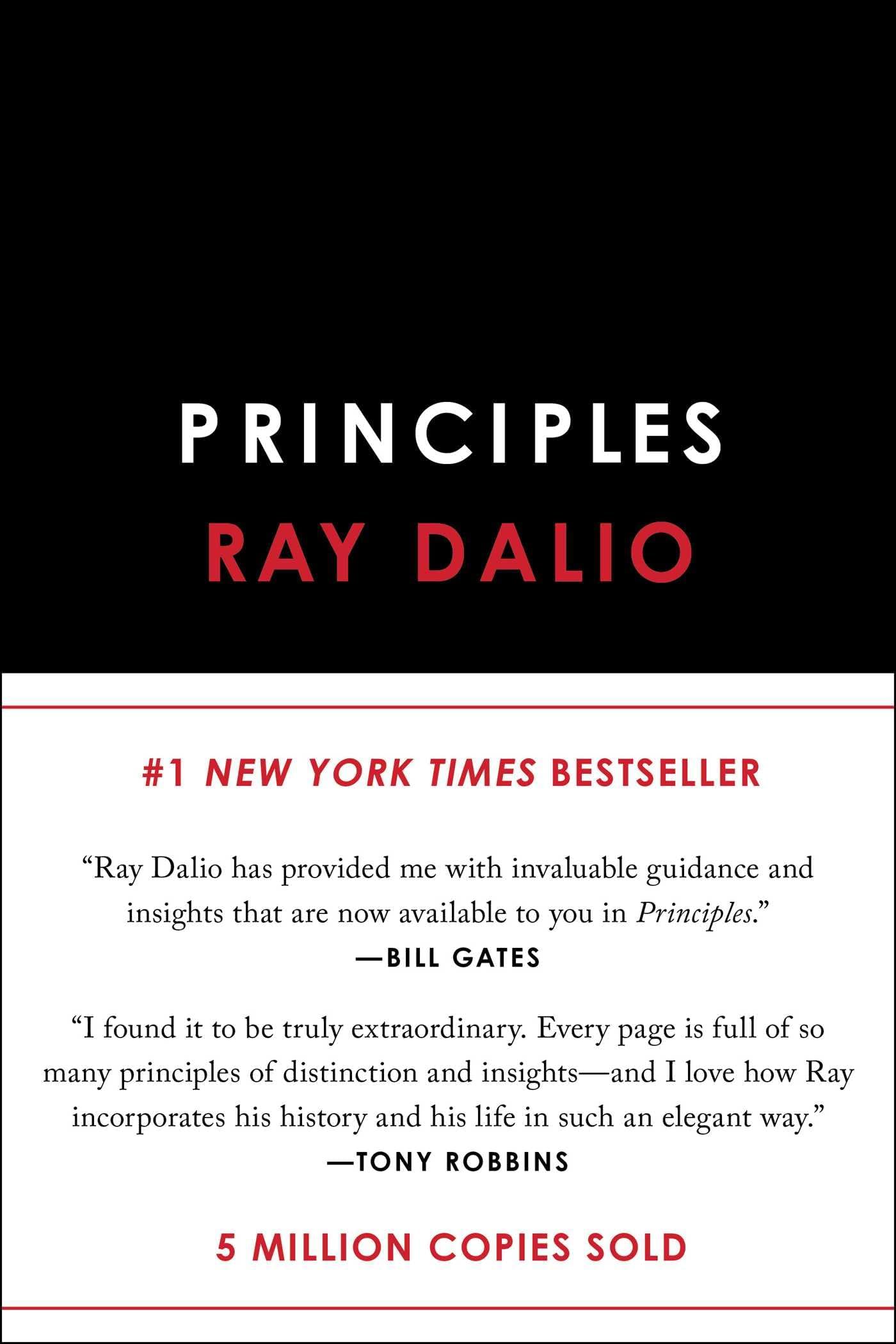
Principles: Life and Work
Product ID: 46553752
📈Top #10 Investing Guide
📚19K+ 4.6★ Reviews
🧠Actionable Life & Work Principles
Buy anything from 5,000+ international stores. One checkout price. No surprise fees. Join 2M+ shoppers on Desertcart.
Desertcart purchases this item on your behalf and handles shipping, customs, and support to Iceland.
📘 Elevate your mindset, lead with principles, and never miss the success wave!
Principles: Life and Work by Ray Dalio is a bestselling guide blending personal anecdotes with actionable strategies, ranked top #10 in Investing and boasting over 19,000 glowing reviews. This book offers a clear, practical framework for mastering decision-making, leadership, and personal growth, making it an essential read for ambitious professionals seeking to thrive in business and life.


| Best Sellers Rank | #2,425 in Books ( See Top 100 in Books ) #9 in Introduction to Investing #22 in Leadership & Motivation #28 in Business Management (Books) |
| Customer Reviews | 4.6 out of 5 stars 19,212 Reviews |
A**K
Ray Dalio’s Principles: A Radically Truthful Review
Spending $26.95 to pick Ray Dalio’s brain for over 16 hours listening to the audiobook appears fantastic value to me. The thought crossed my mind to offer Mr. Dalio a charity donation in his name if he gave me the opportunity to make it a two-way conversation over lunch. But that wouldn’t have been consistent with his (or my) Principles. Instead, I’m offering my radically truthful review for $0. The challenge for Mr. Dalio is whether reading this review will be time well spent. Ray, you do not know my ‘believability’ – and that is a key deficiency in your principles you might want to address, especially when applied to the next phase in your life. Let me expand. Principles details an organically grown set of rules to run a business. Ray shows how his principles have enabled him to build the world’s largest hedge fund and stipulates that anyone can build a great organization following his rules. His success speaks for itself - he is the first to point out that anyone should adopt their own principles. The common theme is a deeply rooted belief that running a business is similar to managing a professional sports team- taking this to an extreme, which Ray does, creates stimulating food for thought. Ray’s definition of “principles” is not what many might expect. Principles go beyond a Rotarian Four-Way Test; they go beyond the Ten Commandments. Principles is more like a Harvard MBA class in waiting (he loves case studies, refers to them as case law), they are an assortment created by someone who, in his own assessment, is an engineer at heart. Engineers get things done, even if messy at first, trial and error is a virtue. I’m married to an engineer and have learned to appreciate this approach. In contrast, I’m a computer scientist. Computer scientists like to generalize problems even if the sample size is one; they like models and abstraction. The approaches are similar, yet distinct: engineers may get to market faster, but there’s a risk that things get too convoluted, too complicated once the complexity increases (you propose an app to wade through the ‘pile of principles’). The computer scientist might never make it beyond the modeling stage, too worried about that potential bug. My hunch is that without their benevolent despot, at some point, newly introduced principles (or old ones re-interpreted) will clog the machine. At that point it might be time to call on a computer scientist to help unclutter things. That said, who am I to criticize Ray’s principles? In fact, this isn’t meant as criticism, just a forecast. Any approach to managing a business will have potential pitfalls, being aware of those pitfalls will help stakeholders navigate them. To appreciate Principles, a passion for investing is helpful, if only because of the industry lingo used. At first, I thought it’s a pity that this might limit his audience. But, no, it makes Principles authentic. Instead, I look forward to also reading books of other thought leaders passionate about their field with a completely different mindset. Since investments are the topic of discussion at various times, let me shout out a big thank you to Ray, as he sheds light on what I believe is one of the biggest misconceptions in the community, notably also amongst hedge fund managers. Many have heard hedge fund managers tend to look for trades that have little downside, but much upside. A lot of investors, notably hedge fund managers, take that too literally, as they pursue options strategies. Buying an option costs fairly little (the premium), but offers potential upside that may be much greater. The problem with options is that they have what’s called time decay, notably that your option may expire worthless. In an era of low volatility, lots of options expire worthless. Options may also be used as insurance; but that, too, can be costly. Don’t get me wrong: there are worthwhile options strategies, but they are not the holy grail of low risk / high reward. Principles does not go into detail of how options work, but has an explainer of diversification. It is generally understood that diversification is the one free lunch available on Wall Street. Ray points out the obvious, notably that stocks are highly correlated with one another, so investors should consider uncorrelated return streams. At Bridgewater, he says, they combine as many as 15 different return streams from different asset classes; I challenge any reader to name just a few, let alone use multiple in their actual investments. Importantly, he argues, the way one achieves high potential upside with limited downside is by combining uncorrelated return streams. That’s very different from buying options (an options strategy may or may not be part of these return streams, but that’s a subordinate issue) in hopes of striking gold. Yes, Ray discusses gold, too; get a copy of the book to learn more. Before I go much further in reviewing Principles, it may be helpful to review Ray’s agenda in publishing the book, as it helps to understand what this book is and what it is not. When I heard Ray as a guest on public radio last week, the cynic in me flagged this must be a symptom of a market top. But I recalled he had also given a “TED Talk”, so I was curious enough to question my gut reaction, leading to my downloading and listening to the audiobook of Principles. Ray is straightforward about his agenda: he considers his principles part of his legacy, wants to pass on the institutional knowledge he has helped build. In publishing the book, he also wants to have bright talent consider working for Bridgewater, as his firm had received bad media coverage about cult-like culture that apparently hampered its recruiting efforts. Ray makes it clear that his firm is the exact opposite of a cult. I agree, but read and judge for yourself. While his book should be cherished by any aspiring entrepreneur, it is not squarely aimed at those running a small business. Sure, the book makes it clear that anyone following his principles can build a great organization, but at various sections in the book it becomes clear he is focused on running a large organization. I have no problem with that, but it helps to understand the context as to why he wrote the book. Ray says successful entrepreneurs tend to be “shapers”, that is persons who can see the big picture, yet pay attention to detail (think Steve Jobs). His style should resonate well as what he profiles as the archetypical small business person: anyone running a small business has big dreams, yet takes care of the details. In fact, I can’t help but contemplate that maybe Ray is a small business person himself, of sorts. One who has managed to grow a big organization by using his principles for many management details – the “machine” as he calls it. The context is relevant though, as everyone, including Ray, is hostage of his environment. Ray makes a convincing case that meritocracy is key to success; that is, decisions are best made based on believability-weighted decisions. He then goes to great lengths to explain the “machine” he has built to develop profiles of his staff. He has run his firm like a petri dish in a closed environment. He argues that, with limited time, it isn’t worthwhile, even potentially hazardous, to listen to unqualified opinions. That approach has worked for him as he has the resources to run his social experiment in-house. But is this the most efficient way? Is it most efficient to grow your talent, weed out a third that’s not up to the task, impose radical transparency and radical truthfulness on them, even if that’s not their nature? It may well be, but there’s a risk standards slip once the benevolent despot is out of the picture, no matter how big the pile of principles is. While I have never called it such, I have applied radical transparency to running my investment business. Unlike most in the industry, for the past fifteen years, I have shared my views and positions with the general public. What do I get in return? Feedback. We have learned to filter that feedback into our idea generation engine, and to stress test our hypotheses. I have most appreciated that as I could not have possibly obtained that feedback with the limited resources I have in managing my comparatively small team. Ray may have brilliant experts in-house, but he is missing out on the brilliance out there. He scoffs at the public’s input in his book; after all, the mob does not have your optimal investment performance in mind. I beg to differ: just as one can develop models to rate the believability of your team, you can develop models to rate the believability of the public or any subset of the public, including those of specific strangers. Take Twitter as the simplest example: everyone can broadcast anything on Twitter, but you can curate who you want to listen to. Folks offer their analysis for free, you might as well harvest the value, separating quality from noise. Like many asset managers, we get visits by strategists of major financial institutions. They provide thoughtful insight. But the so-called strategist at major institutions are not allowed to put their money where their mouth is. While I appreciate their input, it is very different from that of an employee who has his or her own sets of conflicts; and that is yet again very different from the feedback provided by a complete stranger. And while many investment professionals ridicule retail investors, I have learned to appreciate them. We have some public products, so I can see the flows; there are some pretty smart cookies amongst retail investors. What I’m getting at is that Bridgewater – to just name Ray’s firm as an example – may at some point need to turn outward. And with that, I don’t mean it has to be unleashing Big Data indiscriminately (Ray provides criticism I agree with). But I believe the successful machine of the future may well include an assessment of the public. Are the principles flexible enough, can they evolve? I’m not telling you anything you don’t know already, as it is increasingly pervasive in a variety of industries, most notably online advertising. In my humble opinion, it will be crucial for Ray’s next ambition: to help policy makers navigate tough decisions. You are not going to get members of Congress to adhere to the rigors of your meritocracy, yet it would be a pity to just disregard what you have created. So build a system that’s open. Build the machine that helps policy makers make the right decision based on merits. Incidentally, a machine that helps policy makers by sourcing input from the public, amongst others, could also be of use to Bridgewater. One more note on your big-business-mindset, Ray: you argue that a janitor should be an in-house employee, as it is more cost effective as long as the person is full-time. Can it be that you are biased? Can it be that you love building machines so much, so that you in-source the janitor simply to prove your point? Good for you. And, clearly, it was not your goal to write the how-to-book for the smalltime entrepreneur. For anyone but big business, I allege that outsourcing non-core functions can be most effective. Indeed, in today’s world, it is so much easier to start a business because you can outsource so much. The culture in a janitorial firm is different from that in an investment firm; I would also think the typical employee on the investment side at Bridgewater is going to be more open to meritocracy than your janitorial division. If you have read my ‘review’ all the way to this point, let me provide a business idea for the new phase in your life, if you haven’t done it already: hold periodic auctions for a charitable cause – open to the public - for discussions over lunch. Especially in the aftermath of the publicity you generate in promoting your book, you should be able to raise a fair amount to satiate hungry minds that want to discuss Principles with you. Finally, one criticism: get off your butt, start doing exercise and don’t merely talk about the 2nd order benefits. Your family will have you around longer if you invest in your physical wellbeing. Ray: if you’d like me to expand on the above or help in building that open machine, give me a call.
S**N
An enlightening window into an accomplished mind
Ray Dalio became famous through founding and building his company Bridgewater Associates into an economic powerhouse over decades. Of course, many became interested in how he did it. This book narrates his personal story, but it does more. He ran his company through a series of principles as if it were a machine he and his associates built. This book also chronicles those principles at length to communicate Dalio's and Bridgewater's vision of how a good company operates. The foundation for Dalio's principles lie in "meaningful work and meaningful relationships." Interestingly for an investment firm, money is merely an instrument towards those ends. Of course, he is realistic about the challenges of running a company, but he claims to be value-based and demonstrates that ethic through his philosophies. To extrapolate from that foundation, he uses "radical truth and radical transparency" to build an "idea meritocracy." He pusshes good ideas to rise to the front, regardless of an employee's rank. He hopes to avoid an autocracy or democracy in the decision-making process. Instead of making only those in power feel good or having everyone vote about what feels good, he wants to place maximal pressure on producing profitable ideas that help people. Through the principles or company rules, he illustrates how he's not afraid of aggressively pursuing those ends even when it hurts or creates conflict. This book offers a contrast to an ego-driven pursuit of power. It shows how to run an organization that makes maximal use of smart people's ideas. Not everyone wants to run a company, but most motivated folks want to use their hard-wrought talents towards noble ends. Managers and organizational leaders who want to help people - and help others help people - while earning a profit should pay attention.
I**N
“My painful mistakes shifted me from having a perspective of ‘I ...
Whatever success I’ve had in life has had more to do with my knowing how to deal with my not knowing, than anything I know,” says Ray Dalio. To put the author in perspective: his company was rated by Fortune magazine as the 5th most important private company in the U.S. Dalio himself, was rated by Time magazine as one of the 100 most influential people in the world. Forbes rates him as the 100th wealthiest person in the world. The book opens with an introduction to the man and his company, Bridgewater Associates, a US head-quartered, investment management firm. The firm consults to institutional clients such as pension funds, endowments, foundations, governments, and central banks. What makes this company worth knowing about, and this book worth reading, is the way the company is run. The title comes from Dalio’s view that principles - fundamental truths that are the foundations for behaviour - will help you achieve what you want in your life and business - again and again. The first part, a description of the vicissitudes in the fortunes of Bridgewater is a case study. “I learned my principles over a lifetime of making a lot of mistakes and spending a lot of time reflecting on them.” Dalio’s mistakes included one that forced him to reduce his company to one person – himself, and borrowing money to pay his living costs. “My painful mistakes shifted me from having a perspective of ‘I know I’m right’ to having one of ‘How do I know I’m right?’” This led him to the conclusion that it would be invaluable to reflect on decisions one makes, and then to write out the decision-making criteria. The result is being able to systematize your decision-making rather than having to relearn from recurring mistakes, again and again. Dalio built his company on humility, open-mindedness and systematized, principle-based decisions. The brilliant trader and investor Bernard Baruch explained: “If you are ready to give up everything else and study the whole history and background of the market and all principal companies whose stocks are on the board as carefully as a medical student studies anatomy—if you can do all that and in addition you have the cool nerves of a gambler, the sixth sense of a clairvoyant and the courage of a lion, you have a ghost of a chance.” So, what are the principles that allow one to advise successfully in this complex arena? It starts with finding the smartest people who disagreed with you, and to try and understand their reasoning. This is 180 degrees from how almost all corporations operate. Their fundamental principle is consensus in a hierarchy of authority, where you succeed by knowing your place in the hierarchy, and having respect for your superiors. Bridgewater is an idea-meritocracy – a company designed (the critical point) to ensure that the best idea wins. To turn any company into an idea-meritocracy requires that you only employ people who want to be part of a mission (e.g. we sell well-priced fruit to those on a tight budget; we give the soundest advice to our clients, etc.) and not those who work for a paycheck. Good people are not perfect people. Rather they learn from mistakes, record them so they can be learned from, and move on. “If a mistake happened and you logged it, you were okay. If you didn’t log it, you would be in deep trouble.” The error log was Bridgewater’s first management tool. In an idea-meritocracy people put their honest thoughts on the table. There is thoughtful disagreement, and people are willing to shift their opinions as they learn. There are agreed-upon ways of deciding so that the people can move beyond them without resentments. People cannot participate in the company productively if they didn’t know everything that is going on. Without the principle of transparency problems would be hidden instead of being resolved. To have a real idea-meritocracy, there must be transparency so that people can see things for themselves. Why bother with this approach, which is VERY difficult to implement, and will require years of diligent minding to embed? The answer will be clear if you answer these questions posed by Dalio. Would you prefer to have a company in which people are truthful and transparent, or one in which most people keep their real thoughts hidden? Would you prefer to have a company where problems, mistakes, weaknesses, and disagreements are brought to the surface and thoughtfully discussed, or where they are suppressed? Would you prefer a company in which the right to criticize is non-hierarchical, or one in which you don’t criticize upward – publicly? Is the effort and discomfort worth it? The most compelling reason to change the way a business operates, is to look at the financial benefits. Here is what the idea-meritocracy did for Bridgewater. In 2008 their flagship fund made over 14% in an awful year when many other investors recorded losses of more than 30%. In an economy still reeling, their returns were nearly 45% and 28% for their two ‘Pure Alpha’ funds, and 18% for their ‘All Weather’ fund. Need I say more. Readability Light ---+ Serious Insights High +--- Low Practical High +---- Low *Ian Mann of Gateways consults internationally on leadership and strategy, and is the author of the recently released ‘Executive Update.
J**D
A Masterclass in Thinking Clearly and Living Intentionally
⭐️⭐️⭐️⭐️⭐️ A Masterclass in Thinking Clearly and Living Intentionally Principles: Life and Work Review — Ray Dalio’s Blueprint for Better Decisions Principles: Life and Work by Ray Dalio is one of the most impactful books on decision-making, leadership, and personal growth that I’ve ever read. Rather than presenting generic motivational advice, the book offers a rigorous, honest framework for thinking. Dalio shares the principles he developed while building one of the world’s most successful hedge funds, but the lessons extend far beyond finance. The real power is how he translates complex ideas into actionable mental models for self-awareness, teamwork, radical transparency, and better problem-solving. The book is divided into two halves — Life and Work — and both deliver value. The Life section shines for helping readers understand their own psychology, biases, weaknesses, and blind spots. The Work section reads like a practical playbook for leaders, offering structures that improve hiring, performance reviews, conflict resolution, meetings, culture, and organizational trust. What stayed with me most: The importance of embracing reality, not avoiding it The skill of turning mistakes into iterated improvement loops The idea that meaningful progress starts with radical honesty The confidence that systems > guesswork when making decisions It challenges you — respectfully and relentlessly. You don’t just read the principles, you start noticing them in your own thinking, conversations, and daily choices. 📘 Best for: Self-improvement readers who want logic, not fluff Leaders building or managing teams Anyone who wants better decision-making frameworks People interested in psychology, business, and strategic thinking 👍 Pros: ✔ Deep, structured insights you can actually apply ✔ Blends personal psychology with team and business operations ✔ Encourages confident, reality-based thinking ✔ Great for both individuals and leaders ✔ Concepts stick and scale across industries ✔ Challenges assumptions productively ⚠ Cons / Tips: • It’s dense and comprehensive, not a fast snack read — take notes for maximum value. • Some principles may feel confronting at first — that’s part of the growth arc. Bottom line: This book doesn’t just inform — it upgrades the way you think. If you want a powerful, structured, real-world guide to understanding yourself and leading teams better, Principles: Life and Work earns 5 stars without hesitation. One of those books you’ll revisit again and again. 📘🧠💼🔥✅👏
R**E
What's missing from the interviews, headlines, story lines, and universal coverage of Dalio’s every move is his true generosity.
"Principles" is a tome of tried and true methods that lead ultimately to desired outcomes. Mr. Dalio transcribes in precise detail his thoughts, actions, intentions, and experiences over the past four decades and liberally shares his knowledge to readers. "Principles" is worth its weight in gold. Ray Dalio eloquently expresses what most successful people learn over time: pain is the ingredient that leads to growth and evolution. He opines on how pain itself is a catalyst not only to personal evolution, but it is a gateway to problem solving. Dalio attacks problem solving by sorting out the issue, triangulating the issue with "believable people" and examining it both up close and as an observer. His above the fray manner in observing ones actions, skills, efforts, deficiencies, and the like, is at the next level; it is a better way. This observation discipline is sure to enable human beings to examine themselves thoroughly, objectively and more accurately. Mr. Dalio's actions speak volumes of his vision by implementing this higher realm of open-minded personal self-examination throughout the Bridgewater organization. "Principles" is a life map. Mr. Dalio expresses the need for tools and protocols in order to make better decisions. "Principles" is such a tool; it is also a weapon to survive and flourish. I believe that anyone who studies and implements these principles will reap the benefits. Dalio has been painstaking about getting it right, which is a testimony to his determination and grit. I could go on endlessly discussing the contents and merits of this book. "Principles" is a must read for business owners, senior managers, executives, and money managers. "Principles" is written in such a manner that Dalio's message is understandable to anyone. The book is a treasure trove of information that I will reread, look to, study, digest, and implement. Lastly, Mr. Dalio's financial achievements and philanthropy are well documented. What's missing from the interviews, headlines, story lines, and universal coverage of Dalio’s every move is his true generosity. Ray's effort to convey his success formula to money managers, such as myself, and society at large is magnanimous. Mr. Dalio, I have written a book titled "Financial Fitness: The Journey from Wall Street to Badwater 135" that is on Amazon and will be rolled out officially in two weeks. In the book I share the road I've taken to becoming financially and physically fit as a hardworking investment professional and endurance athlete. I hope you will read my book, as I have yours. --William "Chip" Corley
B**S
I am generally pretty skeptical of this book's subject matter
I am generally pretty skeptical of this book's subject matter, as I find most such "self-help" style books to be full of fluff and obviousness without much real insight. This is different. Ray starts out by explaining his background, and although this section was interesting to me, could probably be skipped - especially if you have no interest in finance. The real meat of the book is the section on "Life Principles" which spells out a set of structured principles for getting the most out of life and achieving your goals. Some strong themes of the book that stuck with me: * Focusing on determining what *is* true (opposed to what you *want* to be true), and open disagreement in sole pursuit of this * Radical open-mindedness, staying humble and always asking, "How am I sure I'm not the one who is wrong?" * Radical transparency * Biological evolution as a metaphor applied to progressing as an organization and as an individual * Higher-level thinking - looking down from above at the decision landscape * Believability-weighted decision-making. Not everyone is equally credible. * Calm reason over frantic emotion * Process over circumstance: design rules for the machine and let it run Although not a book about cognitive psychology, the author clearly has some substantial understanding of it (evidenced especially by his neuroanatomy discussion in "Understand That People Are Wired Very Differently" chapter), as many of these themes dovetail nicely with modern cognitive psychology: * Our brains did not evolve for truth-seeking (bias to be overcome by explicitly seeking what is true over what you want to be true) * Our brains evolved to be overly tribal (bias to be overcome by being "radically open-minded") * Individuals show more variance in cognitive traits & styles than many want to believe. Dalio says to accept and learn from this. * System 1 vs. System 2 thinking and being constantly aware of the difference, ala "Thinking Fast and Slow" The book is organized very well, in the form of three levels of principles, with the top level effectively forming chapter titles. There is a ton of substance here - page after page of practical advice. Very little did I find myself skimming or getting bored. The third section is "Work Principles" which apply more to a workplace environment, particularly as a manager. As this doesn't apply to me as much, I approached this with some skimming, though I can see this as being quite valuable for many people. I'm sure the extreme success of Bridgewater (from broke in 1982 to world's largest hedge fund now) is in no small part a result of the careful and thoughtful principles its founder established. I'm grateful Dalio took the time to write this book - often the people most poised to give the best advice inherently aren't exactly motivated to endure the drudgery of book-writing, especially with vast wealth at-hand. This is a worthwhile read for anyone.
A**R
Spectacular views
I received this book as a gift then gifted a separate copy to my father. In my opinion, one of the best business concepts and motivating book I’ve ever had the opportunity to share with others. The emotionally intelligent realistic dialogue in hands down is as refreshing as a clear mountain lake.
B**E
Ray Dalio's principles of life and work - Good at times
It is hard to review Principles by Ray Dalio. At times, the book is exceptional and it is definitively a wonderful insight in the mind of Ray Dalio. Other times, it felt repetitive, arrogant, and simplistic. This, while reading the book, let my mood/opinion shift constantly from "this is the best book ever" to "this is a piece of crap." Eventually, I wouldn't recommend it to anyone but for anyone interested, it is probably worth the read. The book consists of 3 parts, (1) Where I'm coming from, (2) Life principle, and (3) Work principles. The book is auto-biographic. Part 1 is purely just the story of Ray, where he came from and what he has done in life. This also forms the basis for part 2 and 3 which will refer back to Ray's life and work at Bridgewater, the company that Way has founded. Part 2 and 3 are structured around Ray's principles, which is a way he has documented his life and work learnings. The life principles part is one large chapter whereas the work principles is split into 3 large chapters. Each of the chapters consists of a few principles and these are decomposed into sub-principles and each of the sub-principles is clarified. For example, principle 9 is "constantly train, test, evaluate, and sort people" which has the sub-principle 9.6 "Make the process of learning what someone is like open, evolutionary, and iterative". This sub-principle is then clarified in about 6 pages, each consisting again of sub-sub-principles such as 9.6c "look at the whole picture". In the middle of the book there is a summary of all the principles, sub-principles, and sub-sub-principles. The book describes Ray's life and the organization and culture at Bridgewater. A key theme in the book is "radical transparency" through which the best ideas will 'win.' These were definitively the interesting parts of the book. But then it uses 'machine' as the analogy of organizations and people as parts of the machine which is where I liked the book less. I especially felt uncomfortable with the personality screening parts and they very much gave me the impression that people are looked at through how they are now rather than their potential. But, I guess that has worked for Ray Dalio and Bridgewater... they weren't the principles that I would be comfortable with. So, conclusion? If you are interested, worth reading. At times, excellent. Doubted vert much between 3 and 4 stars and decided to stick with 3. A good read.
C**A
Best management book I ever read
Well if you are a manager there are a lot of situations that leave you doubtful if you made the right decision or not. Given Ray’s principles it helped me a lot in actually realizing what is correct and not in my management style. There are so many good chapters and principles but one standing out for me was: create a farm team - the group pf people assessed to be as stand by in case one of the people in the key roles happens to be out in a form or another. I have seen this situation crippling organizations throughout time and its so easy to do, you just need some pragmatism and clear objectives. Also create clear structure clear direct lines of reporting - i know its already known but the way Ray explains it ... its just brilliant. Also the take on conflict resolution and the necessity of disagreement - simply brilliant.
R**I
Nice Book. Nice Packing
The book is fresh and the package was excellant. Delivery was quick and on time.
F**H
DEĞERLİ BİR KİTAP
Sorunsuz ve hızlı bir şekilde teslim edildi. Heycanla elimdeki kitabını bitirip bunu başlamaya bekliyorum.. Satın alanlara şimdiden iyi okumalar dilerim..
S**.
Excelent product.
Great Booker, full of wisdom.
G**A
El mejor libro de los últimos 10 años
No recuerdo que un libro me haya impactado tanto como este desde que leyera el Good to Great de Jim Collins. Roy Dalio te revuelca una y otra vez haciéndote pensar con su propia experiencia, y llega a una conclusión vital: si quieres tener relaciones significativas y hacer cosas de impacto, es esencial que seas transparente y abierto de mente. Me ha ayudado mucho esta reflexión. Todos nos protegemos ante la posibilidad de que otros conozcan nuestras debilidades. O no deciomos la verdad de lo que pensamos por miedo. Este libro me ha proporcionado una guía: di lo que piensas y trabaja con otrss personas para llegar a una verdad operativa.
Trustpilot
1 month ago
1 day ago