We remain fully operational. Our teams are working around the clock to ensure your deliveries continue safely.

DOWNLOAD THE APP


Copyright © 2025 Desertcart Holdings Limited
DOWNLOAD THE APP
Buy anything from 5,000+ international stores. One checkout price. No surprise fees. Join 2M+ shoppers on Desertcart.
Desertcart purchases this item on your behalf and handles shipping, customs, and support to Iceland.
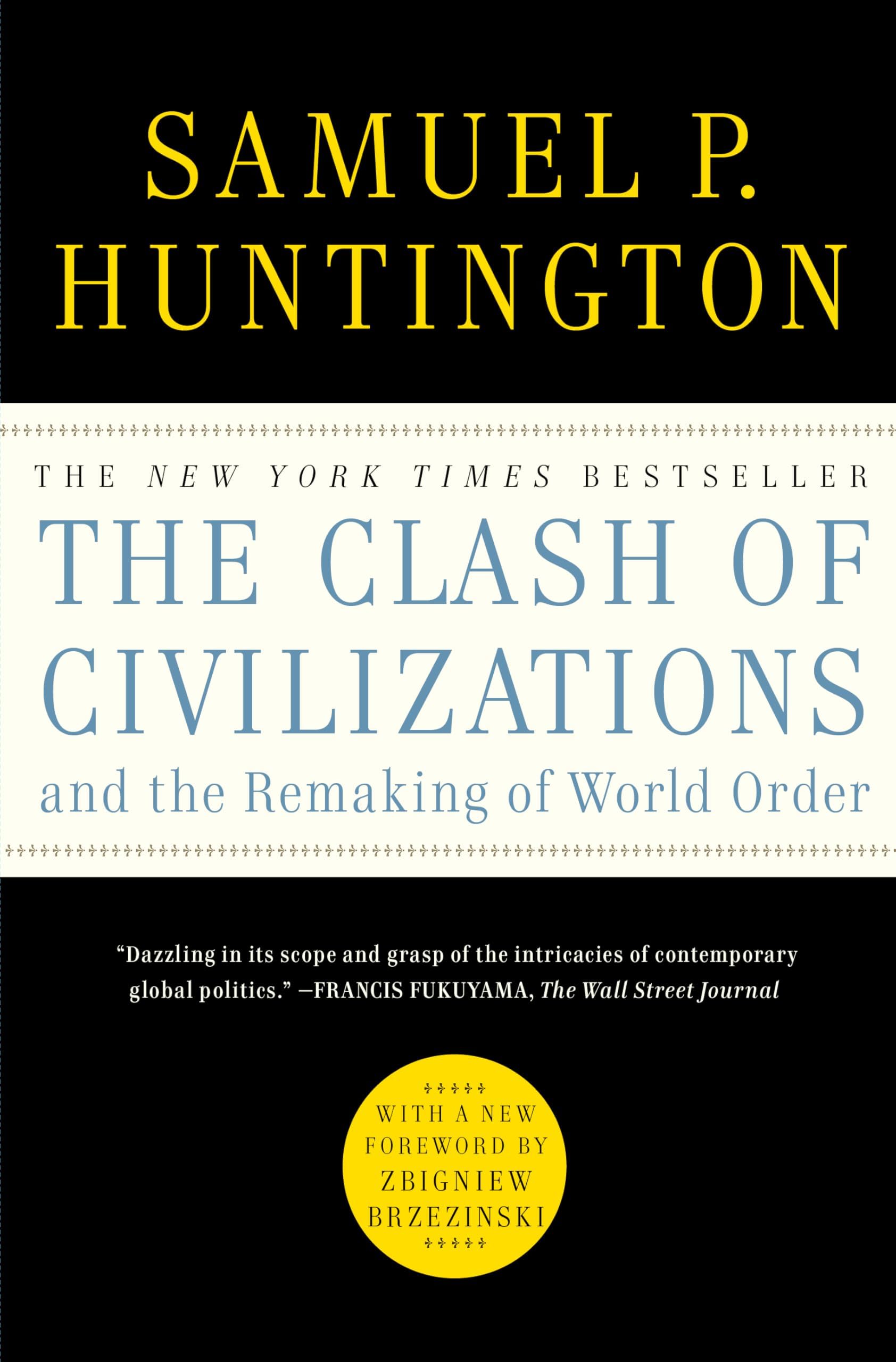
Buy Simon & Schuster The Clash of Civilizations and the Remaking of World Order by Huntington, Albert J Weatherhead III University Professor Samuel P online on desertcart.ae at best prices. ✓ Fast and free shipping ✓ free returns ✓ cash on delivery available on eligible purchase. Review: Reading this book has influenced the way I look at world politics and also my own personal view of `self`. It is perhaps easy to be imbued with the culture of one`s own civilization - I speak as a Westerner - and to regard your world view as irrevocable. `Clash of Civilizations` has modified my world view. I feel I now understand a little more what it may be like to see the world from a Chinese or a Russian perspective. I did not find this a particularly easy read. It is dense and will no doubt populate the book shelves of political academics. It is also a bit dated now - written in 1996 and a lot has happened since then. But it concerns more the mechanisms and machinations of global politics as well as the history of some of the more significant conflicts and so remains relevant. This clash of civilizations might be abstracted into a world of tectonic collision - a morphing map of dominions, dancing a sarabande of evolving allegiances and political manoeuvres to fuse new and ideally mutually beneficial relationships with one another. Review: Reading this 1996 publication after 9/11/2001, the onset of the War on Terror and the US experiment in "regime change" and "nation building," one cannot but be amazed at the accuracy of its prognostication and the degree to which its advice was not heeded. The basic thesis of the book is that it is impossible to impose Western political, religious and cultural values on non-Western countries. A most astonishing proof of this thesis is the first Gulf War of 1990, waged by the United States against Iraq. To Western eyes it was an entirely just war, backed up by a coalition of Arab states, which succeeded in stopping Saddam Hussein from invading a weaker sovereign state, Kuwait. But, as Huntington shows, it was roundly condemned by public opinion in the Middle East as an imperialist intervention in domestic affairs, a threatening show of military force and a war of the West against all Arabs and all Muslims. The good war, even altruistic war, backfired. Undertaken to protect the life and property of an Arab state, it provoked fear and hatred in the Arab world and empowered the defeated aggressor, whose prestige gained in neighboring states. On the basis of such examples, Huntington draws the painful conclusion that we (as Westerners) cannot universalize rights and principles that we hold dear and apply them to other peoples, governments and states that do not observe them. To do so, he warns, is false, immoral and dangerous. He asserts toward the close of his book: "Western intervention in the affairs of other civilizations is probably the single most dangerous source of instability and potential global conflict in a multicivilizational world." He advances an "abstention rule": that core states of one civilization abstain from intervening in the conflicts of other civilizations. He proposes that a constant seeking for common values, practices and institutions among different peoples, states and civilizations is the key to peace and world order in the realignment of nations taking place after the end of the Cold War. THE CLASH OF CIVILIZATIONS was a bestselling book that was widely discussed and debated throughout America--in the popular media, in the halls of academe and in the chambers of government. Henry Kissinger endorsed it. Zbigniew Brzezinski called it revolutionary. Presumably every reader of FOREIGN AFFAIRS, where Huntington's initial statement was published, studied the book. This means all the world analysts in the Department of State, the Department of Defense and the Cabinet. It is hard to imagine another publication that had a greater chance of influencing US foreign policy. And yet, as the US prepared to go to war for a second time against Iraq, then went to war and got stuck, every single argument, proof and piece of advice packed into its nearly 400 pages was forgotten or ignored. All that was left was a catch-phrase, "clash of civilizations," which was denied and almost always misused. Contrary to one of the reviews on this page, there is nothing simplistic about this book. The concepts of "civilization," "core state" and "fault-line war" are put forward with precise definitions, reasoned exposition and pertinent historical examples buttressed by statistical data and a full scholarly apparatus. Balkan politics are discussed in exacting detail, Chinese and Central Asian politics as well. Islamic militancy is examined with unflinching objectivity. Distinctions are drawn between domestic multiculturalism and foreign universalism which are hairsplitting, but crucial. The writing abounds in classifications and qualifications; often tedious, but often capped with a memorable maxim: "The great beneficiaries of the war of civilizations are those civilizations who abstained from it." For me, the discussions of post-Soviet Russia and Eastern Europe are most instructive: "People could no longer identify as Communists, Soviet citizens or Yugoslavs, and desperately needed to find new identities. They found them in the old standbys of ethnicity and religion. The repressive but peaceful order of states committed to the proposition that there is no god was replaced by the violence of people committed to different gods." The presentation of civilizational alignments in the Afghan war of 1979-1989, the Tadzhikistan war of 1992 and the Chechen wars beginning in 1994 provides the background for ongoing conflicts today. The analysis of Sino-Russian politics and prospects brings us right up to the moment. The failure of this book to prevent the very thing it warned against is very troubling and raises questions about the real impact of public discourse today. No doubt it is too much to ask power-mongers to re-read it, but for us mere mortals it is essential. We may not be able to change the world, but we at least want to understand it.
| Best Sellers Rank | #47,361 in Books ( See Top 100 in Books ) #154 in Political Ideologies & Doctrines #175 in Political Science #359 in Specific Topics in Politics & Government |
| Customer reviews | 4.6 4.6 out of 5 stars (1,251) |
| Dimensions | 15.54 x 2.34 x 23.5 cm |
| Edition | Illustrated |
| ISBN-10 | 1451628978 |
| ISBN-13 | 978-1451628975 |
| Item weight | 408 g |
| Language | English |
| Print length | 368 pages |
| Publication date | 2 August 2011 |
| Publisher | Simon & Schuster |
H**L
Reading this book has influenced the way I look at world politics and also my own personal view of `self`. It is perhaps easy to be imbued with the culture of one`s own civilization - I speak as a Westerner - and to regard your world view as irrevocable. `Clash of Civilizations` has modified my world view. I feel I now understand a little more what it may be like to see the world from a Chinese or a Russian perspective. I did not find this a particularly easy read. It is dense and will no doubt populate the book shelves of political academics. It is also a bit dated now - written in 1996 and a lot has happened since then. But it concerns more the mechanisms and machinations of global politics as well as the history of some of the more significant conflicts and so remains relevant. This clash of civilizations might be abstracted into a world of tectonic collision - a morphing map of dominions, dancing a sarabande of evolving allegiances and political manoeuvres to fuse new and ideally mutually beneficial relationships with one another.
G**N
Reading this 1996 publication after 9/11/2001, the onset of the War on Terror and the US experiment in "regime change" and "nation building," one cannot but be amazed at the accuracy of its prognostication and the degree to which its advice was not heeded. The basic thesis of the book is that it is impossible to impose Western political, religious and cultural values on non-Western countries. A most astonishing proof of this thesis is the first Gulf War of 1990, waged by the United States against Iraq. To Western eyes it was an entirely just war, backed up by a coalition of Arab states, which succeeded in stopping Saddam Hussein from invading a weaker sovereign state, Kuwait. But, as Huntington shows, it was roundly condemned by public opinion in the Middle East as an imperialist intervention in domestic affairs, a threatening show of military force and a war of the West against all Arabs and all Muslims. The good war, even altruistic war, backfired. Undertaken to protect the life and property of an Arab state, it provoked fear and hatred in the Arab world and empowered the defeated aggressor, whose prestige gained in neighboring states. On the basis of such examples, Huntington draws the painful conclusion that we (as Westerners) cannot universalize rights and principles that we hold dear and apply them to other peoples, governments and states that do not observe them. To do so, he warns, is false, immoral and dangerous. He asserts toward the close of his book: "Western intervention in the affairs of other civilizations is probably the single most dangerous source of instability and potential global conflict in a multicivilizational world." He advances an "abstention rule": that core states of one civilization abstain from intervening in the conflicts of other civilizations. He proposes that a constant seeking for common values, practices and institutions among different peoples, states and civilizations is the key to peace and world order in the realignment of nations taking place after the end of the Cold War. THE CLASH OF CIVILIZATIONS was a bestselling book that was widely discussed and debated throughout America--in the popular media, in the halls of academe and in the chambers of government. Henry Kissinger endorsed it. Zbigniew Brzezinski called it revolutionary. Presumably every reader of FOREIGN AFFAIRS, where Huntington's initial statement was published, studied the book. This means all the world analysts in the Department of State, the Department of Defense and the Cabinet. It is hard to imagine another publication that had a greater chance of influencing US foreign policy. And yet, as the US prepared to go to war for a second time against Iraq, then went to war and got stuck, every single argument, proof and piece of advice packed into its nearly 400 pages was forgotten or ignored. All that was left was a catch-phrase, "clash of civilizations," which was denied and almost always misused. Contrary to one of the reviews on this page, there is nothing simplistic about this book. The concepts of "civilization," "core state" and "fault-line war" are put forward with precise definitions, reasoned exposition and pertinent historical examples buttressed by statistical data and a full scholarly apparatus. Balkan politics are discussed in exacting detail, Chinese and Central Asian politics as well. Islamic militancy is examined with unflinching objectivity. Distinctions are drawn between domestic multiculturalism and foreign universalism which are hairsplitting, but crucial. The writing abounds in classifications and qualifications; often tedious, but often capped with a memorable maxim: "The great beneficiaries of the war of civilizations are those civilizations who abstained from it." For me, the discussions of post-Soviet Russia and Eastern Europe are most instructive: "People could no longer identify as Communists, Soviet citizens or Yugoslavs, and desperately needed to find new identities. They found them in the old standbys of ethnicity and religion. The repressive but peaceful order of states committed to the proposition that there is no god was replaced by the violence of people committed to different gods." The presentation of civilizational alignments in the Afghan war of 1979-1989, the Tadzhikistan war of 1992 and the Chechen wars beginning in 1994 provides the background for ongoing conflicts today. The analysis of Sino-Russian politics and prospects brings us right up to the moment. The failure of this book to prevent the very thing it warned against is very troubling and raises questions about the real impact of public discourse today. No doubt it is too much to ask power-mongers to re-read it, but for us mere mortals it is essential. We may not be able to change the world, but we at least want to understand it.
A**8
Scary. A Must read in 2013 . Please sent it to all Présidents of this world. My father asked me to read this book. He had just put down his own copy and called me, saying he could'nt sleep after reading it. Since I value my father opinion, I ordered myself a copy, took a deep breath to read what I though would be a tedious political read. How wrong I was!! It read like a thriller. I could not put it down, and as I read more and more, I realize how important this book is. Even though it was written in the 1990's, it is even more scary to read it now, in light of the latest political crisis. Please someone, make it a higher school mandatory read. Please give a copy to all politicians, and Wake up everybody, for the world as we know it, already does not exist anymore.
B**R
Fast delivery and good quality of book itself
A**R
All that's happening in the world today was predicted in this book. Impressive.
Trustpilot
1 month ago
4 days ago