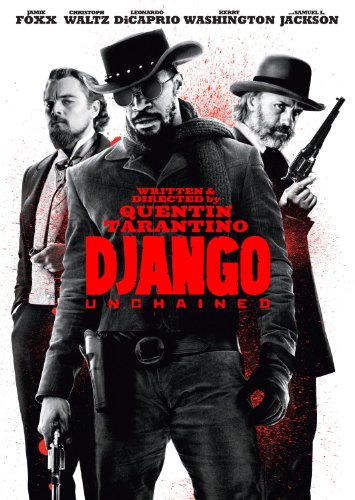

Product Description Set in the South two years before the Civil War, DJANGO UNCHAINED stars Academy Award ®-winner Jamie Foxx as Django, a slave whose brutal history with his former owners lands him face-to-face with a German-born bounty hunter Dr. King Schultz (Academy Award®-winner Christolph Waltz). Schultz is on the trail of the murderous Brittle brothers, and only Django can lead him to his bounty. The unorthodox Schultz acquires Django with a promise to free him upon the capture of the Brittles – dead or alive. Success leads Schultz to free Django, though the two men choose not to go their separate ways. Instead, Schultz seeks out the South’s most wanted criminals with Django by his side. Honing vital hunting skills, Django remains focused on one goal: finding and rescuing Broomhilda (Kerry Washington), the wife he lost to the slave trade long ago. Django and Schultz’s search ultimately leads them to Calvin Candie (Academy Award®-nominee Leonardo DiCaprio), the proprietor of “Candyland,” an infamous plantation. Exploring the compound under false pretenses, Django and Schultz rouse the suspicion of Stephen (Academy Award®-nominee Samuel L. Jackson), Candie’s trusted house slave. Their moves are marked, and a treacherous organization closes in on them. If Django and Schultz are to escape with Broomhilda, they must choose between independence and solidarity, between sacrifice and survival… desertcart.com From the moment Jamie Foxx throws off a filthy, tattered blanket to reveal a richly muscled back crisscrossed with long scars, it's obvious that Django Unchained will be both true to its exploitation roots but also clear-eyed about the misery that's being exploited. Django (Foxx), a slave set free in the years before the Civil War, joins with a German dentist-turned-bounty hunter (the marvelous Christoph Waltz, Inglourious Basterds), who has promised to help Django rescue his wife (Kerry Washington), who's still enslaved to a gleeful and grandiose plantation owner (Leonardo DiCaprio, plainly relishing the opportunity to play an out-and-out villain). What follows is a wild and woolly ride, crammed with all the pleasures one expects from a revenge fantasy written and directed by Quentin Tarantino. Plot-wise, some things happen a little too easily (for example, Django instantly becomes a master gunslinger), but the moral perspective is not glib. For all its lurid violence and jazzy dialogue, this is a still-rare movie that paints slavery for what it was: a brutal, dehumanizing practice that allowed a privileged few to profit from the suffering of many, a practice guaranteed by the gun and the whip. Think of it as the antidote to Gone with the Wind. Tarantino is more heartfelt in Django Unchained than in any of his previous movies--without sacrificing any of the pell-mell action, tension, and delicious language that made Reservoir Dogs, Kill Bill, and Pulp Fiction so very enjoyable. --Bret Fetzer Review: It's a good watch. - I enjoyed the movie for the action and the humor. Review: Very very good - Wonderful movie! Exciting with holds barred

| ASIN | B005LAIIJY |
| Actors | Christoph Waltz, Jamie Foxx, Kerry Washington, Leonardo DiCaprio, Samuel Jackson |
| Aspect Ratio | 2.40:1 |
| Best Sellers Rank | #1,905 in Movies & TV ( See Top 100 in Movies & TV ) #24 in Westerns (Movies & TV) |
| Customer Reviews | 4.8 4.8 out of 5 stars (28,066) |
| Director | Quentin Tarantino |
| Is Discontinued By Manufacturer | No |
| Item model number | 13132597256 |
| Language | Unqualified (Dolby Digital 5.1) |
| MPAA rating | R (Restricted) |
| Media Format | DVD, NTSC |
| Number of discs | 2 |
| Producers | Pilar Savone, Reginald Hudlin, Stacey Sher |
| Product Dimensions | 0.7 x 7.5 x 5.4 inches; 2.08 ounces |
| Release date | April 16, 2013 |
| Run time | 2 hours and 46 minutes |
| Studio | Liosngate Pictures Entertainment |
| Subtitles: | English, Spanish |
M**J
It's a good watch.
I enjoyed the movie for the action and the humor.
C**S
Very very good
Wonderful movie! Exciting with holds barred
A**R
Great movie
A classic!!
A**N
My Django Unchained Review
Quentin Tarantino is one of the greatest director’s working in the movie industry. Django Unchained manages to tell a great story, have a big heart, show the absolute inhumanity and brutality of slavery in pre-civil war United States, be brutally violent, and hysterically funny all at the same time. The combination of all those elements while paying homage to spaghetti westerns and 70′s style film making with Tarantino’s uniquely modern flair is nothing short of amazing. Django Unchained is like the most spectacular house of cards you have ever seen, one slight miscalculation could topple the entire thing but instead it stands strong and is a must see for any movie lover. Django (Jamie Foxx) is a slave in 1858 America. Early on in the film Django crosses paths with Dr. King Schultz (Christoph Waltz). Schultz is an out of practice dentist turned bounty hunter who originally recruits Django’s help for a single job. Schultz makes it clear he despises slavery and quickly forms a bond with Django. Schultz takes an interest in Django’s goal to rescue his wife, Broomhilda (Kerry Washington), who was cruelly separated from him. Django and Schultz spend a winter together hunting bounties and making a good deal of money. Django takes to the bounty hunting trade and gun slinging naturally. Schultz discovers that Broomhilda is being held at an infamously cruel plantation known as Candie-Land under the slaver Calvin Candie (Leonardo DiCaprio). Django Unchained is a fictional story but seems to take place in a very real world. The brutality and widespread of slavery in the early United States is crystal clear all throughout the movie. Every actor in the film does a flawless job of getting the audience up to speed with the general mentality and racial structures in the time period. The abundant racism and cruelty toward the slaves is, at times, almost difficult to watch but it is never overdone or unnecessary. A lot of prejudgements and accusations have been thrown around because of the sensitive material and racist elements. This movie is in no way racist. It tells a story during one of America’s more shameful moments and does so without pulling its punches. The slavery and racist aspect of Django Unchained is also only one aspect of a phenomenal film. On top of the brutal realism and historical aspects is a story about a man willing to do anything for the love of his love. Intertwined to the great, though somewhat unconventional love story, is a fantastic story about two people who could not be anymore different finding common ground and forming a strong friendship. Dress all these elements up with some hilarious moments and amazing action sequences and Tarantino may have produced his best work yet, that’s really saying something. Jamie Foxx plays the titular hero in this Western-action-homage. Soft spoken and closed off for the majority of the movie Foxx plays Django from the inside out. Much of the characters understanding and development is told in his face, and especially his eyes. It is completely believable that Django lived a hard life and the audience never has reason to question the actors commitment to the role. There is never doubt that Django lived through his past traumas or that his blood wasn’t actually boiling during some very tense situations. Foxx is an actor who could have easily made a career out of soft roles and phoned in performances but he is constantly trying new things and succeeding immensely. Christoph Waltz first worked with Tarantino in 2009′s Inglorious Basterds. This was also his introduction to the majority of the Hollywood audience. Waltz absolutely stole the movie and outperformed all of his costars despite being virtually unknown to American audiences and playing the main antagonist. Waltz’s performance is equally impressive in Django, he is quick witted and very funny. Waltz as an actor has an air and charm about him that says he knows something that those around him don’t. He carries scenes effortlessly whether he is merely sitting at a table in dialogue or running a wild west type shoot-out. The dialogue he was given as the Dentist turned Bounty Hunter is perfect and Waltz sells the delivery of every single line, no matter how small it may seem. The only actor who may have out-done him ever so slightly is DiCaprio. DiCaprio has been one of the movie industry’s greatest actors since he was a kid. Constantly blowing away expectations and steering clear of being type cast of thrown into cash-grab quality projects it isn’t a surprise DiCaprio did well. What was surprising is that the actor took the role at all. The role was absolutely a good one but Calvin Candie is a straight up monster. DiCaprio has never played a character so repulsive and evil down to his core. Another complete shock in casting was Samuel L. Jackson as Stephen. Stephen is essentially Candie’s estate manager and top tier slave. The two banter as equals and Stephen seems to hold a power over Candie’s other slaves. Jackson who has proven in the past to be a solid actor lately has been a little lazy in many parts he has played. Choosing to simply play himself in a costume rather than really challenge himself. In Django, Jackson really pulled out all the stops along with the rest of the cast and did something no one has seen him do before. Django is shot so beautifully. In true Western fashion there are plenty of sprawling scenery shots and very nice establishing shots. The camera is never irritating and shots are set up so well that the audience can be totally immersed in the rest of the movie. The most amazing stylistic approach to how this was shot is that despite it being a top quality gorgeous movie it never loses its “Tarantino” flair. Fast zooms, interesting angles, and almost a 70s style feel are applied all throughout the movie in a perfect balance with new film trends and technologies. The soundtrack is equally good and equally as diverse. Music audience’s would expect in a mid 1800s set movie is mixed in with classic rock, easy listening and modern rap. Combining the elements with the flawless sets, props and wardrobes must have been a tough mixture to pull off and Tarantino does it expertly. From sitdown-shutup.net Django Unchained is a movie with a little bit of everything. Quality cinematography, acting, directing and writing all come together to form a perfect historical action movie with a huge heart. This is certainly unlike anything Quentin Tarantino has ever done while still having all the familiarities Tarantino fans have grown to love. It is safe to say this is the director’s best work despite his very impressive resume. Hopefully Django is a sign of more great things to come not only from the director but also from the entire cast. More movies need to be as bold and more actors need to tackle roles they are not as used to being put in. The challenge clearly produces astounding results. It is no question why Django Unchained is a 2012 Best Picture nomination.
G**K
FUNNY! FUNNY! FUNNY! Jamie Foxx does such a great job of acting in this movie.
Hilarious movie. I highly doubt that there is a single American who hasn't already seen this movie for themselves. Why would you even ask someone to review it? It's SO FUNNY!
B**S
Tarantino Sacrifices some Tarantinianity for a Sprawling Adventure
The comedy writer Julius Sharpe said on Twitter the other day that he just wanted to 'thank all the people who reviewed "Star Wars" on Netflix. You guys swayed me, I'll check it out.' He has a point, and it could save us all a whole lot of time. 'Django Unchained' is already a hugely popular movie, and so many, even among those who haven't seen it, are familiar by now with its fairly simple plot. So this time around, I'm only going to point out a few marked ways in which Quentin's seventh film struck me as rather unTarantinian. 'Django', of course, is still very obviously a Tarantino film. But look, for instance, at how the flash-backs are done with quick fades rather than simple cuts, and how they're shot with different filters - 'flash-back' filters. This drains them of most of the immediacy of the flash-backs of his other movies. Or, more accurately, they make them actually feel like flash-backs; the equivalents in his other films were effectively just scene transitions. He also uses music rather flamboyantly this time, often using only small parts of songs, and he uses more of it than usual. The camera is also much more active than in previous films. Look at the often flashy way he films the lengthy scene at Candie's dinner table and compare it to the tavern scene in chapter four of 'Inglourious Basterds'. In that fifteen-minute scene, the camera is resolutely static throughout, using simple two-shots, three-shots and close-ups. For my money, this helped to make the scene quite considerably more immersive and suspenseful than the one at Candie's dinner table. Compare also the realism of the nazis and peripheral characters in 'Basterds' with the slave-owners and townsfolk in 'Django', who are consistently exaggerated and frequently played for laughs. For myself, I was a bit disappointed by this decline in realism. Now, I know Tarantino did this to retain much of the feel of the Spaghetti Westerns he's always loved so much. But one of his greatest strengths has always been his talent for taking lesser genres and accentuating their best elements, while omitting their weaker ones. For most of his movies, this has included maintaining strict realism in the story's environments and supporting characters, but not so much in 'Django"s case. Because of its content, the story it tells and its central characters and performances, 'Django' is an excellent, classical tale of a film. It has a couple of plot twists that are stunning. I am told that the Samurai sword-fight sequence in 'Kill Bill Vol. 1' is probably the best ever filmed, and I have no doubt that 'Django"s revolver melee is as good a one as we're ever likely to see. But to an extent that surprised me, the movie lacks the definition of the rest of Quentin's films. I think there are three main reasons for this. First, the story is that of a journey, an adventure, and has a fairly set path its makers must follow. Tarantino's stories usually move wherever and whenever they want to, but in each place they visit, they tend strongly to sit firmly down and stay there a good while. 'Django' is more fluid and, except for Candyland, moves through its locales rather speedily. The second reason is that after 'Inglourious Basterds', his most restrained and static film yet, I believe Tarantino felt a need to have more fun making his next film, use more music, more comedy (I don't know how long it's been since I've laughed in a theatre as hard as I did when Quentin gets himself blown to smithereens), be more dynamic with his camera, and to finally fully indulge his love of Spaghetti Westerns, a desire which until now he's had to satisfy only in bits and pieces. This is all fine. But I think he set to work with less restraint than was strictly wise this time. The third reason is that his editor Sally Menke died a year or so before production began on the film. Sally had edited all of Quentin's films and had long been known as his greatest collaborator. I realize now that such a loss does have its effect on a film. And her replacement, though he was an assistant in the editing of the Kill Bill movies, may not have been an ideal choice. I point these things out because so few critics seem to have talked about them, and because together they work to produce a film with fewer marks of its director's craft and brilliance. Obviously 'Django Unchained' is a very strong and enjoyable film with numerous virtues, which delves fearlessly into a subject that's been so widely and wrongly ignored for so long that it now seems in real danger of being largely unknown to many of us. Consider the nauseating case of Arkansas Representative Jon Hubbard who, in a book published last year, wrote that 'The institution of slavery that the black race has long believed to be an abomination upon its people may actually have been a blessing in disguise', since the slaves would eventually be given full citizenship. So no harm done, I guess. Watching it, we can sense that this project was one of those dearest to its director's heart. Quentin spoke with bafflement about the unyielding reluctance of the film industry, and of society at large, to discuss or confront the terrors of thralldom. He said of his movie, 'Let this be the first stone through the window.'
P**T
C'è ben poco da fare, Tarantino gira come pochi al mondo. Gustare una delle sue opere e come salire su un ottovolante che poi impazzisce, tra omaggi e citazioni, improvvise esplosioni di violenza grafica e dialoghi fiume che rasentano il genio assoluto (e ti chiedi "Ma come diavolo fara?") Più che il western all'italiana (si, c'è, per carità, e non solo per gli straordinari omaggi musicali micalizzibacaloviani), sembra che Quentin abbia voluto rifare una specie di Radici in salsa pulp e gonfiandolo con prelibatezze ultrasplatter (le sparatorie sono veri e propri geyser di sangue, straordinarie , fulminanti, qualcosa che azzera tutto quello fatto fin'ora-e meno grottesco del massacro alla katana di Kill Bill-. Altro che mexican-stand-off, da mandare in pensione John Woo e company), momenti pulp-comedy (il discorso degli incappucciati, capitanati da un Don Johnson con voce da idiota, non ha rivali. Quintessenza del genio tarantiniano, dove schernisce un gruppo di razzisti-e il razzismo in generale- imbecilli col cervello di un poppante. Forse la migliore sequenza antirazzista mai girata, dove Quentin la riassume in poche battute, ma assolutamente geniali. Le taglie che risolvono a Weltz e Foxx situazioni a dir poco precarie), momenti assoluti di gran cinema (l'arrivo a Candyland, poi, e un pezzo di cinema inarrivabile), dimore vittoriane che diventano veri e propri mattatoi, flahback girati come se fosse un horror grindhouse (la marchiatura e la fustigazione di Brumhilda), lampi feroci che omaggiano I Guerrieri della palude silenziosa (per me già di culto un Tom Savini in versione zozzo redneck-quasi irriconoscibile-che tiene al guinzaglio due cagnacci lerci-e non può venire in mente il John Steiner di Mannaja-che sbraneranno lo schiavo Dartagnan, finito su un albero stile Ciccio Igrassia in Amarcord, e nella fetida combriccola pure Zoe Bell con look stile ninja che rimanda a Kill Bill), un incipt che meriterebbe di saperlo a memoria (l'arrivo di Waltz su un carro da dentista con il molare che dondola, la fulminante sparatoria che prende in pieno il cavallo di James Russo facendolo a pezzi, la vendetta degli schiavi neri, in mezzo a un bosco da horror-gotico), la tortura inflitta a Django/Foxx a testa in giù, con coltello arroventato sugli zebedei mi ha messo addosso più di un brivido A volte mi pareva che Quentin, furbescamente e come solo lui sa fare, avesse preso come pretesto l'western italiano, per fare una specie di remake di Mandingo (i due mandingo che lottano fino alla morte nel salone di Di Caprio ne sono un fenomenale omaggio), ma Quentin e un diavolo, inventa, omaggia, mischia, ti spiazza, ti destabilizza, come il gioco delle matrioske Tutti i dialoghi sono di una forza dirompente (straordinari quelli di Di Caprio a tavola col teschio, delirante teoria sul servilismo dei negri, e assolutamente geniale la battuta sul nomignolo di uno degli schiavi "Eschimo Joe"), che sembra di vivere in prima persona , lì, su quella tavolata da profondo sud Tarantino che rifà se stesso? Ma non scherziamo, Tarantino e Tarantino, più unico che raro. Sembra un film di Robert Rodriguez? Ma non diciamo fesserie, pur amando "mucho gusto", non si avvicina manco al genio esposivio di Quentin (e la splatter/sparatoria e qualcosa di immaginifico mai visto prima, altrochè) Quentin, poi, tocca le corde della spietatezza (per il sottoscritto, una delle scene più dure e insostenibili, e l'umiliazione che Di Caprio, sempre a tavola, fa subire a Brumhilda facendole scoprire la schiena con i segni delle frustate davanti agli ospiti-e mi veniva in mente Salò-o la sequenza del pozzo, pugno allo stomaco che sì, pure a me a ricordato la straziante e poetica sequenza fulciana/bolkiana di Non si sevizia un paperino) Il sangue sgorga, impazza, imbratta, liquami che sprizzano a mo di fontana che manco Street Trash, corpi che volano (letteralmente) da una stanza all'altra (gran lavoro dell'immenso Greg Nicotero), sangue di schiavista che sporca fiori immacolati, Tarantino (ingrassato parecchio) che esplode su dinamite leoniana come fosse un cartoon di Tex Avery. La tortura delle Iene, momenti che toccano il cuore come in Jackie Brown e Kill Bill vol 2, omaggi infino a Ingmar Bergman e la sua "lanterna magica" (tra i tanti), hi-pop (e ci stà), la bellissima canzone morriconiana cantata da Elisa, Waltz che parla di Dumas con Di Caprio, insomma, ogni momento rasenta il cult assoluto Attorialmente, una spanna sopra tutti, c'è Di Caprio, quintessenza del personaggio tarantiniano tout-court. Gustoso il cameo di Bruce Dern nel flashback, mentre non ho riconosciuto-ahimè- James Remar e Don Stroud. Se proprio devo muovere delle critiche a Quentin sono: L'inutile cameo di Franco Nero (che mi pareva anche un pò spaesato), in una citazione un pò forzata La chiusa finale un pò troppo pagliaccesca, con Django/Foxx che fa danzare il suo cavallo davanti ad una divertita Brumhilda sotto un cielo spielberghianamente stellato Il resto e puro, assoluto cinema Grazie Quentin.. Inutile soffermarsi sulla qualità del dvd Sony, semplicemente eccezzionale!
A**G
Two reasons to watch this movie. One is Tarantino himself, who has the mastery of portraying violence in artistic form. You won't find violence offensive but rather appreciate how Tarantino presents it. Second is Christopher Waltz, who is an actor to watch. He essays his role with such an ease and charm that I guarantee this film would not have been half its worth.
J**N
The was used, as advertised. The condition was top notch, no issues. Disc was clean and in good shape Great movie. If you love Tarantino, watch it. Excellent film
G**Y
top film goede verhaal lijn.
M**V
Good acting and movie
Trustpilot
1 month ago
2 weeks ago