We remain fully operational. Our teams are working around the clock to ensure your deliveries continue safely.

DOWNLOAD THE APP


Customer Services
Copyright © 2025 Desertcart Holdings Limited
DOWNLOAD THE APP

⚡ Power your hustle with 60W USB-C PD speed — because slow charging is so last decade!
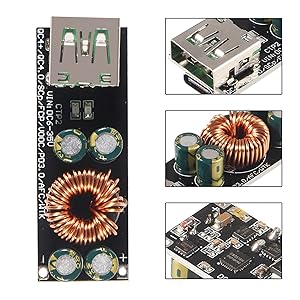
This ACEIRMC 60W DC to USB Type-C PD 3.0 fast charge module efficiently converts a wide 6-35V DC input into a stable USB-C output supporting multiple fast charge protocols. Compact and versatile, it’s engineered for professionals who demand reliable, high-speed charging from 12V or 24V sources, making it perfect for powering mobile devices, DIY electronics, and on-the-go setups.

| ASIN | B09D98799T |
| Best Sellers Rank | #162,922 in Tools & Home Improvement ( See Top 100 in Tools & Home Improvement ) #654 in Power Converters |
| Date First Available | August 21, 2021 |
| Item Weight | 0.317 ounces |
| Item model number | 3c8595a3-f091-4ea6-ae33-c15685d97b77 |
| Manufacturer | ACEIRMC |
| Product Dimensions | 1 x 1 x 1 inches |
B**N
100 WATTS!? Ignore the other reviews regarding power output...
UPDATE 04/24/23 Okay, Funny story! I got a 12V QC cable and another set of these charging boards (I have 4 total now), so I decided to do another round of testing on each of them to test all the voltage outputs. These are the Volts and Amps I believe this board is reliably rated for as at ~3.2-3.5A, the board stops providing power (except 20V). 5V 3A (15W) 9V 3A (QC & PD) (27W) 12V 3A (QC & PD) (36W) 15V 3A (PD) (45W) 20V 3A (PD) (60W)* *The 20V PD charging though is funny, Because on ALL FOUR of the boards I have, I was able to pull 5A from them without any issue. So this 60W board is outputting 100W @ 20V. I decided to test this for an extended period of time without any fan or cooling, just the board sitting by its lonesome. About 10 minutes in, there's a POP, a FLASH, and the smell of Magic Smoke. The back of the charging board was hot to the touch, but... It was NOT the USB charging board that died! My 24V 10A Power supply blew up! Well, by blow up I mean I'm pretty sure the AC Transformer shorted out causing the fuse to blow, but that doesn't really matter to the story. I plugged the board into a 20V laptop power supply I also have laying around, and the board STILL WORKS. I was still able to pull 5A @ 20V from this thing, only for a short time since the laptop PSU is only rated [email protected], but the fact is, it still works. I see No reason why this device wouldn't reliably provide 20V@3A according to the listing spec, or up to 5A for an extended period of time assuming you added a little additional cooling (maybe a heatsink). I'm honestly impressed by what these little boards can do. UPDATE 04/15/23 I received two new cables today and tested them on this board. I dropped my supply voltage to 24V Since that brings it in line with being able to power my TS100 Soldering Iron. Dropping the supply voltage didn't change my previous results with 28.5V when re-tested. Pulling more current than I'm listing caused voltages to break down, or the module to cease providing power. PD 15V - Pulled 3.1A @ 14.9V. Limit to 15V3A(45W) QC 9V - Pulled 3.4A @ 8.6V. The QC cable seems a bit thinner than the PD cables, so that could be contributing to a slightly higher V drop. Limit to 9V3A(27W) ************************************************************************************ I ordered a few of these to play with since USB PD is amazing and will let you power pretty much any device as long as you have the right adapter/cable/power supply. As for the issues the other reviewers faced, I wanted to say a couple things. 1: The USB-C port is NOT an input. It is meant as an output. The ONLY input is the + and - solder holes at the rear end of the board. If you are using the USB ports as inputs, you are doing it wrong. 2: This is NOT battery charging board or a UPS board, you can not charge a battery from it. 3: I'm not sure why the other reviewer wasn't able to get 60watts out of the board, as this was not my experience. I am currently only able to test 5V, and 20V since I do not yet have 9V,12V, and 15V PD trigger cables nor do I have QC trigger cables (yet), but here is what I got Using a 24v 10A power supply running at 28.5V. At 5V output i was able to get 3.47A with a voltage measured voltage of 4.83. This is with a very short 4 inch USB-A to DC plug that I made. At 3.5A, the voltage broke down and dropped to 3.8V. 5V 3A should be easy enough for this board if you don't want to push it. Most phones/tablets won't pull more than 2A, so you're in the clear for those. At 20V output, I was able to easily get 3.3A for a 65W output. I decided to push it to see if there was a current cut off limit, and discovered I was able to pull a full 5A of current through my 20V5A USB-C PD 100W cable. See attached image for proof of this. Now since this device isn't rated for more than 60W, I did have a fan blowing on the board and ran it for two minutes to see what happens. Without additional cooling, I don't see getting 100W for an extended period of time, but I found it interesting that It could do it. I didn't run any long term extended testing, but should I do additional tests, and get additional PD or QC trigger cables, I'll update this review.
T**1
Improvised 12/24 Volt Charging for Meshtastic Node
Using this as a backup plan, if I need to charge any of my devices from 12/24 volt source. First test was with a stepdown transformer 120 - 24v. Charged my flashlights just fine and even was able to charge my Meshtastic batteries through my Heltec V3 and V4 Meshtastic nodes. 2nd test was with your typical batteries for drills. Used both 12v and 24v batteries, working just fine. 3rd test was a car battery and was able to power/charge devices I put on there. Did have to make custom connectors to make it work on the mentioned power sources. Main purpose was for the outdoor Meshtastic node on my house to have other means of charging the battery in it in case of cloudy days, when the solar can't charge it fully, or keeping the node powered and not exhaust the battery first.
T**Y
One was faulty but easily fixed
I bought a 2-pack and out of the box, one of them was faulty. Thankfully it was a simple fix- and presumably anyone who’s tech-savvy enough to have a reason to buy this SHOULD have been able to spot it. It was simply a bad solder point on the inductor. 30 seconds and some solder, and I was up and running. These work exactly as advertised.
N**R
Voltage step down
Amazing for outdoor solar projects
D**E
One out of four works
These are so poorly made. I don’t even want to waste any more time trying to figure out what isn’t connected properly, but only one out of the four I got even works out of the box. I tested both ports with no output connected to a bench power supply and load, connected to a phone, checking the output lines for power. Just nothing on three of them. It also drops voltage very quickly, the one that “works” is only outputting 4.5 volts with a 3A draw. Can’t use these for anything.
K**R
Nice charging board
I used this along with OBVIS USB Type C 3.0 and USB 3.0 Male to Female Flush Mount Cable Waterproof Kit in a DIY battery generator box to run a usb soldering pencil and charge other things that demand a higher amp and voltage draw like charging a Steam Deck Nintendo Switch and my iPhone 12 and iPad pro 11 and run led light while camping or on a road trip or while visiting family where empty power outlets are fought over lol .
C**K
Reliable so far
I’ve been using this for over a year in a custom DC-DC UPS that powers my home network equipment. It’s been very reliable and runs rather cool compared to standard DC-DC buck converters. I’m using it to power a Unifi CGW-Max. I plan to switch to these for all my other power needs (POE switches, fiber modem, etc…) using USB-C to barrel jack cables.
B**L
Great usb unit
They work Used for production item and they work well
A**E
One worked, the other just got hot. Was ready to return them but decided to take a look at it because I wanted to use the other one and not wait for shipping. Is this a scam, to ship a dud with a working one and hope that you'll just throw it in the trash for them? Or is it just complete lack of QC. Anyways the switcher wasn't running and it turned out to be solder bridging between pins. A minute with solder wick and it was working. Good, right? Not good. This means that far from being burn-in tested like power electronics should be, these are not even energized before shipping. You're rolling the dice if you buy this junk.
わ**さ
35Vまでの入力可能な降圧タイプのPD&QCモジュールです 基盤むき出しなので実験的使用だったり、ケースを準備して内蔵させるかになります 台座の取り付け穴はありませんでしたので固定には2液の接着剤になるかな 今回私は安定化電源に接続し24Vの2Aを印加し、USB-Aにはイヤホン、USB-Cにはスマートフォンを接続してみました 1 USB-Aにはイヤホン 青ランプが一つ点灯し5V充電が開始されました 2 USB-Aにスマートフォン 青と赤のランプが点灯し9Vの2Aでスマホの持っている最大速度で充電されました 赤ランプと電圧からQCで充電されていると判断します 3 USB-CにPD対応モバイルバッテリー 青と赤ランプが点灯したが5V2A充電 12Vや20Vにならず 4 USB-Cにスマートフォン 青と赤のランプが点灯し9Vの2Aでスマホの持っている最大速度で充電されました 赤ランプと電圧からPDで充電されていると判断します PDもQDも活かせました PDのPPSを明確に判断出来る機器が無いことから未計測 モバイルバッテリーの充電電圧が上がらなかったところからも相性的な問題は多少あろうかと思います 昇圧機能は無い製品ですので12V電源での使用には12Vを超えての出力を取り出せない制限があると思われます 大きな熱を発することなく使用できましたがこの小さな基盤に60Wを流すのはちょっと怖いかなと思うところです また二箇所の端子が近いですが両方刺した際の挙動は確認していません 機能しないのか排他的になるのか5V固定になるのかは不明です お好みの筐体へ組み込み設置し、スマホ程度を充電するには楽しめるかなと感じます
ア**ー
基盤には±端子の穴があるだけで、ケース固定とかはちょっと工夫しないといけない。その端子のプラス側はハンダで埋まってたりと検品も作りも少し雑かな。あとType AとC端子は近い為、どちらかを使うになるかと。
Trustpilot
1 week ago
2 weeks ago