We remain fully operational. Our teams are working around the clock to ensure your deliveries continue safely.

DOWNLOAD THE APP


Customer Services
Copyright © 2025 Desertcart Holdings Limited
DOWNLOAD THE APP
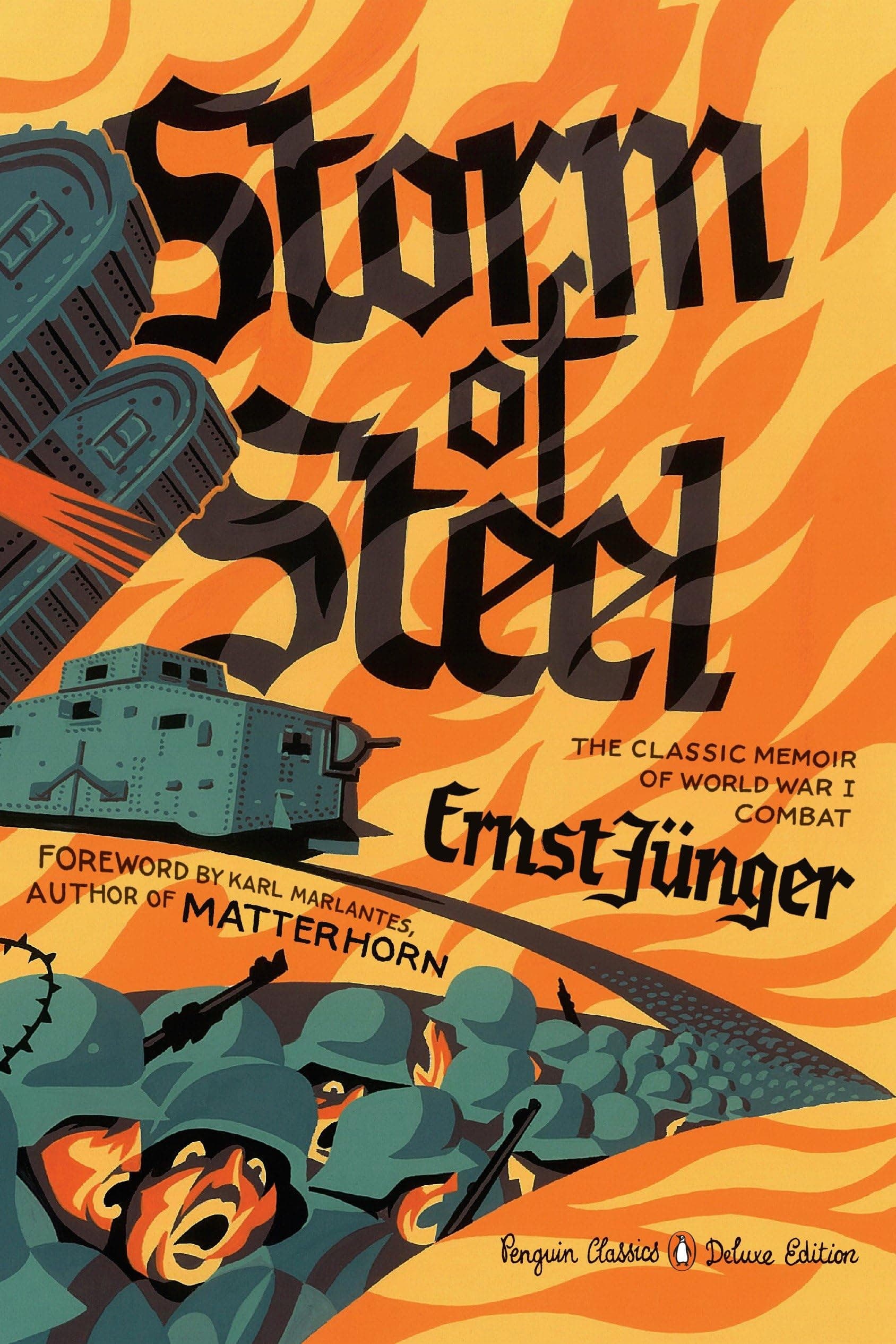
desertcart.com: Storm of Steel: (Penguin Classics Deluxe Edition): 9780143108252: Junger, Ernst, Gower, Neil, Hofmann, Michael, Hofmann, Michael, Marlantes, Karl: Books Review: Surpisingly incredible book - I just read this book, and I must say I'm amazed by it. I'll critique the book mainly by comparison with that most familiar WW1 work which is of course "All Quiet on the Western Front" by Erich Maria Remarque. There are others that are similar, such as "Under Fire" a noted work by Henri Barbusse from the French side, "Goodbye to All That" by Robert Graves (Englishman), and "Company K" by William March (US Marine Corps). Then there is pure fiction such as "Farewell to Arms" by Hemingway. I believe these books represent the dominant WW1 literary genre, across several countries. With the exception of "Storm of Steel", they are all more-or-less of the 'war is hell' theme started first perhaps by Stephen Crane's seminal novel of the American Civil War, "The Red Badge of Courage". Interestingly, Crane was never in combat - a fact unknown to most readers. in fact, many Civil War veterans who read Crane's novel were incredibly moved by its so-called 'accuracy' and depth of feeling. This shows the power of literature in our lives... The immediately obvious differences about "Storm of Steel" vis-a-vis the others are: 1) It was written from Junger's diary, not from dim rememberance. It contains a higher level of detail as to names, dates and places. 2) Junger was a front-line Officer, having been promoted from the ranks. Far as I know (and interestingly) this promotion system was only typical of the German and American armies - the English and Russian armies, and to a slightly lesser degree the French, for instance had only upper class Officers and a strict de-facto class system. 3) Perhaps most significantly, Junger started the book very soon after the war's end. In other words, it is not watered down by time. Though Barbusse's "Under Fire" was even sooner (written during the war), Barbusse spent little time in the army himsel and this as a stretcher-bearer, not a rifleman. Barbusse's work is acknowledged as highly fictionalized. All the others were written some 10 yrs after the war, in a melancholy-ish, "what happened to us?" sort of vein - i.e. the Lost Generation. This is significant both to the level of detail (accuracy and remembrance) and to the mood of the writing. There are other points - Junger served throughout the war. American author March obviously only served during the American involvement (but he may be forgiven in that the last half of the war was surely its worst, with the industrialization and de-humanization of warfare at its peak). Along a similar line, Remarque ("All's Quiet") like Barbusse, somewhat mysteriously served only a short time; a point not at all obvious from his book which is presumed to be autobiographical and covers perhaps three years. There have also been challenges to Remarque's war service - some of the charges unfounded - and some feel he was rather a fantasist about his service which was only a few weeks or months at the actual front. Remarque was spotted soon after the war's end wearing an Officer's coat with decorations he had not earned (he was never an Officer); he was somewhat vague in later years about his service, where he was stationed, etc... He was indeed wounded; that is well documented. But ultimately, the point is, it's impossible he experienced everything he wrote about in "All's Quiet". Junger, on the other hand, had ample experience in the war, having joined in 1914, was wounded multiple times, and was highly decorated (one of the youngest to recieve the 'Pour le Merite', the Blue Max, and its last living military recipient). Junger's reputation is tainted by possible associations with German nationalism after the war. But assertions that he was pro-Nazi are quite untrue. In fact, he lost his son to the Nazi regime. He may even have been on the fringes of the July 20th plot to kill Hitler. Sure, he supported his country, but that does not make him a Nazi. Unfortunately, his supposed politics affected the reception of his writing (and by default, "Storm of Steel") in more recent times. In my opinion this is a loss to the literature from the WW1 period... On to the book: The book is written in a very matter-of-fact way. This may surprise some readers, given that so many other books (as mentioned above) are of the hopeless 'war is hell' theme. Junger pulls no punches - he was trying to do his part to win, and he states it that way. I honestly can't see anything in this book to lead me to think he was some sort of war monger or "pre-Nazi Nazi". Junger had a deep sense of adventure and the ability to keep a cool head. He strikes me as a man trying to do a job, and he wrote thusly. He shows sympathy for his men and NCOs, writes from a 'team perspective' and admits his own mistakes. "All's Quiet" protagonist Paul Baumer on the other hand goes into depth of feeling about the individual soldier (read: Privates) and his sense of futility, hopelessness, camraderie (only with certain other soldiers) and concern over survival versus victory (perhaps justified). Once you read Junger, and contrast him to Remarque, you see the differences: Remarque was a kid, with little overall sense of what was going on beyond his day to day survival and a certain dreaminess; perhaps a representation of the narrow age group that makes up the true "Lost Generation". Junger, on the other hand, was a Type-A personality who directly involved himself in the efforts to win. I unfortunately found that a reading of Junger tends to denigrate (for lack of a better word) the efforts of a Remarque who writes about feelings and hope (or hopelessness, as it were). And vice-versa. You have to juxtapose the two to get a feel for the war in its entirety. I'm uneasy with it, but I also get the feeling Junger was a stronger person than the other WW1 writers - he had a healthy sense of life, and moved on after the war to live a full life (102 yrs), became a scientist (entomologist), and wrote prolifically. His selection to be an Officer is also indicative of an active man. He was adventurous, and had joined the French Foreign Legion before the war while in his teens. Regardless of all my opinions, Junger's book should be better known than it is. It is great for its historical context if nothing else. Review: World War I -- From The Trenches As It Was - For most people who only know World War I from their high school days when they did a book review on "All Quiet On The Western Front" this book is required reading. Against the spate of anti-war books by those who saw limited service and little combat, Ernst Juenger's book is truly authentic. He fought for his nation to win, and it was not until the Ludendorf offensive that he participated in during the Spring of 1918 was stopped (in his opinion, due to German artillery blocking the infantry's advance), that the author came to feel that Germany might lose the war. After all, at that time Romania, Serbia and Russia had been defeated, Italy was in disarray, the French relatively inactive, and the Americans had not yet arrived in strength. And it must be remembered that Germany always possessed inferior numbers compared to the allies on the Western front. The author has been condemned and marginalized in the US for his unabashed nationalism by the American leftist academic and political elite to the point that he is almost unknown in the English-speaking world. Juenger did his duty willingly and with enthusiam for four long years in combat on the Western front during World War I, and his refusal to condemn war has made him anathema to the Western literary world. Even though Juenger was not a Nazi and resisted Hitler's siren songs, his love for his country was enough to have his work censored through silence. The reader should carefully read the review by the Washington Post writer given above. Tellingly he states his personal viewpoint, "Like many people, I have absolutely no love for the martial spirit, detest all forms of nationalism, and feel queasy at the sight of blood." Hopefully the ER personnel attending to him following an accident will be able to function while seeing blood, but I guess "God Bless America" is out, and the Post reviewer will avoid service in the American Army with whatever excuse. This is the contemporary attitude of the liberal elite and media, formed over the last sixty years of leftist propaganda in our schools, universities, and on television. Juenger would be appalled. This translation by Hofmann is better than the ones I have read previously, but German speakers are advised to read his works in their original German. Hofmann effectively translates the German idioms that have stumped other translators and the Introduction should be read carefully to understand why a faithful translation is important. This volume is based on Juenger's revised edition (Juenger revised his book at least eight times), most probably the latest one from 1961. This book was written from Juenger's diary originally in 1920, is not fiction, and is the only extensive work from World War I from a long-serving combat soldier in the war. That alone makes it important, but that it is well-written and describes four major battles from the viewpoint of the soldier in the trenches makes it uniquely invaluable. That it remains almost unknown in the US is a tragedy and due exclusively to the powers that abhor the military and nationalism at any level -- even that for the United States. The details I leave to the many other reviewers who have more than adequately covered the tragedy and frightfulness of war. Juenger retains a sense of humor throughout, and even suggests that war is the most pronounced experience that a man can undergo. For the doubters, please read Glenn Gray's "The Warriors." In many respects, World War I was probably the most terrifying war in history for the individual infantryman. He lived a terrible existence in mud and squalor, subject to death at any moment from the ever-present artillery fire, and his survival depended more on chance than on his own skills. To some degree that changed in World War II and in subsequent wars where individual skills played an increasingly larger part in determining a soldier's survival. In short, BUY & READ this book. Don't accept passively what you are told to believe by the media, your teachers and professors. Juenger is well worth the read and you may actually learn something about lives of soldiers in World War I. Juenger is certainly an Alpha-male type, but his true story is as important as those written by anti-war fiction writers and those with political agendas.
| Best Sellers Rank | #151,708 in Books ( See Top 100 in Books ) #7 in WWI Biographies #19 in World War I History (Books) #1,309 in Memoirs (Books) |
| Customer Reviews | 4.7 4.7 out of 5 stars (2,203) |
| Dimensions | 5.65 x 0.8 x 8.4 inches |
| Edition | Deluxe |
| ISBN-10 | 0143108255 |
| ISBN-13 | 978-0143108252 |
| Item Weight | 2.31 pounds |
| Language | English |
| Print length | 320 pages |
| Publication date | May 31, 2016 |
| Publisher | Penguin Classics |
C**M
Surpisingly incredible book
I just read this book, and I must say I'm amazed by it. I'll critique the book mainly by comparison with that most familiar WW1 work which is of course "All Quiet on the Western Front" by Erich Maria Remarque. There are others that are similar, such as "Under Fire" a noted work by Henri Barbusse from the French side, "Goodbye to All That" by Robert Graves (Englishman), and "Company K" by William March (US Marine Corps). Then there is pure fiction such as "Farewell to Arms" by Hemingway. I believe these books represent the dominant WW1 literary genre, across several countries. With the exception of "Storm of Steel", they are all more-or-less of the 'war is hell' theme started first perhaps by Stephen Crane's seminal novel of the American Civil War, "The Red Badge of Courage". Interestingly, Crane was never in combat - a fact unknown to most readers. in fact, many Civil War veterans who read Crane's novel were incredibly moved by its so-called 'accuracy' and depth of feeling. This shows the power of literature in our lives... The immediately obvious differences about "Storm of Steel" vis-a-vis the others are: 1) It was written from Junger's diary, not from dim rememberance. It contains a higher level of detail as to names, dates and places. 2) Junger was a front-line Officer, having been promoted from the ranks. Far as I know (and interestingly) this promotion system was only typical of the German and American armies - the English and Russian armies, and to a slightly lesser degree the French, for instance had only upper class Officers and a strict de-facto class system. 3) Perhaps most significantly, Junger started the book very soon after the war's end. In other words, it is not watered down by time. Though Barbusse's "Under Fire" was even sooner (written during the war), Barbusse spent little time in the army himsel and this as a stretcher-bearer, not a rifleman. Barbusse's work is acknowledged as highly fictionalized. All the others were written some 10 yrs after the war, in a melancholy-ish, "what happened to us?" sort of vein - i.e. the Lost Generation. This is significant both to the level of detail (accuracy and remembrance) and to the mood of the writing. There are other points - Junger served throughout the war. American author March obviously only served during the American involvement (but he may be forgiven in that the last half of the war was surely its worst, with the industrialization and de-humanization of warfare at its peak). Along a similar line, Remarque ("All's Quiet") like Barbusse, somewhat mysteriously served only a short time; a point not at all obvious from his book which is presumed to be autobiographical and covers perhaps three years. There have also been challenges to Remarque's war service - some of the charges unfounded - and some feel he was rather a fantasist about his service which was only a few weeks or months at the actual front. Remarque was spotted soon after the war's end wearing an Officer's coat with decorations he had not earned (he was never an Officer); he was somewhat vague in later years about his service, where he was stationed, etc... He was indeed wounded; that is well documented. But ultimately, the point is, it's impossible he experienced everything he wrote about in "All's Quiet". Junger, on the other hand, had ample experience in the war, having joined in 1914, was wounded multiple times, and was highly decorated (one of the youngest to recieve the 'Pour le Merite', the Blue Max, and its last living military recipient). Junger's reputation is tainted by possible associations with German nationalism after the war. But assertions that he was pro-Nazi are quite untrue. In fact, he lost his son to the Nazi regime. He may even have been on the fringes of the July 20th plot to kill Hitler. Sure, he supported his country, but that does not make him a Nazi. Unfortunately, his supposed politics affected the reception of his writing (and by default, "Storm of Steel") in more recent times. In my opinion this is a loss to the literature from the WW1 period... On to the book: The book is written in a very matter-of-fact way. This may surprise some readers, given that so many other books (as mentioned above) are of the hopeless 'war is hell' theme. Junger pulls no punches - he was trying to do his part to win, and he states it that way. I honestly can't see anything in this book to lead me to think he was some sort of war monger or "pre-Nazi Nazi". Junger had a deep sense of adventure and the ability to keep a cool head. He strikes me as a man trying to do a job, and he wrote thusly. He shows sympathy for his men and NCOs, writes from a 'team perspective' and admits his own mistakes. "All's Quiet" protagonist Paul Baumer on the other hand goes into depth of feeling about the individual soldier (read: Privates) and his sense of futility, hopelessness, camraderie (only with certain other soldiers) and concern over survival versus victory (perhaps justified). Once you read Junger, and contrast him to Remarque, you see the differences: Remarque was a kid, with little overall sense of what was going on beyond his day to day survival and a certain dreaminess; perhaps a representation of the narrow age group that makes up the true "Lost Generation". Junger, on the other hand, was a Type-A personality who directly involved himself in the efforts to win. I unfortunately found that a reading of Junger tends to denigrate (for lack of a better word) the efforts of a Remarque who writes about feelings and hope (or hopelessness, as it were). And vice-versa. You have to juxtapose the two to get a feel for the war in its entirety. I'm uneasy with it, but I also get the feeling Junger was a stronger person than the other WW1 writers - he had a healthy sense of life, and moved on after the war to live a full life (102 yrs), became a scientist (entomologist), and wrote prolifically. His selection to be an Officer is also indicative of an active man. He was adventurous, and had joined the French Foreign Legion before the war while in his teens. Regardless of all my opinions, Junger's book should be better known than it is. It is great for its historical context if nothing else.
A**R
World War I -- From The Trenches As It Was
For most people who only know World War I from their high school days when they did a book review on "All Quiet On The Western Front" this book is required reading. Against the spate of anti-war books by those who saw limited service and little combat, Ernst Juenger's book is truly authentic. He fought for his nation to win, and it was not until the Ludendorf offensive that he participated in during the Spring of 1918 was stopped (in his opinion, due to German artillery blocking the infantry's advance), that the author came to feel that Germany might lose the war. After all, at that time Romania, Serbia and Russia had been defeated, Italy was in disarray, the French relatively inactive, and the Americans had not yet arrived in strength. And it must be remembered that Germany always possessed inferior numbers compared to the allies on the Western front. The author has been condemned and marginalized in the US for his unabashed nationalism by the American leftist academic and political elite to the point that he is almost unknown in the English-speaking world. Juenger did his duty willingly and with enthusiam for four long years in combat on the Western front during World War I, and his refusal to condemn war has made him anathema to the Western literary world. Even though Juenger was not a Nazi and resisted Hitler's siren songs, his love for his country was enough to have his work censored through silence. The reader should carefully read the review by the Washington Post writer given above. Tellingly he states his personal viewpoint, "Like many people, I have absolutely no love for the martial spirit, detest all forms of nationalism, and feel queasy at the sight of blood." Hopefully the ER personnel attending to him following an accident will be able to function while seeing blood, but I guess "God Bless America" is out, and the Post reviewer will avoid service in the American Army with whatever excuse. This is the contemporary attitude of the liberal elite and media, formed over the last sixty years of leftist propaganda in our schools, universities, and on television. Juenger would be appalled. This translation by Hofmann is better than the ones I have read previously, but German speakers are advised to read his works in their original German. Hofmann effectively translates the German idioms that have stumped other translators and the Introduction should be read carefully to understand why a faithful translation is important. This volume is based on Juenger's revised edition (Juenger revised his book at least eight times), most probably the latest one from 1961. This book was written from Juenger's diary originally in 1920, is not fiction, and is the only extensive work from World War I from a long-serving combat soldier in the war. That alone makes it important, but that it is well-written and describes four major battles from the viewpoint of the soldier in the trenches makes it uniquely invaluable. That it remains almost unknown in the US is a tragedy and due exclusively to the powers that abhor the military and nationalism at any level -- even that for the United States. The details I leave to the many other reviewers who have more than adequately covered the tragedy and frightfulness of war. Juenger retains a sense of humor throughout, and even suggests that war is the most pronounced experience that a man can undergo. For the doubters, please read Glenn Gray's "The Warriors." In many respects, World War I was probably the most terrifying war in history for the individual infantryman. He lived a terrible existence in mud and squalor, subject to death at any moment from the ever-present artillery fire, and his survival depended more on chance than on his own skills. To some degree that changed in World War II and in subsequent wars where individual skills played an increasingly larger part in determining a soldier's survival. In short, BUY & READ this book. Don't accept passively what you are told to believe by the media, your teachers and professors. Juenger is well worth the read and you may actually learn something about lives of soldiers in World War I. Juenger is certainly an Alpha-male type, but his true story is as important as those written by anti-war fiction writers and those with political agendas.
A**A
I bought this novel with very high expectations. To ...
I bought this novel with very high expectations. To be able to read a first hand account of such an incredible, albeit horrid event, from someone who lived in my lifetime, is something that makes my hairs stand up. After reading this, making a trip to the Somme battlegrounds to read a chapter of this novel and try to acquire a few shell fragments to display alongside this in my library (someday) is now on the top of my bucket list. Having said that, in as unbiased opinion as I can give, I will say, if you are not MORE familiar with WWI than the average person walking around nowadays (which is almost no knowledge), this novel will not hit you as hard as somebody who is and may leave a lot to be desired. This arguably was not meant to be a novel to begin with and I feel that a lot of critics wrongfully assume the level of WWI knowledge that the average reader may have. The novel is graphic and can be descriptive, but I always felt (while reading this) that without having previously gone out of my way to research and study WWI for my own personal knowledge and appreciation of sacrifice, that the bulk of the emotional power that this novel can force upon the reader will fly right by a lot of its readers. I gave it four stars based solely off its content and writing. If it was to be based off of Ernst Junger (insert umlaut) himself, absolutely a five star novel. As an American, whenever I start crossing things off my bucket list, I will stop by his grave and thank him for his service. War may draw lines in the sand, but the appreciation of appreciation for ones country and willingness to die for it knows no boundaries.
M**O
Obra maestra y de paso aprender palabras nuevas en ingles
L**N
Based on his notes and diary from World War I, Mr. Junger writes of his experiences as a front line soldier for the German Army. His matter of fact descriptions of the events makes them surreal. A fellow soldier is there one minute, killed by shrapnel, sniper or a stray bullet the next. His calf is pierced by a bullet that finds its way through a small opening in the house where he’s standing yet does no damage to his bones or major artery. Luck plays the major role in separating life from death. Battles are not described in terms of strategy and little judgment is made on decisions made. What is left is a terrific description of life at the front.
お**さ
この本は当時の政治思潮を理解する上で重要です。たやすくドイツ語の原文が手に入るのはありがたいと思います。
A**.
Very good!
L**P
Ottimo libro ma i miei dubbi sono sull’edizione in quanto il concavo è tutto sfalsato (il concavo è il lato delle pagine quando il libro è chiuso). Ho avuto un problema ma l’assistenza clienti è stata eccellente
Trustpilot
2 weeks ago
2 weeks ago