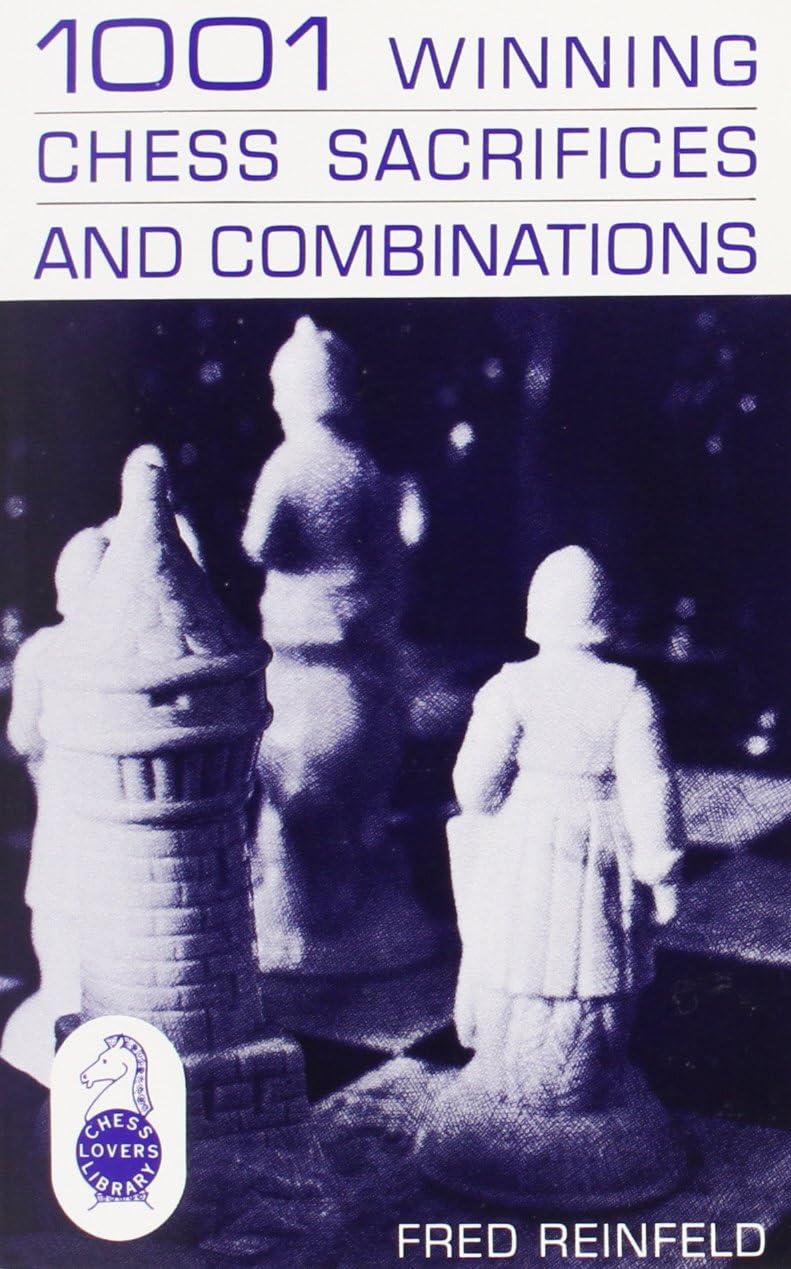
1001 Winning Chess Sacrifices and Combinations
Product ID: 3685901
Copyright 1955, Edition 1973. The paperback book is in excellent condition. Pages are clean, binding is tight, spine is without creases. Cover shows light wear mostly on the spine. We carefully wrap and ship your book within 24 hours of order. (J-35) Review: Fantastic second tactics book for reinforcing the basics. - I'm rated about 1410 on chess.com blitz. I hold the class C status because of my checkmating/king attack skills, not because of my tactics, which are weaker. Some of the diagrams have the black squares so dark that it is hard to see the black pieces on them, but they are still readable. Most diagrams are good. For the price, I'm not complaining. I almost give it 4 stars though since the chapter name is printed at the bottom of each page. If a beginner needs that hint, they should look at the table of contents. But a stronger player has to open to a random page and cover the bottom of it in order to make the problems harder. Some people bad mouth this book because it is divided into sections that tell you the type of tactic, making the problem easier. Well, weak players have to start somewhere. This is a great book to follow Chess Tactics by Paul Littlewood, or Tactics of the Tournament Player by Lev Alburt or another beginner tactics book. This is not an instruction book, but is where you can practice the different types. Each chapter is introduced by about 2/3 page of explanation of what each tactic is, but not in the detail of a true primer. It even talks about a few of the problems, giving beginners hints if they read it. Stronger players can skip the introduction. There are 20 types of tactics, and the positions are beautifully instructive. The difficulty range actually is such that a less strong player can get better with this book. The chapter hint is not as useful as you'd think in some problems, and it is easy to forget what chapter you are in, so even some stronger players can still get something out of this. The difficulty level does vary from problem to problem, as seen by the number of moves in the answer section. 4 moves is most common, 8+ make up 10%, and 3 or less seem to be 30%. Despite the variability, the first page of so of each chapter seemed easy for me to solve, partially because I saw those problems in a primer book I'm currently working through. Once this book is mastered I'll go through the 1115 puzzles book (forgot the title, still in the mail), since it is a mix of themes that go from easy to hard. After I finish with that or get right to the last 100 which are super hard, I'll jump to The Complete Chess Workout with 1200 mixed problems of variable strength. I'll finish the 100 hardest problems after that. Tactics involves calculations, but humans don't consider every move like computers do. We know which moves are good candidates via pattern recognition. So memorize as many patterns as you can as fast as you can. Do some calculation drills too, but don't let slow calculation speed keep you from memorizing a thousand patterns in a timely manner. You are not a computer and you never will be able to analyze 200,000,000 positions per move like they do when they look 5 moves deep. Review: A classic problem book that will add 100-200 Elo points to players between 1400 and 2000 - This classic problem book by Master Reinfeld is an well-organized and excellent set of problems for beginner to advanced intermediate players. It is organized into 20 chapters of different problem categories. The explanations for each of the different chapters explain the general goal for the specified problem category thoroughly but briefly. The only quibble I have with Master Reinfeld is that he did not identify the source players and game for each puzzle. This is the classic puzzle book for strong American players of the Fischer-Spassky generation. I have spoken to many masters and experts of that generation that have happily used this book for problems. I have used this book on several occasions to prepare for USCF tournaments, usually after a playing layoff. In three separate tournaments I achieved 2200+ performance ratings using this book. I am using my real name to review this book, and it matches my USCF ID. Working through the puzzles in this book will add 100 points to your Elo rating if you are under 2000. Other similar books are the Ultimate Chess Puzzle Book by Grandmaster John Emms, and Chess, 5334 Problems, Combinations, and Games, by Laszlo Polgar, the father of the famed Polgar sisters. All of these books are great books for tactics. There is another review of this book that does not do Master Reinfeld justice. He was a strong US master worthy of respect, not "dude". This book is not a waste of time, as this unidentified 1500+ player suggests. You certainly do not need 5-10,000 puzzles to improve your rating. And I finally suggest that you do not need the solution to a problem directly underneath the puzzle: I have not seen any puzzle book except for those written for complete beginners with such a format. Chess is not about instant gratification. Have fun with the book! Jerry Donahue
| Best Sellers Rank | #2,226,605 in Books ( See Top 100 in Books ) #118 in Chess (Books) |
| Customer Reviews | 4.5 out of 5 stars 191 Reviews |
M**9
Fantastic second tactics book for reinforcing the basics.
I'm rated about 1410 on chess.com blitz. I hold the class C status because of my checkmating/king attack skills, not because of my tactics, which are weaker. Some of the diagrams have the black squares so dark that it is hard to see the black pieces on them, but they are still readable. Most diagrams are good. For the price, I'm not complaining. I almost give it 4 stars though since the chapter name is printed at the bottom of each page. If a beginner needs that hint, they should look at the table of contents. But a stronger player has to open to a random page and cover the bottom of it in order to make the problems harder. Some people bad mouth this book because it is divided into sections that tell you the type of tactic, making the problem easier. Well, weak players have to start somewhere. This is a great book to follow Chess Tactics by Paul Littlewood, or Tactics of the Tournament Player by Lev Alburt or another beginner tactics book. This is not an instruction book, but is where you can practice the different types. Each chapter is introduced by about 2/3 page of explanation of what each tactic is, but not in the detail of a true primer. It even talks about a few of the problems, giving beginners hints if they read it. Stronger players can skip the introduction. There are 20 types of tactics, and the positions are beautifully instructive. The difficulty range actually is such that a less strong player can get better with this book. The chapter hint is not as useful as you'd think in some problems, and it is easy to forget what chapter you are in, so even some stronger players can still get something out of this. The difficulty level does vary from problem to problem, as seen by the number of moves in the answer section. 4 moves is most common, 8+ make up 10%, and 3 or less seem to be 30%. Despite the variability, the first page of so of each chapter seemed easy for me to solve, partially because I saw those problems in a primer book I'm currently working through. Once this book is mastered I'll go through the 1115 puzzles book (forgot the title, still in the mail), since it is a mix of themes that go from easy to hard. After I finish with that or get right to the last 100 which are super hard, I'll jump to The Complete Chess Workout with 1200 mixed problems of variable strength. I'll finish the 100 hardest problems after that. Tactics involves calculations, but humans don't consider every move like computers do. We know which moves are good candidates via pattern recognition. So memorize as many patterns as you can as fast as you can. Do some calculation drills too, but don't let slow calculation speed keep you from memorizing a thousand patterns in a timely manner. You are not a computer and you never will be able to analyze 200,000,000 positions per move like they do when they look 5 moves deep.
J**Y
A classic problem book that will add 100-200 Elo points to players between 1400 and 2000
This classic problem book by Master Reinfeld is an well-organized and excellent set of problems for beginner to advanced intermediate players. It is organized into 20 chapters of different problem categories. The explanations for each of the different chapters explain the general goal for the specified problem category thoroughly but briefly. The only quibble I have with Master Reinfeld is that he did not identify the source players and game for each puzzle. This is the classic puzzle book for strong American players of the Fischer-Spassky generation. I have spoken to many masters and experts of that generation that have happily used this book for problems. I have used this book on several occasions to prepare for USCF tournaments, usually after a playing layoff. In three separate tournaments I achieved 2200+ performance ratings using this book. I am using my real name to review this book, and it matches my USCF ID. Working through the puzzles in this book will add 100 points to your Elo rating if you are under 2000. Other similar books are the Ultimate Chess Puzzle Book by Grandmaster John Emms, and Chess, 5334 Problems, Combinations, and Games, by Laszlo Polgar, the father of the famed Polgar sisters. All of these books are great books for tactics. There is another review of this book that does not do Master Reinfeld justice. He was a strong US master worthy of respect, not "dude". This book is not a waste of time, as this unidentified 1500+ player suggests. You certainly do not need 5-10,000 puzzles to improve your rating. And I finally suggest that you do not need the solution to a problem directly underneath the puzzle: I have not seen any puzzle book except for those written for complete beginners with such a format. Chess is not about instant gratification. Have fun with the book! Jerry Donahue
W**S
Take the book for what it is
You've got to accept this book for what it is -- a very large set of chess puzzles to solve. No, it's not a comprehensive manual of the game. No, it doesn't teach openings. No, it's got nothing on strategic conceptions of middle-game play. There could be a whole long list of what it is not. But take it for what it is. One, it's fun to try to solve these puzzles. If you like that kind of thing, you can throw this inexpensive book in a briefcase, purse, or pocket. (Or keep it in the john.) The puzzles are nice diversion. Two, I believe it can really help play to go over and over the puzzles. Doing that will, I think, imprint the repeating patterns that allow these kinds of combinations. It will become easier feel when a position offers combinational opportunities - for you or your opponent - and smoke the combinations out. A word about the descriptive notation. The publishers have kept this book in print by some photoprocess from the original of it, which is now a half century old. A half century ago, descriptive notation was the standard in the English-speaking world. It's now all but died out. The publisher could find a wider audience by having someone translate the notations to algebraic. I assume they've thought of it but decided it's not a profitable move. I don't know; maybe they're right. Hate them for that decision if you will, but anyone still can enjoy and profit from this book as is. Descriptive notation is very easy to master, even if you think it stinks, and the the book includes a clear explanation of how it works.
W**N
Good Exercises to Improve your chess tactics
Good book to improve your chess tactics
J**R
Editing errors
Quite a few mistakes. The editor states, in regard to making changes to the original content, “ you can argue that I should not have done any of this and just let Reinfeld speak for himself. And maybe on another day I would agree. But not today.” Perhaps better editing and less proclamation is in order. Case in point is puzzle 339. Page is Black moves first. Solution is for some other white moves first puzzle. Pics enclosed.
B**Q
wonderful tactics practice, flaws are actually very minor
To play chess with any sort of competency, you must be able to spot the tactics on the board. To get good at spotting tactics, you must practice with lots and lots of tactics puzzles. Hence this book. This book has three flaws, which are not anywhere near as serious as some of the reviewers would have you believe. First, the solutions assume that the defender plays the obvious responses, but in many of the more complex problems there are other, often very nonobvious, responses that are superior and that defeat the attack. However, for the intended reader of this book this flaw is actually not a flaw at all, because the reader with the intended level of skill will have a hard enough time finding the *obvious* responses; he or she will not care in the least that a nonobvious, deeply hidden, better response was available. Second, the book provides hints by grouping problems into categories, whereas real games don't provide hints. Readers who don't want the hints can simply ignore the chapter headings and choose a random problem from the book. The bigger overarching hint that cannot be ignored is the fact that the mere *presence* of a board in this book indicates that it contains a combination. In a real game determining whether a combination is available is hard. Third, the book is written in descriptive notation. For some reason, many chess reviewers love to whine about descriptive notation. The fact is that descriptive and algebraic notations are equally easy to read. The only real drawback of descriptive notation occurs when you are reading a game and want to back up to an earlier position; for that, only algebraic notation provides the necessary information about where pieces came from. For a book like this one, however, descriptive notation is perfectly fine. Learn to read it. It's fun. In short: If you want to get better at chess tactics, study this book.
G**S
it's probably not a good choice for a competitive player
A faithful update of the original; Mr. Pandolfini exercised admirable restraint in leaving Reinfeld's original text intact, and limiting himself to converting the descriptive notation to algebraic. Given that the material is outdated by half a century, it's probably not a good choice for a competitive player. But for a casual player, the discipline of organizing one's moves to accomplish an objective is often weak or non-existent, and such a player (me) is not keeping up with the latest-and-greatest theory anyhow. So, even outdated material will sharpen our skills in recognizing opportunities and then executing the tactical plans to seize those opportunities.
M**G
Great book.
All of the tactical patterns are in the book such as pins, Knight Forks, removing the guard and many more. Some of the problems are very difficult which hopefully will help with chess visualization. How tough are the problems? I missed the first few I tried. After that I really concentrated and got some correct. The only "complaint" if you want to call it that is that I wish the publisher would remove the older style of chess notation and update to the new chess notation.
F**Y
Bad quality book
Bad publication; very low ink as usual in Russel publications.
N**N
Five Stars
Works well with Chess Tactics from Scratch.
V**E
Un livre de tactique incontournable
Ce livre est un grand classique à posséder; depuis que je cherche les positions sur mon échiquier mon niveau s'est amélioré sensiblement ! Il couvre tout le champ tactique avec des problèmes de tout niveau 20 thèmes abordés: Le clouage La fourchette du Cavalier L'attaque double L'attaque à la découverte L'échec à la découverte L'échec double La pièce surchargée Attaque du défenseur Evacuation d'une case Interférence Combinaisons de promotion La faiblesse de la première rangée Sacrifices de Dame Attaque aux rayons X Coups surprenants Combinaisons de défense La pièce piégée Zugzwang Le Roi sans protection La faiblesse du roque La plupart des problèmes sont consistants et riches en variantes à analyser; le seul petit reproche est que le niveau de difficulté n'est pas symbolisé.
J**S
Excelente libro de tactica
Muy buen libro para practicar tactica
P**U
Five Stars
excellent
Trustpilot
1 month ago
1 week ago