We remain fully operational. Our teams are working around the clock to ensure your deliveries continue safely.

DOWNLOAD THE APP


Customer Services
Copyright © 2025 Desertcart Holdings Limited
DOWNLOAD THE APP
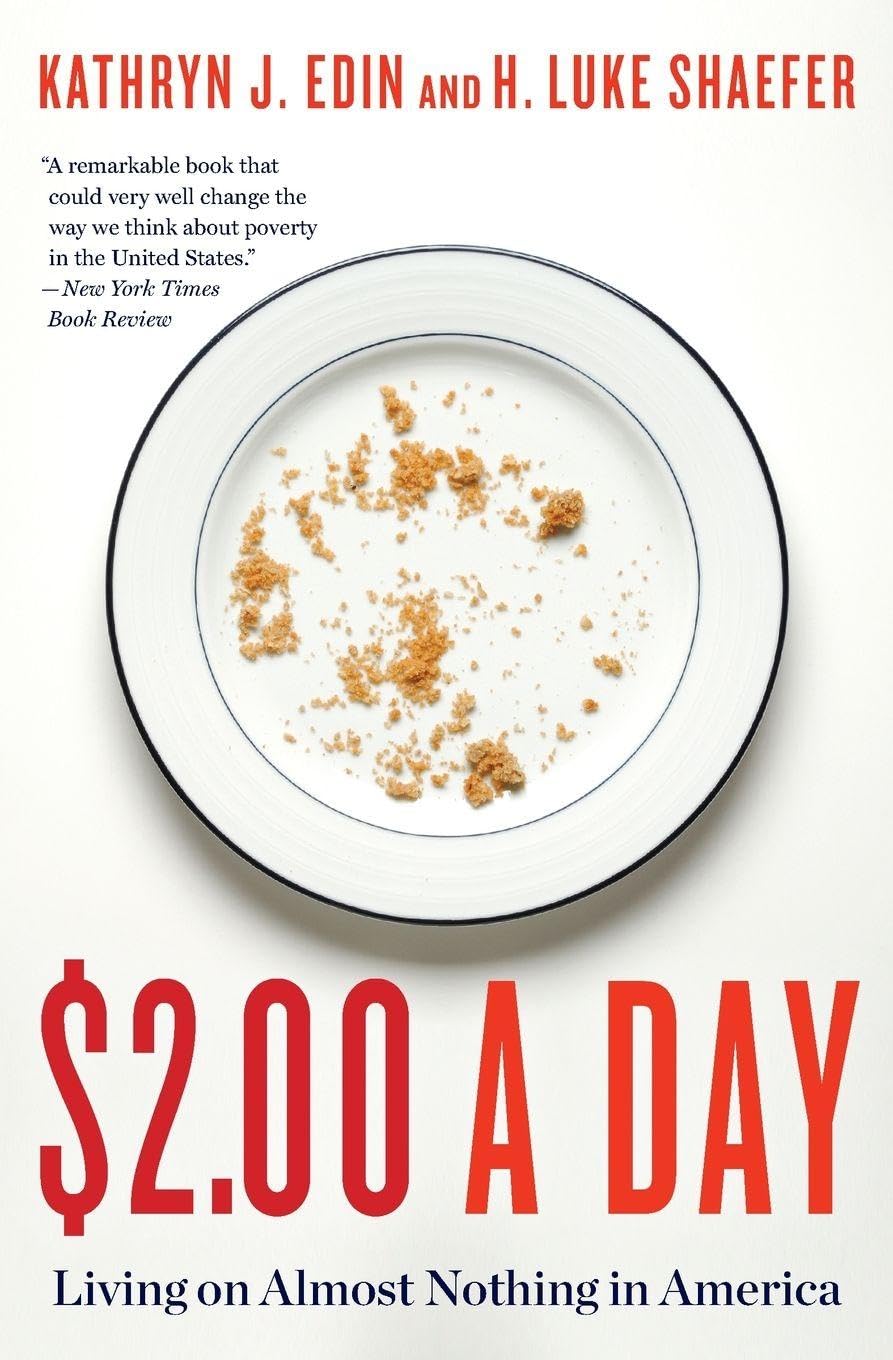
...2.00 a Day: Living on Almost Nothing in America [Edin, Kathryn, H. Luke Shaefer] on desertcart.com. *FREE* shipping on qualifying offers. ...2.00 a Day: Living on Almost Nothing in America Review: Informative and historically enlightening. Loved it. - This book is excellent. Of all people to kick the poor people when they are down leave it to Bill and Hillary who OVERTURNED a 60 year law that was lifting up the poor for decades. Wow. If you bless the poor as an individual then you are blessed by God as an individual. Therefore, who can argue against----- if we bless the poor as a nation then God will bless us as a nation???? It's Psalm 41:1-3. It's in the Bible people. The cuts affect children the most because many single moms have more than one kid. So if you got 15 million on welfare ---- 5 million are moms and 10 million are kids, roughly. You gotta think about who you are starving out. It were better for a millstone to be hung around your neck than to harm some of these kids (Math. 18:6). If you loan to the poor it costs you nothing. Nothing because God pays it back and then some (Prov. 19:17) - both to individuals and nations. Granted If you don't work--- you don't eat, but for single moms raising kids is a job in itself and the only job they should have to worry about. Able bodied adult males is a different story. Welfare reform cut off single moms in the millions. It's fruit is untold misery and its initiators were unmerciful. Review: Sad state of American poverty focuses on people who are not on welfare or SNAP - but should be - Nothing new under the sun, as they say. Barbara Ehrenreich's Nickel and Dimed: On (Not) Getting By in America" (2001) focused on her undercover work as a low-wage employee. This book, by scholars Kathryn Edin and Luke Shaefer is not undercover investigative reporting, but just as worthwhile in its study of a handful of familieses who either do not work, but work off the books in essentially making less than $2 a day. From undocumented ride sharing to selling home-made snacks out of a dining room at a small mark-up, they are, to paraphrase Ehrenreich, "not getting by in America." Some are youngsters, minor children, who sell their bodies to put food on the family table. Others to the almost-timeless (by now) job of selling their food stamps. Parents and children bounce from family to family when they can't pay the rent - sometimes at great cost to the children, such as the young teen in this book who was molested by a relative her mother had trusted. Other mothers meet so-called "friends" (as the families call them) to consensually trade sex for a few dollars (minors can't consent in the United States, even when they are are on cusp of age 18). What is not mentioned is the people who sell their-anti-depressants and other life-saving medications. In my work as a food pantry volunteer, I've know a smattering of such people, seen the drug deals go down; seen the young woman go off with other food pantry guests to trade sex for money, for who knows what the former want and need. The authors should have cited the prescription sellers as well. It's not a new phenomenon. Still, overall thorough research leading from the Middle West to the Mississippi Delta, north to south and back again, focused on a handful of families. Equity is a large and important focus of this study, although whites and Blacks are given equal shrift. Inadequate explanation of why the authors didn't include a coastal community but included two mid-west states (Illinois and Ohio). Cf: David Bowie's song "This Is Not America," for an artistic interpretation of this problem - his song was released more than a decade before President Clinton's so-called 'welfare reform," for defines, in lyrical form, the $2/day problem. The authors don't cite Bowie, but they do cite - extensively - Clinton's disastrous policy on the working and non-working poor. Book needs a 2022 update to cover Covid19's effects on the economy and the $2/day poor, but extensive bibliography and footnotes are very helpful for the reader's future readings and research.


| Best Sellers Rank | #99,885 in Books ( See Top 100 in Books ) #17 in Poverty #88 in Sociology of Class #250 in Discrimination & Racism |
| Customer Reviews | 4.4 4.4 out of 5 stars (1,664) |
| Dimensions | 5.31 x 0.64 x 8 inches |
| Edition | Reprint |
| ISBN-10 | 054481195X |
| ISBN-13 | 978-0544811959 |
| Item Weight | 2.31 pounds |
| Language | English |
| Print length | 240 pages |
| Publication date | September 13, 2016 |
| Publisher | Mariner Books |
D**A
Informative and historically enlightening. Loved it.
This book is excellent. Of all people to kick the poor people when they are down leave it to Bill and Hillary who OVERTURNED a 60 year law that was lifting up the poor for decades. Wow. If you bless the poor as an individual then you are blessed by God as an individual. Therefore, who can argue against----- if we bless the poor as a nation then God will bless us as a nation???? It's Psalm 41:1-3. It's in the Bible people. The cuts affect children the most because many single moms have more than one kid. So if you got 15 million on welfare ---- 5 million are moms and 10 million are kids, roughly. You gotta think about who you are starving out. It were better for a millstone to be hung around your neck than to harm some of these kids (Math. 18:6). If you loan to the poor it costs you nothing. Nothing because God pays it back and then some (Prov. 19:17) - both to individuals and nations. Granted If you don't work--- you don't eat, but for single moms raising kids is a job in itself and the only job they should have to worry about. Able bodied adult males is a different story. Welfare reform cut off single moms in the millions. It's fruit is untold misery and its initiators were unmerciful.
A**W
Sad state of American poverty focuses on people who are not on welfare or SNAP - but should be
Nothing new under the sun, as they say. Barbara Ehrenreich's Nickel and Dimed: On (Not) Getting By in America" (2001) focused on her undercover work as a low-wage employee. This book, by scholars Kathryn Edin and Luke Shaefer is not undercover investigative reporting, but just as worthwhile in its study of a handful of familieses who either do not work, but work off the books in essentially making less than $2 a day. From undocumented ride sharing to selling home-made snacks out of a dining room at a small mark-up, they are, to paraphrase Ehrenreich, "not getting by in America." Some are youngsters, minor children, who sell their bodies to put food on the family table. Others to the almost-timeless (by now) job of selling their food stamps. Parents and children bounce from family to family when they can't pay the rent - sometimes at great cost to the children, such as the young teen in this book who was molested by a relative her mother had trusted. Other mothers meet so-called "friends" (as the families call them) to consensually trade sex for a few dollars (minors can't consent in the United States, even when they are are on cusp of age 18). What is not mentioned is the people who sell their-anti-depressants and other life-saving medications. In my work as a food pantry volunteer, I've know a smattering of such people, seen the drug deals go down; seen the young woman go off with other food pantry guests to trade sex for money, for who knows what the former want and need. The authors should have cited the prescription sellers as well. It's not a new phenomenon. Still, overall thorough research leading from the Middle West to the Mississippi Delta, north to south and back again, focused on a handful of families. Equity is a large and important focus of this study, although whites and Blacks are given equal shrift. Inadequate explanation of why the authors didn't include a coastal community but included two mid-west states (Illinois and Ohio). Cf: David Bowie's song "This Is Not America," for an artistic interpretation of this problem - his song was released more than a decade before President Clinton's so-called 'welfare reform," for defines, in lyrical form, the $2/day problem. The authors don't cite Bowie, but they do cite - extensively - Clinton's disastrous policy on the working and non-working poor. Book needs a 2022 update to cover Covid19's effects on the economy and the $2/day poor, but extensive bibliography and footnotes are very helpful for the reader's future readings and research.
A**M
Rough read, but enlightening
This is one of those books that is not an easy read. Don't get me wrong, the words flow nicely, I don't mean that. I mean the subject. When I purchased this book, I thought it was a book about how to live on $2.00 a day. I didn't realize it was a horrific look at people who were living on $2 a day! The writing drew me in and the stories kept me reading. I cried for the harshness of the world as I read things I never thought about before. It never dawned on me that house cleaners would have to haul their own water to derelict houses to clean because the water was turned off. I never thought about what you do when there is only so much money for gas and your roommate uses all of it, leaving you unable to drive to work. This book is very well written and very well researched. It is one I will keep and look back on when I feel that my life is tough, because my life is not as tough as the people cameoed in the book.
M**F
The question that came to me reading this is:Where are the fathers? Why would you have eight children by an abusive man who does not support his own children? I empathize with the unfair practices like unpaid overtime and unreasonable firings, but think that many of these problems were self inflicted.
M**O
It is a book which describes the other face of the U.S. It shows you how people live with 2 dollars o less per day. The author supports his statements with real cases, and put on the table the problem of the inefficient of the social government departments and highlights the importance of enhancing some essential public services.
M**Y
Littered with racism. America, you want to know why you have a race problem, why you have a crime problem? Read this book!!!
M**N
Very powerful reading! As a student of environmental issues and international relations and politics, this is a very good book to read.
A**R
It was a good book with a lot of good points but was a little dry at time. Still interesting to read.
Trustpilot
1 month ago
1 day ago