
DOWNLOAD THE APP


Customer Services
Copyright © 2025 Desertcart Holdings Limited
DOWNLOAD THE APP
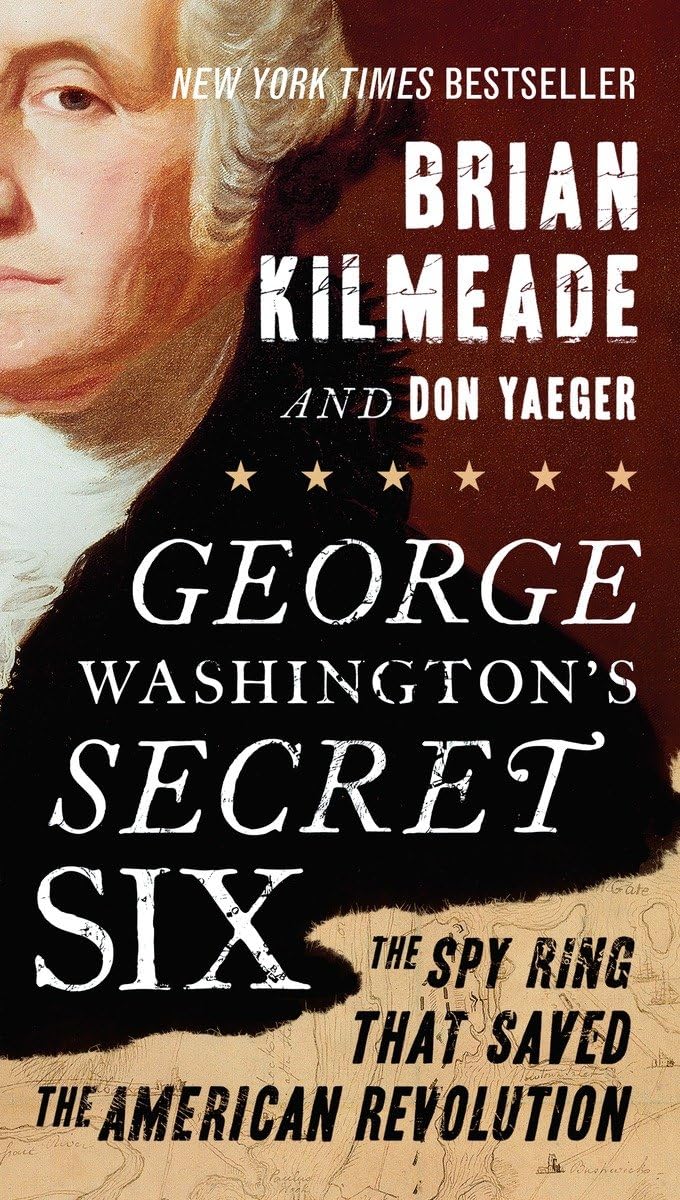
George Washington's Secret Six: The Spy Ring That Saved the American Revolution [Kilmeade, Brian, Yaeger, Don] on desertcart.com. *FREE* shipping on qualifying offers. George Washington's Secret Six: The Spy Ring That Saved the American Revolution Review: Reads Like a Spy Novel.. Exactly What It Is... only it's TRUE!! - "The British were being played, and from the least likely of corners. But they remained oblivious to the double-dealings in their midst. The parties went on. The coffeehouse debates continued as the officers went about surrounded by their circles of admirers. Major Andre's silly love poems were composed and published in Rivington's "Royal Gazette". The wine and words flowed freely as they bantered about their plans. The Army was in garrison -- comfortable, amused and completely oblivious to the fact that any shopkeeper, newspaperman, or charming lady in their midst was listening, remembering, and plotting," - Brian Kilmeade The place was New York City. The time was the Revolutionary War in America. The British Army under Sir William Howe had occupied this, the largest city in North America since September of 1776. General George Washington, commanding the rag-tag collection of professional soldiers, officers, and militiamen calling itself the American Army was camped outside of New York, smarting from the way in which he and his army were run out of that city, and looking for a way to get back in. The British had made their Headquarters there and in spite of Washington's fervent hopes of ejecting them, they would in fact remain there for the entire war. Washington absolutely had to find some way of penetrating inside New York and gathering intelligence on what the Brits were up to. And how he managed to do so is the subject of the truly fascinating book "George Washington's Secret Six - the Spy Ring That Saved the American Revolution." by Brian Kilmeade of Fox News and Don Yaeger. Through correspondence between Washington and the spies or between the spies themselves, and through careful examination of business records. Kilmeade and Yaeger have compiled a richly detailed, and compelling tale of courage and sacrifice in the heart of the enemy: in British-occupied New York City. They tell the story of six ordinary colonial citizens, known as the "Culpers": Abraham Woodhull, a gentleman bachelor farmer, and Robert Townsend, a gently-natured Quaker merchant and reporter for a British publication; the Royal Gazette. They tell of the owner of that publication, and of a popular coffeehouse, James Rivington who was viewed by his countrymen as an outspoken loyalist to the Brits. We learn about Austin Roe and his tavern, and Caleb Brewster, a tough longshoreman who ferried much of the information to the Americans. And most interestingly of all (to me, anyway) we learn of a woman who has never been identified, known only as agent "355" in the correspondence. This young lady of society was able to pick up important scraps of information by flattering self-important British officers who thought of themselves as impressive lady's men while unaware of just how useful they were being to this lady. Between them, they provided information that: foiled a British attempt to flood American markets with counterfeit currency, and stopped a British plan to ambush the troops of the French when they joined the American cause. In one remarkable instance they were able to acquire a copy of the British Naval Code Book, and present it to French Admiral D'Estaing in time to aid him in defeating the British fleet off of Yorktown Virginia. This wound up cutting off the escape of Cornwallis' Army for the decisive victory of the war. And perhaps most importantly, they provided the information which enabled their leader, American Major Benjamin Tallmadge (Codenamed "John Bolton") to break the plot by Benedict Arnold to hand over the American fortress at West Point to the British. And we see how most of these "moles' wished to stay unknown for their brave and heroic service to our country at the moment of her birth. All in all, Mssrs. Kilmeade and Yaeger have given us a fascinating look at a chapter of American Revolutionary history about which little has been written before this book's publication last Fall.* It reads like... well like a spy novel, which is afterall exactly what it is.. only it's true!! I can strongly recommend it for anybody who likes a good tale whether they prefer fiction or non-fiction. It is a top-notch read!!! Review: Secret Six is worth reading with a few objections - First of all, I have read several books since I read Brian Milreade’s book on the spy ring during the American Revolution and I didn’t take notes so now my comments are going to be too general. Part way through I would have given it three stars but by the time I had finished it, I decided it might be worth four stars. I did finally end up enjoying it though I had problems with the early chapters where I thought the author painted with too broad a brush and lacked scholarly support. One of my objections is that the author never referred to the king as George III. He referred to him most often as the king and sometimes King George. There is no excuse for not identifying him as King George III since the king with his administration is the main culprit in causing the unconstitutional usurpations following the French and Indian War that ended in 1763 that led to the American Revolutionary war. The author did not seem to understand or at least appreciate that the colonists did not object to constitutional monarchy but only to the violations of their Charter rights which guaranteed to them the eternal rights of Englishmen just as though they were back home in England. The colonists with every king’s blessing had an elected lower house with the power of the purse. King George III was the first to ignore the guarantees that protected their lower houses. Some of you may disagree when you read the book but I don’t think the author made it clear that Abraham Woodhull, one of the spies, did not reject the authority of King George III because the king had been “born into his position.” To say that without clarification implies that the colonists opposed monarchy on principle whether absolute monarchy or constitutional monarchy. That was not true during American colonial history. It was unlimited power that the colonists opposed. The American colonists were proud of English history and its development into a strong constitutional monarchy with an elected Parliament the supreme of the law with the king under the constitution as well. Limiting the power of the king at crucial junctures of English history is England’s constitutional history and the colonists were proud of it and claimed it as their own since their Charters guaranteed those rights to them forever. They intended to maintain those rights long practiced. The title of the book is an overstatement since I don’t think there is any basis for anyone to maintain that the spy ring “saved” the American Revolution as important as its work was. On a far less important note when discussing the fifty pounds of lead that George Washington appreciated, the lead was referred to as “mettle”. It is a very old variant of the spelling which I have never seen used in a history book on history before. It is my understanding that by 1700 the distinction between “mettle” and “metal” had been fixed so by the time of the American Revolution the spelling would have been “metal”. One other quibble that some of you might appreciate is that the book calls Trenton and Princeton (Christmas 1776 and January 1777) the turning point of the revolution where-as every military historian I have read regards the battle of Saratoga in upper state New York in the fall of 1777, where General Benedict Arnold was able to save the day when the cowardly commanding officer Horatio Gates wanted to retreat, as the turning point of the war. The British General Burgoyne surrendered his entire army which was the first such occasion. The spy ring was not even organized until 1778 so I don’t see how it could be said to have “saved” the revolution. He also distracted me by going back and forth after the Declaration of Independence in referring to colonies or states. Once independence was declared and the Articles of Confederation was ratified as the new constitution, they were all states. Another point that distracted me was in a later discussion the author seemed to be saying that the “implied powers” in the Federal Constitution written after the war in 1787 was used to enlarge executive powers but the last paragraph of Section 8 in Article I shows that the implied powers was delegated to the legislative branch. The problem has been one of the power being misused by the legislative branch, not the executive. After having said all that, once he got beyond these issues and into the spy ring, the book got a lot better for me and I found each spy a fascinating study in his own right: Caleb Brewster, Robert Townshend, Abraham Woodhull, Benjamin Tallmadge ( a close friend of Nathan Hale’s) , Austin Roe, and Agent 355, an unidentified woman. It is really disappointing that no one after the fact, when it was safe to do so, ever divulged her identification and story. Someone among them had to have known it. It is annoying that even belatedly all the men finally received recognition for their vital contribution but not the only woman among them known as agent 355 who was a vital member of the ring. There were other women who helped do some spying but this book focuses on the secret six called the Culper Ring so named by Washington by abridging Culpeper County in Virginia. There seems to be an implication in the information provided about the super careful spy Robert Townshend, who did not want anyone to know his name and was given to much anxiety and trauma over the work he was doing, that he was very disturbed by the fact that Agent 355 was arrested and put in prison but apparently not executed as male spies were. This hints that he might have cared for this woman personally and if so, it seems inexplicable why we don’t know her name though we know Robert Townshend’s name. It is a bitter irony in a sense that this woman was never given any honor. On another issue Benedict Arnold was able to escape while Andre was executed which has always bothered me. Why the British would not give up Arnold to save Andre’s life is never discussed or explained. It is mentioned that George Washington was willing to exchange Andre only for Arnold but the British refused. Why they cared about a turn coat traitor willing to betray his side for money in exchange for a young, courageous man who had served the Crown faithfully with nobility and bravery is inexplicable to me and it frustrates me that the point is not even acknowledged. This story does mention that George Washington may have learned a difficult lesson from Nathan Hale who should never have been sent behind enemy lines without some training and some instructions from those experienced in spying. What Nathan Hale did makes you shake your head with deep regret for the waste of his life, a bright, educated and talented young man so naïve that in the midst of Loyalist surroundings, he was able to be induced to confide in a man who talked like a patriot but in reality was a strong Loyalist in one of the local taverns while he had the incriminating evidence in his boot. The point that was made in this book about Nathan Hale is that George Washington was therefore taught the priority of absolute secrecy and not allowing the names of the spies to be known by virtually anyone and that more sophisticated methods had to be developed in the codes used and the invisible ink employed and the system for making contacts made as obscure as possible so as not to arouse suspicion. The spy ring itself guarded identities with a grim vigilance and Robert Townshend carried it to an ultimate extreme. The book has given me a curiosity to read further. I do recommend this book with all my misgivings, caveats and objections. If the first chapters don’t appeal to you either, skim over them or take notes so you can complain about them in your book review. The chapters that begin with the spy ring are worth reading.
| Best Sellers Rank | #1,076,842 in Books ( See Top 100 in Books ) #29 in U.S. Revolution & Founding History #64 in U.S. State & Local History #1,054 in Political Intelligence |
| Customer Reviews | 4.5 out of 5 stars 10,759 Reviews |
B**N
Reads Like a Spy Novel.. Exactly What It Is... only it's TRUE!!
"The British were being played, and from the least likely of corners. But they remained oblivious to the double-dealings in their midst. The parties went on. The coffeehouse debates continued as the officers went about surrounded by their circles of admirers. Major Andre's silly love poems were composed and published in Rivington's "Royal Gazette". The wine and words flowed freely as they bantered about their plans. The Army was in garrison -- comfortable, amused and completely oblivious to the fact that any shopkeeper, newspaperman, or charming lady in their midst was listening, remembering, and plotting," - Brian Kilmeade The place was New York City. The time was the Revolutionary War in America. The British Army under Sir William Howe had occupied this, the largest city in North America since September of 1776. General George Washington, commanding the rag-tag collection of professional soldiers, officers, and militiamen calling itself the American Army was camped outside of New York, smarting from the way in which he and his army were run out of that city, and looking for a way to get back in. The British had made their Headquarters there and in spite of Washington's fervent hopes of ejecting them, they would in fact remain there for the entire war. Washington absolutely had to find some way of penetrating inside New York and gathering intelligence on what the Brits were up to. And how he managed to do so is the subject of the truly fascinating book "George Washington's Secret Six - the Spy Ring That Saved the American Revolution." by Brian Kilmeade of Fox News and Don Yaeger. Through correspondence between Washington and the spies or between the spies themselves, and through careful examination of business records. Kilmeade and Yaeger have compiled a richly detailed, and compelling tale of courage and sacrifice in the heart of the enemy: in British-occupied New York City. They tell the story of six ordinary colonial citizens, known as the "Culpers": Abraham Woodhull, a gentleman bachelor farmer, and Robert Townsend, a gently-natured Quaker merchant and reporter for a British publication; the Royal Gazette. They tell of the owner of that publication, and of a popular coffeehouse, James Rivington who was viewed by his countrymen as an outspoken loyalist to the Brits. We learn about Austin Roe and his tavern, and Caleb Brewster, a tough longshoreman who ferried much of the information to the Americans. And most interestingly of all (to me, anyway) we learn of a woman who has never been identified, known only as agent "355" in the correspondence. This young lady of society was able to pick up important scraps of information by flattering self-important British officers who thought of themselves as impressive lady's men while unaware of just how useful they were being to this lady. Between them, they provided information that: foiled a British attempt to flood American markets with counterfeit currency, and stopped a British plan to ambush the troops of the French when they joined the American cause. In one remarkable instance they were able to acquire a copy of the British Naval Code Book, and present it to French Admiral D'Estaing in time to aid him in defeating the British fleet off of Yorktown Virginia. This wound up cutting off the escape of Cornwallis' Army for the decisive victory of the war. And perhaps most importantly, they provided the information which enabled their leader, American Major Benjamin Tallmadge (Codenamed "John Bolton") to break the plot by Benedict Arnold to hand over the American fortress at West Point to the British. And we see how most of these "moles' wished to stay unknown for their brave and heroic service to our country at the moment of her birth. All in all, Mssrs. Kilmeade and Yaeger have given us a fascinating look at a chapter of American Revolutionary history about which little has been written before this book's publication last Fall.* It reads like... well like a spy novel, which is afterall exactly what it is.. only it's true!! I can strongly recommend it for anybody who likes a good tale whether they prefer fiction or non-fiction. It is a top-notch read!!!
U**Y
Secret Six is worth reading with a few objections
First of all, I have read several books since I read Brian Milreade’s book on the spy ring during the American Revolution and I didn’t take notes so now my comments are going to be too general. Part way through I would have given it three stars but by the time I had finished it, I decided it might be worth four stars. I did finally end up enjoying it though I had problems with the early chapters where I thought the author painted with too broad a brush and lacked scholarly support. One of my objections is that the author never referred to the king as George III. He referred to him most often as the king and sometimes King George. There is no excuse for not identifying him as King George III since the king with his administration is the main culprit in causing the unconstitutional usurpations following the French and Indian War that ended in 1763 that led to the American Revolutionary war. The author did not seem to understand or at least appreciate that the colonists did not object to constitutional monarchy but only to the violations of their Charter rights which guaranteed to them the eternal rights of Englishmen just as though they were back home in England. The colonists with every king’s blessing had an elected lower house with the power of the purse. King George III was the first to ignore the guarantees that protected their lower houses. Some of you may disagree when you read the book but I don’t think the author made it clear that Abraham Woodhull, one of the spies, did not reject the authority of King George III because the king had been “born into his position.” To say that without clarification implies that the colonists opposed monarchy on principle whether absolute monarchy or constitutional monarchy. That was not true during American colonial history. It was unlimited power that the colonists opposed. The American colonists were proud of English history and its development into a strong constitutional monarchy with an elected Parliament the supreme of the law with the king under the constitution as well. Limiting the power of the king at crucial junctures of English history is England’s constitutional history and the colonists were proud of it and claimed it as their own since their Charters guaranteed those rights to them forever. They intended to maintain those rights long practiced. The title of the book is an overstatement since I don’t think there is any basis for anyone to maintain that the spy ring “saved” the American Revolution as important as its work was. On a far less important note when discussing the fifty pounds of lead that George Washington appreciated, the lead was referred to as “mettle”. It is a very old variant of the spelling which I have never seen used in a history book on history before. It is my understanding that by 1700 the distinction between “mettle” and “metal” had been fixed so by the time of the American Revolution the spelling would have been “metal”. One other quibble that some of you might appreciate is that the book calls Trenton and Princeton (Christmas 1776 and January 1777) the turning point of the revolution where-as every military historian I have read regards the battle of Saratoga in upper state New York in the fall of 1777, where General Benedict Arnold was able to save the day when the cowardly commanding officer Horatio Gates wanted to retreat, as the turning point of the war. The British General Burgoyne surrendered his entire army which was the first such occasion. The spy ring was not even organized until 1778 so I don’t see how it could be said to have “saved” the revolution. He also distracted me by going back and forth after the Declaration of Independence in referring to colonies or states. Once independence was declared and the Articles of Confederation was ratified as the new constitution, they were all states. Another point that distracted me was in a later discussion the author seemed to be saying that the “implied powers” in the Federal Constitution written after the war in 1787 was used to enlarge executive powers but the last paragraph of Section 8 in Article I shows that the implied powers was delegated to the legislative branch. The problem has been one of the power being misused by the legislative branch, not the executive. After having said all that, once he got beyond these issues and into the spy ring, the book got a lot better for me and I found each spy a fascinating study in his own right: Caleb Brewster, Robert Townshend, Abraham Woodhull, Benjamin Tallmadge ( a close friend of Nathan Hale’s) , Austin Roe, and Agent 355, an unidentified woman. It is really disappointing that no one after the fact, when it was safe to do so, ever divulged her identification and story. Someone among them had to have known it. It is annoying that even belatedly all the men finally received recognition for their vital contribution but not the only woman among them known as agent 355 who was a vital member of the ring. There were other women who helped do some spying but this book focuses on the secret six called the Culper Ring so named by Washington by abridging Culpeper County in Virginia. There seems to be an implication in the information provided about the super careful spy Robert Townshend, who did not want anyone to know his name and was given to much anxiety and trauma over the work he was doing, that he was very disturbed by the fact that Agent 355 was arrested and put in prison but apparently not executed as male spies were. This hints that he might have cared for this woman personally and if so, it seems inexplicable why we don’t know her name though we know Robert Townshend’s name. It is a bitter irony in a sense that this woman was never given any honor. On another issue Benedict Arnold was able to escape while Andre was executed which has always bothered me. Why the British would not give up Arnold to save Andre’s life is never discussed or explained. It is mentioned that George Washington was willing to exchange Andre only for Arnold but the British refused. Why they cared about a turn coat traitor willing to betray his side for money in exchange for a young, courageous man who had served the Crown faithfully with nobility and bravery is inexplicable to me and it frustrates me that the point is not even acknowledged. This story does mention that George Washington may have learned a difficult lesson from Nathan Hale who should never have been sent behind enemy lines without some training and some instructions from those experienced in spying. What Nathan Hale did makes you shake your head with deep regret for the waste of his life, a bright, educated and talented young man so naïve that in the midst of Loyalist surroundings, he was able to be induced to confide in a man who talked like a patriot but in reality was a strong Loyalist in one of the local taverns while he had the incriminating evidence in his boot. The point that was made in this book about Nathan Hale is that George Washington was therefore taught the priority of absolute secrecy and not allowing the names of the spies to be known by virtually anyone and that more sophisticated methods had to be developed in the codes used and the invisible ink employed and the system for making contacts made as obscure as possible so as not to arouse suspicion. The spy ring itself guarded identities with a grim vigilance and Robert Townshend carried it to an ultimate extreme. The book has given me a curiosity to read further. I do recommend this book with all my misgivings, caveats and objections. If the first chapters don’t appeal to you either, skim over them or take notes so you can complain about them in your book review. The chapters that begin with the spy ring are worth reading.
M**E
Covert Heroes: The Untold Story
In "George Washington's Secret Six," authors Brian Kilmeade and Don Yaeger uncover the riveting story of the Culper Spy Ring, a clandestine group that played a pivotal role in the American Revolution. As General George Washington faced seemingly insurmountable odds following his retreat from New York City in August 1776, he recognized that traditional military tactics wouldn't suffice against the British forces. Instead, Washington enlisted the help of this carefully concealed intelligence network to infiltrate enemy lines and turn the tide of the war. The book delves into the lives of the six key members of the Culper Spy Ring, each of whom brought unique skills and perspectives to their dangerous mission. Through extensive research, Kilmeade and Yaeger breathe life into these characters, including Robert Townsend, the clever Quaker merchant; Austin Roe, the intrepid tavern keeper; Caleb Brewster, the fearless longshoreman; Abraham Woodhull, the skittish bachelor; James Rivington, the seemingly loyal coffeehouse owner; and the mysterious Agent 355, whose identity remains a compelling secret. With dramatic storytelling and thorough historical context, "George Washington's Secret Six" reveals how these ordinary citizens operated under immense pressure and danger to collect vital intelligence that would ultimately aid Washington's efforts. This engaging narrative not only honors their contributions but also highlights the importance of espionage in shaping the course of history. Perfect for readers interested in history, espionage, and the human stories behind extraordinary events, this book sheds light on the unsung heroes of the American Revolution who worked tirelessly in the shadows to secure their country’s freedom.
J**Y
Washington’s Fight for Freedom
This book I could not put down! It’s a very well written and thoughtful perspective on how our country’s founding fathers shaped our Nation, and how George Washington specifically plaid a vital role. A must read for any history buff!
U**4
The things they never talked about in school!
This was a very fun (and easy) read from one end to the other. It has a compelling narrative, and if one is a history buff - or even not - it is an illuminating read that should click some cerebral levers! I had no idea that any of this had occurred! The author also spends some time discussing Benedict Arnold and how his plot was discovered - and foiled! Nick of time stuff! I had no idea about any of the events the author discusses. Bottom line, this is a very good read with researched facts and evidence, has a page-turning narrative, and portrays events that had a crucial effect on the outcome of the revolution. Well worth the read!
E**F
Good Info About an Important Part of American History
Very interesting bit of American history that I never knew anything about. I think it would be better if more of the intrigue was delved into, but I also understand there is a necessary lack of many details involving this whole subject. It's a little vague how the author connected some documents in the beginning of his research, but he tries to explain it. The rest of the book is quite informative and contains as much detail as possible, given the nature of the subject. The most interesting thing to me is that the information gathered by these civilian volunteers and given to the military, played a key role in the war for the independence of Britain's American colonies. If it weren't for these people the struggle would most likely have gone on much longer, and certainly would have resulted in more patriots' deaths. It's even possible that without them, the Americans might not have won the Revolutionary War. Nevertheless, I was never taught any of this in my history classes when I was a kid. This is basically the written version of the television series "TURN: Washington's Spies" by the A & E Network, but without the suspense and the drama. However, I don't mean to imply that the TV series and this book are related in any way, because they are not, except the subject of both is the same thing. I bought it because of my interest in military history, my like for the TV series, and because Washington's spy master, who has the same last name as I do, was a cousin of one of my ancestors. Ironically, very little is mentioned of him in this book. It's a pretty quick read, but worth it, in my opinion, for anyone interested in U.S. history, colonial times, or espionage (especially pre-dating the electronic age).
S**Q
Important History
I love history. I love our country. Combine the two and you get, "in the beginning. " These are real people who risked so much to help birth a nation; to feel so strongly in our independence that they stood strong and did what they could to secure that outcome. I'm so glad that this story was told. Thank you Brian and Don for bringing these little known people to our attention and giving them the credit they deserve.
J**.
Good Airplane Read. Recommended by Donald Trump!
I suspected that I made a mistake in ordering this book when saw that the dust jacket contained a recommendation from the famous literary critic Donald Trump: "A historical gem. I loved it". Now don't get me wrong, I consider him an interesting TV personality with a fascinating mop of hair who has lots of experience running casinos and lodgement enterprises, some successful and some not so much, and with of course a very acute political sensibility. But probably would have passed on this book in a bookstore since usually prefer recommendations from more literate reviewers. But did enjoy the book despite plodding writing style. If it was a gem then more of a flawed Cubic Zirconia. Story itself quite interesting, to extent sketchy facts are known. Unfortunately the story was better than the telling thereof, found the writing somewhat pedestrian, despite two authors. (Memo to readers-in general probably best to avoid books with two authors, when was the last true literary gem, excepting the Bible, which required more than one author?). Also think that the title does great disservice to memory of George Washington and the many thousands of officers and soldiers who risked their lives in battle, not to mention contributions of statesmen like Benjamin Franklin in Paris, to state that this little civilian spy ring "Saved the Revolution". Talk about ridiculous hyperbole to sell copies. But do have a compliment for this book, for which I gave it two stars [edit-three stars], consider it a Good Airplane Read. The story despite mediocre writing style will keep one absorbed for about the duration of a 3 hour airplane flight, which I suspect is where Mr. Trump read it, albeit on his private plane. And you can leave it in seatback pocket for future travelers to enjoy.
Trustpilot
1 month ago
1 week ago