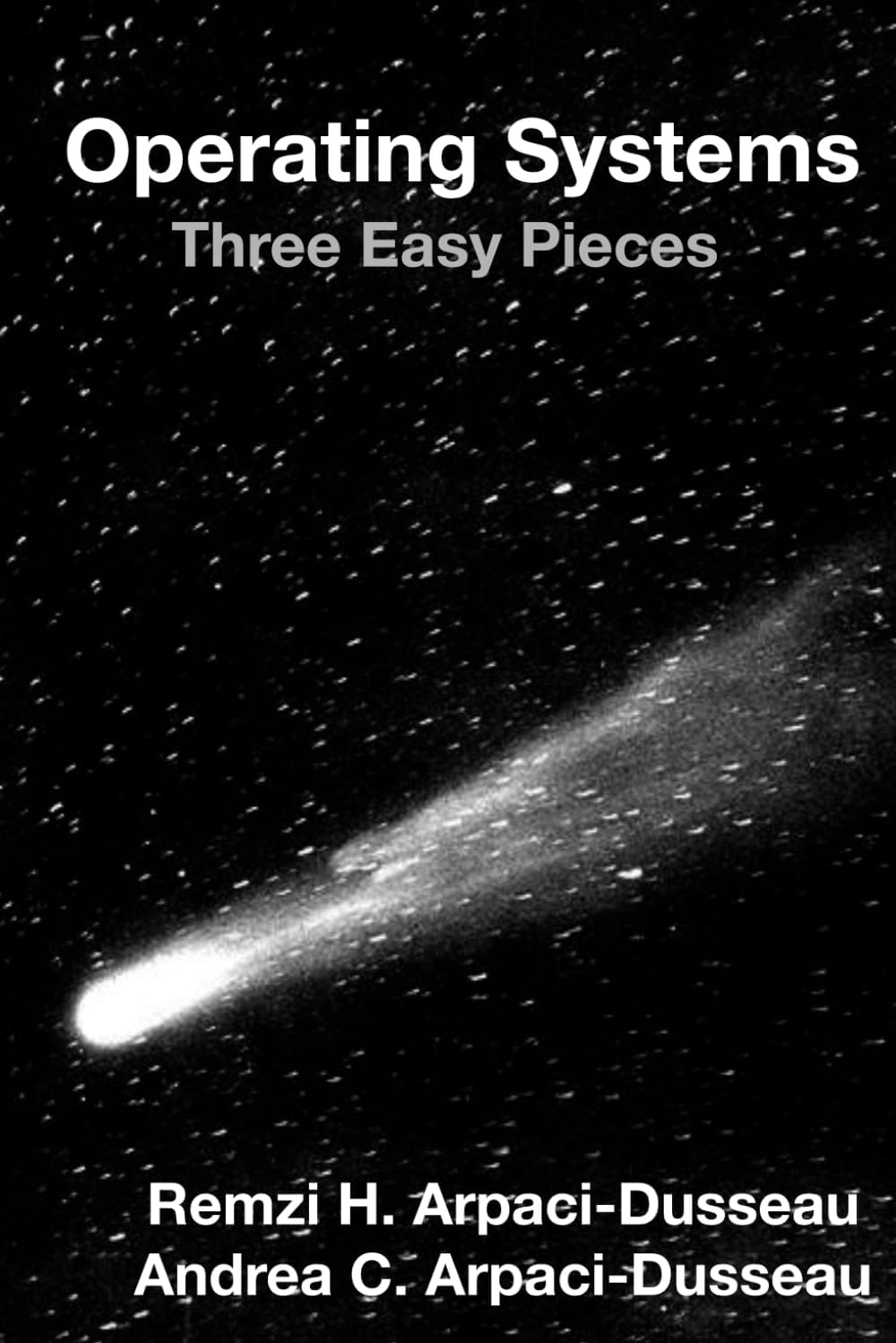
Operating Systems
Product ID: 321242630
Buy anything from 5,000+ international stores. One checkout price. No surprise fees. Join 2M+ shoppers on Desertcart.
Desertcart purchases this item on your behalf and handles shipping, customs, and support to Iceland.
Buy Operating Systems by Arpaci-Dusseau online on desertcart.ae at best prices. ✓ Fast and free shipping ✓ free returns ✓ cash on delivery available on eligible purchase. Review: One of the best books, if not the best, on Operating Systems. The entire topic is divided into three pieces, virtualization, concurrency and persistence. The treatment on the virtualization and concurrency is almost perfect. Each chapter is built upon the other and flows in a way that helps you understand what's going on. The topic itself is mind bending, and it's actually not an easy subject. If you find yourself struggling, don't give and don't panic, just read the chapter slowly again, most of the time for a CS undergrad student, the second time works. Chapters such as Thread API, Locks, Conditional Variables, Semaphores, and Common concurrency problems (deadlocks) are key for any aspiring software engineers. The authors know the in and out of the topic, and the book is gold. Printing-wise, it's not a fancy textbook, but the printing is solid, the page paper's thickness is great. It's almost 700 pages double sided printing for 35 Canadian dollars, it's like someone printed out for you for 5 cents a page. You can't ask for more! Review: Great contents. Written well, reads well. Physical book itself is mediocre. Medium size book itself but huge borders mean the printed pages are small. Page quality differs within the bind too - odd. Boring cover. Find a better distributor
| Best Sellers Rank | #68,114 in Books ( See Top 100 in Books ) #368 in Computer Programming #414 in Computer Science #6,647 in Higher & Continuing Education Textbooks |
| Customer reviews | 4.6 4.6 out of 5 stars (557) |
| Dimensions | 15.24 x 4.29 x 22.86 cm |
| Edition | 1.00 |
| ISBN-10 | 198508659X |
| ISBN-13 | 978-1985086593 |
| Item weight | 998 g |
| Language | English |
| Print length | 714 pages |
| Publication date | 1 September 2018 |
| Publisher | Independently Published |
F**N
One of the best books, if not the best, on Operating Systems. The entire topic is divided into three pieces, virtualization, concurrency and persistence. The treatment on the virtualization and concurrency is almost perfect. Each chapter is built upon the other and flows in a way that helps you understand what's going on. The topic itself is mind bending, and it's actually not an easy subject. If you find yourself struggling, don't give and don't panic, just read the chapter slowly again, most of the time for a CS undergrad student, the second time works. Chapters such as Thread API, Locks, Conditional Variables, Semaphores, and Common concurrency problems (deadlocks) are key for any aspiring software engineers. The authors know the in and out of the topic, and the book is gold. Printing-wise, it's not a fancy textbook, but the printing is solid, the page paper's thickness is great. It's almost 700 pages double sided printing for 35 Canadian dollars, it's like someone printed out for you for 5 cents a page. You can't ask for more!
B**G
Great contents. Written well, reads well. Physical book itself is mediocre. Medium size book itself but huge borders mean the printed pages are small. Page quality differs within the bind too - odd. Boring cover. Find a better distributor
A**R
It is not 747 pages, nor the latest version.
A**S
A little hard to read(small font size) and sometimes difficult to understand. Take your time to read it and at the end you will understand what OS is and how it works.
Y**Y
I wish I'd read this book years ago. This book covers 3 broad areas: virtualization, concurrency, and persistence. In my opinion the most worthwhile sections are the ones on virtualization. I found the sections on cpu virtualization (processes, interrupts, scheduling, context switches, etc) to be quite the riveting read, and super useful in my day-to-day work life. The sections on memory virtualization were equally useful, but I have to caution potential readers that this is probably the most difficult part of the book. It's written well, and everything is introduced step by step and with good motivation behind it, but... memory is just a lot more complicated than you think. Don't get discouraged if it doesn't click right away. For some reason, every book in the history of mankind has an uncontrollable urge to give the exact same treatment of concurrency as every other book, so the concurrency sections didn't "do it" for me. Finally, the persistence sections... there is some good and some bad here. The good would be the descriptions of a few unix file systems; I now have a very good understanding of what ext2/ext3/ext4/zfs are, how they work, what the tradeoffs are, and so on. I have a very good understanding of what it means to "mount" a device. I have good understanding of how paging works, and how memory can act as a cache for disk - at a low level. However, there is a lot of additional stuff in this chapter that doesn't need to be there IMO. To wit, descriptions of the various levels of hardware RAID (hardware raid is on its way out - software RAID does it all but better, and with only a small amount of overhead), and a collection of chapters on how flash-based storage works. Spoiler: flash-based storage is a nightmare. Just be glad somebody else did the work here, and cross your fingers that you never have to understand this stuff. I would happily pay full price for this book for just the virtualization parts. I am giving it 5 stars 100% because of the virtualization parts. The difference between knowing and not knowing these topics deeply is like night and day. It is difficult to impress upon you, dear reader, just how much of a difference this knowledge makes, in terms of confidence and competence in working in a unix-like environment. Finally, if you've read this far, let me recommend a followup to work through some time after this book: Computer Systems: A Programmer's Perspective. It has a lot of overlap with this book but is more advanced (for example, OSTEP covers memory virtualization over a hundred pages or so. CS:APP covers it in passing in like 10 pages, but uses this as the beginning of its treatment of memory mapping).
Trustpilot
2 weeks ago
2 months ago