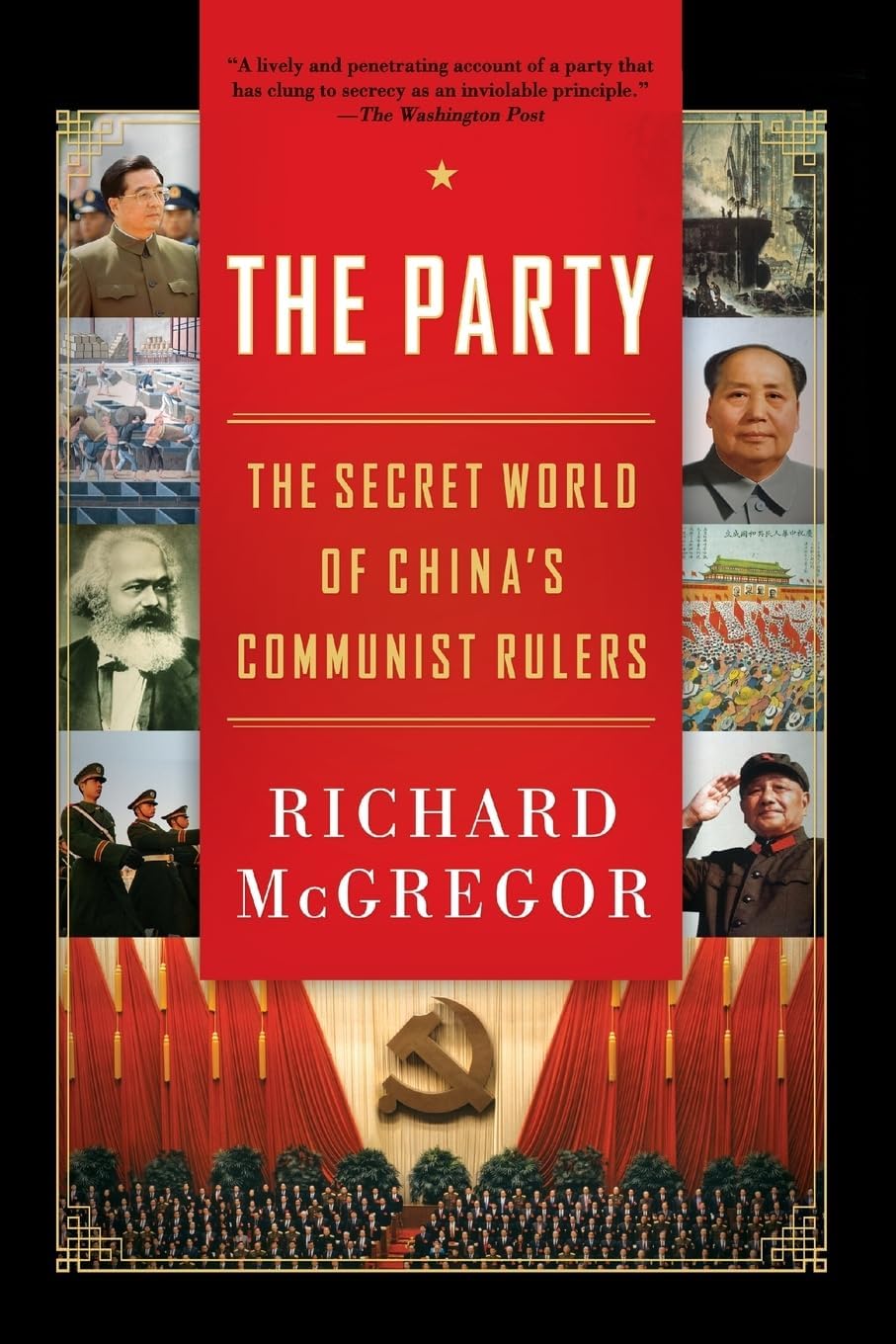
The Party: The Secret World of China’s Communist Rulers – A Revelatory Inside Look at the CCP's Grip on Power
Product ID: 320111
Buy anything from 5,000+ international stores. One checkout price. No surprise fees. Join 2M+ shoppers on Desertcart.
Desertcart purchases this item on your behalf and handles shipping, customs, and support to Iceland.
“A masterful depiction of the party today. . . . McGregor illuminates the most important of the contradictions and paradoxes. . . . An entertaining and insightful portrait of China’s secretive rulers.” —The Economist “Few outsiders have any realistic sense of the innards, motives, rivalries, and fears of the Chinese Communist leadership. But we all know much more than before, thanks to Richard McGregor’s illuminating and richly-textured look at the people in charge of China’s political machinery. . . . Invaluable.” — James Fallows, National Correspondent for The Atlantic In this provocative and illuminating account, Financial Times reporter Richard McGregor offers a captivating portrait of China’s Communist Party, its grip on power and control over China, and its future. China’s political and economic growth in the past three decades has been one of astonishing, epochal dimensions. The most remarkable part of this transformation, however, has been left largely untold—the central role of the Chinese Communist Party. McGregor delves deeply into China’s inner sanctum for the first time, showing how the Communist Party controls the government, courts, media, and military and keeps all corruption accusations against its members in-house. The Party’s decisions have a global impact, yet the CCP remains a deeply secretive body, hostile to the law and unaccountable to anyone or anything other than its own internal tribunals. It is the world’s only geopolitical rival of the United States, and is primed to think the worst of the West. Review: Illuminating introduction to arguably the most important political party in the world - Politics in China can be often opaque to foreigners. In some sense it is surprising the lack of literature on the Chinese Communist Party and the means in which it functions, but as illustrated in this book, much happens behind closed doors. If one wants an introduction to the party as well as the way in which it governs and integrates itself then this serves perfectly. After reading this one gets a better perspective on how the party operates, the stresses that it deals with, how it has adapted in the past and what it is dealing with today. The Party uses both example and commentary to show by example how the Party is behind some of the major business decisions of recent history. It gives examples of how the Party directly influences some of the biggest corporates on the planet. In particular the rotation of the CEOs of the 3 biggest chinese telco operators was done behind closed doors without consultation with the public. It discusses Chalco's impact on disrupting one of the biggest potential mergers in modern business history (Rio and BHP), as such a merger would shift bargaining power of mineral prices away from consumer (china) and towards producer. Its actions need to be assessed through the lense of an entity who is both asserting and preserving its power as well as protecting its sovereign interests. The Party also discusses the internal stresses faced by the communist party. With the phenomenal success of the chinese economy and the wealth that has been created with growth comes greater competition between the lure of the party, and the desire for commercial wealth. This stress has been a source of corruption and rent seeking. With economies directed from the bottom up with preferential state lending, the position of power of local authorities can and is used for personal benefit. The party it is argued acknowledges and accepts this. It must deal with both punishing examples to show vigilance but realizing that removing the rents that are recieved with political power would remove the incentive to join and thus would promote instability. Overall this is a fascinating overview of how the Chinese Communist Party operates and what it has to deal with. It has had to adapt quickly, and the stresses it is dealing with will likely intensify over time. The way in which the party maintains its power is on a tightrope in which differences in opinion within the party are abundant. Nonetheless they have so far been able to form consensus and progress despite their differences. It is the ability to unify and come to consensus that has taken them this far, despite some near break points. Whether that will continue to be the case, time will tell, but as an overview on what is happening today and some of the solutions the party has crafted, this book is excellent. It is a must read to gain perspective into how the communist party operates and how it sees things. Review: Highly recommended reading for anyone working in China, investing in China, interested in China - This is one of the most well researched and chronicled books on the impact that the Communist Party has over all things in China. The author has meticulously researched (from Chinese and non-Chinese sources) the topic and the major structures of one of the most closed, opaque political systems in the world. Even though the central leadership, standing committee memberships and politburo has changed (as of 2012), this is still highly relevant to many of the themes that the Party continues to struggle with and confront. This includes the growing middle class and income disparity, State-Owned versus Private Corporation governance, environmental issues, the major anti-corruption campaign underway. And this books helps understand why these dominate the party, and why the party behaves the way it does. And the author does this in a very effective manner - well organized, well researched, and well sourced. The chapters on the Shanghai Gang are also very informative as it allows the reader to understand the massive struggle Xi Jinping must of had (continues to have) in installing his key officials into key posts that will help him with his policy agenda. Highly recommend this for anyone doing business in China (or with Chinese companies), travelling or planning to live in China as this book provides a very well-rounded view of the key decision making body that is present throughout all aspects of life in this interesting country.
| Best Sellers Rank | #140,705 in Books ( See Top 100 in Books ) #80 in Asian Politics #105 in Chinese History (Books) #110 in Communism & Socialism (Books) |
| Customer Reviews | 4.5 out of 5 stars 559 Reviews |
A**N
Illuminating introduction to arguably the most important political party in the world
Politics in China can be often opaque to foreigners. In some sense it is surprising the lack of literature on the Chinese Communist Party and the means in which it functions, but as illustrated in this book, much happens behind closed doors. If one wants an introduction to the party as well as the way in which it governs and integrates itself then this serves perfectly. After reading this one gets a better perspective on how the party operates, the stresses that it deals with, how it has adapted in the past and what it is dealing with today. The Party uses both example and commentary to show by example how the Party is behind some of the major business decisions of recent history. It gives examples of how the Party directly influences some of the biggest corporates on the planet. In particular the rotation of the CEOs of the 3 biggest chinese telco operators was done behind closed doors without consultation with the public. It discusses Chalco's impact on disrupting one of the biggest potential mergers in modern business history (Rio and BHP), as such a merger would shift bargaining power of mineral prices away from consumer (china) and towards producer. Its actions need to be assessed through the lense of an entity who is both asserting and preserving its power as well as protecting its sovereign interests. The Party also discusses the internal stresses faced by the communist party. With the phenomenal success of the chinese economy and the wealth that has been created with growth comes greater competition between the lure of the party, and the desire for commercial wealth. This stress has been a source of corruption and rent seeking. With economies directed from the bottom up with preferential state lending, the position of power of local authorities can and is used for personal benefit. The party it is argued acknowledges and accepts this. It must deal with both punishing examples to show vigilance but realizing that removing the rents that are recieved with political power would remove the incentive to join and thus would promote instability. Overall this is a fascinating overview of how the Chinese Communist Party operates and what it has to deal with. It has had to adapt quickly, and the stresses it is dealing with will likely intensify over time. The way in which the party maintains its power is on a tightrope in which differences in opinion within the party are abundant. Nonetheless they have so far been able to form consensus and progress despite their differences. It is the ability to unify and come to consensus that has taken them this far, despite some near break points. Whether that will continue to be the case, time will tell, but as an overview on what is happening today and some of the solutions the party has crafted, this book is excellent. It is a must read to gain perspective into how the communist party operates and how it sees things.
C**O
Highly recommended reading for anyone working in China, investing in China, interested in China
This is one of the most well researched and chronicled books on the impact that the Communist Party has over all things in China. The author has meticulously researched (from Chinese and non-Chinese sources) the topic and the major structures of one of the most closed, opaque political systems in the world. Even though the central leadership, standing committee memberships and politburo has changed (as of 2012), this is still highly relevant to many of the themes that the Party continues to struggle with and confront. This includes the growing middle class and income disparity, State-Owned versus Private Corporation governance, environmental issues, the major anti-corruption campaign underway. And this books helps understand why these dominate the party, and why the party behaves the way it does. And the author does this in a very effective manner - well organized, well researched, and well sourced. The chapters on the Shanghai Gang are also very informative as it allows the reader to understand the massive struggle Xi Jinping must of had (continues to have) in installing his key officials into key posts that will help him with his policy agenda. Highly recommend this for anyone doing business in China (or with Chinese companies), travelling or planning to live in China as this book provides a very well-rounded view of the key decision making body that is present throughout all aspects of life in this interesting country.
J**N
Communism--a primer on the Chinese version
This book is a real head turner or should I say an eye turner for those looking for an up to date description of how the Communist Party in China controls industry from top to bottom of its society. But if you are looking for a description of original communist theory as postulated by Marxist-Leninist principals then a book on that subject may better suit your needs. But what you can learn from this book is exactly how the Chinese have managed to slowly change their industrial policies to a combination of of communism and capitalism. The author takes you on and interesting insiders view of how corruption, incompetance, and politics have been woven together to create one of the most productive societies in the world. It even in some cases mirrors some of the things going on in our own society which could if left unchecked could lead to the demise of our economic system to the level of China's. The author describes the major departments of Chinese Government and the role each plays in maintaining control of both the industries and the people. The most interesting is the Department of Organization which in our society would be the Personnel Department. It is there that people are selected for positions in government and the private sector. However this department functions with no rhyme or reason and does so simply through the buying and selling of jobs by people who want jobs or in some cases want to lose theirs by crossing this department the wrong way. There is no merit system in China, major players are selected simply by corruption, incompetance or through politics. And if you should happen to be selected for a high level or sometimes a lower lever job you are assigned a Communist party member to watch you to make sure you tow the Party line. Sometimes the CEO and your assigned party member are regarded as being at the same level of power in a company or government agency. Talk about confusion about lines of authority and role in society. Imagine writing a job description for those jobs. Sometimes the party member is also the CEO. So he gets to watch himself. Obviously he is not going to report on himself. This opens the door to the question as to how China even functions in any productive way but it does this through deceit,lies, and the general ignorance of its population. What an eye opening book!! A must read for all Americans.
S**E
Party Keen on Stealth Exposed to Sunlight
Richard McGregor renders a great service to his readers by shedding light on the inner workings of the ruling Chinese Communist Party which is keen on secrecy. The transformation of China's economy and society and its impact on the rest of the world in the last three decades has too often deflected attention from formal politics in Beijing. Highly pragmatic, cynical, and adaptive, the Party has succeeded in the last three decades in linking the power and legitimacy of a communist state with the drive and productivity of an increasingly entrepreneurial society. The party's legitimacy still depends largely on the economy and its accompanying resurgent patriotism and nationalism. For all its increasingly international presence, China and, therefore, the Party will remain focused mainly on solving the country's problems due to their scale, depth, multiplicity, and variety. McGregor shows systematically how high secrecy, tolerance of non-embarrassing corruption in its ranks, resolute hostility to the rule of law, and vindictive pursuit of enemies are all vital for the Party if it wants to remain at the core of the modern Chinese narrative through its tight grip on 1) personnel, 2) propaganda, and 3) People's Liberation Army. At the same time, the Party has traded in Mao Zedong's totalitarian terror for a seductive modus vivendi with Chinese citizens. As long as ordinary Chinese accept the enlightened leadership of their empowered elite and do not ask for either accountability or the rule of law, they can pretty much lead their life and career as they see fit and eventually get rich. McGregor also shows clearly that although the Party has adapted its membership make-up to ongoing changes in China, it is struggling to keep up with the rapidly evolving aspirations, demands, and cleavages of the Chinese society. However, the bargain that the Party has struck with ordinary Chinese does not exist in a vacuum. The Party's propaganda system has to constantly remind Chinese citizens that there is no serious alternative to the Party in order for it to remain at the top of Chinese society. The Party is also keen to minimize its profile abroad. For example, the Party likes to promote the largest state-owned enterprises (SOEs) that are publicly traded in Hong Kong and outside mainland China as independent commercial entities. The Party's myriad functions, starting with its control over top management of these SOEs, have been downplayed systematically. In summary, McGregor convincingly demonstrates that the Party is determined to pursue its own model of economic, political, and social development on its own implacable terms. The rest of the world, especially the West, has no other option but to adapt to the reemergence of China, regardless of the ultimate outcome of this metamorphosis.
W**R
No time soon ....
There is no need to add to the praise of McGregor's work other than to say he brought with him a Sovietologist background when he turned to the Chinese Communist Party that allowed him to see what many others have missed and that is the core embedded Leninist principles as the foundation of the CCP's mode of operation at all levels of activity. As the term Communist has been washed away in western dialog about the Peoples Republic of China McGregor never makes that mistake. His work is a brilliant analysis of the strengths and weakness of the system and he lists the many forecasts that have been made of its inevitable demise but it is worth quoting his final conclusions. "It has always been easy to construct scenarios under which the Party loses power. A financial crisis was a favoured one for years. As it turned out, the great financial crisis of the early twenty-first century came to symbolize the eclipse of the west, and China's rise, rather than the other way round. ... Within China, the country's distinctive system is not a source of concern. Rather, it is played up as a point of pride. The Global Times, the nationalistic tabloid owned by the People's Daily, the Party's mouthpiece, trumpets how China's rise has ended the post-Cold-War `unilateral' world lorded over by the USA. `The biggest contribution that China has made to world politics is that through revolution, reform and development China has shown the world that the Western model is not the only way to modernize,' it said in an opinion piece in October 2009. `China has also demonstrated that the non-Western world does not necessarily follow the West's footsteps.' The editorial captured a longtime article of faith in China that is only now becoming evident in a western world still recuperating from the financial crisis. The end of the Cold War did not mean the end of history after all. The Chinese communist system is, in many ways, rotten, costly, corrupt and often dysfunctional. The financial crisis has added a dangerous dash of hubris to the mix. But the system has also proved to be flexible and protean enough to absorb everything that has been thrown at it, to the surprise and horror of many in the west. In the absence of democratic elections and open debate, it is impossible to judge popular support for the Party with any degree of accuracy. But it is indisputable since Mao's death that the twin foundations of the Party's power-economic growth and resurgent nationalism-have been strengthened. China has long known something that many in developed countries are only now beginning to grasp, that the Chinese Communist Party and its leaders have never wanted to be the west when they grow up. For the foreseeable future, it looks as though their wish, to bestride the world as a colossus on their own implacable terms, will come true." This is 2014, the year another approach by Neo-Marxist analysts* list as the likely date of the collapse of the Chinese economy for its similarities to western capitalists systems. They might reevaluate all their conclusions regarding China if they were to see what McGregor was capable of seeing; a mixed economy with a dynamic non-state sector harnessed to a vibrant state sector like no other communist model. To quote again: "The Party's genius has been its leaders' ability in the last three decades to maintain the political institutions and authoritarian powers of old-style communism, while dumping the ideological straitjacket that inspired them. The Party's conscious retreat from the private lives of Chinese citizens over the same period had a similarly liberating effect on society. The dehumanization of everyday life that characterized traditional communist societies has largely disappeared in China, along with the food queues. In the process, the Party has pulled off a remarkable political feat, somehow managing to hitch the power and legitimacy of a communist state to the drive and productivity of an increasingly entrepreneurial economy. The visible hand of the state and the invisible hand of the market, far from being contradictory, are made to complement and reinforce each other." * See Endless Crisis: How Monopoly-Finance Capital Produces Stagnation and Upheaval from the USA to China Foster, John Bellamy; McChesney, Robert W. W. (2012-09-01)
M**E
Required reading!
This is a very readable, fascinating book that puts together what a lot of people who pay any attention to China already know - yet perhaps fail to "appreciate". The central premise is that the CCP works very hard, and largely successfully, to stay behind the scenes, and to run the country through nominal governmental, judicial and legislative entities that are for all practical purposes "front" organizations with no independent power. It makes one appreciate how the rule of law really is the underlying basis for all liberty. The next time I'm confronted with a bureaucratic rule being blindly enforced by an unsympathetic bureaucrat... I will try to appreciate how much better that is than having to deal with party officials with almost unlimited power to decide whether to be helpful or obstructive based on their own discretion. The book itself is very readable. There are a couple of places where the writing is a bit repetitive -- chapter introductions are like "executive summaries" of each chapter. My Kindle edition had a small number of typographical errors that did not interfere with the book's overall readability. If you do business with China, or are interested in China, or have views on how the west interacts politically with China, you really ought to read this book to help inform your understanding of the fascinating country and state that is modern China.
D**W
Good on how the Chinese party works, not a great read, could have used editing
A good book on understanding how the Chinese communist party really works and why things are done the way they often are. It makes one think about how to feel about what the Chinese government does, proposes to other governments and so on. Unfortunately the book could have used a stern editor - some of it reads slowly to say the least, some of the details of examples are unnecessary or repetitious, and so on. So not a good bedtime read as one may fall asleep.
A**R
The Party survival is of paramount importance, not the people's livelihood, not the nation's welfare.
An extremely insightful book. I have been puzzled by many actions of the players of the Chinese Communist Party (CCP) until I have read this book. The central thesis of the book is this: the primary aim of all the important players of the CCP was the survival of the Party, all else are secondary - the people, the nation, morality and so on. Once one accepts that idea, then many of the actions of the CCP become understandable. Take for instance Xi's drive to weed out corruption. Since taking power, Xi has been issuing statement that it is important for the survival of the party to weed out all corruption. But then a few weeks ago, 2 activists who were calling for the declaration by party members of the assets they own to be made public, arguing this is one way of preventing corruption in high places. But to the dismay of many, these two were arrested. Surely, if Xi was sincere in trying to weed out corruption, those two activists should not be arrested. However, having read the book, their arrests were fully understandable. First, note that Xi's reason for his weeding out corruption was that if corruption was to continue on its grand scale, that would undermine the survival of the party. He is doing it not out of any sense of justice or morality, it's out of necessity for the survival of the party. Second, if he takes heed of the activists call for transparency of asset holdings by party members, that would probably show to the Chinese people that everyone in the party, and possibly even he himself or his family, are corrupt! That would undermine the survival of the party. By arresting the two activists, and keeping the mechanism for the weeding out of corruption within the party itself, that would both assuage the anger of the people regarding corruption as well as allowing those untouched by any scandal to continue their robber baron method of getting rich, at the same time ensuring the survival of the party. The party HAS to survive in order to allow them to continue to make money. In so far as the people must be kept docile in order to let the party survive, the people would be allowed economic freedom, particularly when economic freedom can let the people make money, which the Party can then parasitize upon.
A**H
A more thoroughly understood analysis of the Chinese Government
The Party turns both commonly misunderstood analyses of China on their head, namely that China has a wholesale embrace of unrestrained capitalism, and the more unobservant one, that China is still communist. The Party's central thesis is that, in the words of one Beijing University professor "The Party is like God. He is everywhere, you just can't see him." What follows is a series of detailed accounts of how the party is at the heart of all the instruments of state, the economy, the media, and the military. Chapters 1, 2, 3 and 6 are in many ways rather similar, detailing the party's involvement in the economy, in both state and private enterprise and how the demarcation between the state and private sector are increasingly blurred. Toward the end of the book, greater insight is shown into several high profile corruption cases, such as the Sanlu baby milk poisoning scandal, and the initial attempt to cover it up. Perhaps little new is offered in the chapter concerning corruption, an issue highly familiar to many China hands, but the most insightful chapter for myself was Chapter 4, Why we fight: The Party and the Gun. Here is examined one of the most curious aspects of modern China, and indeed the modern world, a national military, the world's largest by standing troop numbers, who's first loyalty is to the party, as opposed to most other armies, who's first loyalty is to the state and constitution. The workings of the subordination of the military to the party are given better examination than this reader has hitherto encountered, and chapter 4 is a chapter worthy of disciplined re-reading. The final chapter on the Party and their official rendering of history, and control of the national media may be familiar to experienced China hand's but nonetheless new insights are contained. On the whole, The Party is a highly readable and detailed examination of China's system, and essential reading for new and old China hands alike.
E**R
Indispensable pour comprendre la Chine
Un journaliste d'investigation se fait recevoir officiellement par le Parti chinois. Il parle la langue et connait le pays. Il a rencontré des jeunes et des vieux, des gens importants et des gens mis au placard. Il emmène le lecteur dans un voyage qu'on ne peut pas oublier. Depuis des années j'assistais aux évènements sans comprendre. Je suis (un peu) éclairé maintenant. La version numérique est honnête et lisible (les images trop petites).
R**S
A must read
Goes into the inner workings of the Party, which is still as much of an underground operation as an official organisation. A must read to understand rising China.
B**N
Focus on the hidden architecture behind China’s modern rise
An illuminating deep dive into the inner workings of the Chinese Communist Party (CCP), written with the sharpness of investigative journalism and the clarity of a well‑crafted narrative.
C**D
china
very complete analysis of china capitalist version of communism' (1984)!!
Trustpilot
1 week ago
1 month ago