
DOWNLOAD THE APP


Customer Services
Copyright © 2025 Desertcart Holdings Limited
DOWNLOAD THE APP
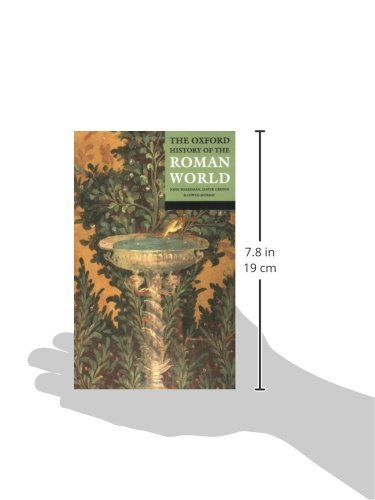
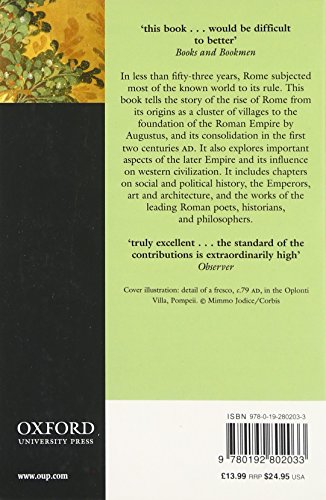
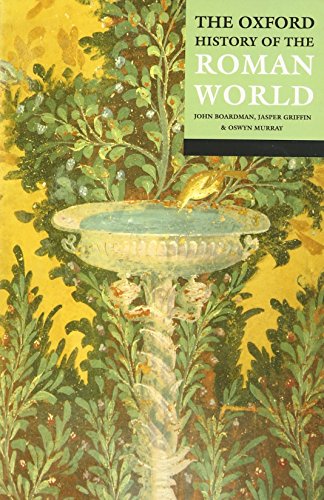
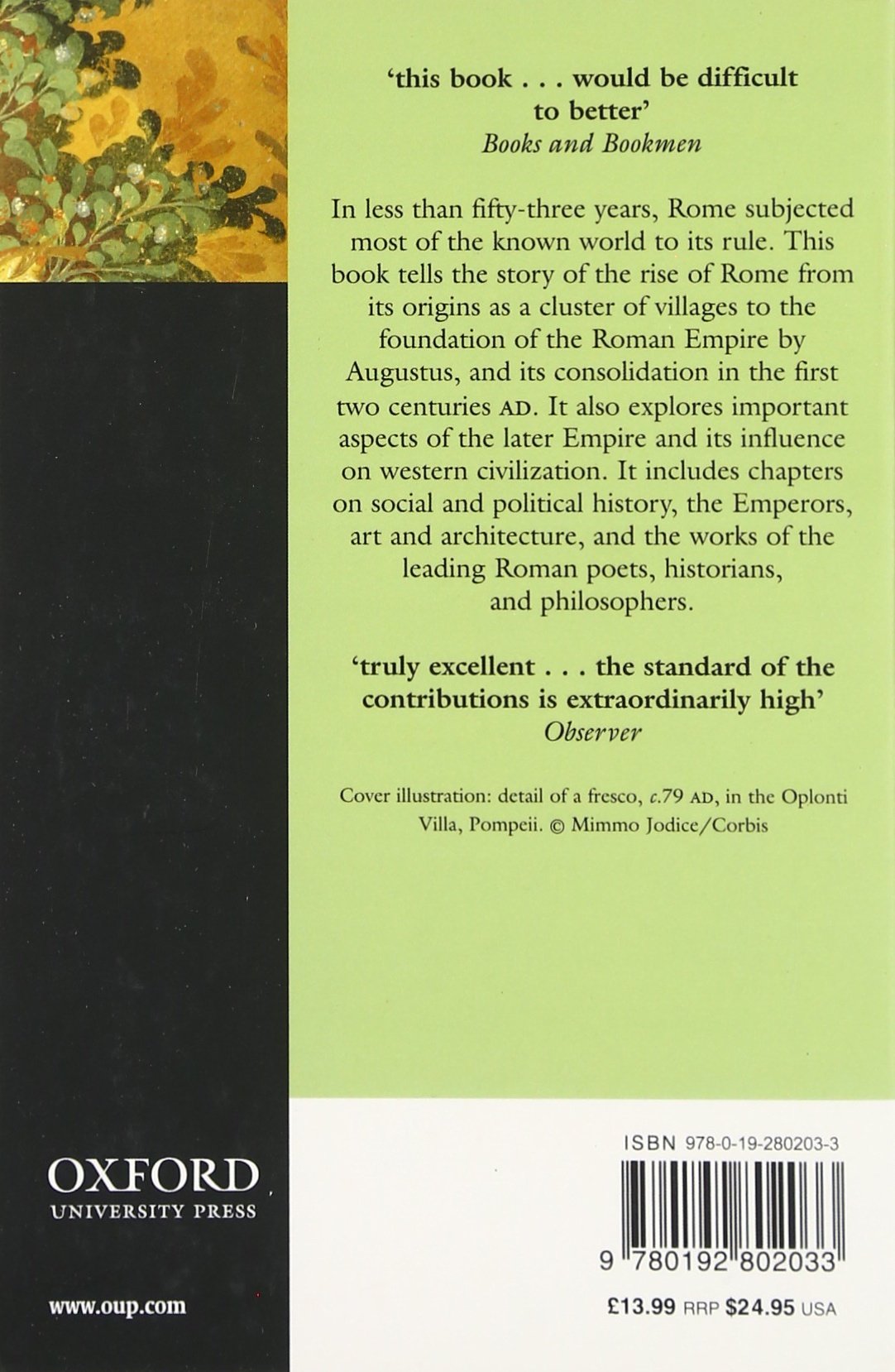

OXFORD UNIVERSITY PRESS The History of the Roman World : Boardman, John, Griffin, Jasper, Murray, Oswyn: desertcart.ae: Books Review: Interesting and informative Review: very philisophical nibeliy
| Best Sellers Rank | #395,123 in Books ( See Top 100 in Books ) #469 in History of Ancient Rome #775 in Legal Theory & Systems #19,289 in Religion & Spirituality |
| Customer reviews | 4.3 4.3 out of 5 stars (60) |
| Dimensions | 19.3 x 12.95 x 3.3 cm |
| Edition | Reissue |
| ISBN-10 | 0192802038 |
| ISBN-13 | 978-0192802033 |
| Item weight | 1.05 Kilograms |
| Language | English |
| Print length | 528 pages |
| Publication date | 27 September 2001 |
| Publisher | Oxford University Press |
J**N
Interesting and informative
A**R
very philisophical nibeliy
B**R
Ce lit avec plaisir.
A**D
Too dry and academic especially on the first few chapters about Rome's beginnings and government. Written by various experts, no wonder you can't count on a consistently enjoyable elucidation of a specific topic; I skipped or didn't finish most of the chapters ('Virgil' and 'Roman Historians' are good though). Compared to 'Greece and the Hellinistic Period' (which I thoroughly enjoyed), this one is a borefest.
S**E
The Oxford History of the Roman World is, first and foremost, an excellent edition and a perfect primer for the lay-historian and undergraduate. I am not denying that fact (though in this case I wish it was possible to give this book 4 1/2 stars, but nevertheless...); what I will do now, however, is go into a bit more detail about the positives and negatives of this broad history. Being The Oxford HISTORY of the Roman World, one logically starts with the pure historiography. It is very good indeed, but, unlike the Oxford History of Greece (a superior volume), the pure history stops about mid-way through the book and is replaced with more specific chapters dealing with literature, philosophy, religion, art and architecture. All of these are fascinating, in particular literature and philosophy, but the history of the later Imperial times becomes somewhat muddled due to no chapter dedicated solely to the background of the period. This is disappointing, even more so because it certainly could have been done: the final chapter, Envoi: Taking Leave of Antiquity, is an excellent chapter on, among other things, the (very) general history of the fifth century Roman Empire (up to its collapse in 476 AD by the Goths), and the Cambridge authority who wrote it, I feel, could have easily written a larger chapter on solely the history of the Imperial period to be slotted into it's appropriate place. Unfortunately that is not the case and the volume, in this regard, is left feeling naggingly incomplete. The chapters on philosophy and literature, as I have said, are excellent (philosophy, I feel, more interesting.) Like the Greek history had its chapter dedicated to Homer, so does the Roman history have a chapter dedicated to Virgil - both are fascinating. The philosophy component is excellent, but I felt it was underrepresented in this volume. It had a large presence in the Greek edition and I found it enthralling reading. The chapters on art and architecture were interesting indeed, but there were too many and they were too lengthy. Art and architecture for the casual historian is important but perhaps too specialised a field to have such a large presence in the general history of a period. They would do better to be either cut down in length and number or saved for another, more comprehensive, volume. As they stand they are interesting; but it leaves me wondering what they left out to include these (perhaps my missing history of later Imperial Rome!) Overall, this is an excellent volume and a great primer for those wishing to understand ancient Rome from it's foundations to the collapse of the Western Empire. For all its faults I couldn't bear to give it four stars - four and a half would have been perfect but, alas, that cannot be done. So I give it five. As always, the bibliography and further reading sections are excellent, as are the maps and the overall quality of the book's construction. Enjoy (and I won't hold it against you if you skip the Art and Architecture essays!). You won't regret it.
Trustpilot
1 month ago
1 day ago