Desertcart purchases this item on your behalf and handles shipping, customs, and support to Iceland.
🛠️ Fix it once, fix it right — the epoxy that works as hard as you do!
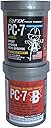
PC Products PC-7 is a heavy-duty, two-part epoxy paste designed for professional-grade bonding, sealing, and filling. With a 60-minute work time and a tensile strength of 2150 psi, it bonds over 10 materials including metal, wood, glass, and concrete. Its high wet grab formula prevents drips and sagging, making it perfect for vertical and overhead repairs. Resistant to chemicals and extreme temperatures (-20°F to 200°F), PC-7 cures rock hard in 24-48 hours while maintaining slight flexibility to withstand movement. Trusted by pros for durable, versatile fixes indoors and outdoors.


| ASIN | B000BOHJJ0 |
| Best Sellers Rank | #5,028 in Industrial & Scientific ( See Top 100 in Industrial & Scientific ) #10 in Tile Epoxy Adhesives |
| Brand | PC Products |
| Brand Name | PC Products |
| Color | Charcoal Gray |
| Compatible Material | Brick, Ceramic, Concrete, Fiberglass, Glass |
| Container Type | Can |
| Customer Reviews | 4.6 out of 5 stars 2,321 Reviews |
| Full Cure Time | 48 hours |
| Global Trade Identification Number | 00054983167779 |
| Included Components | (1) PC-7 |
| Item Form | Paste |
| Item Package Quantity | 1 |
| Item Type Name | PC-7 Epoxy Adhesive Paste, Two-Part Heavy Duty |
| Item Weight | 1.6 ounces |
| Manufacturer | Protective Coating Co. |
| Material | Paste |
| Material Type | Paste |
| Model | 167779 |
| Number of Pieces | 2 |
| Other Special Features of the Product | Extended working time, High wet grab |
| Part Number | 167779 |
| Special Feature | Extended working time, High wet grab |
| Specific Uses For Product | Casting, Countertop, Craft, Flooring, Masonry, Repair, Tile Repair, Wall Repair |
| Tensile Strength | 2150 psi |
| UPC | 371904680866 549831677796 054983167779 |
| Unit Count | 16 Ounce |
| Viscosity Level | Medium to High |
| Volume | 1 liters |
| Warranty Description | Warranty |
| Water Resistance Level | Water Resistant |
T**N
Rock hard but not brittle
Consistent good results: I used it for two weeks now and made about 6-7 batches to glue metal banisters into the handrail of my staircase. Each batch cured well and there seems no difference in the end result despite the fact that I didn’t measure anything. I just eyeballed as best as I could. Work time: I actually don’t know! I used each batch within about an hour after mixing at about 70 degrees and low humidity. I noticed it got a little stiffer, but otherwise still as sticky as before. Cure time: After 24 hours it was very hard but had some minimal flexibility and after 48 hours it appears fully cured. However, this material doesn’t become brittle, which is important for my application as there is always going to be movement between the wood and metal. Consistency of paste and mixing: Each component has a distinctive different consistency. The light gray (part 1) is somewhat crumbly, grainy and slightly sticky. You can get it easily out of the can and reasonably well of the spatula that I used to scrape it out of the can. The pitch-black hardener (part 2) is a totally different story. It is annoyingly sticky and although thick, will slowly flow. Think of ultra-thick honey. This makes it a pain to get out of the can and very difficult to get off the spatula. Now to the mixing part. Somewhat difficult because it is sticky and thick, but within 3-5 minutes you end up with a dark grey paste that has the consistency of chewing gum. When you try to lift a small amount off the mixture, you will stretch the material until it gets thin enough to break off. For me, the best tool was a disposable chop stick which I rolled back and forth to capture the stretched-out material. Stickiness: I had to work it into the wood grain for it to stick well. For example, if I would drop a small amount on a smooth surface, I would suspect you could easily pry it off once it is cured. But once it is pressed into place it will never come off. Flow properties while uncured: As I alluded to before, this material will flow a little bit over the course of 1-2 hours. In my case, I had to smear it into the holes at the bottom of the handrail. It worked reasonable well, but you can't put too much in the hole or it will slowly flow out.
F**1
Great overall epoxy for projects that require no running and strong bonds.
This is a much more affordable replacement for JB Weld. It has a long 1 hour working time. It does take a good 24 hours to cure solidly. The first hour it is still malleable by using a alcohol to smooth out the surface. It cures rock hard if you mix it in the right proportions and is mixed thoroughly. It sands very easily. I use this for creating fillets on high powered rocket fins, both plywood or fiberglass. Its easy to work with. It does not run/slide like thinner epoxies which allows you to apply it to multiple locations on your project at the same time. It is pretty thick to mix but is a great product overall. It is super strong. Use tape to mask off the area you don't want it to come in contact with.
M**N
Slow cure at room temperature but quite strong and easy to shape but tricky to handle.
As with most adhesives you need some experience with each product to become familiar with it and how it works. I am in no way 'knocking' PC-7 here just explaining how it performs in normal use. 1] It is a thick paste that mixes easily and is slow to cure. At room temperature it can take days to fully harden. I have not experimented with accelerating cure time at all, the long working time can be both handy and frustrating. 2] Mixing is a breeze. It requires more effort than other epoxies, but it is easy to tell when it is fully mixed. Mixed PC-7 is a stiff paste that is extremely sticky. It is not going to flow in place and needs to be forced to fill gaps and large voids. A good set of disposable gloves is almost necessary to work with this stuff and don't think it won't stick to the gloves. Planning how you are going to place and handle PC-7 is important. You have been warned. 3] Once placed, final shaping is simple. I cut a finger off a spare glove and use water to shape the final finish. Not too much water, just enough to keep it from sticking. Dip your finger in some water and re-wet it when you think it might be starting to stick. 4] PC-7 vs JB Weld: PC-7 is a paste once mixed and probably has more air inclusion than JB Weld. It is slower to cure and really seems like an 'apples to oranges' comparison. IMHO JB Weld is a little stronger, but not so much that it matters materially. Fully cured JB Weld is more brittle and PC-7 seems to have a little more resilient. It all boils down to use case. For the most part you could use PC-7 or JB Weld, but there are times when only one of the two will do. And yes, I know, JB has a rainbow of specialty formulations. I just wanted to give a primer to new PC-7 users on what to expect.
J**T
Stiff, low coverage, hard to mix.
This is so stiff that i broke the plastic cup mixing it. It did not cover a 2x3' door with a 1/16 notched trowel. I assume it will work. At that coverage it is expensive.
A**E
Favorite glue and repair material
I have used this product for many decades on hundreds of projects-clean up application with denatured alcohol, and let it dry hard( 3-5 days). It is worth the wait ; repair will last forever and be strong, if applied correctly. If you do not wish to have a side not stick, placed wax paper on that surface.
D**N
Used to bond inner bow of wooden boat
Prepare ahead to mix and you'll need gloves and sticks you may want to throw away. Solves while damp with household vinegar. Once it is set it is pretty tough to get off and got some in a tiny crack in my rough hands and it had to be removed like a splinter once it dried. Easiest to simply take both whole cans and put both together on a discardable hard surface (6" x 12" piece of dustless plywood scrap)to mix well. I used plastic painters knives to quickly mix and apply and that worked very well. Cheap enough to use the whole can and make ENOUGH to use all at once. Like I said prepare ahead. Essentially a gooey epoxy that hardens into a VERY tough bond. If it touches a surface (skin etc) then it will stay on it SO remove with household vinegar while damp. The data sheet shows thousands of pounds of tensile strength per sq inch when cured and supported. Not for use around fire etc but in a wooden boat it is excellent to fill and then mill an area. I would tend to use this to fill an area that is well supported rather than put it out on the end of an arm etc as a primary strength point. If you put a greased bolt into the stuff the bolt will back out and leave threads if that does not work heating the bolt with a soldering iron briefly will let it back out also. This can take a thread well if supported well and cured. More for tertiary strength than primary strength (in my opinion) on critical equipment. A very thin coat comes off (pops off) a smooth surface so unless it is affixed to the substrate properly by roughening the substrate a surform will take off a cured thin coat easily. Works best to create a tough bond in an area rather than cosmetic patches. Appears to be pure epoxy without fiberglass fibers unlike Bondo. I will use it when I repair my mast step as opposed to other epoxies. Sands and surforms (micro plane) and scrapes very well once set completely on a roughened surface. Get all amine blush and waxes and oils off the substrate before affixing the PC....
D**S
Will bind almost anything.
I had a very unusual project. My son has a pet moray eel that is extremely friendly, but needed a home in the aquarium. As you can imagine, a moray eel is not a small pet so the home had to be large and durable. The home is a maze constructed from 4" PVC pipe and many elbows to create tunnels for the eel. There several openings within the maze for the eel to escape or enter the maze. Once the maze was built we wanted to disguise the maze a a rock cliff. Florida base rock (A very porous rock, that is cream in color) seemed like the best choice to make the bottom of the tank and back of the tank look like the ocean floor. The issue is that the what every epoxy we selected to bind the rocks to the PVC would have to hold up to the harsh elements in a saltwater aquarium and the abuse from a moray eel. In addition to being able to bond rock to PVC. I watched a video from a website where another individual used PC-7 to bond rock in his saltwater aquarium. The PC-7 was very easy to work with. It is a two part epoxy. Simply mix can A with can B. It gives you plenty of time to work with the epoxy before it sets. Once set, the bond is permanent. Even the harsh elements of being in saltwater does not influence the bond. The eel loves his new home and darts through the maze like a small fish, even though he is several feet long. The home is very realistic, and as a SCUBA diver, I can say it looks like the bottom of the ocean. I would highly recommend this product to anyone that needs a permanent bond that will hold up through any harsh conditions.
S**S
Simple easy patch
Excellent great patch
J**Z
Excelente
Lo utilice para sellar fugas en una fuente y hasta el momento todo bien.
D**E
great service
fast delivery with cirrect product
B**E
Recommended
I've now used this twice to repair stone stairs - once to prevent a crack from growing and the second time to reattach a big chunk of stone that had cracked off when the installers put in the railing. It worked amazing both times. The stair is as solid as it was before the damage. Highly recommend this product.
H**E
Das beste auf dem Markt. Oder auch auf der Welt !
Ich habe viel ausprobiert. Auch auf Empfehlung. Aber als ich PC-7 das erste mal verwendet habe wusste ich gleich. Jetzt ist alles gut. Wichtig ist nur aus Erfahrung eine Aushärtezeit von mindestens 2-3 Tagen. Ich übertreibe nicht ! Das ist der beste 2 K Klebstoff den ich je verwendet habe. Mittlerweile schon seit 1 Jahr für viele Kundenaufträge oder Privat und ich hatte nie irgendwelche Beanstandungen. TOP !! Danke PC-7 und an deren Entwickler
D**S
It sticks to everything I have tried it on so far.
worked on my gas tank. sets up hard and stays where you put it. It does not run. The set time can be slow but speeds up with a little heat.
Trustpilot
1 week ago
2 weeks ago