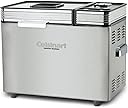
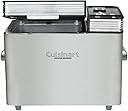


Cuisinart CBK-200 Convection Bread Maker, 12" x 16.5" x 10.25"
Product ID: 300885
Details
- Capacity2 Pounds
- ColorSilver
- Item Weight16 Pounds
- MaterialStainless
- Product Dimensions10.25"D x x
⚡680W Power
🍞2lb Capacity
🕒12-Hour Delay
🍞 Rise to the Occasion with Cuisinart!
The Cuisinart CBK-200 Convection Bread Maker is a versatile kitchen appliance that offers 16 preprogrammed menu options, including gluten-free and low-carb settings. With a 2-pound capacity and unique convection technology, it ensures perfect crusts and textures. Features like a 12-hour delay start and audible alerts for mix-ins make it user-friendly and efficient. Crafted from stainless steel, this bread maker is both stylish and functional, backed by a limited 3-year warranty.
| ASIN | B0009VELTQ |
| Best Sellers Rank | #424,844 in Kitchen & Dining ( See Top 100 in Kitchen & Dining ) #159 in Bread Machines |
| Brand Name | Cuisinart |
| Capacity | 2 pounds |
| Color | Silver |
| Customer Reviews | 4.4 out of 5 stars 4,797 Reviews |
| EU Spare Part Availability Duration | 3 years |
| Global Trade Identification Number | 00086279011046, 10086279011043 |
| Item Dimensions D x W x H | 10.25"D x 16.5"W x 12"H |
| Item Type Name | Convection Bread Maker |
| Item Weight | 16 pounds |
| Manufacturer | Cuisinart |
| Material | Stainless Steel |
| Model Number | CBK-200 |
| Number of Items | 1 |
| Number of Programs | 16 |
| Part Number | CBK-200 |
| Product Care Instructions | Hand Wash Only |
| Product Dimensions | 10.25"D x 16.5"W x 12"H |
| UPC | 702916199389 719918374423 722651274530 804065566934 702916497713 086279011046 887667373353 722651276039 636426181094 |
| Unit Count | 1 Count |
| Warranty Description | Limited 3 Year Warranty |
| Wattage | 680 watts |
B**K
so I wanted to see if the bread machine could bake a better loaf. This is the first bread machine I ...
I live at the 3000' level on top of a mountain in South Carolina and baking bread at this elevation introduces a lot of problems to the bread baker. I had been having a love/hate relationship with bread baking since we moved to this location, so I wanted to see if the bread machine could bake a better loaf. This is the first bread machine I have ever owned, so I had nothing to fall back on. I used the hundreds of reviews to help make the decision on the Cusinart CBK-200 and I was not disappointed. I've baked several loaves since receiving the CBK-200 a few day ago and wanted to let others know about my experience. The instructions in the manual are very clear and easy to follow. For the first loaf, I followed the directions to the letter for the 2lb, medium crust, White Oatmeal Bread on page 2 of the Instruction Manual. I wanted to remove the paddle before baking, so, after I pressed Start, I set the oven timer for 1:25 (elapsed time before the 3rd rise). After 15 minutes into the first rise, I pressed Pause, opened the lid and used a rubber spatula to scrape down the sides of the pan, then pressed Start. When the oven timer went off, the audible tone (explained on page 9) went off (not loud enough) and I pressed Pause (the manual instructs to use oven mitts to remove the pan, but I found that was not necessary, also, you have 15 minutes to remove the paddle before the machine continues), removed the pan, removed the dough ball and removed the paddle, rolled the dough back into a ball and inserted into the pan then reinserted the pan back into the machine and pressed Start. NOTE: The dough at this stage seemed too dry and too hard to me and I made a mental note to add more liquid to the next loaf. The machine continued through the 3rd rise and Bake cycles and issued the Baking Cycle Complete beeps. I pressed Stop (press and hold the Stop/Pause for 3 seconds) otherwise the machine will go into a Warming cycle. Opened the lid, and with a kitchen towel, removed the pan by the handle and placed on the counter (pan will be very hot) to cool. The top of the loaf was light brown. After 15 minutes, turned the pan upside down and shook out the loaf onto a cooling rack.The sides and bottom of the loaf were dark brown and very crusty. After cooling. I sliced the loaf (see photo's), and the crumb was a little hard, but acceptable. The taste of the bread was a little floury and not sweet enough for me. After making a few tweaks to the recipe, I tried another stab at the Oatmeal Bread, and this time the results were almost perfect. There was greater rise than the first loaf, the crust was the same as the first loaf and the crumb was soft. The taste was not floury and quite good. My tweaks were to add an extra tablespoon of Buttermilk, and an extra tablespoon of Maple Syrup. I have since made another loaf of the same bread with an additional tablespoon of sugar and it tasted absolutely wonderful. In closing, even with my brief experience, I highly recommend this bread machine. With a little experimenting, I firmly believe that anyone can produce a loaf of bread that will satisfy any palate.
A**R
4+ years later... I still love it.
Well it's about time I put a review for the machine I used every other day for 4+ years! This is so easy, I mean EASY! My family needs bread every other day and it never feels like a chore to make the bread. Put in the ingredients, I watch knead for th first 5 minutes...but not needed just a habit I have formed over the years. The beeps are loud so that you can hear when to add nuts or remove the paddle. And it smells WONDERFUL having fresh bread baking. Over the years I have used every type of program on it. Low carb is really wonderful, I would recommend! We usually do a traditional white or wheat and comes out consistently ever time. I have also use it just the knead and do a first rise on the bread, and finish it in my oven for a special loaf. This machine is used a lot!! When I purchased the machine it came with a little book of recipe book. We still use it! Selecting the different types of bread is 9 out of 10. Yes you have to push a button a few times for each type. But not an issue. Cleaning 10 put of 10. Put in my dishwasher and comes out perfect. We also wash the bucket once a week. The bread comes out clean so I don't feel the need to wash every time. Once a month, wipe with a moist cloth the inside and out. Keeps it nice looking. "Set and forget" 8 out of 10. I ranked this a bit lower than perfect because sometimes if you don't put in the correct amount of ingredients, you can have flour in the corner. I account this to user issue but something to remember. Doesn't ruin the bread, but picky toddlers notice. 🤣 This is why I watch it the first 5 minutes to be sure. Paddles left in bread 8 put of 10. Now this is user preference. There is a paddle that kneads and mixes the bread. Is it big? Yes, of course it is! But is it too big where it has this huge hole in the bread? Not at all. We do half and half of taking the paddle put and there is no issue for us to leave it or not. If you leave in the paddle you to let gravity and some shaking to get the loaf out. Having a loud beep when you take out the paddle is a HUGE bonus! If you are on the fence of buy this, do it. Knowing exactly what is in your bread, no high fructose corn syrup, and fresh loaf a few hours away is worth it. It really is easy to get bread at home! Get a quality bread box, high quality bread knife (A MUUUUUSTTTT to limit the crumbs and doesn't crush the loaf!!) and a cutting board (many bread boxes have cutting boards as the lid). You will love it for years to come.
D**S
I don't know what some folks are doing wrong, but this is a great bread machine!
I cannot imagine what some of these reviewers are doing to these poor machines. I specifically waited to write this review due to the many complaints "reviewers" have left. I have had my CBK-200 for several months now and make at least one loaf of bread a week. It works flawlessly. The recipe I use is a basic white bread recipe... proof the yeast in 1 cup of 110 degree water and 2 tablespoons of sugar for 10 minutes. Once it is good and "foamy", add 4 tablespoons (1/2 stick) of butter, add 3 cups of white bread flour topped off with 1 teaspoon of salt. Then put the baking pan in the machine and push Start. An hour and a half or so later, it beeps 6 times and I push Pause, take the mixing paddle out, put the baking pan back in the machine and push Start to continue the baking process. In about 3 hours over all, fresh, hot bread. Other "reviewers" have complained about the "noise". Ummm... what noise? It isn't as noisy as my washing machine in my kitchen, and I can barely hear that running. The CBK-200 does make a bit of noise when it's kneading, but only a bit. Nothing like the "Volkswagen" comlained about by one reviewer, and I know . . . I've owned several VWs. This bread machine is NOT noisy. I solidly recommend this machine to anyone . . . if they can read the instructions. I've already suggested the CBK-200 to all my friends. *UPDATE - 2021* Well . . . after 4 years of baking a LOT of bread (sometimes 2-3 loaves a day) and two back to back hurricanes in 2020, the bread machine is on it's last legs. I'm about to order a replacement. While I am replacing it, I will say that the original machine is still making bread . . . it is finicky, needs monitoring, and no longer makes noise . . . the loaves aren't "pretty", but they're edible. This machine has been such a soldier, we're replacing it with the exact same machine.
J**L
Good bread if you pay attention to what's happening
I've had this machine for about a year now. The learning curve has been gradual but steady. I think that the negative reviews here stem from people having unrealistic expectations. This is not the sort of machine where you put in the ingredients, walk away and come back for a perfect loaf every time. As this is the only breadmaker I have owned, I cannot say if there are other machines that perform ideally. I do know that the user needs to PAY ATTENTION to what is happening with the Cuisinart breadmaker. 1st--mixing: a quick check with a spatula 5-10 minutes into the first knead cycle is advisable. (Yes, it is quite noisy when kneading). 2nd--dough consistency: towards the middle of the first knead cycle check the dough. The ratio of liquid to flour is always variable when making bread. In most recipes I have to add flour to get a stiff enough dough. If you cannot knead the dough by hand, it will not make good bread, I don't care if you have followed the recipe to the milligram. 3rd--take out the paddle when you hear the appropriate beep, if you can. This will give you a nicer loaf. At this point I often like to coat the dough with rolled oats, oat bran or wheat bran before I put it back in for the last rise and the baking. 4th--check how much the loaf has risen before the baking cycle starts. If it has not risen enough, press pause, it will continue to rise "off the clock" for about 15 minutes. Repeat as necessary. There is a chart with timings for every segment of every setting in the booklet. 5th--the crust: look and smell towards the end of the baking cycle (this will be the final countdown on the timer) and take your loaf out BEFORE the crust gets too dark. I never use the "dark" setting, only "medium" and "light." This breadmaker does bake very hot, and recipes with lots of sugar do poorly. The recipe for banana bread is a disaster, so don't try it. I imagine the other recipes for sweetbreads are equally useless. Finally, it is advisable that you make sure everything is right before you press start--loaf size, crust, cycle, etc., because the machine cannot be reset. You have to leave it unplugged for about a half hour before it "forgets" what it has been told to do. This flaw annoys me. There should be a reset button. Also, I wish I could program my own settings instead of just using the factory presets when I know, for example, that I need a longer 3rd rise on a certain recipe. These days I am experimenting with the order of adding the ingredients. The manufacturer advises liquid, then salt, then flour, then yeast. Lately I have been doing it this way: adding yeast and liquid, including WARM water, and leaving it for 5-10 minutes in the machine to get the leavening process get well underway, then flour, and then salt. Loaves seem to rise better this way. In conclusion, I am generally happy with the bread I make with the help of the Cuisinart breadmaker. I would advise potential users who have no experience with making bread by hand to try it a few times. You will see that it is an art more than it is a science, that it's all about adding more flour or liquid to get the right consistency, that it's about seeing how your dough is rising TODAY, and so on. Knowing breadmaking on that most basic level will show the user that putting the ingredients into the machine and not paying any more attention to it until the final beep is a risky proposition. Perhaps other machines produce more consistent results with less attention on the part of the user. I am skeptical about this myself but encourage others to continue the search for their "perfect" machine if the Cuisinart seems more trouble than it's worth.
D**N
Perfect Combination of Price, Function, and Construction (5- Stars)
I'm a bread machine junkie, having owned/tried numerous brands: Oster, WestBend, Hamilton Beach, Panasonic, Zojirushi, Breadman, Dash, DAK, Nictemaw, and now this Cuisinart. I also "need" (that is, want) three bread machines in the house so I can simultaneously make multiple loaves for guests and gatherings. I originally ordered this Cuisinart as a back-up to an aging Panasonic, but, after using it just a few times, I replaced the Panasonic with this as the workhorse in my kitchen. It's powerful, relatively quiet, reliable, and built to last. It has 15 different menu cycles, including rapid bake, gluten-free, and jam. The only missing functions are a pasta dough cycle, customized program cycles, an automatic dispenser for mix-ins, and a yeast dispenser; those features are found in higher-end brands. I like that it bakes a horizontal loaf instead of a cylindrical or vertical one. The main differences among brands usually has to do with the timing (rising and bake) and the strength of the motor. This Cuisinart uses the correct rise and bake times to give a good crumb instead of a too-elongated or too-dense one. The motor doesn't strain, even when kneading a 2-pound dough. If the hole in the bottom of a baked loaf bothers you, you can remove the dough when it beeps a second time, take out the paddle, and put the dough back in. I'm so used to that hole, however, that I never do it. If I'm going to bake the bread inside the machine, I just select the correct menu, select the size (1 lb, 1.5 lb, or 2 lb), the crust color, and push start. My bread comes out perfect every time, although newbies should be aware that not all bread machine recipes are created equal. As long as you start with a good recipe, you will be fine. (More on this later, if you're interested.) Because I'm comfortable baking bread, I mostly use bread machines for the dough cycle so that I can shape and control the rise of my bread. It allows me to make pizza dough, focaccia, sourdough boules, hamburger rolls, Italian bread, cinnamon rolls, and other speciality breads and shapes. I love that the dough cycle only takes 1 hour and 40 minutes from start to finish. Most recipes will require a rise time after shaping, usually 45 minutes. Panasonic and Zojirushi, both premium brands, take close to 2 hours, 30 minutes because they add a 30 minute rest time up front that you cannot change, plus a slightly longer cycle in general. (The Panasonic has a much shorter pizza dough cycle that starts mixing right away but that doesn't rise much in the pan.) If I want a sliceable, regular loaf shape, I let the machine do all the work, including baking. I find that a 1-pound loaf works best for sandwich-size bread, with the 1.5 lb size coming in second. The 2-pound loaf is just too high for my tastes, even though it bakes up beautifully. This bread maker comes with a recipe book that's much better than most. Usually, the included recipes in a given brand are so bad that people give up and junk their bread makers. I always start with my own tried-and-true white bread recipe to make sure that the machine works properly: 1 cup + 2 T water; 3 cups bread flour (all-purpose will do); 2 T butter; 1 tsp salt, 1 T sugar, and 2 tsp bread machine yeast (one packet will do.) For softer bread, I sometimes add 2 T dried milk powder. If that recipe works well, I know the machine is a good one. Any failures after that are the fault of the recipe. All the recipes in the included booklet that I've tried have turned out well, whether baked in the pan or on the dough cycle. In general, when adapting a recipe, 2 cups of flour = 1 lb; 3 cups of flour = 1.5 lb; and 4 cups of flour = 2 lb. When I use the dough cycle, I almost always go for the 2 pound size. The dough paddle is more difficult than most to remove/insert, with a tight fit. I always soak my pan with the paddle inside for easier removal, but this still requires a bit more wiggling than most other machines. To clean, rinse with warm water, wipe to remove all dough residue, and dry. Because of the nonstick interior, everything comes easily clean. Never submerge the pan or put in the dishwasher. For those who are comparison shopping among the brands listed above: Panasonic is a great all-round bread machine with premium features; Zojirushi is the most expensive but also has the sturdiest build (I adore the small 1-lb model for sandwich loaves); Hamilton Beach and Oster are the best among lesser expensive models. This Cuisinart combines premium performance and good build-quality, with a lower price than some of the best models. It might not be as rugged as Panasonic and Zojirushi, but it performs just as well. If you want bread that is indistinguishable from by-hand breads, use the dough cycle to do all the mixing, kneading, and timing for the first rise. Then shape, rise, and bake in your oven. If you want the convenience of a warm, ready-to-slice bread, use the appropriate cycle to bake inside of the machine; it's especially decadent to use the timer to have the bread finished the next day at breakfast time. I find that this Cuisinart bread maker is among the best I've tried in this price point, even though it lacks an automatic dispenser for nuts and fruit, the only feature I truly miss since I have to be around when it beeps to add the mix-ins. It combines a good price with excellent performance. -- Debbie Lee Wesselmann
B**T
In Danger of Gaining Weight!
We've had this breadmaker for about three weeks. It's simple to use and does not require much preparation time to get it set up and running. It seems to be well constructed and the pieces go together easily. The recipes are easy to follow; just dump the ingredients into the pan in the order they're listed. Snap the pan into place, close the lid and punch in your preferred settings from the cookbook. It provides three different size options for the loaves. We've used three of the different types of bread which the machine can produce with excellent results. We've found that the lightest crust setting works best for us. Even the medium setting is too dark and crusty for our tastes. We're afraid to try the darkest setting! The bread recipes in the book have been outstanding. The ones we've tried thus far have been simple, without exotic ingredients. The results have been delicious (perhaps too delicious)! We also tried a seven grain bread recipe from a regular cookbook and that turned out well. The only complaint about the unit itself is that the warning signals (such as the one for add-ins or to remove the mixing paddle) are too faint to be easily heard. We can use the timetable included in the cookbook to set a louder timer to alert us when these alarms are scheduled to occur so this has not been much of a problem. Clean up is easy. The main problem we are having is that our consumption of bread has risen considerably! However, eating whole grain breads has cut down on sugary processed snack foods so it's a good exchange. I would recommend this breadmaker since the results are so superior to most of the packaged bread from the store. Who can resist fresh baked bread?!
S**N
I thought Cuisinart was a good brand...
So I've been using this bread maker now for a few months, having used a Westbend (that cost 3/4 what this thing does) for years. I bought it figuring that Cuisinart was a better brand than I was used to, and spending a little extra would result in better quality. I was mistaken. The machine looks nice in its stainless-steel dressing, but the manufacturing isn't the greatest. The handles on the side are plated plastic, not metal, and the parts that are metal feel like they could cut your hand if you touched them wrong, particularly the lid handle and the pan retaining clips inside. My biggest gripe about this unit is the bread pan. It's aluminum with a non-stick coating, which in and of itself isn't necessarily a bad thing. However, the aluminum is so THIN that you can almost dent the pan by pushing on it with your thumb. Think about the cheapest aluminum bread pans you've seen at a discount retailer, and you'd be in the right ballpark. Dropping the pan in the sink (heaven forbid) WILL result in denting the pan. The thin aluminum also leads to burning on the bottom because there's not enough mass to distribute the heat and the heating element is in close proximity. If you like dark, thick crust, perhaps that's a bonus, but I don't. Even on the "light" crust setting, the bottom ends up feeling like a crouton in spite of the top being so pale that you wonder if it's even cooked. The non-stick coating in the pan is about the poorest non-stick I've ever seen. I noticed the first scratches after only 4 or 5 loaves. The coating was completely cut through after about a dozen loaves or so, and it's not uncommon now to find bits of nonstick in the loaves as they come out. And lest ye think that it's a problem with the beater -- the non-stick is pealing in the corners where the beater doesn't reach. A couple details are workable, but suboptimal. The use of a single, rather large beater in the middle of the rectangular loaf makes it so that you can only get about 4 whole slices of bread. All the other slices will have large chunks missing from them where the beater had to be ripped out of the loaf after baking. If you're a sandwich maker (kids, anyone?), 4 slices per loaf just doesn't cut it. The single-beater-in-a-rectangular-loaf also makes it difficult to get a pretty-looking loaf out of the unit. 90% of them are lop-sided, with the dough having collected more heavily on one end of the pan than the other. You have to shake the pan rather violently to get the loaf out once it's done. It hangs on to that monstrous beater too well. Lastly, one of the reasons I bought this was that it was a "convection" oven. True, it does have a fan in it to even out the temperature, but it's fairly small and can't compensate for the overly-thin bread pan. I wouldn't use the convection feature as a decision-maker. So there are a couple redeeming qualities. It's fairly quiet, and does have lots of cooking programs. Too bad the display shows so little information. Navigating all the programs is a bit cryptic. Bottom line: wouldn't buy it again. Invest your money in something a little more substantial.
M**N
Makes Great Bread - Pan Popping Can Be A Problem
Bread machines seem to be out of fashion the past 5+ years. Many brands don't even make them anymore. They are also rare to find in retail stores. Many stores don't carry any and those that do have maybe one or two to choose from. Walmart, for example, only has the Sunbeam 5891 and even that isn't carried in all their stores. So, when my old Oster developed a leaking pan and I needed to replace it I found my choices somewhat limited. I started out wanting the cheapest one I could get which right now is the Sunbeam 5891. Then I had a change of heart and wanted something I thought would last. The thing that led me to the Cuisinart CBK-200 was the warranty and mid-range price. My experience has been that bread machine pans just don't last. I felt if Cuisinart was backing their product for 3 years it had to be well built. Upon unpacking I was pleased to find a solid, heavy and well constructed machine. There were none of the stripped screws or misaligned plates that one reviewer noted. After reading the instructions I set about making my first loaf. I went with a French bread recipe I love from my old Oster manual. The Cuisinart was easy to program (simply select size and crust color then press start). The unit was fairly quiet during kneading and didn't creep/crawl on the counter. When it got to the remove paddle beep (another reason I selected this machine) I removed the paddle. It did it's last 55 minute rise then started the bake cycle. This is where I listened for the convection fan noise. I had to hold my ear right up to the unit to hear an almost imperceptible fan noise. This is not a loud unit during the bake cycle. After the 70 minute bake I removed the finished loaf to cool on a wire rack. The pan mixing spindle did hold onto about 3/4 inch of loaf but it was acceptable and better than digging out the paddle. The loaf was perfect in color...not at all burned. After an hour to cool I cut into the masterpiece and it was perfect. The crust was crunchy and exploded with flavor. The bread was just the right density and even. A 5 star loaf on my first attempt. Since then I've made a 1 lb batch of pizza dough. The unit handled the 1 lb dough remarkably well. With the shape of the pan I was worried it wouldn't get all the ingredients mixed in; however, the paddle cycled between periods of clockwise and counter-clockwise action to fling the dough all around the rectangular pan to get everything well mixed in. When I made my 2 lb french loaf the paddle only went clockwise so I think the unit may be programmed to alternate direction for smaller loafs. Ingenious. The unit did creep a little and got a bit loud on the counter-clockwise action but that was due to the violent action going on in the pan. I tried the Cuisinart recipe for cinnammon swirl loaf and that was delicious. Came out perfect (ie, not burned, great crust and texture). Today I made my 2nd French loaf. As perfect as the first. I'm not sure I like the look of all the recipes but it does have quite a few. I like the fact that the manual and recipe book is spiral bound: another thing Cuisinart did not 'cheap' out on. If you read the reviews for this bread maker it seems to be either a 5 star winner or 1 star loser. There's not much in between. Well, count me in the 5 star column. Maybe I'm lucky in the unit I received? All I can say is I feel this was a real bargain at $100. The build quality of my unit is excellent and the perfect loaves I'm getting out of it are heavenly. UPDATE, 1/26/09: I experienced the bread pan popping out on several 1 LB loaves even though I made sure it was securely in place at the outset. On 1 and 1.5 LB loaves the unit gets real violent during the kneading cycle. When the dough hits the inside of the pan with the proper angle and force it pops out. I found the side wall clips and the clips on the pan itself interact to keep the pan in place. The more important clips to adjust are those on the pan itself. If the pan clips are out too far at a horizontal angle it makes it difficult to seat the pan in the machine...this is because it makes the pan wider and they don't want to clear the side clips of the machine. If the pan clips are too far down (ie, angled beyond 30 degrees) the pan becomes too narrow and, while easy to seat in the machine, doesn't receive enough side pressure from the side clips to hold the pan in place. I think I have my pan clips at the right adjustment. It needs to be somewhat hard to snap in place to provide enough side tension to keep the pan in place. I have the pan clips pretty far up. To seat the pan I use my left thumb to place a bit of pressure on the left inside wall of the bread maker while I push the pan into place. The pan seems much more solidly seated now. I will continue to monitor on 1 LB loaves until I feel all is well I do believe there's a bit of an engineering issue here. The pan itself if constructed of pretty thin metal leading to the clips on the pan gradually bending out of adjustment during repeated cycles of inserting and removal of the pan. This is a design flaw but I think easy enough to compensate for if you know the proper angle of the clips. UPDATE 1/29/09: So far so good on my pan clip adjustment. With the pan being hard/tight to seat and requiring a bit of help/pressure from my left thumb to the side wall of the unit, the pan is rock solid in place. UPDATE, 2/1/09: Pan rock solid in place (good). Finding screw and lock washer under unit after making latest loaf (bad). Yes, a screw and lock washer from the underside of the unit fell off during the last loaf I made. All the rocking and kneading of the 1.5 lb loafs I've been making must be the cause. It was simple enough to screw back in place --tightly I might add-- but should it have come loose in the first place? There were two other screws on the underside with lock washers: I made sure all three are nice and tight. Starting to wonder..... 3/7/09 UPDATE: If I had to do all over I would purchase another unit. The pan pop and clip adjustment usually work but the thing can't be trusted to stay in place even with that. I made whole wheat pizza dough last week and the pan popped three (3) times. Now I've got the clips on the oven wall bent up and then the longer piece down and in just enough to insert the pan. As far as the pan goes the metal is just too thin for the pan to retain it's shape. This is definitely the cause of the pan pop. I'm also starting to see some black on loafs from the pan spindle...a sign it will leak and fail before too long. This is for a pan I treated like a fragile egg: only ever hand washed the inside and avoided getting the outside wet. Amazon won't let reviewers change ratings: I would now give this unit only 2 stars. 5/29/09 UPDATE -- I had to get a replacement pan under warranty from Cuisinart last week. The original pan started leaking grease/oil onto loaves/doughs....so much so that a pizza dough I was making was streaked throughout on the 2nd knead cycle (yuck!). When the new pan arrived it didn't fit the machine properly (It was way too loose). It was then that I discovered all my pan and clip adjustments with the old pan had led to the left side wall of the baking chamber being bent outward essentially widening the chamber. I managed to bend it back into shape which led to further clip adjustments needed. Now the new pan is rock solid. Cuisinart was pretty good on the pan exchange: I only had to pay return shipping which was about $6.25 from PA to NJ via FedEx Ground. I read somewhere that the bread pan should be allowed to cool before cleaning --something to do with expansion and contraction of metal-- and that may help reduce pan seal failure. I'll let it cool before cleaning with the new pan and see if it helps. I do like this unit but am glad it has a 3 year warranty. I have a feeling I'm going to using the warranty quite often. 10/26/09 -- UPDATE. The pan pop problem has disappeared since I got the left side wall back in shape as described in my 5/29/09 update 5 months ago. I make about 1 or two loaves a week and a pizza dough weekly. The new pan is lasting longer...probably due to it being under less stress now that it is centered better in the baking chamber. I'm liking the machine again. 1/9/10 -- UPDATE. I just got my 2nd replacment pan under warranty from Cuisinart. They are good about replacing but the pan is obviously a weak link. Also, I'm noticing loaves getting more well done than desired. I have to remove them from the machine before the cycle is finished. I may have to warranty claim the entire unit soon -- Good thing it's 3 years.
M**H
Efficasse
Merveilleux
J**N
Excelente
Tuve suerte con un remate de almacen de Amazon. Segun su estado era ‘aceptable’ pero llego en muy buenas condiciones. Obviamente usado pero lo sabia. La maquina funciona perfecto, agrego foto del primer pan blanco que hice. NB: libro de recetas esta en ingles. Instrucciones estan en ingles.
M**A
Four Stars
Great to add to your kitchen.
G**Z
Funciona bien, necesita atención periódica, no es automatica.
La maquinita funciona bien, viene con taza y cuchara de medidas. Incluye recetario, en inglés. Durante sus ciclos la máquina puede pedirte que hagas algo, como agregar ingredientes, remover la aspa, o acomodar la masa. No puedes solo dejar la maquinita y esperar a que termine. A menos que la forma del pan horneado no sea problema. La máquina puede necesitar levadura, el polvo de hornear no levanta tanto, al menos en mi caso, con pan salado.
J**F
Middle of the line price with top of the line performance.
I waited a while to review this bread maker so I could give an honest review. This is an excellent machine. The recipes in the book are close to perfect but still need some user tweaking. USE THE LIGHT CRUST SETTING!!!!! I can’t stress this enough if you’re using it to bake the bread as well as kneed the dough. Very happy with this and love the ease of cleaning. The timer settings to remove the paddle or add items to the needed dough are excellent as well. You’re guaranteed to hear the alarm!
Trustpilot
2 days ago
1 month ago