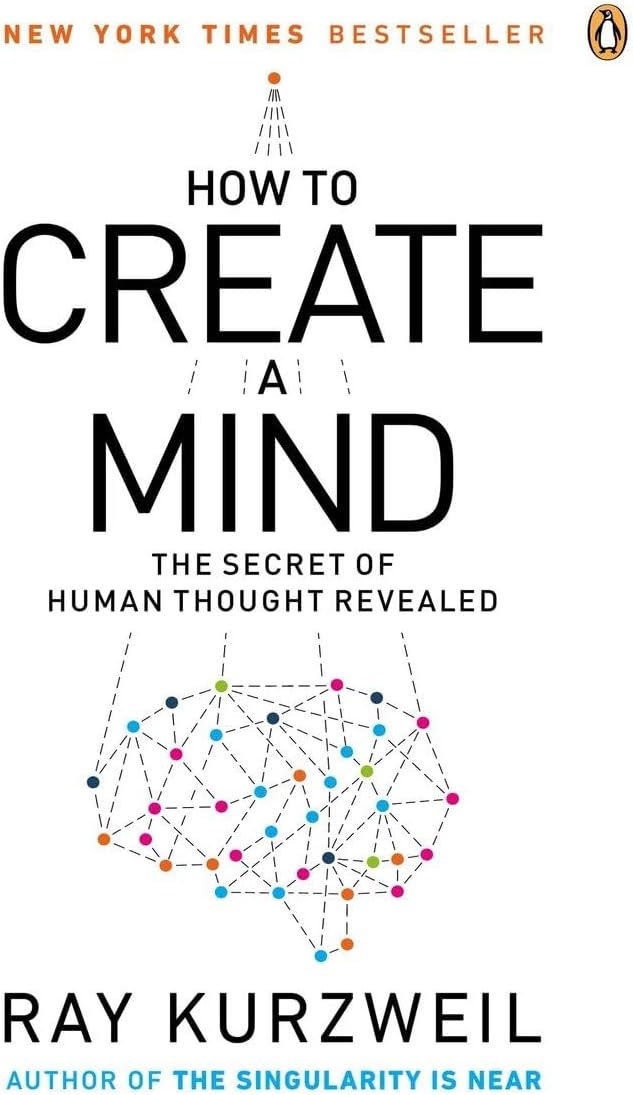
How to Create a Mind: The Secret of Human Thought Revealed
Product ID: 2844978
Desertcart purchases this item on your behalf and handles shipping, customs, and support to Iceland.
NEW YORK TIMES BESTSELLER • The bold futurist and renowned author of The Singularity Is Near explores the limitless potential of reverse-engineering the human brain. “This book is a Rosetta Stone for the mystery of human thought.”—Martine Rothblatt, chairman and CEO, United Therapeutics, and creator of Sirius XM Satellite Radio “Kurzweil’s vision of our super-enhanced future is completely sane and calmly reasoned, and his book should nicely smooth the path for the earth’s robot overlords, who, it turns out, will be us.” —The New York Times In How to Create a Mind, Ray Kurzweil presents a provocative exploration of the most important project in human-machine civilization: reverse-engineering the brain to understand precisely how it works and using that knowledge to create even more intelligent machines. Kurzweil discusses how the brain functions, how the mind emerges, brain-computer interfaces, and the implications of vastly increasing the powers of our intelligence to address the world’s problems. He also thoughtfully examines emotional and moral intelligence and the origins of consciousness and envisions the radical possibilities of our merging with the intelligent technology we are creating. Drawing on years of advanced research and cutting-edge inventions in artificial intelligence, How to Create a Mind is an incredible synthesis of neuroscience and technology and provides a road map for the future of human progress. Review: Ray Kurzweil: Brave New Future - "As the most important phenomenon in the universe, intelligence is capable of transcending natural limitations, and of transforming the world in its own image. In human hands, our intelligence has enabled us to overcome the restrictions of our biological heritage and to change ourselves in the process. We are the only species that does this." Ray Kurzweil: How to Create a Mind; the Secret of Human Thought Revealed Proposition: Anybody who reads, studies and reflects deeply on Ray Kurzweil's "How to Create a Mind: The Secret of Human Thought Revealed" will never think the same again. The person who opens the book and follows his argument closely cannot be the person who lays it down. He or she, even against their will, if honest will be in some intellectual turmoil because Kurzweil overturns many fundamentals of contemporary conventions on thinking. His title tells it all: He is determined to pursue the secrets of human brains and reproduce these through Artificial Intelligence. Kurzweil's ideas are so revolutionary that a prior look at his credentials is useful . He wrote his first computer program aged fifteen and sold it for half million dollars. He was the inventor of the first music synthesizer capable of reproducing the grand piano and other orchestral instruments, the CCD flat-bed scanner, the first optical character recognition for all fonts, the first print-to-speech synthesizer and the first commercially marketed large-vocabulary speech recognition. A millionaire many times over, he has received the National Medal of Technology, the nation's highest honor in technology, from President Clinton in the White House in 2002. The Wall Street Journal called him the "restless genius," Forbes labeled him the "rightful heir to Thomas Edison" and PBS included him as one of the sixteen "revolutionaries who made America" in the past two centuries. Truth in advertizing: No review of this length can possibly explore satisfactorily the mega complexities of Kurzweil's thought. Kurzweil explores the human mind, determining how it functions, and then relates this to the enormous advances in computer technology. He sets this out clearly in two comparative chapters, "The Biological Neocortex," and "The Biological Inspired Digital Neocortex.""The goal of the project is to understand precisely how the human brain works, and then to use these revealed methods to better understand ourselves, to fix the brain when needed, and--most relevant to the subject of this book--to create even more intelligent machines." Already in his previous best-selling book, "The Singularity is Near," he predicts with great confidence the not-too-distant point at which artificial intelligence will surpass human capabilities, and many computer scientists agree. Kurzweil wants to reverse-engineer the brain, and to do this he begins with an examination how the brain thinks, before then moving on to artificial intelligence and the world of computers. Kurzweil offers a number of provocative "thoughts on thinking" in introducing his study of the brain. He describes how he has been `thinking about thinking' since the age of twelve and some of the insights this provided. For instance, most people can recite the alphabet, but fail when they try to do it backwards. To Kurzweil this demonstrates our memories are sequential. "They can be accessed only in the order that they are remembered." Next Kurzweil asks that we reconstruct our afternoon's walk, the people we saw. Few can in any detail, to which Kurzweil comments "...there are no images, videos, or sound recordings stored in our brain. Our memories are stored as sequences or patterns." And it is this "pattern recognition" that Kurzweil finds the true function of the brain. Kurzweil argues that our memories are stored as sequences of patterns." He calls it his "pattern theory of mind." "Human being have only a weak ability to process logic, but a very deep core capability of recognizing patterns. He illustrates this by quoting chess master Gary Kasparov who attributes his genius to pattern identification. Kasparov apparently thinks like the rest of us one step at a time, has learned 100,000 board positions, that is, patterns. Kurzweil then describes how these patterns (he estimated 300 million are stored in the neo-cortex) are arranged in "hierarchies" in the brain Although neuroscientists are by no means agreed on how the brain works, Kurzweil believes he has enough evidence to focus almost entirely on the neocortex, which he credits with being able to deal with patterns in hierarchical fashion. The human neocortex is the newest part of the brain, the outermost layer, thin, two-dimensional, about 2.5 milimeters thick. It is intricately folded over the top of the rest of the brain, and accounts for 80% of its weight. Kurzweil offers a standard accepted description of its various functions. The human brain has only weak ability to process logic, but a very deep core capability of recognizing patterns. Such is the centrality of the neocortex in Kurzweil's thinking that he calls other regions of the brain--the amygdale, thalamus, hippocampus and cerebellum--the "old brain" the pre-evolutionary brain, the "one we had before we were mammals," essential for only a few functions. But it was the neo cortex which exponentially accelerated the pace of human learning, from thousands of years to months--"or less" he adds. Putting on his A-I hat, Kurzweil reviews his own accomplishments- culminating most recently in a program enabling the blind to read in all fonts--as they relate to his theories on thinking. Most computer engineers agree that a computer capable of emulating the technical function of the brain is not too far off. Kurzweil goes further: "Ultimately we will create an artificial neocortex that has the full range and flexibility of its human counterpart. There will be electronic circuits billions of times faster than our biological circuits." "Thinking" will migrate to electronic "clouds," with virtually unlimited capabilities. The system will make possible billions, or even trillions of pattern recognizers, the essence of thought--including the emotions of fear, sadness and pleasure. (Kurzweil doesn't indicate whether the machine will have tear ducts.) Understandably, there has been some criticism of Kurzweil, most of all for his venture into admittedly bizarre transhumanism in predicting he will be able to talk to his long-deceased (40 years) father. It must be emphasized, however, that he doesn't expect to resurrect his father, merely to create electronic circuitry which can be programmed on all his known characteristics--DNA, RNA, personal qualities, quirks, moods, humor (or not). It's a natural spinoff from his conviction that AI will assume all the qualities of a human being, so that conceivably (with a lot of skepticism) Kurzweil might recreate a robot of his father's qualities. Challenging this facet of his thinking, however, does not basically undercut his other perceptions on thought. Kurzweil also takes some humorous criticism for his admittedly singular health regimen--taking 200 pills daily and having monthly blood transfusions. It remains to be seen who gets the last laugh. The public has already had something of an introduction to what Kurzweil is projecting in the performance of IBM's computer, universally recognized as "Watson," on the television show Jeopardy in soundly trouncing the best human players ever on the show. In February 2011 (eons ago in digital terms) Watson correctly answered correctly virtually every question, including those including puns, similes and metaphors.Two such questions were: (a) Wanted for a twelve-year crime spree of eating King Hothgar's warriors: officer Beowulf has been assigned the case garment worn by a child, perhaps aboard an operatic ship, and (b) In act three of an 1846 Verdi opera, this Scourge of God is stabbed to death by his love, Odabella. (Watson is not infallible, Watson's performance is beyond belief--and right in the AI direction Kurzweil is projecting. It (or is it "he? she?)) runs on 90 IBM 750 servers with 15 terabytes of RAM and 2,800 processors operating in parallel. It's preloaded with dozens of encyclopedias, news articles, internet connections. It contains all of Wikipedia. This data base is humongous, far beyond the capability of the human brain. Watson scans two million pages in three seconds. Kurzweil bristles at criticism that Watson only works through statistical probabilities rather than "true" understanding. So do humans, he retorts. "One could just as easily dismiss the distributed neurotransmitter concentrations and redundant connection patterns i n the human cortex as `statistical information.'" By 2020, says Kurzweil, "we'll have at least in a routine personal computer type computer (power) about equal to the human brain." "...at today's rate of change," he adds, "we will achieve an amount of progress equivalent to that of the whole 20th century in 14 years." Regardless of how one judges the multiple facets of Kurzweil's theories, he clearly established two indisputable facts shaping our lives. Research, from neuroscience to psychiatry to physical monitoring through such techniques as MRI imaging, is providing new insights into the biological mind at exponential speeds. Parallel to this, understanding of the digital world is progressing even more rapidly, with the "singularity" point-- where biological brain and the digital world connect--not . And, yes, what if things take a bad turn and the computers get out of hand and turn on their masters, as with "Hal" in "2000: Space Odyssey" who goes berserk and turns on his creators. Ray Kurzweil makes an unassailable case that it's time to begin thinking more profoundly about thinking.far away. Indeed, for most persons the distinction between "I" and "my IPhone" is blurring--the computer virtually a `brain extender' of our selves. Kurzweil describes how when Google shut down he thought "part of my brain was going on strike." It makes clear, "how thoroughly we have already outsourced parts of our thinking to the cloud of computing." Clearly it's time to begin to think through the ramifications of this, everything from robotics to the cyber world Review: A Brief Summary and Review - *A full executive summary of this book is available here: An Executive Summary of Ray Kurzweil's 'How to Create a Mind: The Secret of Human Thought Revealed' When IBM's Deep Blue defeated humanity's greatest chess player Garry Kasparov in 1997 it marked a major turning point in the progress of artificial intelligence (AI). A still more impressive turning point in AI was achieved in 2011 when another creation of IBM named Watson defeated Jeopardy! phenoms Ken Jennings and Brad Rutter at their own game. As time marches on and technology advances we can easily envision still more impressive feats coming out of AI. And yet when it comes to the prospect of a computer ever actually matching human intelligence in all of its complexity and intricacy, we may find ourselves skeptical that this could ever be fully achieved. There seems to be a fundamental difference between the way a human mind works and the way even the most sophisticated machine works--a qualitative difference that could never be breached. Famous inventor and futurist Ray Kurzweil begs to differ. To begin with--despite the richness and complexity of human thought--Kurzweil argues that the underlying principles and neuro-networks that are responsible for higher-order thinking are actually relatively simple, and in fact fully replicable. Indeed, for Kurzweil, our most sophisticated AI machines are already beginning to employ the same principles and are mimicking the same neuro-structures that are present in the human brain. Beginning with the brain, Kurzweil argues that recent advances in neuroscience indicate that the neocortex (whence our higher-level thinking comes) operates according to a sophisticated (though relatively straightforward) pattern recognition scheme. This pattern recognition scheme is hierarchical in nature, such that lower-level patterns representing discrete bits of input (coming in from the surrounding environment) combine to trigger higher-level patterns that represent more general categories that are more abstract in nature. The hierarchical structure is innate, but the specific categories and meta-categories are filled in by way of learning. Also, the direction of information travel is not only from the bottom up, but also from the top down, such that the activation of higher-order patterns can trigger lower-order ones, and there is feedback between the varying levels. (The theory that sees the brain operating in this way is referred to as the Pattern Recognition Theory of the Mind or PRTM). As Kurzweil points out, this pattern recognition scheme is actually remarkably similar to the technology that our most sophisticated AI machines are already using. Indeed, not only are these machines designed to process information in a hierarchical way (just as our brain is), but machines such as Watson (and even Siri, the voice recognition software available on the iPhone), are structured in such a way that they are capable of learning from the environment. For example, Watson was able to modify its software based on the information it gathered from reading the entire Wikipedia file. (The technology that these machines are using is known as the hierarchical hidden Markov model or HHMM, and Kurzweil was himself a part of developing this technology in the 1980's and 1990's.) Given that our AI machines are now running according to the same principles as our brains, and given the exponential rate at which all information-based technologies advance, Kurzweil predicts a time when computers will in fact be capable of matching human thought--right down to having such features as consciousness, identity and free will (Kurzweil's specific prediction here is that this will occur by the year 2029). What's more, because computer technology does not have some of the limitations inherent in biological systems, Kurzweil predicts a time when computers will even vastly outstrip human capabilities. Of course, since we use our tools as a natural extension of ourselves (figuratively, but sometimes also literally), this will also be a time when our own capabilities will vastly outstrip our capabilities of today. Ultimately, Kurzweil thinks, we will simply use the markedly superior computer technology to replace our outdated neurochemistry (as we now replace a limb with a prosthetic), and thus fully merge with our machines (a state that Kurzweil refers to as the singularity). This is the argument that Kurzweil makes in his new book 'How to Create a Mind: The Secret of Human Thought Revealed'. Kurzweil lays out his arguments very clearly, and he does have a knack for explaining some very difficult concepts in a very simple way. My only objection to the book is that there is a fair bit of repetition, and some of the philosophical arguments (on such things as consciousness, identity and free will) drag on longer than need be. All in all there is much of interest to be learned both about artificial intelligence and neuroscience. A full executive summary of the book is available here: An Executive Summary of Ray Kurzweil's 'How to Create a Mind: The Secret of Human Thought Revealed'


| Best Sellers Rank | #267,056 in Books ( See Top 100 in Books ) #112 in Artificial Intelligence & Semantics #254 in Biology (Books) #2,850 in Behavioral Sciences (Books) |
| Customer Reviews | 4.4 out of 5 stars 1,641 Reviews |
B**A
Ray Kurzweil: Brave New Future
"As the most important phenomenon in the universe, intelligence is capable of transcending natural limitations, and of transforming the world in its own image. In human hands, our intelligence has enabled us to overcome the restrictions of our biological heritage and to change ourselves in the process. We are the only species that does this." Ray Kurzweil: How to Create a Mind; the Secret of Human Thought Revealed Proposition: Anybody who reads, studies and reflects deeply on Ray Kurzweil's "How to Create a Mind: The Secret of Human Thought Revealed" will never think the same again. The person who opens the book and follows his argument closely cannot be the person who lays it down. He or she, even against their will, if honest will be in some intellectual turmoil because Kurzweil overturns many fundamentals of contemporary conventions on thinking. His title tells it all: He is determined to pursue the secrets of human brains and reproduce these through Artificial Intelligence. Kurzweil's ideas are so revolutionary that a prior look at his credentials is useful . He wrote his first computer program aged fifteen and sold it for half million dollars. He was the inventor of the first music synthesizer capable of reproducing the grand piano and other orchestral instruments, the CCD flat-bed scanner, the first optical character recognition for all fonts, the first print-to-speech synthesizer and the first commercially marketed large-vocabulary speech recognition. A millionaire many times over, he has received the National Medal of Technology, the nation's highest honor in technology, from President Clinton in the White House in 2002. The Wall Street Journal called him the "restless genius," Forbes labeled him the "rightful heir to Thomas Edison" and PBS included him as one of the sixteen "revolutionaries who made America" in the past two centuries. Truth in advertizing: No review of this length can possibly explore satisfactorily the mega complexities of Kurzweil's thought. Kurzweil explores the human mind, determining how it functions, and then relates this to the enormous advances in computer technology. He sets this out clearly in two comparative chapters, "The Biological Neocortex," and "The Biological Inspired Digital Neocortex.""The goal of the project is to understand precisely how the human brain works, and then to use these revealed methods to better understand ourselves, to fix the brain when needed, and--most relevant to the subject of this book--to create even more intelligent machines." Already in his previous best-selling book, "The Singularity is Near," he predicts with great confidence the not-too-distant point at which artificial intelligence will surpass human capabilities, and many computer scientists agree. Kurzweil wants to reverse-engineer the brain, and to do this he begins with an examination how the brain thinks, before then moving on to artificial intelligence and the world of computers. Kurzweil offers a number of provocative "thoughts on thinking" in introducing his study of the brain. He describes how he has been `thinking about thinking' since the age of twelve and some of the insights this provided. For instance, most people can recite the alphabet, but fail when they try to do it backwards. To Kurzweil this demonstrates our memories are sequential. "They can be accessed only in the order that they are remembered." Next Kurzweil asks that we reconstruct our afternoon's walk, the people we saw. Few can in any detail, to which Kurzweil comments "...there are no images, videos, or sound recordings stored in our brain. Our memories are stored as sequences or patterns." And it is this "pattern recognition" that Kurzweil finds the true function of the brain. Kurzweil argues that our memories are stored as sequences of patterns." He calls it his "pattern theory of mind." "Human being have only a weak ability to process logic, but a very deep core capability of recognizing patterns. He illustrates this by quoting chess master Gary Kasparov who attributes his genius to pattern identification. Kasparov apparently thinks like the rest of us one step at a time, has learned 100,000 board positions, that is, patterns. Kurzweil then describes how these patterns (he estimated 300 million are stored in the neo-cortex) are arranged in "hierarchies" in the brain Although neuroscientists are by no means agreed on how the brain works, Kurzweil believes he has enough evidence to focus almost entirely on the neocortex, which he credits with being able to deal with patterns in hierarchical fashion. The human neocortex is the newest part of the brain, the outermost layer, thin, two-dimensional, about 2.5 milimeters thick. It is intricately folded over the top of the rest of the brain, and accounts for 80% of its weight. Kurzweil offers a standard accepted description of its various functions. The human brain has only weak ability to process logic, but a very deep core capability of recognizing patterns. Such is the centrality of the neocortex in Kurzweil's thinking that he calls other regions of the brain--the amygdale, thalamus, hippocampus and cerebellum--the "old brain" the pre-evolutionary brain, the "one we had before we were mammals," essential for only a few functions. But it was the neo cortex which exponentially accelerated the pace of human learning, from thousands of years to months--"or less" he adds. Putting on his A-I hat, Kurzweil reviews his own accomplishments- culminating most recently in a program enabling the blind to read in all fonts--as they relate to his theories on thinking. Most computer engineers agree that a computer capable of emulating the technical function of the brain is not too far off. Kurzweil goes further: "Ultimately we will create an artificial neocortex that has the full range and flexibility of its human counterpart. There will be electronic circuits billions of times faster than our biological circuits." "Thinking" will migrate to electronic "clouds," with virtually unlimited capabilities. The system will make possible billions, or even trillions of pattern recognizers, the essence of thought--including the emotions of fear, sadness and pleasure. (Kurzweil doesn't indicate whether the machine will have tear ducts.) Understandably, there has been some criticism of Kurzweil, most of all for his venture into admittedly bizarre transhumanism in predicting he will be able to talk to his long-deceased (40 years) father. It must be emphasized, however, that he doesn't expect to resurrect his father, merely to create electronic circuitry which can be programmed on all his known characteristics--DNA, RNA, personal qualities, quirks, moods, humor (or not). It's a natural spinoff from his conviction that AI will assume all the qualities of a human being, so that conceivably (with a lot of skepticism) Kurzweil might recreate a robot of his father's qualities. Challenging this facet of his thinking, however, does not basically undercut his other perceptions on thought. Kurzweil also takes some humorous criticism for his admittedly singular health regimen--taking 200 pills daily and having monthly blood transfusions. It remains to be seen who gets the last laugh. The public has already had something of an introduction to what Kurzweil is projecting in the performance of IBM's computer, universally recognized as "Watson," on the television show Jeopardy in soundly trouncing the best human players ever on the show. In February 2011 (eons ago in digital terms) Watson correctly answered correctly virtually every question, including those including puns, similes and metaphors.Two such questions were: (a) Wanted for a twelve-year crime spree of eating King Hothgar's warriors: officer Beowulf has been assigned the case garment worn by a child, perhaps aboard an operatic ship, and (b) In act three of an 1846 Verdi opera, this Scourge of God is stabbed to death by his love, Odabella. (Watson is not infallible, Watson's performance is beyond belief--and right in the AI direction Kurzweil is projecting. It (or is it "he? she?)) runs on 90 IBM 750 servers with 15 terabytes of RAM and 2,800 processors operating in parallel. It's preloaded with dozens of encyclopedias, news articles, internet connections. It contains all of Wikipedia. This data base is humongous, far beyond the capability of the human brain. Watson scans two million pages in three seconds. Kurzweil bristles at criticism that Watson only works through statistical probabilities rather than "true" understanding. So do humans, he retorts. "One could just as easily dismiss the distributed neurotransmitter concentrations and redundant connection patterns i n the human cortex as `statistical information.'" By 2020, says Kurzweil, "we'll have at least in a routine personal computer type computer (power) about equal to the human brain." "...at today's rate of change," he adds, "we will achieve an amount of progress equivalent to that of the whole 20th century in 14 years." Regardless of how one judges the multiple facets of Kurzweil's theories, he clearly established two indisputable facts shaping our lives. Research, from neuroscience to psychiatry to physical monitoring through such techniques as MRI imaging, is providing new insights into the biological mind at exponential speeds. Parallel to this, understanding of the digital world is progressing even more rapidly, with the "singularity" point-- where biological brain and the digital world connect--not . And, yes, what if things take a bad turn and the computers get out of hand and turn on their masters, as with "Hal" in "2000: Space Odyssey" who goes berserk and turns on his creators. Ray Kurzweil makes an unassailable case that it's time to begin thinking more profoundly about thinking.far away. Indeed, for most persons the distinction between "I" and "my IPhone" is blurring--the computer virtually a `brain extender' of our selves. Kurzweil describes how when Google shut down he thought "part of my brain was going on strike." It makes clear, "how thoroughly we have already outsourced parts of our thinking to the cloud of computing." Clearly it's time to begin to think through the ramifications of this, everything from robotics to the cyber world
A**T
A Brief Summary and Review
*A full executive summary of this book is available here: An Executive Summary of Ray Kurzweil's 'How to Create a Mind: The Secret of Human Thought Revealed' When IBM's Deep Blue defeated humanity's greatest chess player Garry Kasparov in 1997 it marked a major turning point in the progress of artificial intelligence (AI). A still more impressive turning point in AI was achieved in 2011 when another creation of IBM named Watson defeated Jeopardy! phenoms Ken Jennings and Brad Rutter at their own game. As time marches on and technology advances we can easily envision still more impressive feats coming out of AI. And yet when it comes to the prospect of a computer ever actually matching human intelligence in all of its complexity and intricacy, we may find ourselves skeptical that this could ever be fully achieved. There seems to be a fundamental difference between the way a human mind works and the way even the most sophisticated machine works--a qualitative difference that could never be breached. Famous inventor and futurist Ray Kurzweil begs to differ. To begin with--despite the richness and complexity of human thought--Kurzweil argues that the underlying principles and neuro-networks that are responsible for higher-order thinking are actually relatively simple, and in fact fully replicable. Indeed, for Kurzweil, our most sophisticated AI machines are already beginning to employ the same principles and are mimicking the same neuro-structures that are present in the human brain. Beginning with the brain, Kurzweil argues that recent advances in neuroscience indicate that the neocortex (whence our higher-level thinking comes) operates according to a sophisticated (though relatively straightforward) pattern recognition scheme. This pattern recognition scheme is hierarchical in nature, such that lower-level patterns representing discrete bits of input (coming in from the surrounding environment) combine to trigger higher-level patterns that represent more general categories that are more abstract in nature. The hierarchical structure is innate, but the specific categories and meta-categories are filled in by way of learning. Also, the direction of information travel is not only from the bottom up, but also from the top down, such that the activation of higher-order patterns can trigger lower-order ones, and there is feedback between the varying levels. (The theory that sees the brain operating in this way is referred to as the Pattern Recognition Theory of the Mind or PRTM). As Kurzweil points out, this pattern recognition scheme is actually remarkably similar to the technology that our most sophisticated AI machines are already using. Indeed, not only are these machines designed to process information in a hierarchical way (just as our brain is), but machines such as Watson (and even Siri, the voice recognition software available on the iPhone), are structured in such a way that they are capable of learning from the environment. For example, Watson was able to modify its software based on the information it gathered from reading the entire Wikipedia file. (The technology that these machines are using is known as the hierarchical hidden Markov model or HHMM, and Kurzweil was himself a part of developing this technology in the 1980's and 1990's.) Given that our AI machines are now running according to the same principles as our brains, and given the exponential rate at which all information-based technologies advance, Kurzweil predicts a time when computers will in fact be capable of matching human thought--right down to having such features as consciousness, identity and free will (Kurzweil's specific prediction here is that this will occur by the year 2029). What's more, because computer technology does not have some of the limitations inherent in biological systems, Kurzweil predicts a time when computers will even vastly outstrip human capabilities. Of course, since we use our tools as a natural extension of ourselves (figuratively, but sometimes also literally), this will also be a time when our own capabilities will vastly outstrip our capabilities of today. Ultimately, Kurzweil thinks, we will simply use the markedly superior computer technology to replace our outdated neurochemistry (as we now replace a limb with a prosthetic), and thus fully merge with our machines (a state that Kurzweil refers to as the singularity). This is the argument that Kurzweil makes in his new book 'How to Create a Mind: The Secret of Human Thought Revealed'. Kurzweil lays out his arguments very clearly, and he does have a knack for explaining some very difficult concepts in a very simple way. My only objection to the book is that there is a fair bit of repetition, and some of the philosophical arguments (on such things as consciousness, identity and free will) drag on longer than need be. All in all there is much of interest to be learned both about artificial intelligence and neuroscience. A full executive summary of the book is available here: An Executive Summary of Ray Kurzweil's 'How to Create a Mind: The Secret of Human Thought Revealed'
R**E
RECOGNIZE the POWER of YOUR BRAIN
HOW TO CREATE A MIND Ray Kurzweil's range of knowledge is almost overwhelming. His patient and clear explanation of the structures in the brain will help anyone who has little understanding of it and will be an excellent reinforcer for those with previous knowledge. As a parent and retired teacher I wish this information had been available when my younger brother at age 19 had an auto accident (1957) that left him with permanent aphasia and crippled on his right side. I learned about equipotentiality of brain function, but had no clue that the plasticity of the brain was so powerful. A guest on my radio show suffers from serious autism. The new data I gleaned from this book enabled me to help her in ways no one had in her 38 years. It will enable me to ask better questions to some of my guests. I also realized that my ability to give students the opportunities to try many new things, to fail and learn from their mistakes was now based on solid evidence on the brain's ability to be a pattern recognizer and - learning from its mistakes is learning. Instead our organizations look for error-proofing, like teacher-proofing, that demand mindless, coerced conformity, which crushes the brain's natural creativity. Ray, whose book on the Singularity, discussed his belief that computers will eventually be able to duplicate, even outdo human abilities. Or, we will become one with them, which could give us longer life - or immortality. At 81 I won't be around to see this, but I'm happy for my descendants. Between what the Japanese and others are doing with robotics it is very conceivable they will be our servants first, but why not our companions? Many of us are already cyborgs and when computers are the size of our red blood cells maybe we'll finally see that our heart, our "guts," every organ or system of our body can be read by us and keep us informed. If we can combine this with various types of implants, we could be the creators of our evolution. And, we do need help now as every institution of every society is partially to completely dysfunctional. Despite our often productive rule of law we have not learned to deal effectively with our aggression (necessary for individual survival) or our sexuality (necessary for our species survival.) Ray has given us a blueprint so we can begin to accept the fact that what can be created will be created. The sooner we start to see the potentials he discusses, the sooner we be able to meet many of the challenges our species faces. If Ray wants an uninterrupted hour conversation on my radio show - [...] - he can contact me at [email protected].
S**E
Thoughts on "thinking about thinking"
I found this book to be interesting and challenging at the same time. Its difficulty wasn't because of the author's material however was due to my limited ability to understand such profound concepts; perhaps I would do better with a "For Dummies" version. As a result I had to reread many portions over again and still I am not sure if I understood them. This was a pleasant exercise; performed mostly for the joy of exploring the topics whilst attempting to train myself to better comprehend (Kurzweil himself said he has this problem). What I liked most was about the book was how it changed my understanding of how the brain works. Kurzweil has been `thinking about thinking' since the age of twelve and has developed a theory that our memories and thoughts are simply stored sequences of patterns. He proposes that the brain's neocortex functions as a pattern recognizer; there are no recordings being played back on a screen in our minds. The Pattern Recognition Theory of Mind (PRTM) alone makes this reading worthwhile. I especially enjoyed the reading about neural nets, vector quantization and hidden Markov model. These mathematical techniques are used with an evolutionary genetic algorithm to recognize speech patterns. Kurzweil puts forward that these probability methods can be used as a strategy for creating a mind. These are the portions I had to go over numerous times; I learned something new with each reading however still have more to attempt to comprehend. After reading this book one can appreciate the good fortune we have to part of this time in the human experience. Consider that over billions of years the universe evolved the brain's neocortex. Initially for the purpose of survival which humanity has now usurped to develop technological tools to pursue our own goals, create our own comforts and amusements. In short cosmological time the human phenomenon of hierarchical pattern recognition will overcome its inherited biological constrictions and become one with the universe. The spark of humanity having climbed out from the primordial slime, gradually developing the tool of pattern identification in the mammalian mind to exponentially emerge as the planets dominant species; ultimately transcending all natural limitations. We then turn to the face of God himself saying, "Thanks, we'll take it from here".
D**E
Excellent view of pattern matching in the mind
Of course another in Kurzweil's books on working our way to AI good enough to have a mind of its own. To be conscious in the way humans are. About half the book is explaining PRTM (his pattern recognition theory of the mind). Pretty good explanation in layman's terms of how important pattern matching is in functioning of the mammalian brain. Some of this info is covered in more detail in "On Intelligence". You also get some taste of it in "Reading in the brain: the Science and Evolution of a Human Invention" by Dehaene. One result of this is the mammalian brain is portrayed as a repeated group of pattern matching modules. This book explores that and explains some of the subtle effects that result. It goes on to some reasonable conjecture about how understanding this has already and will increasingly allow us to artificially in a digital manner accomplish very much the same resulting processing. And then spends the last bit of the book examining whether a machine with human levels of processing ability or beyond will be considered conscious, be accepted by humans as such and what some implications might be. Along with that is the sticky examination of what it means to be conscious even as a human. And finally the author's idea that increasingly we will augment and merge with improved pattern matching abilities to enhance our own rather perhaps than constructing completely stand alone intelligent machines. All in all a book very much worth reading. Most of his ideas are handled by others elsewhere and are up to date. His isn't a lone far out view of this field. He does mention his own work a bit much for my taste, but then again I suppose he has earned that. I would say, this current book has a tone more down to earth, accessible and less that of a grand utopian vision of the future than his previous books. I think some of it is we are much closer to knowing how the brain works than we were. So less need to guess about what we will find out though no doubt there are still surprises in store for us all.
B**M
The Cortex Spins its Tales with Hidden Markov Models
Like a news commentator explaining a bad day on Wall Street, the cortex has an explanation for everything - it generates our subjective universe. To paraphrase George Box, all our brain's models of the world are wrong, but some are useful, generative, and simple (but not too simple). In How to Create a Mind acclaimed inventor Ray Kurzweil puts forth a model of how the brain works: the pattern recognition theory of mind (PRTM). The brain successively interiorizes the world as a set of patterns. Kurzweil's framework uses hierarchical hidden Markov models (HHMMs) as its main stock in trade. HHMMs add to the PRTM model the notion that those patterns are arranged into a hierarchy of nodes, where each node is an ordered sequence of probabilistically matched lower nodes. So, the key question for me is this: are HHMMs really the key to understanding and building a mind? Ray has been on this track since the sixties, when he and I were classmates at MIT. In a spectacular career spanning decades, Ray invented systems for OmniPage OCR, text to speech (famously for Stevie Wonder), and automated speech recognition as in Dragon Naturally Speaking. Nuance bought Ray's precursor company. All automatic speech recognition nowadays is done using HHMMs, and the results are astounding. For example, see Microsoft Research Chief Rick Rashid's YouTube "Speech Recognition Breakthrough." A computer transcription of Rick's talk appears in real time and is quite accurate. The amazing success of HHMMs in handling speech and language is a story that needs to be understood by AI aficionados, and Kurzweil presents this topic in a beautifully comprehensible exposition. Kurzweil elaborates a story here that 1) the cortex is the key to thought; 2) it is hierarchically organized into 300 million pattern recognizers; 3) each pattern recognizer consists of a 100 neurons in a vertical minicolumn, and 4) those pattern recognizers communicate with one another via a Manhattan-like grid (similar to an FPGA) - end of story for the neocortex. This is a story similar to the one told by entrepreneur Jeff Hawkins in On Intelligence, and one that Hawkins, his former associate Dileep George (now at Vicarious), and Kurzweil himself are trying to capitalize on in cortex-engineering startups. I eagerly follow their results. So, HHMMs work well and are a required part of a computational neuroscience curriculum, but ARE THEY THE MASTER KEY that will unlock the doors not only to a full understanding of the mind but also to a future of superintelligent AIs? How to Create a Mind is a good story but IS IT FICTION or nonfiction? While HHMMs are required reading for automatic speech recognition, they DO NOT DO all the brain's heavy-lifting. Rather, the brain employs MANY mechanisms (which robots that aspire to humanity may need to incorporate or emulate.) Five stars for HHMM exposition. Subtract one star for giving short shrift to the following pivotal neuroscience principles: 1) attentional mechanisms, 2) brain-wide dynamical networks, 3) gamma oscillations and inhibitory networks and also 5) the role of insula and brain stem in emotion, 6) reward based learning including the essential role of basal ganglia and midbrain, and 7) hippocampus and memory. Despite its corticocentric focus, Kurzweil's impressive engineering successes make this an important story; furthermore, it is engagingly told. I cover neuroscience and AI at bobblum.com . Below are two recent 'DO NOT MISS' FIVE STAR stories.) Addendum: 30 Nov 2012 - Today's issue of SCIENCE (and Ray K's newsletter) features a story about a new 2.5M spiking neuron model (SPAUN) that performs 8 tasks and outputs to a physically modeled arm. See the videos at NENGO > Videos > Collection of Spaun. That is the state of the art! Addendum: Jan 2013: Want to know where the brain stores meaning? (YOU DO!) See Alex Huth's 5 min YouTube from Jack Gallant's lab. Search: Alex Huth, gallantlabucb "Perceptual Object and Action Maps in the Human Brain."
B**5
The Path to True Artificial Intelligence
In "How To Create a Mind," Ray Kurzweil offers a fascinating and readable overview of his theory of how the human brain works, as well as a road map for the future of artificial intelligence. Kurzweil makes a compelling argument that choosing the proper scale is critical when approaching the problem of how the brain works. Many skeptics believe that we are no where near understanding or simulating the human brain because of its overwhelming complexity. However, Kurzweil suggests that a complete understanding of the micro-level details (such as individual neurons or even biochemistry) is really not necessary. Instead, the brain can be understood and simulated at a higher level. The book gives many examples in other fields of science and engineering where such a high level approach has produced tremendous progress. The core of Kurzweil's theory is that the brain is made up of pattern processing units comprised of around 100 neurons, and he suggests that the brain can be understood and simulated primarily by looking at how these lego-like building blocks are interconnected. The book includes accounts of some of the most important research current research in both brain science and AI, especially the "Blue Brain Project" (that is working on a whole brain simulation), and also the work on IBM's Watson (Jeopardy! champion) computer. Kurzweil continues to assert that we will have human-level AI by around 2029. A typical human brain contains about 300 million pattern processing units, but Kurzeil thinks that AIs of the future might have billions, meaning that machine intelligence would far exceed the capabilities of the human mind. Ray Kurzweil is clearly an optimist both in terms of the progress he foresees and its potential impact on humanity. If he is even partly right in his predictions then the implications could be staggering. Machines that are as smart, or even smarter, than people could completely transform society, the economy and the job market.
S**S
A "Mind," but Blind
Despite a severe difference in philosophy, I much enjoyed this book [How to Create a Mind]. I appreciated Kurzweil's recountings, sprinkled throughout, of his own intellectual history during his AI and business building endeavors. The exposition of his pattern recognizer hierarchies and hierarchical Markov chain architecture, clearly done, detailed enough to see what is going on, I thought outstanding and the insights provided on the current state of the art, to include the structure of the Jeopardy playing Watson, were also appreciated. To boot, his revelation of a bit of his own spiritual/religious upbringing, his spiritual view on the natural of evolution, and even the valiant effort to come to grips with the problem of consciousness and machines - all were welcome. In all, I gained a deeper respect for, and understanding of, Dr. Kurzweil and the rationale for his position. It is definitely worth the read. However, sitting in the center of Kurzweil's thought, in the middle of his hierarchical pattern recognizers, squatting in his Markov networks, there is a huge gorilla. Kurzweil tries to stare down this beast. This begins in his sincere attempt (Chapter 9) to deal with the origin of consciousness and his treatment of Chalmers' problem of qualia - how is it that a computer or neural architecture accounts for our experience of the "yellowness" of the grapefruit on the kitchen table. Kurzweil diminishes this problem, at least it terms of its clarity, essentially moving simply to "how is there our `experience' of this world?" But this he cannot account for, opting eventually for the ever elusive, near-mystical hope that somehow, from the complexity of computations, consciousness (experience) will "emerge." In other words, he actually has no idea how we actually see the world or hear it - nor for his future robots. The difficulty is this: Chalmers' formulation has been misleading; the true problem is explaining the origin of the image of the external world - not only the grapefruit with its yellowness, but the kitchen table with its wood-grained surface, its coffee cup, the knife cutting the grapefruit slices, the floor stretching in every direction with its tiles ... Yes, this image is also our "experience." The origin of the image is the problem of perception, and in the history of philosophical thought on this subject, starting with the Greeks, this was essentially considered an optical problem. This image, too, is dynamically transforming over time - the knife is cutting, the coffee pot pouring coffee, the wife's lips moving... Now this is why the gorilla is so huge, more massive than any AI-type theorist wants to realize: If you have no theory of the origin of our image of the external world, then you have no theory of experience, and in turn therefore, you can have no theory of the "storage" of this experience; your theory of memory is totally ungrounded, and this despite your Kurzweilian confidence (based by the way on a highly selective reading of the memory literature) that only a "subset" or a selected set of elements of this "experience" is stored (with no in principle method of selection) and this done in your pattern recognizers. Ungrounded too then is any theory of cognition, reliant as it is on retrieval and use of our experience. Abstract "computations" in themselves are simply insufficient to explain consciousness (our experience). Here then is a distinct possibility concerning the nature of the brain that should give Kurzweil pause: What if the brain, along with the computations or statistical analyses (same thing) that Kurzweil is quite sure are taking place, is at the same time, and actually more importantly, sustaining a real, concrete dynamics - as real, for the sake of example, as an AC motor generating an oscillating electric field of force. Yes, knowing its equations, one can "simulate" the AC motor via a computer, but the computer is not generating the oscillating field of electric force; it is not even running a light bulb. For this, one needs a device whose construction and function is to achieve a real, concrete dynamics. This in fact was the thesis of Bergson (Matter and Memory, 1896). Bergson had presciently seen the essence of holography in 1896 (making his theory incomprehensible to his contemporaries). He viewed the universal field, in which we all are embedded, as holographic - a vast interference pattern, a field intrinsically non-imageable. Effectively, he saw the brain (with all its underlying quantum dynamics) as creating a modulated reconstructive wave passing through this holographic field, selecting out information in the field related to the action systems of the body, and in this becoming "specific to" a subset of the field - now an image of aspects of the field, e.g., the kitchen with its tables, its chairs and grapefruit. In other words, we are explaining how perception is limited, not how it arises. This image of the external world, due to the brain's dynamics (with its underlying chemical velocities) is specified at a scale of time - a fly "buzzing" by the grapefruit, his wings oscillating at 200 cps, is seen as a blur in our normal scale of time. Drop a catalyst into this dynamics - the fly becomes a heron-like fly, slowly flapping his wings and equally now specific to a new possible action of the body, e.g., picking the fly out of the air by a wing, for as the selection of a subset of the field is made in relation to the action systems of the body, then, as Bergson stated succinctly, perception is virtual action. If the brain is actually such a device - a modulated reconstructive wave - consider engineering this - yes, engineering, not software - by 2045. Of course there is more, for in this conception, perception (experience) is not occurring solely within the brain, therefore experience cannot be solely stored there, yet our experience is retrievable by the same reconstructive wave process. Obviously this is a quite different theory of memory retrieval; it is inherently supportive of analogical retrieval - a phenomenon foundational to thought,to include analogy in general. Hofstadter in his vast consideration of the subject of analogy ( Surfaces and Essences: Analogy as the Fuel and Fire of Thinking ) clearly has no idea (in fact I sense deep doubt) as to how to implement this operation in a computer (or neural net). Yet analogy - the foundational operation of thought as Hofstadter shows - is something Kurzweil severely underestimates (with only the most cursory of mention). Finally, the use of "specific to" is also exactly the language of J. J. Gibson The senses considered as perceptual systems in his theory of perception, where the brain is "resonating" to invariants in the external field and "specific to" the external environment. Bergson fills in the holographic mechanism by which Gibson's "specific to" explains the origin of the image, but a piece that is critical is Gibson's reliance on invariants defined over time, for example, the form of a rotating cube emerging only over the flow fields defined on its turning sides, and in general on the invariance laws defining the ecological events to which the brain is "resonating" (or picking up). The invariance structures defining the events of the ecological world drive the modulation of the "reconstructive wave," the operation of memory retrieval, and the operation of analogy. These laws of invariance must be incorporated into any model of the brain's processing. But this entire literature, namely that of Gibson and ecological psychology (see for example Information, Natural Laws, and Self-Assembly of Rhythmic Movement (Resources for Ecological Psychology) ), is unfortunately absent in Kurzweil's thought (and computations). In simply stirring the coffee on the kitchen table, there is a radial flow field over the coffee surface, in the back and forth stirring motion an adiabatic invariant (a constant ratio of the energy of oscillation to the frequency of oscillation), and an inertial tensor whose elements define the resistance to angular acceleration as we wield the spoon. This is not the form of "invariance" which Kurzweil envisions or of which he speaks, and it would not be trivial in any way (if possible, which is doubtful) to account for in his architectures, for again, real dynamics are ultimately involved. These are just some (of many) thoughts on missing pieces in Kurzweil's understanding. There is no way for example that his model will handle the Piagetian learning tasks or in general, anything relying on explicit memory. Consider this just some things by which Dr. Kurzweil might want to "modulate" his optimism over 2045, or for that matter, over the achievement of his singularity.
F**0
Libro didáctico de futuros tecnológicos
El libro está nuevo, calidad "recién fabricado". El contenido un catálogo de futuros tecnológicos con grandes ejemplos claros y maravillosos
B**A
Muito bom e em bom estado
Muito bom e em bom estado
K**S
Ein faszinierender Einblick in den aktuellen Stand der Hirnforschung und künstlichen Intelligenz
Ich kann mich noch gut an Prognosen in meiner Kindheit in den 70-ern erinnern, in denen illustriert wurde, wie wir um das Jahr 2000 herum alle in automatisch gesteuerten Autos herumfahren, unterseeische Städte bevölkern und die Planeten des Sonnensystems besuchen, ganz zu schweigen von kugelförmigen Fernsehern, die jedes Wohnzimmer dominieren. Man möge mir daher nachsehen, dass ich derartige Prognosen eher in Hinsicht auf ihren Unterhaltungswert betrachte. Über Ray Kurzweil wusste ich vor der Lektüre dieses Buches wenig außer seiner berüchtigten Prognose über die nahende technische Singularität; von daher habe ich mir von dem Buch nicht besonders viel versprochen. Um so angenehmer wurde ich von dem Inhalt überrascht, der zumindest in der ersten Hälfte keine wilden Prognosen enthält, sondern im wesentlichen über neueste wissenschaftliche Erkenntnisse der Hirnforschung referiert. Ich bin zwar nicht der Lage, ein qualifiziertes Urteil über die Korrektheit der dargelegten Hypothesen zu bilden; aber wenn die These stimmt, dass das menschliche Großhirn im wesentlichen strukturiert ist als ein hierarchischer Mustererkenner, ergeben sich daraus interessante und weitreichende Erkenntnisse. Selbst wenn diese Hypothese komplett falsch sein sollte, halte ich die Beobachtungen, die zu dieser Hypothese führen, für interessant genug, um auch durch Nicht-Fachleute zur Kenntnis genommen zu werden. Im zweiten Teil überträgt Kurzweil dann diese Erkenntnisse auf die Möglichkeit, intelligente Computer zu entwerfen, die die Strukturen des menschlichen Großhirns nachbilden. (Hier vergisst er nicht, auch die Resultate seiner eigenen Firma zu erwähnen; da aber auch die Konkurrenz zu Wort kommt, empfand ich das nicht als störend.) Gegen Ende wird er dann doch noch seinem Ruf gerecht, kontroverse und weitreichende Spekulationen zu äußern, in diesem Fall über Bewusstsein, freien Willen und Persönlichkeit, sowohl beim Menschen als auch bei hypothetischen Maschinen, die solche Eigenschaften haben mögen. Wer in dem Gebiet tiefschürfende Gedankengänge gewohnt ist, wird diesen Abschnitt für etwas oberflächlich halten, aber als jemand ohne große Vorkenntnisse finde ich den allgemeinen Überblick recht gelungen, zumal Kurzweil auch andere Positionen als die seine referiert, und seine eigene Position als Glaubensfrage und nicht als wissenschaftlichen Standpunkt darlegt. Ganz zum Schluss muss er sich dann doch nochmal seiner berüchtigten Prognose widmen, aber das hat er sich sozusagen verdient, da mag ich dem Buch deswegen keine Abstriche in der Bewertung geben. Insgesamt ein gehaltvolles Buch mit interessanten Thesen, welches trotz des wissenschaftlichen Anspruchs leicht verständlich ist.
M**N
This subject is still getting too little attention
The second industrial revolution is on its way. So, this book deals with the technical side of this. it is written as far as technology books go, with a very entertaining and easy to read flow. If you have not read any of Kurzweils other books. I would say its best to start with this one. Although very few people care how the technology works that they are using everyday, here is someone who makes a fantastic effort to bring the most complex of machines closer to those who care whats under the hood. maybe his next book will have a robotic co-author? I can't wait.
N**.
Ultimate
Awesome book for AI interested and kundalini reader with background of molecular biology and physics
Trustpilot
2 weeks ago
2 days ago