
DOWNLOAD THE APP


Customer Services
Copyright © 2025 Desertcart Holdings Limited
DOWNLOAD THE APP
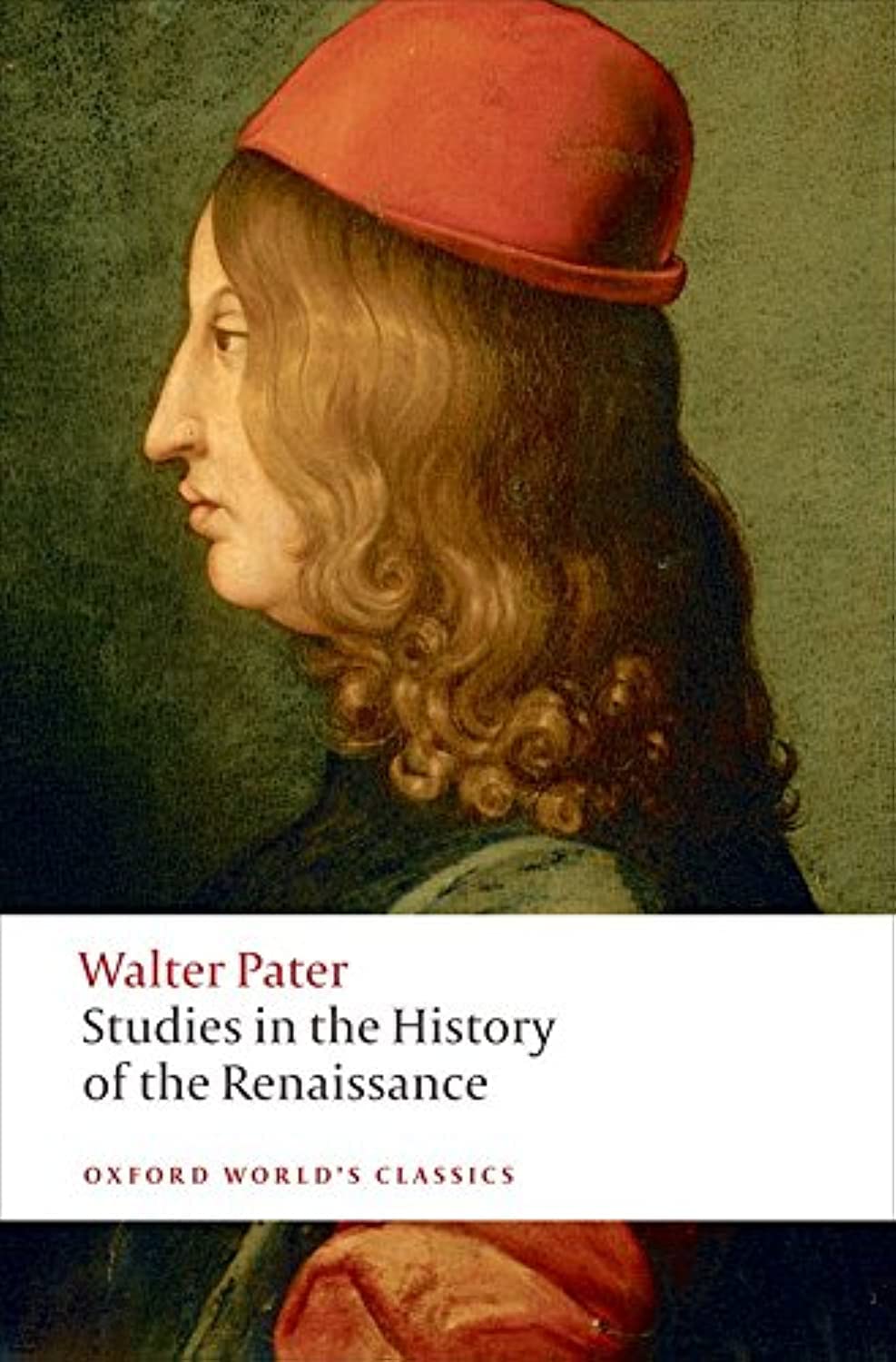
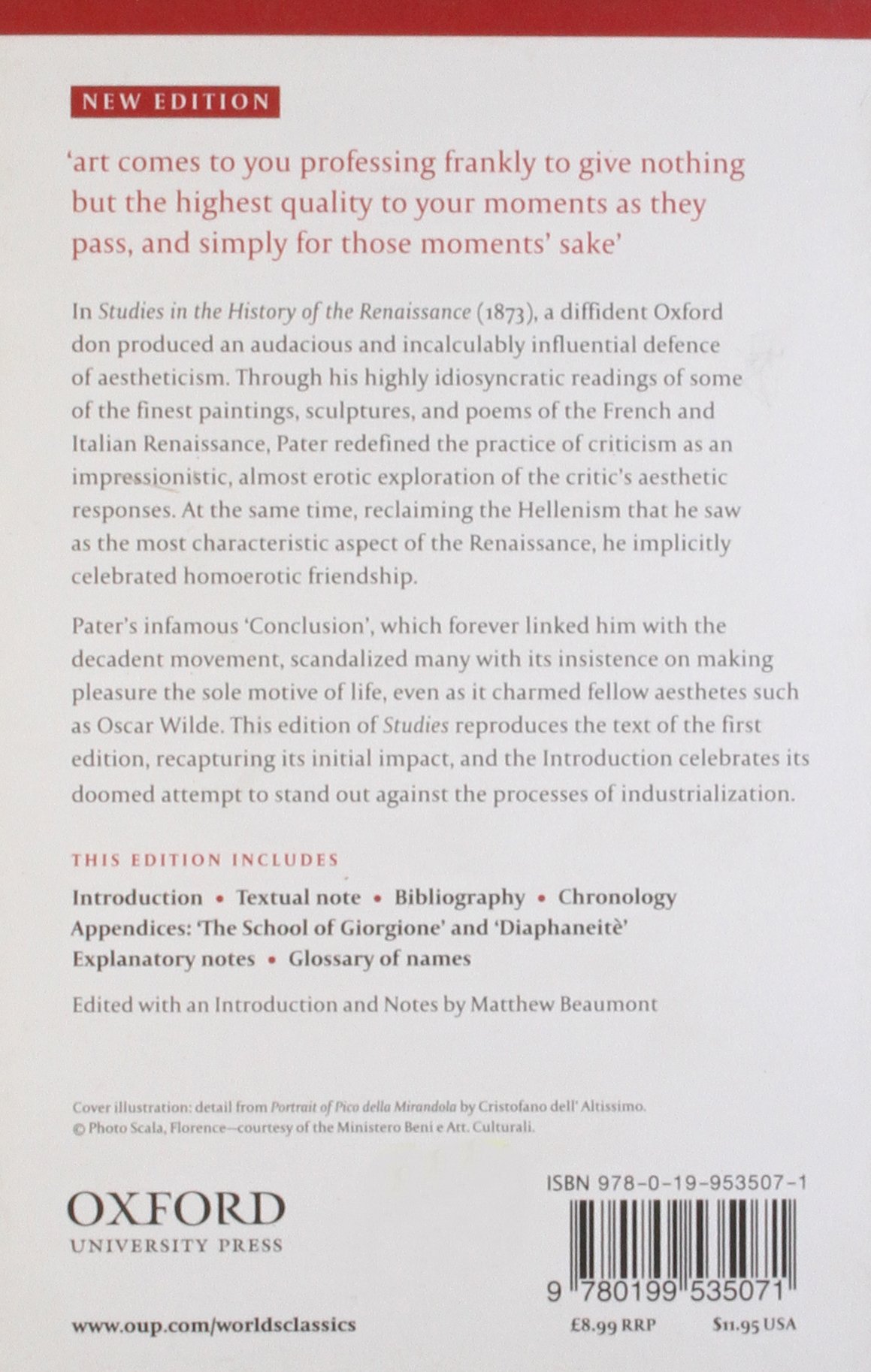


desertcart.com: Studies in the History of the Renaissance (Oxford World's Classics): 9780199535071: Pater, Walter, Beaumont, Matthew: Books Review: Great Studies of the Renaissance - Walter Pater was a brilliant historian of the Italian Renaissance. His observations on the lives of the artists are as authentic as any others. While Pater died in Oxford, England in 1897, his studies of the Renaissance underscore his love of art “for arts sake”. Review: Excellent read - Pater begins his discussion by stating in the preface that beauty is relative, and like all abstract terms has meaning only in the concrete. To give meaning to the concept of beauty, the observer does not need to "possess a correct abstract definition" of it, but instead should have "a certain kind of temperament, the power of being deeply moved by the presence of beautiful objects. He will remember always that beauty exists in many forms." Each chapter develops this theme through discussion of a specific artist or critic. Especially interesting are his essays on Michelangelo, Leonardo, and Botticelli. Pater demonstrates his own ability to be "deeply moved" by the artists he considers, using terms such as "charm," "strangeness" and "sweet" along with more traditional historical and critical terms to describe their work. The concluding chapter on Winckelmann synthesizes various points from his treatments of the individual artists into one coherent statement of the meaning and role of beauty in our lives. Art, he says, must be enjoyed for its own sake and not for other more extraneous reasons. It "comes to you professing frankly to give nothing but the highest quality to your moments as they pass, and simply for those moments' sake." Pater has an elegant and engaging writing voice that draws the reader through his various arguments. His prose style is itself an object of beauty. His larger argument has been validated repeatedly throughout the 125 years since he lived. Reading this book, I found myself wondering why it was considered so controversial when it first appeared. Perhaps it was considered revolutionary for its day; but from the perspective of 2014, I found it hard to understand what all the fuss was about.
| Best Sellers Rank | #474,477 in Books ( See Top 100 in Books ) #434 in Art Movements (Books) #1,530 in Art History (Books) #31,457 in History (Books) |
| Customer Reviews | 4.5 4.5 out of 5 stars (76) |
| Dimensions | 7.7 x 0.5 x 5 inches |
| Edition | New |
| ISBN-10 | 0199535078 |
| ISBN-13 | 978-0199535071 |
| Item Weight | 6.4 ounces |
| Language | English |
| Print length | 240 pages |
| Publication date | April 15, 2010 |
| Publisher | Oxford University Press |
G**H
Great Studies of the Renaissance
Walter Pater was a brilliant historian of the Italian Renaissance. His observations on the lives of the artists are as authentic as any others. While Pater died in Oxford, England in 1897, his studies of the Renaissance underscore his love of art “for arts sake”.
B**R
Excellent read
Pater begins his discussion by stating in the preface that beauty is relative, and like all abstract terms has meaning only in the concrete. To give meaning to the concept of beauty, the observer does not need to "possess a correct abstract definition" of it, but instead should have "a certain kind of temperament, the power of being deeply moved by the presence of beautiful objects. He will remember always that beauty exists in many forms." Each chapter develops this theme through discussion of a specific artist or critic. Especially interesting are his essays on Michelangelo, Leonardo, and Botticelli. Pater demonstrates his own ability to be "deeply moved" by the artists he considers, using terms such as "charm," "strangeness" and "sweet" along with more traditional historical and critical terms to describe their work. The concluding chapter on Winckelmann synthesizes various points from his treatments of the individual artists into one coherent statement of the meaning and role of beauty in our lives. Art, he says, must be enjoyed for its own sake and not for other more extraneous reasons. It "comes to you professing frankly to give nothing but the highest quality to your moments as they pass, and simply for those moments' sake." Pater has an elegant and engaging writing voice that draws the reader through his various arguments. His prose style is itself an object of beauty. His larger argument has been validated repeatedly throughout the 125 years since he lived. Reading this book, I found myself wondering why it was considered so controversial when it first appeared. Perhaps it was considered revolutionary for its day; but from the perspective of 2014, I found it hard to understand what all the fuss was about.
L**T
I am pleased such an outlook is still available to read
A remarkable historic prospective. I am pleased such an outlook is still available to read. I deem it a valuable tool for chipping away the opinions of time.
O**A
Cut out the best bits
I didn't realize this was an abridged version when I bought it. I've read the original on Gutenberg.org and was really disappointed to find out that some of my favorite sections were cut. Fortunately, I found a better edition at my local store. Very disappointed by this!
C**D
It is a little hard to understand his point. ...
It is a little hard to understand his point. But that is just me. Not really into art. Thought it would be interesting to read about the Renaissance.
Y**I
Clean book.
Clean book.
M**R
A Bookish Man Called A Rake
Walter Pater was one of the mildest and least adventure seeking people imaginable. He was shy, retiring, and quite bookish. It came as a great surprise to him and to those who knew him well that his STUDIES IN THE HISTORY OF THE RENAISSANCE was trumpeted as a call to indulge in the wildest of sexual and artistic excesses. Oscar Wilde, during his trial for homosexuality, admitted that Pater's works had been a significant influence on him. Pater was the first Victorian writer not to adhere to the credo that one must at all costs hold to a continuation of the painful quest for Truth that had dominated Oxford since the days of Newman. Pater, to the delight of his days' youthful rebels, assured his readers that the quest was pointless. Truth, he claimed, was relative. Instead of echoing Carlyle's call to duty and social responsibility, Pater reminded his readers that life passes all too quickly and that our only duty is to enjoy life right now while they still can. He urged his readers to relish the sensations of art. In this sense, he was a forerunner of Timothy Leary, the later Harvard psychologist who said, `Tune in, turn on, drop dead.' In the `Preface', Pater sets forth his initial attempt to define beauty and the goal of the critic who seeks to do so: `What is important then is not that the critic should possess a correct abstract definition of beauty for the intellect, but a certain kind of temperament the power of being deeply moved by the presence of beautiful objects.' It was the conclusion to his book that gave Pater his unwanted notoriety. He described life as a whirlpool with its `flame more eager and devouring.' Life is a `group of impressions--color, odor, texture--in the mind of the observer.' He urged his readers `to burn always with this hard, gemlike flame, to maintain this ecstasy.' He concludes with: `For our one chance in expanding that interval, in getting as many pulsations as possible into the given time. Great passions may give us this quickened sense of life, ecstasy, and sorrow of love.' Given that his readers were used to a call to live the straight and narrow life, Pater's call to `ecstasy' sounded most inviting.
J**S
Essays for any art or history lovers who prefer passion over theory. Less subjective than post-Derridean onanists, Pater makes one yearn to see the works up close. Sensual and excited these little masterpieceswill send your mind on the Grand Tour! Burn with his light!
M**E
Arrived promptly. Would definitely use again.
B**A
Capolavoro d’Estetica inglese di fin de siècle sul Rinascimento nel culto del Bello e dell’arte for art’s sake!
C**Y
An absolute classic
R**A
This is a very good book, a fine example of how literary (or artistic) reviews should be. The prose is sober, sharp and effortlessly displaying a vast knowledge on the topics it touches. Any contemporary literary / book reviewer worthy of this name will tell you that he or she did read Pater constantly (like Harold Bloom or James Woods). Before one reads Pater one could think that's an exaggeration; after reading him, that it's a must. Shakespeare, the Romantics, Vasari and other giants of culture are analyzed here as never before. The only bad thing of this sublime book is that's too short - well, nobody's perfect.
Trustpilot
1 month ago
2 weeks ago