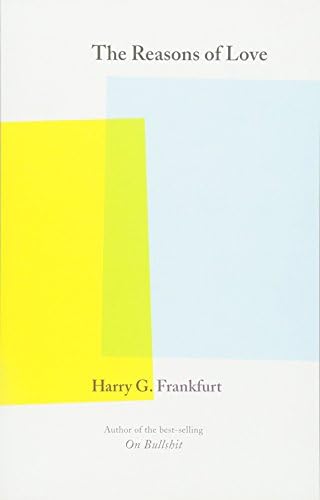


The Reasons of Love Paperback – January 22, 2006
Product ID: 27219311
Buy anything from 5,000+ international stores. One checkout price. No surprise fees. Join 2M+ shoppers on Desertcart.
Desertcart purchases this item on your behalf and handles shipping, customs, and support to Iceland.
Full description not available
P**I
Looking for Love in all the Wrong Places
Frankfurt correctly describes Kant’s moral rigorism as a replacement of inclination by moral law, only to go on to reject the Kantian approach. As an alternative he offers a distinction between self-indulgence and disciplined self-love (p. 78). We must adopt the same kind of discipline toward our dear selves, Frankfurt explains, that we adopt toward our children. This includes (1) ascertaining what is “genuinely important” to our children, and (2) taking inclination into account only insofar as it accords with the “true interests” we have thus ascertained (p. 79).Frankfurt insists a lover will have “concern for the true interests” of the beloved (p. 88). From this it clearly follows that the lover will want to know what the interests of the beloved are. But beyond this, “concern” might have at least two different meanings. On the one hand, the lover might be concerned whether or not the beloved’s interests are salutary interests that lead to spiritual growth. On the other hand, concern for the interests of the beloved might also mean a desire to “protect” and “advance” (p. 89) these interests, no matter what they are.But how do we ascertain the true interests of our children? Suppose my daughter manifests a powerful, persistent interest in the lives of Hollywood celebrities. According to Frankfurt’s logic I must nurture and cultivate this genuine interest. If a fleeting interest in virtue or wisdom subsequently arises, I must discourage this fleeting interest as merely a distraction from her “true interests.”Frankfurt hasn’t eliminated inclination. He has enthroned it. The way in which the mind’s direction is established is exempt from investigation and criticism. Once a direction is established, deviations are discouraged. The direction of movement is a matter of indifference. Momentum alone is sacred.Frankfurt’s premise is that we develop the capacity to love by “finding things to love” (p. 89). By finding things to love, we become more loving human beings. And by helping those we love find things to love, we care for them and help them develop their capacity to love (p. 89).But is this premise correct? When our love lands on certain things, can’t this in fact impair our capacity to love? John the Evangelist warns that loving the world and the things in the world impairs our capacity to love God (1 John 2:15).The idea that love for mundane objects can raise the lover by degrees toward love of God and the neighbor is nicely refuted by Anders Nygren in his study of agape and eros. Nygren describes a misguided “eros-ethic,” in which love for material objects is transformed and refined into love for transcendent and spiritual objects. The objects become higher. The form of the love remains the same. Nygren contrasts this misguided eros-ethic with the well-guided agape ethic, in which genuine love for God and the neighbor arises, not from a change of direction or object, but rather from a change in the character and motivation of the love itself. The “conversion” from misguided, self-centered worship of inclination to well-guided love of God and the neighbor occurs when the individual sets aside love produced by inclination and has a “complete change of heart.” After this change, love is motivated by obedience rather than inclination. Its source and motivation is no longer self, but God.[1]“It is a necessary feature of love that it is not under our direct and immediate voluntary control,” Frankfurt insists. “What we love and what we fail to love is not up to us” (pp. 44, 46). Since no evidence is offered to support these statements, we might interpret them as autobiographical. Because our author is incontinent in regard to his desires, he makes this autobiographical feature a feature of his philosophy, and generalizes his own moral incontinence as a prescription for others.“Common sense” and “ordinary language” in a culture of greed and narcissism will be a manifestation of greed and narcissism. An autobiographical philosophical approach based on “common sense” and “ordinary language” will do no more than give articulation to the barbarity of the age.“Avoiding boredom,” claims Frankfurt, is a healthy manifestation of “vitality of the self” (pp. 54-55). Vitality of the bourgeois self is maintained by cultivating a wide array of hobbies and distractions. This ensures silent times, when the mindlessness of the narcissistic bourgeois life might unwittingly be revealed, are scrupulously avoided. Unlike Heidegger, for whom boredom reveals aspects of time and existence that might lead us to better understand the human condition,[2] Frankfurt sees boredom as merely a threat. Frankfurt would maintain the inertia of the bourgeois self and its loves, rudimentary, narcissistic and inconsequential as they are. He scrupulously avoids a state of mental silence, where the futility of his bourgeois conception of life might come into consciousness.Socrates, with reference to the sophists, warns his interlocutors to be wary of hucksters who offer wares in the realm of the spirit, praising what they sell so they can sell more, without offering any real evidence their wares are beneficial to the spirit.[3] Has any evidence ever been offered that the games and shows hawked by Hollywood and Madison Avenue are salutary for spiritual growth and development? Children need “pure spiritual milk” (1 Peter 2:2) for healthy growth and development of the spirit for the same reason they need wholesome water not contaminated with lead and arsenic for healthy growth and development of the flesh. Frankfurt’s notion of child rearing, which encourages children to choose hobbies and interests from the surrounding culture in accordance with their inclination, I would argue is form of spiritual child abuse, analogous to feeding children whatever street vendors are selling without first ascertaining whether it is poisonous.Finite creatures, Frankfurt insists, can’t afford to be heedless in our loving. We need to maintain “defensive selectivity and restraint” (p. 63). In one sense the terms selectivity and restraint are misleading. We are commanded to love the neighbor, and must not be selective about which neighbor we love, nor restrained in the magnitude of our love. In another sense, however, Frankfurt is correct that love must be restrained. We must restrain our inclination to seek out attractive neighbors and avoid unattractive ones. We must restrain our inclination to love the world and the things of the world. In seeing this restraint as a matter of defensiveness, however, Professor Frankfurt couldn’t be more wrong. True love for God and the neighbor isn’t defensiveness. It is complete surrender. We allow God to conquer our minds and hearts with no remainder. We join the parade of God’s captives (2 Cor 2:14), loving not of our own will and inclination, but entirely subject to the will and command of God.________________________________[1] Anders Nygren, Agape and Eros (1930), as translated by P. S. Watson (1932), p. 223.[2] “Fundamental Attunement” (1930), as translated by Jerome Veith, The Heidegger Reader (2007), p. 101.[3] Protagoras 313c.
P**D
The Examined Life
Why must we examine our lives, Franfurt asks us? For its own sake, he tells us. In this small and engaging philosophical journey, "The Reasons for Love" are well articulated and numerous. First of all, caring binds us to our most important desires. "Caring as an activity is indispensably foundational as an activity that connects and binds us to ourselves "(p.17). Regardless of how suitable or unsuitable the various things we care about may be, Franfurt asserts, "Caring about something is essential to our being creatures of the kind human beings are" (p.17). He asks, can self love possess a fundamental and inherent value? What happens when we are helplessly deprived of self love? In what ways are our commitments innate? What is the relationship between moral complexity and our ability to love? Why is confidence and clarity about our beliefs essential for living a good, "coherent" life? These are thoughtful and important questions "The Reasons for Love" helps us answer. But, John Kekes in his 1995 book, "Moral Wisdom and Good Lives' emphasizes not only self-reflection as primary, but adds that moral imagination allows us to move beyond the confines of our limited psychosocial context. He tells us that our culture conditions many of our desires as well as how we pursue them. Kekes asks, what happens when our reflection is defective and our desires are ill informed? Since "The Reasons for Love" include the pursuit of a good life, perhaps, moral wisdom deserves a more prominent role in this discussion, than Frankfurt considers. "The increasing breadth of moral imagination helps us appreciate our own possibilities by providing a point of view we can reflect on. Breadth allows us to step outside of our tradition and view it from an external vantage point, not committing us to it, but by providing a basis for contrast and comparison. On that basis we can see better the dangers and pitfalls and losses that we confront by committing ourselves to some among our own possibilities" (Kekes, 1995, p.107). While I see nothing contradictory in what Frankfurt asserts, Kekes can and does make an important point. Love and good lives and moral wisdom intersect in many relevant ways. In his emphasis on culture, Kekes makes an important assertion about our commitments. The role our moral imagination can play in our efforts to live good and satisfying lives can be explored through the prism of other cultures. While I have explored other considerations in my review, the most relevant aspects of my thoughts have emerged as a consequence of reading Frankfurt. Asking good questions, isn't that what philosophy is all about?
K**H
Definitely worth it
One of my favorite philosophy books.
A**L
Stick with it for the rewards.
There are certain passages that might take re-reading, but it's worth it. Those that have given negative reviews I suspect found it a little difficult and didn't fully understand the profundity of what Frankfurt is doing here. I mean, it's a philosophy book, what do you expect?!My only complaint is a broader one about Frankfurt himself, in the lack of output from such a brilliant mind. Come on Frankfurt, we need more!
O**S
Something Wonderful
Perhaps if I were more familiar with modern moral philospohers (Bernard Williams, G.E.Moore) this slim volume would appear less impressive - although it does seem to become slightly bogged down in the last section - but, as I am not, Frankfurt's calm prose seems to me to be enlightening. Gone - the intractable problems of ethics - in favour of what we all know; that what one loves needs no reason beyond itself.
A**R
Kindle Edition
The kindle edition actually has page numbers! I wish they would mention that while buying it though because it proves useless in class with it
Trustpilot
1 day ago
1 week ago