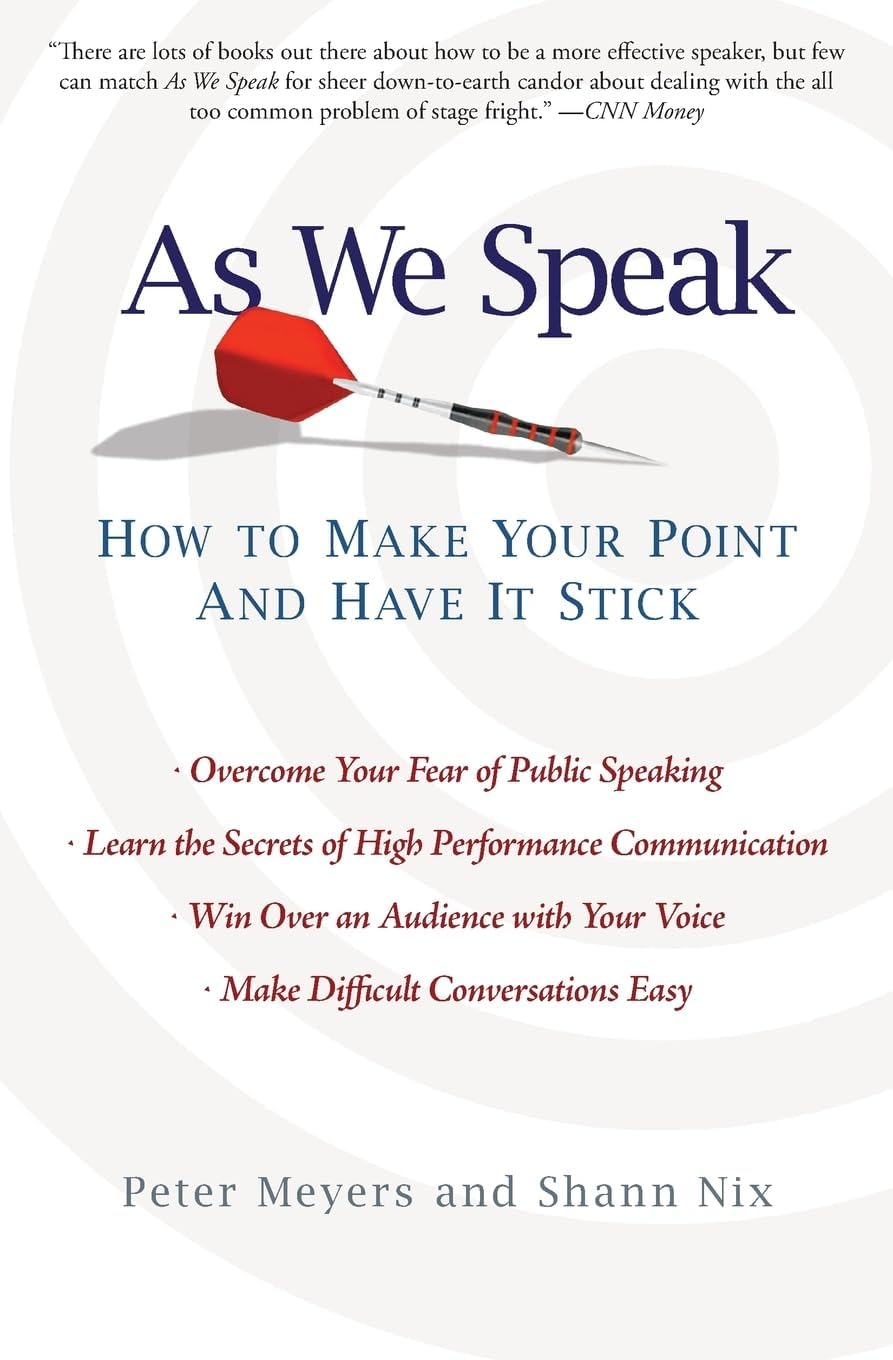
As We Speak: How to Make Your Point and Have It Stick
Product ID: 271561830
Desertcart purchases this item on your behalf and handles shipping, customs, and support to Iceland.
Buy As We Speak: How to Make Your Point and Have It Stick by Meyers, Peter, Nix, Shann online on desertcart.ae at best prices. ✓ Fast and free shipping ✓ free returns ✓ cash on delivery available on eligible purchase. Review: Este libro me ayudó a entender mejor como organizar un speech y comprender mejor que aspectos debo de considerar Muy interesante Review: L'ho trovato fantastico, chiaro, facile da usare. Davvero una lettura che consiglio a tutti quelli che vogliono passare dal parlare al comunicare
| Best Sellers Rank | #103,797 in Books ( See Top 100 in Books ) #780 in Self-Esteem #1,508 in Business Motivation & Self-Improvement #1,955 in Words, Language & Grammar |
| Customer reviews | 4.7 4.7 out of 5 stars (88) |
| Dimensions | 13.97 x 1.78 x 21.43 cm |
| Edition | Illustrated |
| ISBN-10 | 1439153086 |
| ISBN-13 | 978-1439153086 |
| Item weight | 249 g |
| Language | English |
| Print length | 288 pages |
| Publication date | 14 August 2012 |
| Publisher | Atria Books |
F**O
Este libro me ayudó a entender mejor como organizar un speech y comprender mejor que aspectos debo de considerar Muy interesante
G**O
L'ho trovato fantastico, chiaro, facile da usare. Davvero una lettura che consiglio a tutti quelli che vogliono passare dal parlare al comunicare
O**T
英語の文章自体が面白いし、 プレゼンをするのが楽しく思いさせてくれる最高の本です。
R**S
In Chapter 3, Peter Meyers and Shann Nix acknowledge their appreciation of Chip and Dan Heath and especially of what the Heaths share in their masterwork, Made to Stick. I share their high regard for this book and its co-authors. That book and As We Speak complement each other almost seamlessly. For example, the Heaths provide a brilliant explanation of the "what" and "why" of stickiness whereas Meyers and Vann provide an equally brilliant explanation of the "how" as well as why what they recommend is so effective. Here in a single volume is just about all you need to know about high-impact communication, especially after checking out the Heaths' book and reviewing the Six Principles that all sticky ideas demonstrate. (Please see Pages 16-18.) They are Simplicity, Unexpectedness, Concreteness, Credibility, Emotions, and Stories. Meyers and Nix have decades of experience helping people whose ability to think exceeds their ability to express themselves. "We develop the language and content, put them on their feet, rehearse them, and give them the tools they need to rise to the occasion." However, and it is impossible for me to exaggerate the importance of one point: this book offers more - FAR MORE - than "how to do it" advice for public speaking. They carefully organize their material within five Parts: Content, Delivery, State (i.e. presence), High-Stakes Situations, and Finding Your [own] Voice and Making It Heard. They are determined to help each reader's thinking gets the expression it deserves, "that the quality of the ideas is matched by the vitality of the [reader's] presence. The potential applications of what Meyers and Nix hare are almost unlimited because there are so many opportunities to achieve high-impact communication. The audience could be a single person or members of a governing board or several thousand people. The same principles apply: outstanding content + compelling delivery = high impact. As Warren Beatty suggests, "They may forget what you said, but they will never forget how you made them feel." After explaining in the first chapter how to ensure that a speech is outcome-focused, relevant, and on point, Meyers and Nix note that when taking the next step, "you can't just start slapping bricks together. First, you need to know where they go. You need a design. So now it's time to put together the architecture of ideas." The architecture consists of three parts: Ramp (the beginning), Discovery (the middle), and Dessert (the end). Meyers and Nix suggest three "Master Tips": o Get the I/You ratio right: Use ten "You's" for every "I."' o You have only seven seconds at the beginning in which the audience decides whether or not they're going to pay attention.' o Don't bury the lead. If you don't hook them right up front, you've lost them forever. There are no second chances. Here are the opening strategies they recommend: 1. Open with the word "You"' 2. Use a powerful statistic (i.e. a "sexy number")' 3. Ask an intriguing question.' 4. Shock them.' 5. Make a confession.' 6. Use the word "imagine" to serve as an invitation. 7. Tell an historical anecdote that is relevant to your key point.' 8. Tell a story: setting, characters, conflicts, tension, key developments, resolution, etc. This book is a "must read" for those who want to develop the mindset and the skills to communicate with high impact, whatever the circumstances may be. That assumes, of course, that the content is of a very high quality and appropriate for the given audience. Hence the importance of rigorous preparation. I agree with Peter Meyers and Shann Nix: Ultimately, "It's not about you. It's all about them."
R**S
Great book!!
Trustpilot
1 month ago
2 months ago