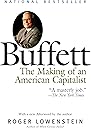
Buffett: The Making of an American Capitalist
Description
📊 Own the blueprint of a billionaire’s rise—don’t just read it, live it!
- PROVEN BESTSELLER STATUS - Ranked top 100 in Money & Monetary Policy—trusted by thousands of readers.
- ENDURING HARDCOVER QUALITY - A durable, collectible edition that stands the test of time and bookshelf envy.
- INVESTMENT WISDOM UNLOCKED - Dive deep into Buffett’s mindset and strategies that shaped modern capitalism.
- INSPIRES PATIENCE TOUGHNESS - Learn the resilience and discipline behind Buffett’s legendary success.
- JOIN THE ELITE READERS CIRCLE - Be part of a community that values financial mastery and timeless business insights.
Buffett: The Making of an American Capitalist is a highly rated, collectible hardcover book first published in 1995. It offers an in-depth biography of Warren Buffett, ranked #80 in Money & Monetary Policy books, with a 4.6-star rating from 590 readers. This edition is perfect for professionals seeking timeless investment wisdom and inspiration from one of the world’s most successful capitalists.

Specifications
| Asin | 0812979273 |
| Dimensions | 13.97 x 2.9 x 20.9 cm |
| Edition | Illustrated |
| Isbn 10 | 0812979273 |
| Isbn 13 | 978-0812979275 |
| Item Weight | 1.05 Kilograms |
| Language | English |
| Print Length | 512 pages |
| Publication Date | 29 April 2008 |
| Publisher | Random House Trade Paperbacks |
Reviews
User
👌
👏👏👏
User
It teaches you toughness and patience
Good if you are Buffet fan
User
The Oracle of Omaha!
As the title indicates this book is a biography of the self-made billionaire investor Warren Buffett. It takes us through his family upbringing, his early years, his eduction and the building of his capitalist empire in Berkshire Hathaway. The author focuses on the people that were influential in his life, particularly his mentor in value investing: Benjamin Graham. This theme is central to Warren's investment strategy (with adaptation on intangibles - such as brand, reputation etc.) . Through the years, despite all the macro-economics event, changes to the business landscape and technological advances this strategy has driven unparalleled sustained business returns over a period of over 40 years which the book covers. The book is full of non-investment business advice, relationship building, career management etc.Below are some excerpts from the book I found particularly insightful:-"One sees in Buffett a strongly similar suspiscion of public opinion. Buffett viewed a crowd as a potential source of a sort of intellectual contagion. It was the author of acts and feelings which, rather than being a summing-up of the parts, no one individual among the crowd would have subscribed alone."-"Regardless of price, we have no interest at all in selling any good business that Berkshire owns, and are very reluctant to sell sub-par businesses as long as we expect them to generate at least some cash and as long as we feel good about their managers and labor relations. We hope not to repeat the capital allocation mistakes that led us into such sub-par businesses....Nevertheless, gin rummy managerial behavior (discard your least promising business at each turn) is not our style."-"A compact organization lets all of us spend our time managing the business rather than managing each other."-"Buffett's guides to finding such a stock could be summarized quickly:a) Pay no attention to macroeconmic trends or forecasts, or to people's predictions about the future of stock prices. Focus on long-term business value - on the size of the coupons down the road.b) Stick to stocks within one's "circle's of competence." For Buffett, that was often a company with a consumer franchise. But the general rule was true for all: if you don't understand the business - be it a newspaper or a software firm - you couldn't value the stock.c) Look for managers who treated the shareholders' capital with ownerlike care and thoughfulness.d) Study prospects - and their competitors - in great detail. Look at raw data, not analysts' summaries. Trust your own eyes, Buffet said. But one needn't value a business too precisely. A basketball coach doesn't check to see if a prospect is six foot one or six foot two; he looks for seven-footers.e) The vast majority of stocks would not be compelling either way - so ignore them. Merrill Lynch had an opinion on every stock; Buffett did not. But when an investor had conviction about a stock, he or she should also show courage - and buy ton of it.-"I want employees to ask themselves whether they are willing to have any contemplated act appear on the front page of their local paper the next day, to be read by their spouses, children and friends...If they follow this test, they need not fear my other message to them: Lose money for the firm and I will be understanding; lose a shred of reputation for the firm, and I will be ruthless."-"Among history's great capitalists, Buffett stands out for his sheer skill at evaluating businesses. What John D. Rockefeller, the oil cartelist, Andrew Carnegie, the philanthropic steel baron, Sam Walton, the humble retailer, and Bill Gate, the software nerd, have in common is that each owes his fortune to a single product or innovation. Buffett made his money as a pure investor: picking diverse businesses and stocks."-"More than most, he reclaimed the rewards that spring not from trading commitments one for the next, but from preserving them."For anyone interested in the field of investment, it goes without saying that this is a must read book. Given that I had read another book by Roger L. (When Genius Failed - The Rise and Fall of Long Term Capital Management), I had very high expectations from him and he did not dissapoint. Don't let the size of the book discourage you, once you get started you will have a hard time stopping.
User
No pude acabarlo
El libro que todo inversor debe leer...., pero no pude acabarlo. Se me hizo monótono y pesado. Tras sus inicios, y su comienzo de éxito, el libro se vuelve repetitivo y a mí no me deja ninguna enseñanza en el plano moral sobre esta persona. Hará ricos a muchos pero deja mucho que desear sobre su forma de tratar a su familia. No recomiendo su lectura, mejor comprarlo de segunda mano y te ahorras unos cuantos euros
User
Great biography
Well written. Great anecdotes.
User
Great for understanding how to think like Warren Buffet
Seen this recommended everywhere and now I know why. A great little read if you want to understand how Warren Buffet was 'made' and the roots of his success. A much more balanced portrait that those which just concentrate on his financial performance.
Common Questions
Trustpilot