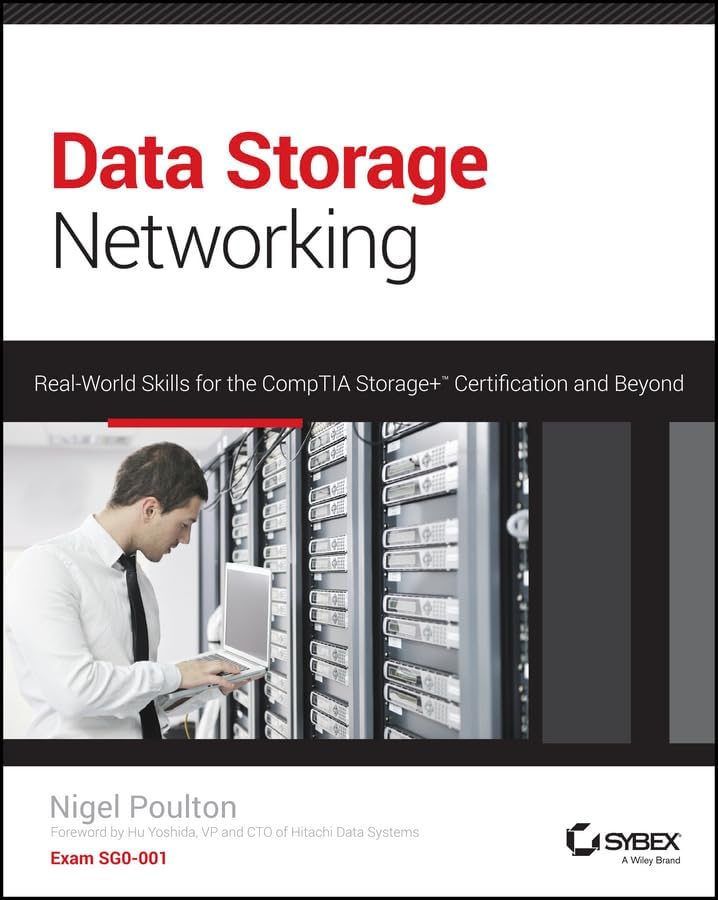

Learn efficient ways to harness and manage your data storage networks Whether you're preparing for the CompTIA Storage+ exam or simply seeking a deeper understanding of data storage networks, this Sybex guide will help you get there. This book covers data storage from the basics to advanced topics, and provides practical examples to show you ways to deliver world-class solutions. In addition, it covers all the objectives of the CompTIA Storage+ exam (SG0-001), including storage components, connectivity, storage management, data protection, and storage performance. Focuses on designing, implementing, and administering storage for today's evolving organizations, getting under the hood of the technologies that enable performance, resiliency, availability, recoverability, and simplicity Covers virtualization, big data, cloud storage, security, and scalability as well as how storage fits in to the wider technology environments prevalent in today's cloud era Provides advice and real-world examples that storage administrators in the trenches can actually use An excellent study aid for the CompTIA Storage+ exam (SG0-001), covering all the exam objectives Data Storage Networking: Real World Skills for the CompTIA Storage+ Certification and Beyond provides a solid foundation for data storage administrators and a reference that can be consulted again and again. Review: Passed the CompTIA Storage+ exam studying only this book - There are some areas, in my opinion, in relation to the exam, not well covered, or as clearly as could be. The book isn't directly designed for this exam, but it does cover the major topics and seems, and from what I found at the time, is the closest thing to an official study guide. I've had some experience over the years with NetApp, VMware, networking etc. in a Data Center so that helped. Someone with less experience, using only this book (and the CBT that comes with it), passing the exam might be cutting it close. Of course, each exam is at least slightly different for each test taker as most computer IT exams are, meaning, you and I could be asked different questions, so it's hard to say for sure what areas might need a little extra study as that could vary. Also, as with so many of these exams, often, a different answer could also be "correct" depending on scope and interpretation, etc. (i.e. they want a certain answer, but a different answer could be argued to be at least as correct), in my opinion, often questions on exams are poorly written, but that's not the books fault. This book is very readable and covers a lot of topics, some of which, can be confusing. The book for the most part, does a nice job of teaching them and it's worth a place on your book shelf. Review: Enjoyable to read - I bought this book directly from desertcart to help me study for the CompTIA Storage+ exam, and to gain knowledge in data storage for my job. The book was listed on sale for about $36.00 instead of $59.99 as printed on the back cover of the book. I just began to read the 2nd chapter called 'Storage Devices.' So far, the book has been enjoyable to read. When I say 'enjoyable,' the book is not boring and not written for an English professor IQ to read and understand. Normally when I read IT books for about 15 minutes, I need tooth picks to keep my eyes open. Not this time. The author explains concepts in plain English and gives an easy to understand definition for someone who does not have any knowledge is data storage. For example, the author says, "Tape storage refers to magnetic tape." Also, the author adds some humor in the text for example, "Flash memory, on the other hand, is like greased lightning..." I am looking forward to continue reading this book and to gain more knowledge in data storage. As stated, this book is enjoyable to read.
| Best Sellers Rank | #3,332,931 in Books ( See Top 100 in Books ) #1,487 in Database Storage & Design #1,864 in Computer Networking (Books) #2,223 in Computer Networks, Protocols & APIs (Books) |
| Customer Reviews | 4.6 out of 5 stars 69 Reviews |
M**K
Passed the CompTIA Storage+ exam studying only this book
There are some areas, in my opinion, in relation to the exam, not well covered, or as clearly as could be. The book isn't directly designed for this exam, but it does cover the major topics and seems, and from what I found at the time, is the closest thing to an official study guide. I've had some experience over the years with NetApp, VMware, networking etc. in a Data Center so that helped. Someone with less experience, using only this book (and the CBT that comes with it), passing the exam might be cutting it close. Of course, each exam is at least slightly different for each test taker as most computer IT exams are, meaning, you and I could be asked different questions, so it's hard to say for sure what areas might need a little extra study as that could vary. Also, as with so many of these exams, often, a different answer could also be "correct" depending on scope and interpretation, etc. (i.e. they want a certain answer, but a different answer could be argued to be at least as correct), in my opinion, often questions on exams are poorly written, but that's not the books fault. This book is very readable and covers a lot of topics, some of which, can be confusing. The book for the most part, does a nice job of teaching them and it's worth a place on your book shelf.
T**K
Enjoyable to read
I bought this book directly from Amazon to help me study for the CompTIA Storage+ exam, and to gain knowledge in data storage for my job. The book was listed on sale for about $36.00 instead of $59.99 as printed on the back cover of the book. I just began to read the 2nd chapter called 'Storage Devices.' So far, the book has been enjoyable to read. When I say 'enjoyable,' the book is not boring and not written for an English professor IQ to read and understand. Normally when I read IT books for about 15 minutes, I need tooth picks to keep my eyes open. Not this time. The author explains concepts in plain English and gives an easy to understand definition for someone who does not have any knowledge is data storage. For example, the author says, "Tape storage refers to magnetic tape." Also, the author adds some humor in the text for example, "Flash memory, on the other hand, is like greased lightning..." I am looking forward to continue reading this book and to gain more knowledge in data storage. As stated, this book is enjoyable to read.
D**O
So good on theory that it loses focuses on the little details for the exam.
I am writing this review in comparison with the Storage+ certification exam. There is no doubt that the content in this book is awesome. This book is heavy on theory and does a great job of explaining how the technologies work. I took the exam two days ago and passed (not the greatest score but I'll take it). The materials I used were this book, Pluralsight (which is this book in audible format), and the uCertify package featured on the CompTIA site. I'll give my two cents about the latter and focus on the book at the moment. An area that the book does not focus on are specifications. Having taken some CompTIA certifications before, I knew the exam would certainly have questions on specifications. For instance (and these weren't questions, just examples), which generation of LTO was WORM first available? Or, what is the maximum distance of 1000Base-LX? The certification exam that I took had a lot of these types of questions and this book contains very little in terms of exact specifications of formats for certain media and technology. While reading the book, I did my due diligence and researched these items on my own as I encountered the subjects. The book also has a lot of errors in terms of typos and calculations (probably from the typos). You should be able to figure everything out and correct the errors on your own from the content in the book, don't let that detract from the book's quality content. Aside from the specifications, this book did an outstanding job in explaining the theory behind the technologies. The exam I took was heavily sedated with RAID and FC questions (I think I only received one iSCSI question which is odd, I thought I'd see more of them). I felt confident in most of my answers in regards to answering the questions that were heavy on theory and troubleshooting the technologies and felt the questions I missed were the simple yet overlooked questions on specifications and some other miscellaneous questions. I am not disappointed with the book. This book was definitely written by someone who works in the field and knows his stuff. The book reflects upon the material that you'd encounter on an every-day basis and not the unimportant fluff we know is irrelevant such as maximum distance and throughput numbers (unless you're an engineer and designing such technologies). The content that comes with the book should not be ignored. The exam that comes with the book (downloaded from the web) is actually pretty close to the type of questions you'll see on the exam (in fact, there was one question that was exactly the same on the certification exam from the book's exam). The flashcards, which is always a nice feature, is merely just a 100 words/phrases. I would of loved to see about 300 questions and double the amount of flashcards for materials to properly study. This is what led me to try uCertify. (Note: The author notes the difference of Cumulative and Differential Incremental backups and the conflict between the terms being used, yet has the wrong answer on the exam) Is the book a good enough source to pass the exam? I guess it would depend on the version of the exam you get (as the % of questions from certain groups are changed with every instance). The version I took I don't think I would of passed, perhaps come close. However, as long as you research the specifications of certain technologies like fiber, Ethernet, and so forth, you should be able to pass. For my opinion on Pluralsight and uCertify (which does not reflect upon the book), I do not recommend either. Pluralsight is literally just a cut-down version of the book in audio format. However, it may be worth it to sign up for the trial to access the materials that accompany the videos (PDF files of the slides being used in the videos. These work great on a tablet device that you can just flip through anywhere you have downtime for review). uCertify wouldn't of been so bad if the material on the site wasn't old (about 7 years behind or so when compared to the content with the book). It seems like whatever certification that SNIA had back then was simply taken and just rebranded with the Storage+ name. The review material and flashcards are not helpful and its best to just go straight to the practice exams. I will admit that 60% of the questions are simple questions you may encounter (you'd have no problem answering them from the material in Nigel's book), 30% of them are just outdated/not relevant (I do not care about FC-AE and neither does CompTIA) or wrong (I've bashed my ahead against the desk a few times in frustration. There will be questions that have answers that make no sense and easily half the questions have no explanation as to why the answer is suppose to be right), and 10% of the questions present something new and valuable to learn. Bottom line: Get the book, it is a fantastic resource for learning the technologies, just do some research on specifications (make sure you know your RAID inside/out). Skip Pluralsight (except for the downloadable materials using the free trial). Skip uCertify (unless you can get it cheap. $30 would be a fair price in my opinion).
J**E
Reads like a novel
Wow! I found this book almost by accident here on Amazon. I was browsing for a DR and VMware book and found it and I am glad I did. The writing style is fantastic, very informal and succinct. It really reads like a novel. But the author does not let important technical information out. There a plenty of graphics, so concepts like disk's structure, sectors, tracks, etc, are easier to grab because it's being shown as well, not only explained with words. I'm currently not pursuing the CompTia Storage+ certification but wanted to refresh some data storage concepts now that we moved our SQL servers to a SAN and VMware environment. And this book is certainly helping me on that regard. Also, for the Kindle users, the formatting is good enough for reading it on a Kindle Paper White. I may download it on my iPad air which has a bigger screen, but reads fine on a 6" screen. Very enjoyable read. For some with entry or mid level concepts on Storage, I fully recommend this book. Very enjoyable.
C**S
I've not yet completed Chapter 3 and I'm in information overload (this is a good thing). I have learnt so much and my ...
I bought this book to understand SANs and NAS and how they can be exploited to obtain the benefits. I've not yet completed Chapter 3 and I'm in information overload (this is a good thing). I have learnt so much and my understanding is far beyond where it was when I started. I had no intention of doing the certification but if I'm going to absorb this quality of knowledge I just might take the exam. You simply cannot go wrong with this book and while I want to skip chapters straight to the backup section (Chapter 11) I just can't. The book is well organized and provides a foundation of information in each chapter that builds on the previous chapter. This allows you to understand storage from the ground up, from the mechanics of HHDs and SSDs, SANs, NAS, RAID, Snapshot, Replication and even Virtual Storage technologies. The list goes on and on but this book is great to say the least. I also agree with a comment from another reviewer. This book needs to be available in hard cover. For certain this will be a desk reference and a hard cover edition would be nice. To Sybex and Nigel Poulton ... Thank you. I'm on my way to gaining competence in storage technologies.
A**F
Excellent reference
This is an excellent reference and I feel like my fundamental understanding of storage technologies is greatly improved after reading it. There were a couple of minor things that annoyed me. - The book uses terminology before it is adequately defined and examined. For example, Chapter 3 "Storage Arrays" makes several references to RAID volumes and I just feel like the RAID chapter should have come earlier than the Storage Arrays chapter. - There are many times where the author describes a technology and then goes on to say "All good storage arrays have this." Can you please give us a couple examples of storage arrays or vendors that do support the technology? I realize the purpose of the reference is exam preparation, but as somebody who is trying to refresh on storage ahead of a storage project or purchase, it would be nice to know Storage Array XYZ vendor has this technology in their arrays before I even have to ask the sales representatives.
S**M
Are you kidding me? Perfect IT book.
Nigel Poulton wrote a gem of an IT book here. He managed to take a subject that can be bone dry and presented it in an interesting and even entertaining manner. This book is great for laying down an amazing foundation for field of IT that can be daunting to learn. I had almost 0 storage experience and I never felt underwater at any point in this book. Nigel does a great job of presenting the stripped down basics of a topic in digestible sections and gradually builds into explaining some very complicated Storage subjects. He somehow managed to make the unassuming hard drive into a fascinating microcosm of computing. Bravo!
K**A
I passed the Storage+ with the help of this book
As many other reviewers have, I also purchased this book for the purpose of passing the Storage+. I'm happy to say that I successfully passed the test on the first try with an 804. A quick note about my background, I've been in IT for 6+ years as a server admin, I have my Server+, A+, and Security+ and the only storage experience I have is setting up a small SAN in at current position. The only study materials I used were this book, the accompanying test questions and flashcards, and random practice questions I found after doing many Google searches. Since this is a review for the book, I'll try to be as thorough as possible, then I'll very briefly describe what else I used. I know there are decent reviews already on here, so I'll try not to sound too repetitive, but must say I agree with the majority of what others have already said. In general I would recommend this book as it does a good job of explaining the theories behind Storage Management. In regards to using it to pass the Storage+ it's probably the best book you're going to find available right now. Based on my research and what I found in forums, it's one of the most interesting storage books around. As another reviewer mentioned, it does lack a bit in the specifications department. So if you're only using this book be sure to look up things like LTO specifications, CAT cable specifications, SMF vs MMF cable specifications (OM1, OM2, etc. - this is mentioned in the book), etc. One thing I'll also say is that in the book it's mentioned that the test uses the SNIA definitions for differential incremental and cumulative incremental backups and I believe that the test does use these definitions, however the practice exams that accompany the book seem to use the mainstream definitions, which can be a bit confusing. If you have your Server+ or A+ keep those concepts in mind while studying, basic/common sense stuff like making sure to troubleshoot from the bottom up. As far as the other things I use, I signed up for the free trail of uCertify and took the pre-assessment test which I thought was helpful. I also signed up for the PluralSight free trial, I didn't really use that, I think I listened to one lesson at most. If you don't pick up things well by reading them, I would suggest PluralSight in addition to this book. The course is done by the author and is basically just a shorter version of what's covered (at least that's what I got from what I listened to). If nothing else you can sign up for the free trial and see if it would help you. In the end I would suggest you purchase the book. It really is handy and was essential in my success with the Storage+.
B**N
Excellent book to start building storage knowledge
I'm not sure about the relevance for the exam as it's not something I'm looking to pursue. From a design and choice side of things, this book really helps explain the protocols and limitations of each. Writing is clear and concise, if you are looking to learn how storage connects and why you might choose iSCSI over FC, this is a great starting place.
A**I
A must read
It is a must read for any one serious about storage, beginners or full fledge professionals. The book covers history, technical details and much more in a very nice blend. As I know the author personally as we worked together in HDS I can clearly see his great sense of humour and his ability to make huge effort to explain things. Well done Nigel
C**N
Excelente livro!
Excelente livro! Me ajudou a passar na prova da CompTia e da SNIA. Recomendo!
R**9
Had this book now for at least 2 weeks and ...
Had this book now for at least 2 weeks and it was definitely what I was looking for. Not too complicated and was designed for a novice or intermediate individual getting into this subject. I find each chapter can stand on its own.
F**O
good book
Very easy to read. It is helping me to fill some gaps about storage, now I am thinking seriously if I would have to take the exam or not.
Trustpilot
2 months ago
2 months ago