We remain fully operational. Our teams are working around the clock to ensure your deliveries continue safely.

DOWNLOAD THE APP


Customer Services
Copyright © 2025 Desertcart Holdings Limited
DOWNLOAD THE APP
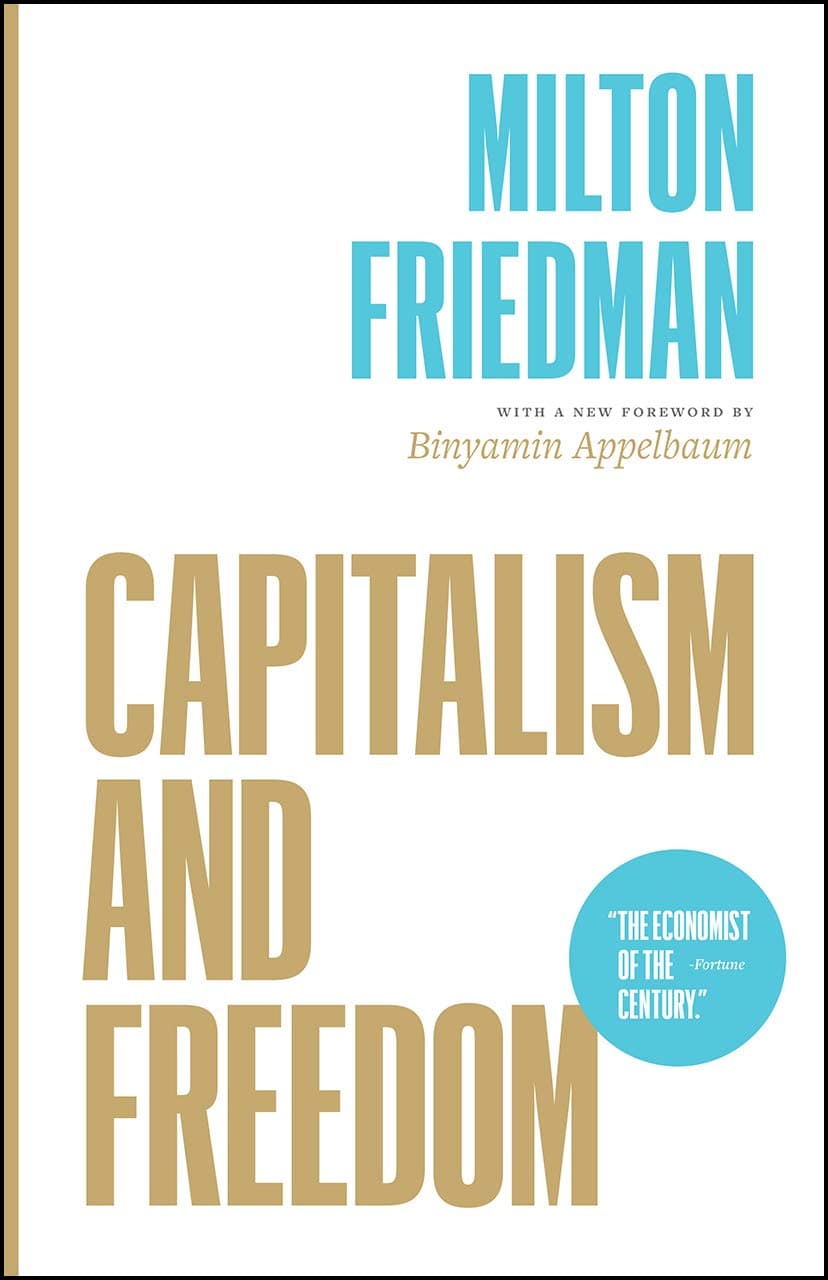
desertcart.com: Capitalism and Freedom: 9780226734798: Friedman, Milton, Appelbaum, Binyamin: Books Review: Insight for those who wish to be free - Nobel laureate Milton Friedman is quite possibly the most brilliant economist in the world today and a man on the cutting edge of libertarian (classical liberal) thought. And in "Capitalism and Freedom" he lays out a basic political philosophy in the classical liberal tradition in the first two chapters of the book and alternately defends and expands upon that premise for the remainder of the work. In much the same way that F. A. Hayek - an ideological predecessor - spelled out his basic thesis in one concise book and then fleshed it out in another, Friedman provides the basics here and fleshes them out in the larger (and somewhat better written) "Free to Choose". In addition, while not wishing to rehash some of the detailed support for his assertions, he does - through footnotes - provide the reader with opportunity to delve deeper. Given the nature of the subject matter and the expertise of the author, the writing can be dry and may appear difficult to approach, particularly in the initial chapters, but the reader who sticks with it will be well rewarded. Subsequent chapters, largely adapted from lectures by the author, are easier reads. And Friedman avoids, for the most part, the economic jargon that can make works such as this hopelessly confusing to the layman. Friedman is often tagged with the "monetarist" or "supply-side" labels (if you don't believe me, read some of the other reviews), largely because he believes that these methods of economic manipulation are infinitely preferable to the fiscal manipulation that has been the norm in this country. Those who actually READ this book will find that he advocates intervention by neither means, preferring instead stable monetary growth removed from the hands of either fiscal or monetary interventionists. He provides one of the most succinct explanations of the monetary actions (of the Fed) that created and worsened the Great Depression that I have ever come across, though mentioning only briefly the fiscal policies that subsequently lengthened it considerably: the New Deal and, to a much lesser extent, Smoot-Hawley. This alone makes the work valuable. He goes on to examine a number of things that are now taken for granted in this country (the Welfare State, Social Security, public education, licensing requirements) and asks the question, "Have these government actions made things better or worse?" The record is less than stellar (especially in the subsequent 40 years since this was written). And he proposes some alternatives such as the negative income tax and other alternative roles for government that are, arguably, less intrusive on the liberty of the citizenry. And he uses examples that are easy to follow and understand including one about men stranded on desert isles that is NOT as presented in another review. As an economist, I would say that this work has aged remarkably well. The analysis has clearly not become dated as have those of Galbraith and, to a certain extent Keynes. [Keynes WAS a genius, providing the mathematical and econometric bases for much of current economic thought, but, contrary to the assertion by another reviewer, much of what he proposed should be done by the state has been discredited.] Friedman, for example, was one of the first to advocate a school voucher system, which is only now receiving serious attention. It is noteworthy that a number of economists from the left have criticized Friedman in general and this work in particular. But those attacks (by Krugman, Herman and Diesing, among others) have proven to be, for the most part, without merit. If you accept the basic premise that freedom is vitally important and that the actions of the state should be viewed from that point of view, you will find this work to be invaluable. If not, you will certainly not be pleased. And if you believe the utter nonsense that capitalism is in any way "oppressive", well, if you can't see reality... Review: The Best Book for New Libertarians - I loaned this book to someone so, of course, I had to buy it again. It's a fantastic book! I recommend this book to anyone interested in economics and/or Libertarian thought. Milton Friedman is a great teacher because he has a very natural way of laying things out. It doesn't read like a dry textbook at all.
| Best Sellers Rank | #15,381 in Books ( See Top 100 in Books ) #2 in Free Enterprise & Capitalism #7 in Theory of Economics #30 in Economic History (Books) |
| Customer Reviews | 4.6 4.6 out of 5 stars (2,918) |
| Dimensions | 5.5 x 0.65 x 8.5 inches |
| Edition | First Edition |
| ISBN-10 | 022673479X |
| ISBN-13 | 978-0226734798 |
| Item Weight | 2.31 pounds |
| Language | English |
| Print length | 287 pages |
| Publication date | November 17, 2020 |
| Publisher | University of Chicago Press |
W**N
Insight for those who wish to be free
Nobel laureate Milton Friedman is quite possibly the most brilliant economist in the world today and a man on the cutting edge of libertarian (classical liberal) thought. And in "Capitalism and Freedom" he lays out a basic political philosophy in the classical liberal tradition in the first two chapters of the book and alternately defends and expands upon that premise for the remainder of the work. In much the same way that F. A. Hayek - an ideological predecessor - spelled out his basic thesis in one concise book and then fleshed it out in another, Friedman provides the basics here and fleshes them out in the larger (and somewhat better written) "Free to Choose". In addition, while not wishing to rehash some of the detailed support for his assertions, he does - through footnotes - provide the reader with opportunity to delve deeper. Given the nature of the subject matter and the expertise of the author, the writing can be dry and may appear difficult to approach, particularly in the initial chapters, but the reader who sticks with it will be well rewarded. Subsequent chapters, largely adapted from lectures by the author, are easier reads. And Friedman avoids, for the most part, the economic jargon that can make works such as this hopelessly confusing to the layman. Friedman is often tagged with the "monetarist" or "supply-side" labels (if you don't believe me, read some of the other reviews), largely because he believes that these methods of economic manipulation are infinitely preferable to the fiscal manipulation that has been the norm in this country. Those who actually READ this book will find that he advocates intervention by neither means, preferring instead stable monetary growth removed from the hands of either fiscal or monetary interventionists. He provides one of the most succinct explanations of the monetary actions (of the Fed) that created and worsened the Great Depression that I have ever come across, though mentioning only briefly the fiscal policies that subsequently lengthened it considerably: the New Deal and, to a much lesser extent, Smoot-Hawley. This alone makes the work valuable. He goes on to examine a number of things that are now taken for granted in this country (the Welfare State, Social Security, public education, licensing requirements) and asks the question, "Have these government actions made things better or worse?" The record is less than stellar (especially in the subsequent 40 years since this was written). And he proposes some alternatives such as the negative income tax and other alternative roles for government that are, arguably, less intrusive on the liberty of the citizenry. And he uses examples that are easy to follow and understand including one about men stranded on desert isles that is NOT as presented in another review. As an economist, I would say that this work has aged remarkably well. The analysis has clearly not become dated as have those of Galbraith and, to a certain extent Keynes. [Keynes WAS a genius, providing the mathematical and econometric bases for much of current economic thought, but, contrary to the assertion by another reviewer, much of what he proposed should be done by the state has been discredited.] Friedman, for example, was one of the first to advocate a school voucher system, which is only now receiving serious attention. It is noteworthy that a number of economists from the left have criticized Friedman in general and this work in particular. But those attacks (by Krugman, Herman and Diesing, among others) have proven to be, for the most part, without merit. If you accept the basic premise that freedom is vitally important and that the actions of the state should be viewed from that point of view, you will find this work to be invaluable. If not, you will certainly not be pleased. And if you believe the utter nonsense that capitalism is in any way "oppressive", well, if you can't see reality...
C**W
The Best Book for New Libertarians
I loaned this book to someone so, of course, I had to buy it again. It's a fantastic book! I recommend this book to anyone interested in economics and/or Libertarian thought. Milton Friedman is a great teacher because he has a very natural way of laying things out. It doesn't read like a dry textbook at all.
D**E
King of Econ! I strongly recommend this book and intend to take a shot at more of Friedman's books.
This is a fundamental work for liberal market economies. His simple principles of freedom have led to changes in economic institutions worldwide, which have lifted millions out of poverty. Great man and a great crusader for freedom. The role of a 'large state' restricts individual freedoms. Milton's ideas on capitalism are based on economic reasoning and a unique perspective. I agree with his argument that we should minimize government intervention and allow the market to operate freely. Capitalism helps alleviate issues in discrimination, social welfare, and education. Ultimately, the information in this book is timeless and should be used as a reference for future years. America will be better off with a capitalistic system than any other collectivist society.
C**.
A polemic on philosophers of both economics and political philosophy that fail to accept the "real world"
This is a fairly dense book. In the sense that if you don't know some of the basic key economic concepts and philosophers that Friedman references, then you will be totally lost and have to re-read full chapters to get the ideas. It took me a month to work through this book, basically having to re-read whole chapters because some of the explanations that Friedman uses get confusing as be jumps around. That said, to me in reading this and thinking about it; the book is probably misunderstood by most of the general public that attempts to read this. It appears that Freidman presents a libertarian ideals of how the economy could run and that a capitalistic economic theory. At the same time he shows how the Keynesian, Engles/Marx philosophy can't work in some of their ideas because the empirical data from both history that they can't work. Then also explains how some of the ideas that are popular in both the Keynesian and Marx economic philosophy can't work when applied to the logical end since they would violate other portions of those related to basic economic philosophy and just the general idea of other economic principles such as basic ideas of Monetary Policy or Fiscal Policy. When viewed thru this idea, then this book is an interesting philosophy book about both political concepts, economic theories and showing that if we even apply some basic logic of philosophy concepts from Plato or Kant or similar. To me once I took this idea on that what Friedman is doing, at least in my mind, he is presenting is not only a polemic on Keynesian and Marx economic theory; but also on most all economic theories and philosophies as a whole. Since, as he states numerous times in most of the chapters, that these theories are idealized and perfect worlds. Rather than the history has shown constantly and as he reviewed the data with his students, that theory was nice until it hit harsh reality. In that sense this book should be idealized as an economic or political treatise as some put it. Rather it should be viewed as a harsh attack on the philosophers who are unwilling to view reality as it actually happens and properly interpret the human condition on their philosophies. As well as those that try and hand wave away those questions from folks with the "What about ... when ... happens?" sort of concerns. When I re-read some of the chapters later after viewing what I have interpreted Friedman's theme, then some of his explanations and concepts became a little clearer and even he showed that they weren't perfect, but it would be an interesting thought experiment if they were tried.
O**S
Reading Milton Friedman for the first time can be an overwhelming experience. The wealth of ideas coupled with the wry delivery and almost John the Baptist like certitude with which he preaches his version of the economic gospel all make for a challenging, if not occasionally infuriating read. The central pillars of Friedman's thinking are deceptively simple but the consequences should they ever be fully enacted by any government would be profound. Friedman feels that government is `guilty' until proved `innocent'. Government equals power over individuals, waste, inappropriate resource distribution and the indulgence of what economists call `rent seeking' special interest groups. Governments want to tax, regulate, control and disperse revenues and favours to suit their own particular agendas. Even when they are trying to act in the public interest, governments frequently make matters worse. Extra taxes lead to disincentive effects, extra spending leads to inflation and interventions like minimum wage legislation lead to increased unemployment. The list of potential and actual government failings are lovingly documented by the author. The relish with which he grinds out his dismal litany of state mismanagement and corruption is almost disconcerting, but it is entertaining. So what are governments for? Well in time honoured Libertarian fashion, as little as possible. Government should be about up -holding the rights of citizens and business to operate in accordance with their own best interests. So the protection of property rights, the proper fulfilment of contracts and basic civil liberties. Just about everything else can be resolved by the market. This is where Friedman gets serious. He takes on issues that softy `mixed- market' types think of as sacred and untouchable. Discrimination, inequality, education, protection of farm incomes, industrial competition and licensing of occupations, all come under the Friedman hammer. His argument is that government by `featherbedding' unions, producer groups or favourite causes at high costs and nearly always to the disadvantage of citizens and not infrequently the particular groups themselves do more harm than good. He backs up his position with some pretty convincing arguments and reference to data (sadly getting a little out¬¬-dated and relates only the USA) or particular case studies. If you give markets the chance he argues, they will supply the answer. Discriminating employers for instance will be landed with higher costs and lower profits as they hire the more expensive labour that suits their particular tastes. One of the great advantages he posits is that like love, capitalism is blind. It only seeks the most efficient use of resources and the lowest costs. Your religion, gender, colour or cultural background is simply irrelevant in the market place, just as long as you are competitive. So what need for government if the market as an unintended consequence promotes higher incomes, employment and civil rights? So where is the flaw in all this free market evangelism? Friedman is rather too keen to down play the virtue of good governance. At least governments are elected and at play lip service to the idea of improving the lot of citizens. Governments are accountable in a way that big business can never be if left to themselves. Monopoly capitalism may confer benefits but competition and choice are not necessarily at the top of the list, viz the 'Robber Barons of late Nineteenth century American industry and finance. Likewise businesses need regulating - why should citizens be left at the mercy of the unscrupulous or the incompetent? Not forgetting of course markets have innate instability built in- inflation, unemployment and issues of social provision cannot or will not always be addressed by the market. When the economy is growing, Friedman wants government to take its foot off the brake, but when there are problems such as the 1929 `Great Crash', he wants to blame government for the `high spirits' of the market. Come on Milton, you can't have it both ways!! `Capitalism and Freedom' provides great insight into Libertarian economics. It entertains, engages (and enrages on occasion) but is very clear in its line of argument. As a book it is aging gracefully. The data is rather old and very selectively used but the ideas still have much relevance for us all today. Recommended.
D**E
Un libro obbligatorio per capire il mondo.
A**R
Milton Friedman foi um dos grandes defensores da liberdade individual. Mostrando a forma liberal de ser ver o mundo com diversos exemplos da vida real, Friedman consegue ilustrar que poder, por que se tenham boas intenções, acabam gerando consequências não intencionais de privilégios que acabam por reduzir a liberdade individual em prol do coletivismo.
M**S
Friedman's wisdom appears clearly in this wonderful book. Following Hayek, he shows that political freedom cannot genuinely exist without economic freedom. The book is beautifully written and Friedman convincingly backs every one of his assertions. I doubt critics of Friedman have ever read his writings. To my mind, this book is a must have and should be read in conjunction with "Capitalism, Socialism and Democracy" by Joseph Schumpeter, and "The Vision of the Anointed" by Thomas Sowell.
E**R
For its times it was excellent. Nowadays free market economics in both the Austrian and Chicago School have evolved and improved past what is exposed in the this book. Never the less it was one of best books I read early in my search for understanding economics and a springboard into other books on radical capitalism
Trustpilot
2 days ago
1 week ago