

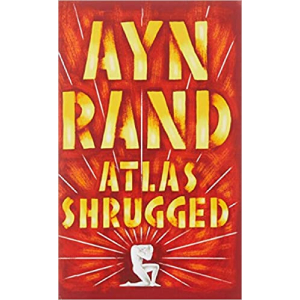
Atlas Shrugged
Product ID: 260385701
⭐4.5/5 from 8,415 readers
🏆Top #9 in Political & Protest Poetry
📚Classic 1957 edition
Desertcart purchases this item on your behalf and handles shipping, customs, and support to Iceland.
📖 Unlock the revolutionary mind behind a timeless bestseller!
Atlas Shrugged, Ayn Rand’s 1957 magnum opus, is a genre-defining philosophical thriller that explores the collapse of a near-future America through a gripping narrative of innovation, ethics, and power. Highly rated by over 8,400 readers and ranked top 50 in political fiction, this edition comes in durable packaging to preserve your copy for years of intellectual inspiration.
| Best Sellers Rank | #17,408 in Books ( See Top 100 in Books ) #9 in Political & Protest Poetry #34 in Genetic Engineering Science Fiction #50 in Political Fiction |
| Customer Reviews | 4.5 out of 5 stars 8,415 Reviews |
A**S
Font Size
Fabulous Book However this copy font too small
M**O
Perfecto
Muy bueno
P**N
Don't mention the S-word
The author saw the Russian revolution of 1917 at first-hand. She experienced its economic effects directly when her father's business was nationalised by force. The Russian revolution took place as a result of the country's military defeats during the First World War. It is interesting to note that there was also a revolution in 1905, after the national humiliation experienced in the Russo-Japanese war. It is open to speculation as to whether the autocratic Czar would have survived with a reformist government (Perestroika 1917?) if it has not rushed to the aid of Serbia in 1914 as part of its ill-fated pan-slavic foreign policy. However that debate is for another day. Ayn Rand depicts a socialist takeover of the United States, one that is as drastic but not as dramatic as Russia's. She also shies away from actually using the word 'socialism' or 'communism' in her novel. To her this would be shorthand and what she wants to do is describe the effects of collectivism without resorting to labels. The descent into socialism is depicted as the non-violent triumph of ideas, where the political, media and some of the business elites gradually come to accept the principle of 'from each according to their abilities, to each according to their needs' as a consequence of legally sanctioned industrial cartelisation, until it becomes national policy and full state control of the economy takes place, ostensibly to mitigate the effects of the cartels. Unlike Russia, this takes place in a democracy with an ostensibly free media so the changes that take place are gradual and more or less consensual amongst the majority. Somewhere along the way the US Constitution has been amended out of existence and the President is now known as the Head of the State. He works with a Politburo in all but name consisting of business cronies and power brokers. Rand maps the effect of the political and social changes throughout the novel in an intelligible fashion that people in a free country would understand and demonstrates how this socialism utterly depends on people to whom this concept is anathema. As the novel opens the economic collapse is under way, but no-one understands why. Rand depicts in her story the theory that collectivist economies only survive by coercing the most productive to continue to produce while at the same time denying them the true rewards of their labours by redistributing all the value they create while providing subsistence. One man, John Galt, realises this and organises a strike of the mind, of the creative entrepreneurs who drive or sustain progress through their creativity, innovation and organisational and management skill. As the skilled and competent disappear (this is done by having them choose 'voluntary simplicity', working in low-paid, menial positions that require no thought, or retreating to a valley concealed by a cloaking device) their successors find themselves unable to maintain the technological civilisation and the country regresses into a new stone age as supplies of raw materials and food diminish. The country also slides into dictatorship, as force replaces the price mechanism as the only way to drive the economy. State terror and the threat of unleashing WMDs on the populace are contemplated, but by then it is too late. The only people left to terrorise are simply not productive enough to sustain the economy. The novel was published in 1957 and it is interesting to note that a 'strike of the ablest' was actually under way in East Germany, where the young and the skilled were making use of an open border in Berlin to escape to West Germany. It was in response to the impending economic collapse (the only people left in the country was rapidly becoming the old, infirm and very young) that the Berlin Wall was constructed. Ayn Rand's motivation? Well she saw the rise of socialism in otherwise free countries like Britain and revolutionary movements in Cuba and South America. Soviet domination of Eastern Europe was a fact and perhaps she felt that a cautionary tale, in line with her developing philosophy, was necessary to prevent the growth of 'People's States' as she depicts taking over the world except the USA in her novel. She may have been worried that Free-Market Capitalism was in fact in decline. There has been a lot of criticism of the writing style of the novel. It is not generally fast-paced or dramatic and a lot of space is given over to philosophic thinking and speeches, especially John Galt's speech, which runs to several pages. However it has to be recognised that this is a book of ideas and these ideas are presented very well indeed. I have not read Mein Kampf or Das Kapital and nor do I intend to. I do however suspect that they do not project their ideas in such a concise and entertaining manner. This book defends and justifies free-market capitalism and gives commerce a soul. It has enhanced my understanding of the socio-economic environment I was brought up in and is arguably the only book I sincerely wish I had read in my teens. Although the book rejects altruism and self-sacrifice, it is my strong opinion that if you know anyone with a mind who is 15-20, this is the best present you can get them as it will give them something that is life-improving and life-affirming. However this is a book that can by people of all ages as it does not target a specific age range.
J**.
Not suggest to buy this version
Don’t suggest buying this version, the font size is too small.
C**O
Glue does not work in heat of the desert. Pages let go....
Glue does not work in heat of the desert. Pages let go.... Content good :-)
S**N
Great reading
Great book
Trustpilot
3 weeks ago
5 days ago