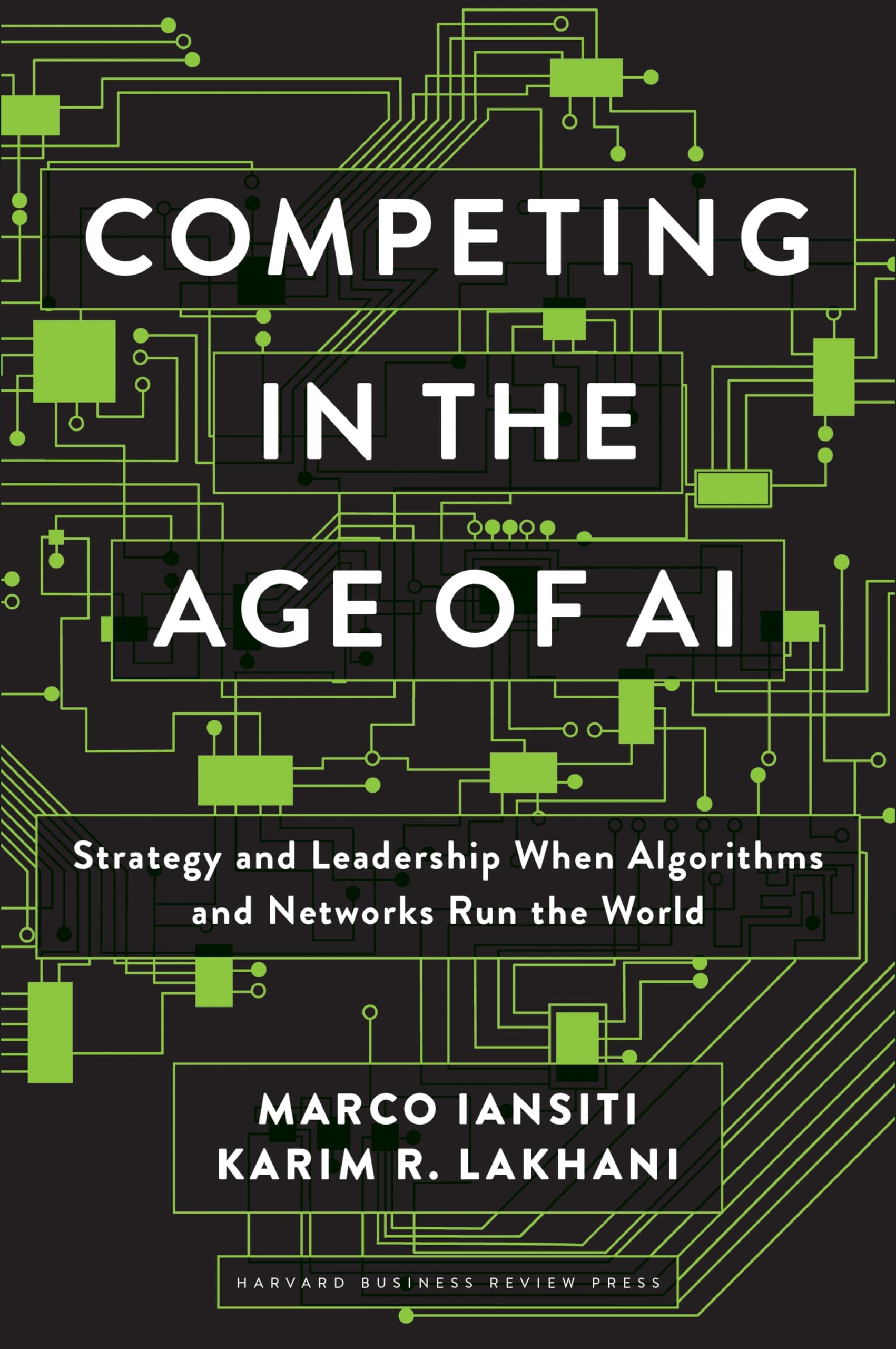
Competing in the Age of AI: Strategy and Leadership When Algorithms and Networks Run the World
Product ID: 254188874
Buy anything from 5,000+ international stores. One checkout price. No surprise fees. Join 2M+ shoppers on Desertcart.
Desertcart purchases this item on your behalf and handles shipping, customs, and support to Iceland.
Buy Competing in the age of ai: strategy and leadership when algorithms and networks run the world by Iansiti, Marco, Lakhani, Karim R. online on desertcart.ae at best prices. ✓ Fast and free shipping ✓ free returns ✓ cash on delivery available on eligible purchase. Review: Disappointment - That's how you learn the difference between books written by ex businessmen and professors. A lot os smart words and hollow charts. No usefull information or even inspiration. It's probably expected as the subject is quite new and people who are on the cutting edge do not hare a lot. Still, not of any help for those who are looking for actual hints, tools or right approach. Review: Operating system of organizations. - Instead of merely seeing AI as a tool, Competing in the Age of AI by Iansiti and Lakhani argues it is the fundamental new architecture of modern organizations, requiring a redesign of scale, leadership, and decision-making. The book is a timely blueprint for leaders on integrating AI, people, and governance to create value in the intelligent age.

| ASIN | 1633697622 |
| Best Sellers Rank | #16,491 in Books ( See Top 100 in Books ) #21 in Networking & Cloud Computing #69 in Communication & Media Studies #177 in Industries |
| Customer reviews | 4.6 4.6 out of 5 stars (694) |
| Dimensions | 16.26 x 2.79 x 23.62 cm |
| Edition | Illustrated |
| ISBN-10 | 1444916432 |
| ISBN-13 | 978-1633697621 |
| Item weight | 1.05 Kilograms |
| Language | English |
| Print length | 288 pages |
| Publication date | 7 January 2020 |
| Publisher | Harvard Business Review Press |
M**A
Disappointment
That's how you learn the difference between books written by ex businessmen and professors. A lot os smart words and hollow charts. No usefull information or even inspiration. It's probably expected as the subject is quite new and people who are on the cutting edge do not hare a lot. Still, not of any help for those who are looking for actual hints, tools or right approach.
M**.
Operating system of organizations.
Instead of merely seeing AI as a tool, Competing in the Age of AI by Iansiti and Lakhani argues it is the fundamental new architecture of modern organizations, requiring a redesign of scale, leadership, and decision-making. The book is a timely blueprint for leaders on integrating AI, people, and governance to create value in the intelligent age.
F**A
Easy to read and insightful on its matter
S**A
Excelente livro, bastante interessante, pois explica os conceitos de inteligência artificial utilizando grandes empresas como exemplo.
A**N
Competing in the Age of AI is an overview of the changing business landscape with competition from digital operating models. We are certainly living in a time of change of historic proportions and business models are changing rapidly and achieving enormous scale with completely different resources than in previous eras. Business school professors Marco Iansiti and Karim Lakhani discuss the changing nature of competition and provision of services in this new world and make clear that changes to business operating environments will be the norm and all businesses need to adapt to the new environment or face marginalization. It is readable, intuitive and at times provovative; definitely timely given the acceleration of change due to Covid. The authors start by discussing how operating models adopting AI and use of algorithms on datasets to drive business decisions is changing the business landscape and has completely different economies of scale. The authors talk about the nature of the value add of the firm and how traditionally business models have diminishing returns to scale at certain points while business models focused on AI and larger data sets to drive greater efficiency have positive learning effects from the scale of the business. The authors then discuss with a multitude of case examples how new operating models work and how software integration across business verticals is a pre-requisite for scale. The authors give anecdotes from Amazon, Alibaba, Netflix and Microsoft to give substance to the strategic decisions that went into addressing operating challenges that were inevitably part of migrating businesses from traditional operating models to one based on driving efficiency through use of algorithms on customer data. The authors discuss what needs to occur to make these changes for any given firm and the institutional challenges that come with such architecture changes at the core. The authors describe how digital business models are encroaching on traditional businesses which are completely unprepared for the level of competitiveness that would come from digital operating models. The authors discuss the variety of competitive advantages that can arise in digital operating models. They describe various network effects and learning effects that one should focus on, they describe the lack of certain scales in particular operating models like UBER that differ from the scale effects in AirBNB. The authors give a good overview of how to think about monopolization potential of business and operating models and the paths to profitability prior to the scale benefits being in place. The authors end with a discussion of the challenges of digital operating models when it comes to influence and bias. The current political environments show this in abundance but the authors describe the issues with Cambridge Analytica to focus on deep problems that come from harvesting data with the goals of influencing. No real solutions are provided other than some discussion on the need for businesses to understand their social responsibility (good luck). Competing in the Age of AI is an excellent overview of how digital operating models are disrupting and scaling in so many places. They describe how firms can potentially adapt by changing their own operating models and they describe when such operating models are more and less likely to succeed. Certainly this is just a heuristic overview but the lessons are valuable and the discussions they provide of real businesses give good case studies to think about. I don't believe the policy discussion is particularly useful or realistic but this is not an economic policy book it is a business school book. In the description and analysis of the changing landscape for business, this book does well for the reader.
H**K
Competing in the Age of AI is not merely a business book; it is a manifesto for how organizations must reinvent themselves when algorithms and networks become the primary engines of value creation. Marco Iansiti and Karim Lakhani combine rigorous empirical insight with lucid strategic guidance, producing one of the most important management books of the decade. What makes this work exceptional is the clarity with which it explains the seismic shift from traditional “pipeline” models to platform thinking. The authors open with a definition that becomes the backbone of the book: “A platform is a business based on enabling value-creating interactions between external producers and consumers… providing an open, participative infrastructure and setting governance conditions to facilitate matches among users.” Through this lens, they brilliantly contrast pipelines—where firms push products through controlled, asset-heavy chains—with platforms that orchestrate value creation by enabling external participants. The authors show how platforms consistently outcompete pipelines because they: Unlock new sources of supply and value; Scale more efficiently by removing internal bottlenecks; and Harness data-driven feedback loops that compound improvements over time. Their treatment of network effects is especially masterful. They don’t stop at defining them: “Network effects refer to the impact that the number of users of a platform has on the value created for each user…” Instead, they show how world-class platforms manage these effects through thoughtful governance, quality control, reputation systems, and rules that prevent negative network dynamics. The idea of frictionless entry—allowing users to join and participate with minimal barriers—emerges as a defining competitive advantage. Combined with demand economies of scale, the authors illustrate how market power shifts from production excellence to the sophisticated orchestration of interactions. The book’s strategic implications are immense. Iansiti and Lakhani offer a credible roadmap for leaders who must transform their organizations to survive: 1. Reconfigure companies to be modular, adaptive, and deeply data-driven. 2. Move from controlling supply chains to orchestrating networks of producers, consumers, and partners. 3. Build durable feedback loops powered by data, algorithms, and standards. Treat strategy as a continuously evolving system shaped by experimentation and AI—not a static plan. Their examples—from digital-native giants to legacy incumbents attempting reinvention—make the playbook both accessible and actionable. In a world where artificial intelligence is rewriting the rules of competition, Competing in the Age of AI is essential reading. It explains not just what the future looks like, but how to build an organization capable of thriving in it. This is a rare book: intellectually rigorous, strategically practical, and urgently relevant. A true five-star read.
H**N
Describe AI perfectly
Trustpilot
1 day ago
5 days ago