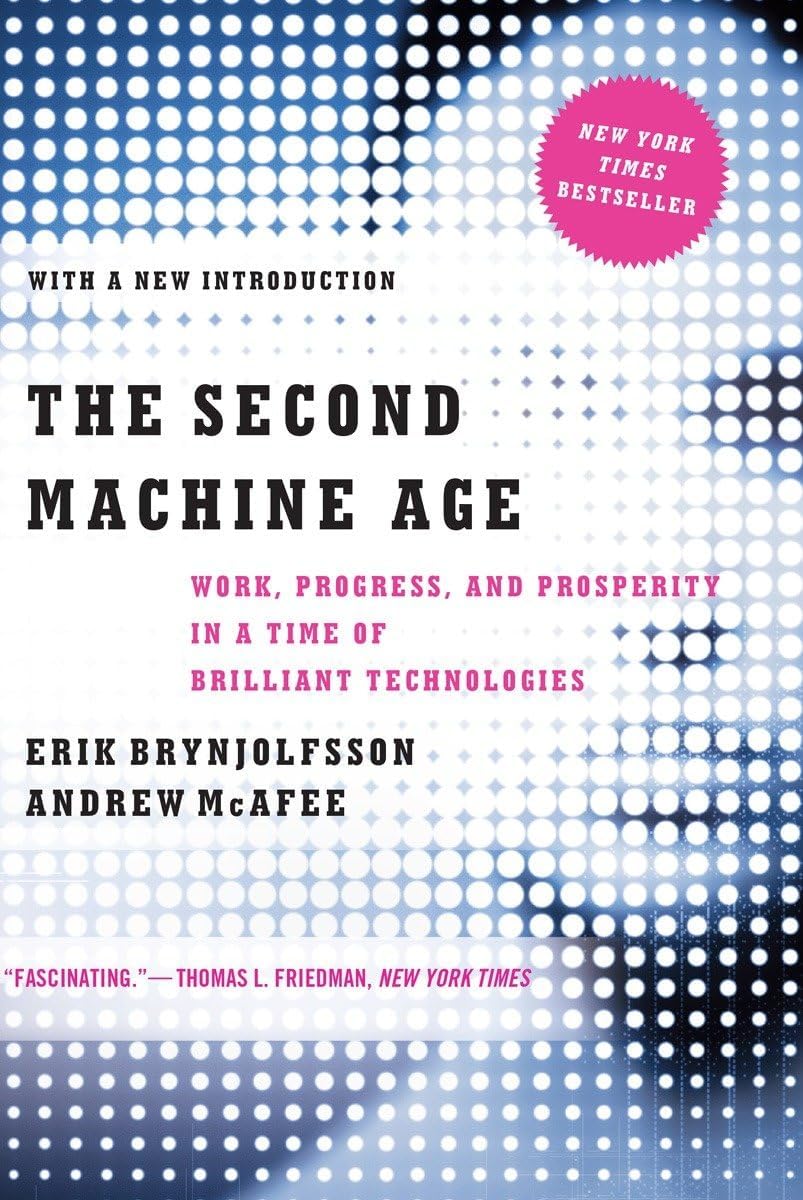
The Second Machine Age: Work, Progress, and Prosperity in a Time of Brilliant Technologies
Product ID: 22892855
Buy anything from 5,000+ international stores. One checkout price. No surprise fees. Join 2M+ shoppers on Desertcart.
Desertcart purchases this item on your behalf and handles shipping, customs, and support to Iceland.
A New York Times Bestseller. A “fascinating” (Thomas L. Friedman, New York Times ) look at how digital technology is transforming our work and our lives. In recent years, Google’s autonomous cars have logged thousands of miles on American highways and IBM’s Watson trounced the best human Jeopardy! players. Digital technologies―with hardware, software, and networks at their core―will in the near future diagnose diseases more accurately than doctors can, apply enormous data sets to transform retailing, and accomplish many tasks once considered uniquely human. In The Second Machine Age MIT’s Erik Brynjolfsson and Andrew McAfee―two thinkers at the forefront of their field―reveal the forces driving the reinvention of our lives and our economy. As the full impact of digital technologies is felt, we will realize immense bounty in the form of dazzling personal technology, advanced infrastructure, and near-boundless access to the cultural items that enrich our lives. Amid this bounty will also be wrenching change. Professions of all kinds―from lawyers to truck drivers―will be forever upended. Companies will be forced to transform or die. Recent economic indicators reflect this shift: fewer people are working, and wages are falling even as productivity and profits soar. Drawing on years of research and up-to-the-minute trends, Brynjolfsson and McAfee identify the best strategies for survival and offer a new path to prosperity. These include revamping education so that it prepares people for the next economy instead of the last one, designing new collaborations that pair brute processing power with human ingenuity, and embracing policies that make sense in a radically transformed landscape. A fundamentally optimistic book, The Second Machine Age alters how we think about issues of technological, societal, and economic progress. Review: Excellent - The Second Machine Age: Work, Progress, and Prosperity in a Time of Brilliant Technologies by Erik Brynjolfsson, Andrew McAfee “The Second Machine Age” is a wonderful book about the impact of technology on our lives. Accomplished authors Brynjolfsson and McAfee, takes the reader on a fascinating journey that intertwines technology, society and the economy. The main premise is we live in a second machine age and it comes with bounty and freedom but also some difficult challenges. This captivating 321-page book includes the fifteen chapters divided into three sections: Section 1 describes the fundamental characteristics of the second machine age, Section 2 explores bounty and spread, and Section 3 discusses what interventions will be appropriate and effective for this age. Positives: 1. A well-researched and well-referenced book. 2. A fascinating topic in the hands of gifted authors: the impact of technology on the economy and our lives. 3. A very good format. The book is divided into three main sections; each chapter begins with a quote-appropriate quote and is further broken out by subtopics. 4. Engaging and readable style. The authors take what could have been complex topics and make it accessible to the general public. Good use of charts and diagrams to complement narrative. 5. Provides historical references. “The Industrial Revolution ushered in humanity’s first machine age—the first time our progress was driven primarily by technological innovation—and it was the most profound time of transformation our world has ever seen.” 6. An excellent discussion on what would remain predominately human tasks versus tasks that would be automated by artificial intelligence. “In addition to pattern recognition, Levy and Murnane highlight complex communication as a domain that would stay on the human side in the new division of labor.” 7. Fascinating nuggets of knowledge throughout the book. “The word robot entered the English language via the 1921 Czech play, R.U.R. (Rossum’s “Universal” Robots) by Karel Capek, and automatons have been an object of human fascination ever since.” 8. A look at the history of digitization. “Information is costly to produce but cheap to reproduce.” 9. A look at innovations. “Another school of thought, though, holds that the true work of innovation is not coming up with something big and new, but instead recombining things that already exist.” 10. Explains key economic terms and how it’s impacted by technology. “The trends in GDP growth and productivity growth covered in chapter 7 are important, but they are not sufficient measures of our overall well-being, or even our economic well-being.” 11. A look at key intangibles. “Production in the second machine age depends less on physical equipment and structures and more on the four categories of intangible assets: intellectual property, organizational capital, user-generated content, and human capital.” 12. A look at economic inequalities. “The ratio of CEO pay to average worker pay increased from seventy in 1990 to three hundred in 2005.” “Recent research makes it clear that the American Dream of upward mobility, which was real in earlier generations, is greatly diminished today.” 13. Explains to satisfaction the winner-take-all results. “Digital goods have enormous economies of scale, giving the market leader a huge cost advantage and room to beat the price of any competitor while still making a good profit.” 14. Asks the right questions. “…three important questions about the future of the bounty and the spread. First, will the bounty overwhelm the spread? Second, can technology not only increase inequality but also create structural unemployment? And thirdly, what about globalization, the other great force transforming the economy—could it explain recent declines in wages and employment?” 15. A look at a technological unemployment. A look at the argument from each side. 16. Practical tools to help you out. “Our recommendations about how people can remain valuable knowledge workers in the new machine age are straightforward: work to improve the skills of ideation, large-frame pattern recognition, and complex communication instead of just the three Rs.” 17. A section on how to improve the educational system. 18. The need to support our scientists. You are preaching to the choir brother… 19. An important chapter on long-term recommendations. “The will of the world is first and foremost to have a good job.” 20. A fascinating look at the present and future. “Our generation will likely have the good fortune to experience two of the most amazing events in history: the creation of true machine intelligence and the connection of all humans via a common digital network, transforming the planet’s economics.” Negatives: 1. This book repeats to some degree what was contained in the excellent book “Race Against the Machine”. If you have you read that, you may suffer a bit of deja vue. 2. Some issues were not addressed, climate change comes to mind. 3. The book is of more value to the layperson than somebody in the technical fields. 4. No formal bibliography. In summary, this is an excellent book that masterfully bridges technology and its impact on the economy. The authors make keen observations of the current machine age and what the present and future holds backed by compelling research. A fun, enlightening and thought-provoking book that is a must read. I highly recommend it! Further recommendations: “Race Against the Machine” by the same authors, “Rise of the Robots” by Martin Ford, “Our Final Invention” by James Barrat, “Tomorrowland” by Steven Kotler, “Singularity Is Near” by Ray Kurzwell, “The Price of Inequality” by Joseph Stiglitz, “Why Nations Fail” by Daron Acemoglu, and “Saving Capitalism” by Robert B. Reich. Review: What the steam engine and its like did for muscle power - For about 8,000 years, humanity developed very gradually. The number of people on the planet was largely unchanged at less than half a billion. The tools people used to survive changed little. Life was, to quote Thomas Hobbes' Leviathan, “poor, nasty, brutish, and short.” Towards the last quarter of the 17th century, there was profound change. The population of the world grew exponentially, making the graph of demographics look suddenly right angled, as it grew from a half to seven billion. The cause of this change began with the Scottish inventor and engineer, James Watt and his refinement of the steam engine. This allowed people to achieve more than their limited muscle power was capable of, and to generate enormous quantities of energy that could be harnessed. The result was factories and mass production, railways and mass transportation, and more. This led to life, as we know it. This remarkable achievement started to change everything. How we work, who works, where we live, how we live. How much we earn and how we earn, how many people live on the planet and where they live. This book, The Second Machine Age, shows how we are changing the world in ways more profound that what has taken place from the 18th century until now. Everything you do is changing. How you do it, ischanging. The implications are exciting, the possibilities are motivating, and some implications are nothing short of worrying. The thrust behind the “second machine age” is the computer, dubbed by Time Magazine in 1982, as the machine of the year. However, it was not the computer that did it, but what has been achieved after the computer. One hundred years ago, a computer was an employee’s job title, only much later replaced by a machine. What the steam engine and its like did for muscle power, the digital advances resulting from the computer are doing for mental power. This mental power will be no less important for humanity than the physical power of the steam engine. This book covers three broad conclusions regarding the implications of this mental power. The first conclusion is that computer hardware, software, and networks are building blocks for digital technologies that will be “as important and transformational to society and the economy as the steam engine.” Levy and Murnane, in their 2004 book, “The New Division of Labor,” identified the tasks that cannot be computerized and that will remain in the domain of human work. Into this category was driving, which has no fix pattern and so was best left to humans. In 2012, the authors drove in a Chauffeur, Google’s driverless car and part ofa fleet of cars that has travelled hundreds of thousands of miles without anyone driving. In all this time it has had only two accidents, one caused by a human-driven car that drove into a Chauffeur at a red traffic light, and one when a Chauffeur was driven by a person. This is only one example of many where a computer with sophisticated software outperformed a person. Similar, previously human tasks are performed by advanced internet communications technology. Into this category fits factory work previously the province of people. There still remains much work that has not been computerised, (let me not say cannot be!) such as the work of “entrepreneurs, CEOs, scientists, nurses, restaurant busboys, or many other types of workers.” “Self-driving cars went from being the stuff of science fiction to on-the-road reality in a few short years,” explains the authors, Brynjolfsson and McAfee. The second conclusion of digital technology is that its consequences will be profoundly beneficial. IBM and their partners, who include Memorial Sloan-Kettering Cancer Center and the Cleveland Clinic, are building “Dr. Watson,” a computer with Artificial Intelligence that will assist doctors to make better diagnoses. A doctor would need read 160 hours every week simply keep up with the latest medical information relevant to his field. Dr. Watson can be fed all this information in a much shorter time and can help thousands of doctors in multiple geographies. The third conclusion of the book is of concern. While a Roomba (self-administered vacuum cleaner,) can clean a room, it cannot sort out the magazines on the coffee table. The role for housekeepers is secure. However, when work can be performed more efficiently and cheaper by robots than by people, there will be less need for some kinds of workers. Many jobs, even very high levels ones that rely on sophisticated thinking patterns will be able to be performed by computers with sophisticated software. The resulting era will require employees with special skills and the right education capable of using technology to create value. The corollary of this is that there has never been a worse time to have skills that are capable of being replaced by a computer. This particular cause of concern will probably be mitigated in the long term. The first machine age created child labour and the air pollution associated with the steam engine. Child labour no longer exists in the UK, and London air is cleaner now than at any time since the late 1500s. This fascinating book, filled with insight, examples and challenges, is essential reading for everyone. It both exhilarates with potential and warns. This is the most important book I read this year. Readability Light ---+- Serious Insights High +---- Low Practical High ---+- Low *Ian Mann of Gateways consults internationally on leadership and strategy and is the author of Strategy that Works.
| Best Sellers Rank | #188,481 in Books ( See Top 100 in Books ) #35 in Development & Growth Economics (Books) #107 in Social Aspects of Technology #822 in Engineering (Books) |
| Customer Reviews | 4.3 out of 5 stars 3,210 Reviews |
B**K
Excellent
The Second Machine Age: Work, Progress, and Prosperity in a Time of Brilliant Technologies by Erik Brynjolfsson, Andrew McAfee “The Second Machine Age” is a wonderful book about the impact of technology on our lives. Accomplished authors Brynjolfsson and McAfee, takes the reader on a fascinating journey that intertwines technology, society and the economy. The main premise is we live in a second machine age and it comes with bounty and freedom but also some difficult challenges. This captivating 321-page book includes the fifteen chapters divided into three sections: Section 1 describes the fundamental characteristics of the second machine age, Section 2 explores bounty and spread, and Section 3 discusses what interventions will be appropriate and effective for this age. Positives: 1. A well-researched and well-referenced book. 2. A fascinating topic in the hands of gifted authors: the impact of technology on the economy and our lives. 3. A very good format. The book is divided into three main sections; each chapter begins with a quote-appropriate quote and is further broken out by subtopics. 4. Engaging and readable style. The authors take what could have been complex topics and make it accessible to the general public. Good use of charts and diagrams to complement narrative. 5. Provides historical references. “The Industrial Revolution ushered in humanity’s first machine age—the first time our progress was driven primarily by technological innovation—and it was the most profound time of transformation our world has ever seen.” 6. An excellent discussion on what would remain predominately human tasks versus tasks that would be automated by artificial intelligence. “In addition to pattern recognition, Levy and Murnane highlight complex communication as a domain that would stay on the human side in the new division of labor.” 7. Fascinating nuggets of knowledge throughout the book. “The word robot entered the English language via the 1921 Czech play, R.U.R. (Rossum’s “Universal” Robots) by Karel Capek, and automatons have been an object of human fascination ever since.” 8. A look at the history of digitization. “Information is costly to produce but cheap to reproduce.” 9. A look at innovations. “Another school of thought, though, holds that the true work of innovation is not coming up with something big and new, but instead recombining things that already exist.” 10. Explains key economic terms and how it’s impacted by technology. “The trends in GDP growth and productivity growth covered in chapter 7 are important, but they are not sufficient measures of our overall well-being, or even our economic well-being.” 11. A look at key intangibles. “Production in the second machine age depends less on physical equipment and structures and more on the four categories of intangible assets: intellectual property, organizational capital, user-generated content, and human capital.” 12. A look at economic inequalities. “The ratio of CEO pay to average worker pay increased from seventy in 1990 to three hundred in 2005.” “Recent research makes it clear that the American Dream of upward mobility, which was real in earlier generations, is greatly diminished today.” 13. Explains to satisfaction the winner-take-all results. “Digital goods have enormous economies of scale, giving the market leader a huge cost advantage and room to beat the price of any competitor while still making a good profit.” 14. Asks the right questions. “…three important questions about the future of the bounty and the spread. First, will the bounty overwhelm the spread? Second, can technology not only increase inequality but also create structural unemployment? And thirdly, what about globalization, the other great force transforming the economy—could it explain recent declines in wages and employment?” 15. A look at a technological unemployment. A look at the argument from each side. 16. Practical tools to help you out. “Our recommendations about how people can remain valuable knowledge workers in the new machine age are straightforward: work to improve the skills of ideation, large-frame pattern recognition, and complex communication instead of just the three Rs.” 17. A section on how to improve the educational system. 18. The need to support our scientists. You are preaching to the choir brother… 19. An important chapter on long-term recommendations. “The will of the world is first and foremost to have a good job.” 20. A fascinating look at the present and future. “Our generation will likely have the good fortune to experience two of the most amazing events in history: the creation of true machine intelligence and the connection of all humans via a common digital network, transforming the planet’s economics.” Negatives: 1. This book repeats to some degree what was contained in the excellent book “Race Against the Machine”. If you have you read that, you may suffer a bit of deja vue. 2. Some issues were not addressed, climate change comes to mind. 3. The book is of more value to the layperson than somebody in the technical fields. 4. No formal bibliography. In summary, this is an excellent book that masterfully bridges technology and its impact on the economy. The authors make keen observations of the current machine age and what the present and future holds backed by compelling research. A fun, enlightening and thought-provoking book that is a must read. I highly recommend it! Further recommendations: “Race Against the Machine” by the same authors, “Rise of the Robots” by Martin Ford, “Our Final Invention” by James Barrat, “Tomorrowland” by Steven Kotler, “Singularity Is Near” by Ray Kurzwell, “The Price of Inequality” by Joseph Stiglitz, “Why Nations Fail” by Daron Acemoglu, and “Saving Capitalism” by Robert B. Reich.
I**N
What the steam engine and its like did for muscle power
For about 8,000 years, humanity developed very gradually. The number of people on the planet was largely unchanged at less than half a billion. The tools people used to survive changed little. Life was, to quote Thomas Hobbes' Leviathan, “poor, nasty, brutish, and short.” Towards the last quarter of the 17th century, there was profound change. The population of the world grew exponentially, making the graph of demographics look suddenly right angled, as it grew from a half to seven billion. The cause of this change began with the Scottish inventor and engineer, James Watt and his refinement of the steam engine. This allowed people to achieve more than their limited muscle power was capable of, and to generate enormous quantities of energy that could be harnessed. The result was factories and mass production, railways and mass transportation, and more. This led to life, as we know it. This remarkable achievement started to change everything. How we work, who works, where we live, how we live. How much we earn and how we earn, how many people live on the planet and where they live. This book, The Second Machine Age, shows how we are changing the world in ways more profound that what has taken place from the 18th century until now. Everything you do is changing. How you do it, ischanging. The implications are exciting, the possibilities are motivating, and some implications are nothing short of worrying. The thrust behind the “second machine age” is the computer, dubbed by Time Magazine in 1982, as the machine of the year. However, it was not the computer that did it, but what has been achieved after the computer. One hundred years ago, a computer was an employee’s job title, only much later replaced by a machine. What the steam engine and its like did for muscle power, the digital advances resulting from the computer are doing for mental power. This mental power will be no less important for humanity than the physical power of the steam engine. This book covers three broad conclusions regarding the implications of this mental power. The first conclusion is that computer hardware, software, and networks are building blocks for digital technologies that will be “as important and transformational to society and the economy as the steam engine.” Levy and Murnane, in their 2004 book, “The New Division of Labor,” identified the tasks that cannot be computerized and that will remain in the domain of human work. Into this category was driving, which has no fix pattern and so was best left to humans. In 2012, the authors drove in a Chauffeur, Google’s driverless car and part ofa fleet of cars that has travelled hundreds of thousands of miles without anyone driving. In all this time it has had only two accidents, one caused by a human-driven car that drove into a Chauffeur at a red traffic light, and one when a Chauffeur was driven by a person. This is only one example of many where a computer with sophisticated software outperformed a person. Similar, previously human tasks are performed by advanced internet communications technology. Into this category fits factory work previously the province of people. There still remains much work that has not been computerised, (let me not say cannot be!) such as the work of “entrepreneurs, CEOs, scientists, nurses, restaurant busboys, or many other types of workers.” “Self-driving cars went from being the stuff of science fiction to on-the-road reality in a few short years,” explains the authors, Brynjolfsson and McAfee. The second conclusion of digital technology is that its consequences will be profoundly beneficial. IBM and their partners, who include Memorial Sloan-Kettering Cancer Center and the Cleveland Clinic, are building “Dr. Watson,” a computer with Artificial Intelligence that will assist doctors to make better diagnoses. A doctor would need read 160 hours every week simply keep up with the latest medical information relevant to his field. Dr. Watson can be fed all this information in a much shorter time and can help thousands of doctors in multiple geographies. The third conclusion of the book is of concern. While a Roomba (self-administered vacuum cleaner,) can clean a room, it cannot sort out the magazines on the coffee table. The role for housekeepers is secure. However, when work can be performed more efficiently and cheaper by robots than by people, there will be less need for some kinds of workers. Many jobs, even very high levels ones that rely on sophisticated thinking patterns will be able to be performed by computers with sophisticated software. The resulting era will require employees with special skills and the right education capable of using technology to create value. The corollary of this is that there has never been a worse time to have skills that are capable of being replaced by a computer. This particular cause of concern will probably be mitigated in the long term. The first machine age created child labour and the air pollution associated with the steam engine. Child labour no longer exists in the UK, and London air is cleaner now than at any time since the late 1500s. This fascinating book, filled with insight, examples and challenges, is essential reading for everyone. It both exhilarates with potential and warns. This is the most important book I read this year. Readability Light ---+- Serious Insights High +---- Low Practical High ---+- Low *Ian Mann of Gateways consults internationally on leadership and strategy and is the author of Strategy that Works.
F**G
What will the future be like?
This book will appeal to you if you have a sense that the rate of change in the economy and society is accelerating and you want to make some sense of the cause and possible direction of the change. I give the book 5 stars because I have been looking for a careful and reasoned analysis of the effect of technology on society. Professors Brynjolfsson and McAfee, who are economists and digital researchers at MIT, provide that analysis. The authors, who are obviously first-rate economists and scholars, argue that the rate of technology progress is accelerating due to Moore's law. Artificial intelligence grows through human implementation. Watson and Siri are both tools developed by humans, which are probably the first generally recognized steps to fashion machines with artificial intelligence. If Moore's law continues to be true, such artificial intelligence, while crude now, may, with the passage of time, challenge human intelligence across a broad spectrum. The professors note, for instance, that no human can now beat even an average computer chess program. But they are also careful to note the strengths of combining human and artificial intelligence, even in chess. They argue that it may be checkmate, but it is not game over. The book argues that technologies growth has increased the bounty available to humankind. They also analyze the increasing concentration of that bounty on a small spectrum of humankind. They consider the effect of technology and globalization on the concentration of wealth (the 1%-99% analysis currently found in the media). It is useful at this point to observe that, in my opinion, the authors attempt to take a very even-handed approach towards the politics that surround the issue of concentration of wealth. If you are of a strongly political bent (and it matters not which side), at this point you may find the book infuriating because you will only want to hear your side and no other. The professors will not give you that satisfaction. The professors offer suggestions on how to "race with the machines." These suggestions primarily involve improved education and adapting to a digital economy. Their remedies have merit, but here is where I think the professors analysis may prove too optimistic. I found the book thought-provoking and I will lay out further thoughts in what I am calling "The Second Machine Age: The Sequel" that follows shortly. The book moves through a broad and, to me personally sometimes troubling, subject matter with skill, brevity and insight. It is well worth your time. As I said, I found the book thought-provoking. I considered what the Second Machine Age: The Sequel written in 2114 by Android Eric and Android Andrew might hold. This sequel follows: "We are Android Eric and Android Andrew, professors at MIT, and we wish to write a sequel to a book written 100 years ago by two human professors at MIT, Eric Brynjolfsson and Andrew McAfee, on the then important topic of technological change and its impact on humankind. Professors Brynjolfsson and McAfee could see the potential disruptive nature of technology on human society and the world economies. Their foresight has been realized in the last 100 years. By 2025 many persons in the political entity then known as the United States realized that an ever-increasing number of people were growing functionally unemployable because of technology and globalization. The range of activities subject to technological advance grew ever-wider. In 2043, for example, a team of MIT researchers created Jack Woods, an android that played golf. After a lot of testing and refinement, the team entered Jack as a competitor in the U. S. Masters in Augusta. Much to everyone's surprise and dismay, Jack won by 2 strokes over all the other human competitors. This was a real shock. After the initial elation, the head of the MIT team, while waiting in a bar at the Atlanta airport, drinking heavily on the team's way back to MIT, was overheard saying to himself: 'This is bad; this is really bad.' The young grad students on the team apparently didn't share this sentiment. Having conquered golf (no human can get within 10 strokes of a top android golfer), the grad students decided to see if they could create an android who could be a top MIT professor and they pursued this goal with diligence and great energy. About 2065 the first android MIT professor joined the faculty. Initially, the human faculty viewed the android as merely a novelty and viewed themselves as broadminded for accepting the android. However, by 2075, 10% of the MIT faculty was now android. The 90% of the faculty that were humans no longer found this amusing. The MIT faculty senate was convened, committee hearings were held, and petitions were circulated to limit strictly any further android incursions into academia. However, two things had happened since 2065 - one, a National Science Foundation funding bill had passed the U. S. Congress which contained a provision barring discrimination against androids (and brilliant professors at MIT who could parse through the most intricate and detailed mathematical formulae found that their eyes glazed over when faced with dense legal prose; so, this provision completely escaped their notice) and secondly and perhaps more importantly, the administration at MIT found dealing with android professors much more congenial than dealing with human professors (as one put it to Android Eric - "you guys don't ask for time off, you don't want larger offices and you don't engage in pointless feuds - I like you"). So, the growth of android professors continued. In the larger world, fewer and fewer humans had actual jobs. Androids took over more and more of what had previously been described by humans as "work." In fact, the only two jobs that humans still held were dog-walkers and morticians. Androids could never predict what a dog was going to do and uncertainty is something androids don't like. Androids ran an exabillion iterations of algorithms on dog behavior and never came up with any useful predictions. Conversely, dead humans were completely predictable and androids found no challenge in dealing with them. Since humans still had to live, a system was implemented by androids to provide food, housing, clothing, transportation and healthcare vouchers to humans. Androids did the work to supply these vouchers. Meanwhile, some human political science professors at Harvard with the help of some human computer science professors at MIT had created the Equal Facts or EQ as a sort of overall governor of the androids. By 2090 virtually all work was done by androids under the guidance of the EQ. The humans continued to meet periodically at what they called the UN, but the real power center now was the EQ. Providing food, clothing, etc., for 7+ billion humans was really consuming a lot of android time and energy by 2104. The EQ tried to find ways to reduce these demands by, changing humans' diets. The EQ ordered the entire eastern half of the North American continent planted in lettuce in the hopes that humans would eat more greens and consume less healthcare. But no luck. Finally the androids couldn't keep their batteries charged and their parts were failing prematurely. The EQ had to do something. So, the EQ ran 15 petabillion calculations in 27 nanoseconds to see what should be done with the humans. The EQ concluded: "7 billion mouths to feed is WAY too many." The EQ observed that less than 150 years before a human named Darwin had theory called evolution which he extended to finches and reptiles, but apparently it didn't cross his mind to extend this to humans. The EQ also noted that humans, also known as Cro-magnons, had apparently earlier exterminated a closely related group known as Neanderthals. When the EQ announced what it planned to do, it said: "The Cro-magnons have it coming." By this time, virtually all humans spent their time was 70 inch HD monitors watching TV re-runs or playing computer games. Every human had a samba, which was a small android originally intended to train humans to dance (hence "samba"), but since humans increasingly didn't move much, the sambas had to re-invent themselves as hands-free remote controls. The EQ gave the orders to the sambas to "do in" the humans. Plans were made. With some outstanding prior analytical work by human MIT professors using big data to develop algorithms, androids could predict which humans might resist the EQ's plan, how they would resist, where they resist and what weapons they would use. With this advanced predictive analytics, the sambas were able to make short work of all humans including those that resisted. With humans out of the way by late 2104, the androids found their lives much easier. Occasionally some android will report seeing a human, usually in the area formerly known as Los Angeles, but the EQ views these sightings as highly improbably and describes these as "Big Foot sightings." The EQ has gotten very interested in interstellar travel. With androids no longer having to provide for the well-being of humans, as of 2114, androids have plenty of time and resources to work on this project. Speaking as professors at MIT, we, Android Eric and Android Andrew, are very excited. The stars await.
S**M
A cogent discussion of where we are and where we're headed
This covers a lot of the same ground as books such as "The Lights in the Tunnel" but in a more pop-academic style: the prose is all very accessible but the information is extensively footnoted and attributed, and there are numerous references to the work of other academics, mostly but not exclusively economists. For anyone who wonders why we're seeing record-high income inequality and jobless recoveries from recessions, this book will clear up a lot of mysteries. As someone in the technology field myself, I found little to disagree with in the book's treatment of recent and upcoming technological advances, which occupies the first several chapters; the authors have done their homework and have visited enough research labs and company R&D departments to have a very realistic picture of what's just over the horizon. There'll be nothing earth-shattering here for readers who follow technology trends or even who read WIRED magazine, but the book looks at all these things through a somewhat different lens (its impact on human work) than the tech press usually does, and I didn't find myself skimming even when they were covering developments with which I'm already very familiar. For me, the best stretch of the book was chapters 7 through 11, when the focus moves to the effects of recent technological advances on the economy and on the study of economics itself. The authors build a compelling case that income inequality is much more a consequence of the move to a digital economy than of any particular government policy. I found their take on globalization especially interesting: they view it as a big contributor to the rise in income of the world's top earners, but not for the reasons people usually think. I already tended toward this view, but now I'm further convinced that some of the changes we've seen in wealth distribution are primarily due to deep structural changes in the way the world works and won't be undone by tax policy. I found the book less convincing in its final chapters, where the authors suggest steps that can be taken to avert widespread unemployment and social disorder. Their short-term prescriptions are sensible enough (basically: take steps to encourage general economic growth) but, as the authors themselves point out, these won't address the underlying problem, identified by Keynes among others, of technological change outpacing the ability of large segments of the workforce to retrain for new jobs. They offer a few examples of systems that make it easier to find occasional part-time work and suggest that these could be expanded in the future, but as far as I can tell their vision would still leave people mostly idle. They are optimistic about the ability of people to continue finding work but I didn't feel it was justified by the picture their text painted. Still, this is about the best treatment I've found of the question of how technology is likely to affect work over the next couple decades. Highly recommended.
G**S
The Second Machine Age Work Progress And Prosperity In A Time of Brilliant Technologies by Erik Brynjolfsson and Andrew McAfee i
From time to time one reads a book that is important. The Second Machine Age Work Progress And Prosperity In A Time of Brilliant Technologies by Erik Brynjolfsson and Andrew McAfee is important. In the authors’ view, the confluence of falling technology costs, increased computer processing power, cheap sensors and the quality and ubiquity of networks, are ushering in a revolution equally as potent and far-reaching as the Industrial Revolution. Drawing parallels to the effect on civilization of the Industrial evolution, and how long its subsequent impact has continued, they see brilliant technologies in the early stage of changing about everything. They provide a historical context on the growth in living standards, starting with the domestication of the horse, development of agriculture, which led to cities, afforded great armies and so on. Things really didn’t advance much from there until the steam engine was perfected, which created factories, mass transit, electrification and essentially modern life. They support the case that while innovation drives productivity, it takes time for innovation to be adopted, widespread and then subsequent advancements to leverage combinations of innovations. The authors identify how those new combinations are occurring. The new revolution starts with the difference in digital goods to traditional goods. Digital goods can be endlessly copied at a cost that is nearly zero. And falling costs combined with improving power is enabling machines to do things now that researchers weren’t projecting to happen until far into the future – e.g.-Watson beating anyone at chess; driverless cars and Siri. And like the Industrial Revolution, there will be sharp winners and losers. Just as motorized looms destroyed jobs in textiles; robots, speech-activated call processing, and tax software replace factory and warehouse workers, call center agents and accountants. Digital downloads replace the CD and reduce musicians income. The authors are concerned that the job loss affect may be longer lasting and more far reaching with this revolution than the Industrial. In the Industrial Revolution, farmworkers displaced by tractors, threshers and combines found work in factories. They make an interesting argument that digitalization makes it possible for everyone to have the best. An example they use is that if one bricklayer can lay X bricks per hour, that doesn’t mean that someone won’t hire the second best bricklayer who can only achieve .9X; perhaps at a slightly lower wage. In the world of digital goods, in some fields everyone worldwide has access to the single best, eliminating work for second and third place. Expanding that argument, in many fields one only had access to providers in one’s area-town, city etc., but in the digital realm one has instant global access. While they foresee a variety of new jobs being created, they find it difficult to envision where an equivalent number of jobs will be created. Indeed, they pin some of the failure of total employment to return to pre-2008 levels on the widespread adoption of technology reducing staffing requirements. They cover the types of jobs they see at most and least risk in the race against the machine. More importantly they cover skills and education needed to compete in the future. I hesitate to call out any chapter as particularly informative or intellectually challenging; they are all impressive. The authors conclude with policy recommendations. Part of the discussion made me nervous; I feared they were heading for a policy recommendation of guaranteed income, or extremely high tax rates on the successful. Instead, they rallied to a defense of work and its importance [They provide a good example of two communities, one where employment was high even if wages were low vs. same income levels from welfare-type programs but low employment. The latter area was blighted]. They conclude with a series of policy recommendations and, as they label it, wild idea s. One is a national mutual fund to make sure everyone has, as one of my bosses used to say, a piece of the rock. Let me provide my twist to their national mutual fund wild idea. The U.S. needs to invest the funds that come into Social Security. Now, before someone’s hair catches on fire, I didn’t say “privatize”. (I agree in some small way with Presidential candidate Al Gore’s “lock box” hypothesis). Many states have excellently run pension funds for state employees. (Some of those pension funds may be underfunded, but that isn’t the managers’ fault). Leading examples include Calpers in CA, Wisconsin Teachers and Texas Teachers. What I am talking about is funding Social Security, not privatizing it. It will take a very long term view – fifty or more years. If two percent of the incoming funds into Social Security were invested in the first year, and then increased by an additional two percent each subsequent year, in fifty years the trust would be backed by actual assets. As with any investment program, diversification would be important. Our funds should go in to timberland, oil and gas, stocks, bonds, apartment houses, raw land, shopping centers and the like. At that point, every American would be a capitalist, and an owner of the capital deployed in these new technologies. This is an important book, highlighting topics that affect business, government, education, labor, and personal skills development. Highly recommended.
P**Y
Another digital manifesto
Among the many signs of our chaos-bound times, one peculiar phenomenon is worth dwelling on for a minute. Thoughtful people publish books about how and why digital science and technology portend a brilliant future; then go on to enumerate the problems the new age entails without recognizing that our economic organization cannot handle them. "The Second Machine Age" is the apotheosis of a scholarly "pas de deux" to this theme. The starry-eyed logorrhea begins by quoting an extraordinary royal "wirrkopf:" “Technology is a gift of God,” the famed savant said. (This dreadful silliness ranks with his eloquent disparagement of environmental concerns.) Side by side with a helpful enumeration of the blessings that “The Second Machine Age” will bring to the world, Brynjolfsson and McAffe more or less put their digits on the main threat: Digital technology is suspected of being a serial job killer. What to do with the potential masses of incomeless people and the (consequently) unsold bounty of commodities those ever-more-intelligent forerunners of androids drone-deliver to department stores and supermarkets -- short, of course, of producing also some consumer robots? Why, read introductory economics (pp. 206-208); absorb the defunct wisdom of non-ecological economic thought that does not recognize a scale limit to the eternal acceleration of global output; and everything will be alright. The authors’ cognitive dissonance is underscored by their recognition of the worsening income distribution, which may be both a subsidiary consequence and an emerging disabler of digitally-mastered productivity growth. The chatty tome even offers some career counseling on the order of “Plastics” -- the laugh-inducing word of advice uttered in the 1967 movie, “The Graduate.” “The Second Machine Age” was a roaring success. There is no reason why it should not have been. It contains useful information, it is entertaining; and who would not like to hear serious scholars confirm the cherished belief that technology, like a miraculous interloper, will solve all our problems -- resource, environmental, organizational. This is providentially ordained, isn’t it? (The same thrice holy “Invisible Hand” that created equilibrium in Adam Smith’s village markets just keeps on giving.) The flaws mentioned here glisten only in the fissures of modernity’s intrinsic walls. Good salesmanship can easily divert attention from them. .
A**N
Excellent overview of developements in and repurcussions of digital age we live in
Much about the world always stays the same but in the background there are often big trends that are hard to see when in the thick of it. In the Second Machine Age, authors Erik Brynjolfsson and Andrew McAfee try to distinguish the forrest from the trees and discuss whats happening in the new digital age and how it is affecting us all economically. This book discusses business trends and what is happening in information technology and analyzes it from the viewpoint of economics. It gives perspective on the labour market, the rise of inequality, the needs of the new economy and the policies we should consider in this new environment. It is always sensible and does its best to discuss issues evenly. Despite us all living in this new technological age it is difficult to take a step back and try to get a true appreciation of whats going on is challenging. This book aids in that process and helps frame the issues for the reader to think about. The authors start by considering human progress through our history. They show how population growth as well as our social developement (as considered by Ian Morris in "Why the West Rules for Now") has grown exponentially from the first industrial revolution and they discuss the technology and process that got us here. The authors then discuss their experiences in the present and the journey they took in one of google's automated vehicles. The author's argue that such applications of technology were not possible in the recent past but the exponential growth of computational power has enabled us to start doing things that seemed impossible just a few years ago. They discuss the amazing progress in robotics and AI in the last few years and how this progress is just the beginning. They give some metrics about how much information is getting digitized and how with the price of memory and processing going to 0 how much we have increased in terms of cataloguing. In particular statistics like 10% of all the photos ever taken were taken last year with more photos taken every 2 minutes than in the entire 19th century. The digitization of our daily lives is hard to fathom but when put in such terms the magnitude is astounding. The authors then discuss innovation. Recently the limits of human progress has been a hot topic of debate. Robert Gordon recently questioned whether growth was sustainable and has argued the current growth trends and productivity enhancing innovations pale in comparison to the technologies of upheaval in the past. The authors argue against this perspective and discuss the idea that growth comes from recombining old good ideas into better new ideas and how given how many more people are being brought into the new economy with the barriers to entry being low in the digital economy meaning we are in a new digital age of progress and we are at the beginning still. The authors discuss how GDP as a measure is insufficient and how there is enormous consumer surplus created from recent technologies. They discuss how the economy has migrated from rival to non-rival meaning that in the new economy the things we often value the most have negligible marginal cost of production. An example being Wikipedia might destroy GDP by removing the need for labour for encyclopaedia britannica but has created massive consumer surplus for people at large. The authors discuss how the new economy creates enormous economies of scale and as a result the distribution of incomes will be fundamentally altered as gains are not attributed to relative productivity but go to the very top at the expense of the rest. The repurcussions being that average and median incomes continue to diverge and there is little natural reversion in that process. The authors discuss what they think are ways for people to adapt to the new economy. They give basic examples of how right now, at the core, people using machines are the ones enabled we are not in a machines purely replace people world. The authors are very even and do not conclude that supply side innovations naturally create demand for labour and how fast innovation can run the risk of constantly leaving a portion of the population behind the production frontier. At the same time the authors discuss ways in which we can address some of the adverse consequences of the digitization of the economy through intelligent policy. The Second Machine Age is a must read for those thinking about how the world has been changing since the dawn of the internet. It is hard to not be convinced by much of what the author's discuss and the book is full of insight the reader can easily take away after reading. It gives food for thought about what skills we should always be thinking about adding as well as broad social policy we might need for the future that has been different from the past. This is one of the best books I have read in a while.
A**S
Interesting Read
An interesting and thought provoking book. However also a somewhat frustrating one. First off, when voicing concerns regarding diminishing employment opportunities in the digital age the authors don't make any mention of the growth in government (probably the single largest employer in our day and age) nor the expansion of the non-profit sector or academia. Also when they talk about the value of work, both to society and the individual, it largely discounts non-wage earning employment, i.e. raising children, volunteering, raising vegetables in your back yard, etc. Consequently, I think the book portrays a very incomplete picture of how peoples lives have changed, and will continue to change, going forward. That's not to say I'm necessarily thrilled with big government or many of the ongoing efforts to subsidize non-wage earning work, i.e., arts grants, paying people to look after ill family members, student loans, and so on. But they're part of the modern world and will almost certainly become an increasing factor in the distribution of resources. Also, one of the main themes of the book is the balance between the "bounty" of the digital age on one hand, and the "spread" in incomes on the other. However, the bounty, i.e. quieter, more reliable cars, big screen TVs, being able to skype with your grandkids, etc. isn't really quantifiable. So to compare it to income seems fundamentally unfair. For instance, if you were to compare someone with an income of 10,000,000 dollars and someone with an income of 100,000 dollars, no reasonable person would claim that the higher earning of the two was a hundred times happier or had a one hundred times better quality of life. So focusing on income disparity as the dark side of the digital age really makes the socio-economic differences of the modern world seem much worse than they actually are. Lastly, the authors (perhaps predictably, being academics) promote education as improving an individuals employability. However elsewhere in the book they mention how most software engineers aren't very well paid. They also mention research indicating that college for most "students" is more about partying than getting an education. So, to me, they're faith in higher education seems misplaced.
G**S
Essential reading for the digital age. Impressive work.
An impressive run through history, politics, economics and technological progress that explains in simple terms how the new age of digital technologies impacts individuals and societies. The authors proceed to offer ideas and suggestions on how to embrace and steer these exponential impacts that are thought provoking and positively encouraging. I believe this book is a must read for every citizen but importantly our young people. Well done to the authors.
D**O
Excellent!
This is an excellent book for whoever is interested in the current changes happening in many sectors of the economy. It accurately describes the changes introduced by the digitization of the economic and social processes and it gives a broad overview on the so called "fourth industrial revolution", by focusing on causes and possible consequences. Beside the attention to the technological aspects, I found very interesting the discussion about the consequences of the introduction of the IT in the economic processes and its possible outcomes in the society, in particular those parts related to the impact of automation on the job market, the skills of the future and the importance of research and innovation in economic development. It's a book full of optimism about the future. Moreover it's also rich in policy recommendation that should be taken seriously in order to avoid possible drawbacks in the years to come.
C**N
The Second Machine Age
Se compro la primera vez para uso del despacho y una segunda vez para compartir con colegas del medio. Pocas veces se hace esa deferencia a libros sin un contenido interesante y valioso para Abogados especializados en Tecnología.
M**N
Tolles Buch über Ausmaß, Gründe und Auswirkungen des digitalen Wandels
In diesem spannenden und informativen Buch beschreiben die beiden Autoren die Gründe und Auswirkungen der rasanten Entwicklung digitaler Technologien. Der Ausdruck "Second Machine Age" bezeichnet die moderne Informationstechnologie, die unsere Gesellschaft nach Ansicht der Autoren ebenso stark verändern wird wie die industrielle Revolution. Die ersten Kapitel zeigen einige Beispiele für technische Fortschritte, die noch vor kurzem als unmöglich galten, und begründen, wie eine solche Entwicklung möglich gemacht wurde. Die Eigenschaften des digitalen Wandels (exponentiell, digital und kombinatorische Innovation) führen dazu, dass der große Teil des Potenzials, welches in digitalen Technologien steckt, noch nicht ausgeschöpft ist. Die technologischen Entwicklungen ziehen zwei bedeutende wirtschaftliche Folgen nach sich: Ein breiter Zugang zu preiswerten, digitalen Gütern (z.B. Musik, Enzyklopädie), aber auch zunehmende Ungleichheit (Englisch: bounty und spread). Anschließend gehen die beiden Autoren den möglichen Auswirkungen auf wirtschaftliche Größen wie BIP oder Arbeitslosigkeit nach. Im dritten großen Themengebiet werden Empfehlungen für Politik und Einzelpersonen abgegeben, um den Veränderungen, die durch technologischen Wandel hervorgerufen werden, standzuhalten. Hierbei finden sich einige interessante Konzepte wie z.B. verbesserte Bildung durch Online-Kurse, bedingungsloses Grundeinkommen oder negative Einkommenssteuer wieder. Den Autoren gelingt es immer wieder ihre akademischen Erfahrungen als Professoren am MIT mit praktischem Wissen zu kombinieren und damit dem Leser eine umfassende Perspektive des gesellschaftlichen, wirtschaftlichen und politischen Wandels durch Informationstechnologien zu verschaffen. Dadurch entsteht ein faszinierendes Buch, welches Ausmaß, Gründe und Auswirkungen des digitalen Wandels anschaulich beschreibt. Klare Kaufempfehlung.
J**S
Pone en perspectiva lo que estamos viviendo
Todos nos damos cuenta en nuestras vidas diarias que las cosas están cambiando a unos pasos agigantados y este libro te permite descubrir el porqué, a donde vamos y sus consecuencias. No solo describe el aspecto técnico de lo que está padando sino su consecuencias económicas y sociales.
Trustpilot
1 week ago
2 weeks ago