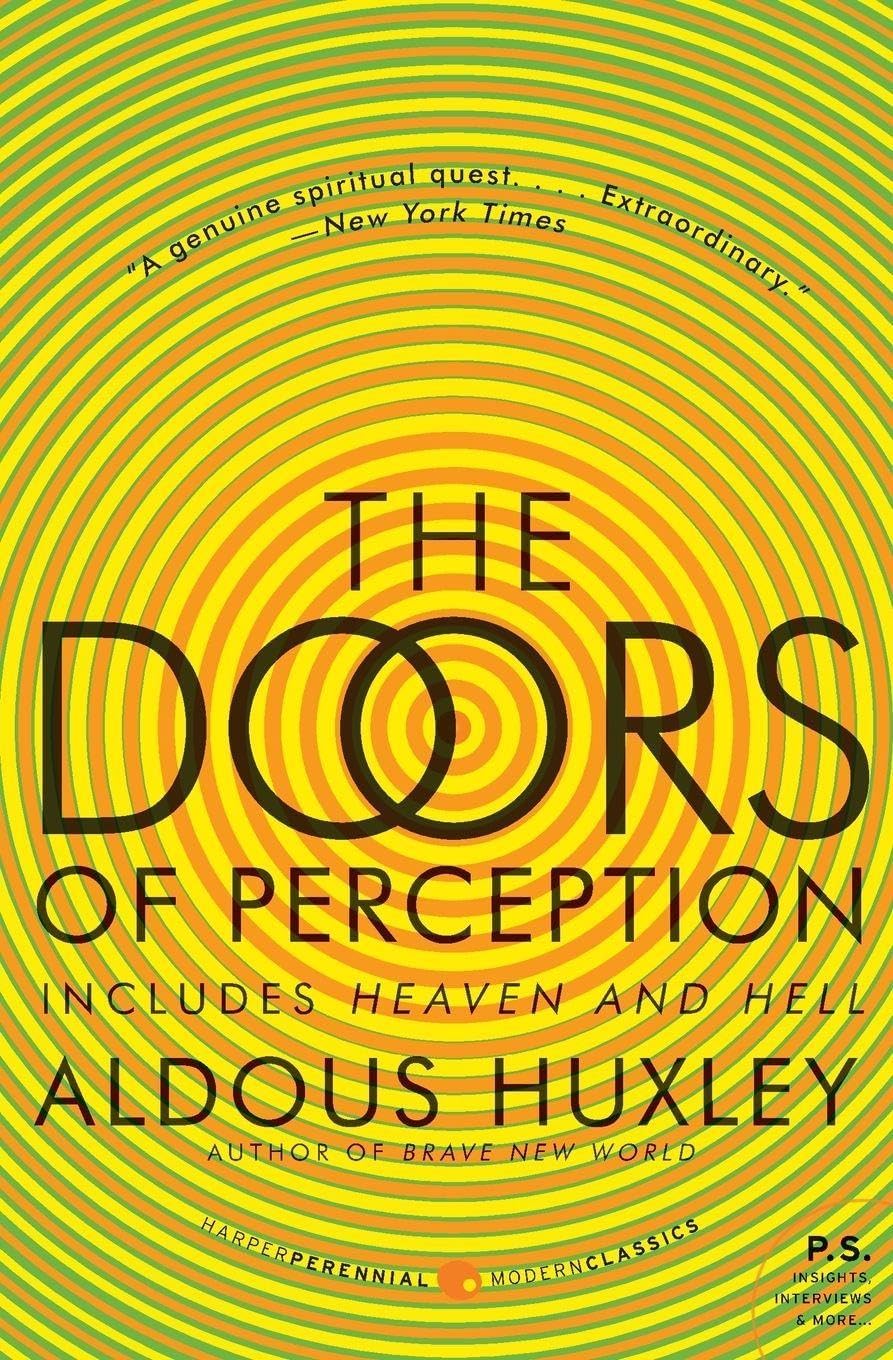
The Doors of Perception and Heaven and Hell (P.S.)
Product ID: 22605386
Desertcart purchases this item on your behalf and handles shipping, customs, and support to Iceland.
"A genuine spiritual quest. . . . Extraordinary." — New York Times Among the most profound and influential explorations of mind-expanding psychedelic drugs ever written, this landmark work of consciousness exploration includes two complete classic books— The Doors of Perception and Heaven and Hell —in which Aldous Huxley, author of Brave New World , reveals the mind's remote frontiers and the unmapped areas of human consciousness. This edition also features an additional essay, "Drugs That Shape Men's Minds," now included for the first time. This foundational work of psychedelic literature details Huxley’s transformational journey and includes: Firsthand Psychedelic Experience: Follow Huxley as he swallows four-tenths of a gram of mescalin and meticulously documents the profound changes in his perception of reality, from seeing the "Inner Light" in a vase of flowers to understanding the "divine source of all existence." Consciousness Exploration: Delve into the theory of the brain as a "reducing valve," a concept that explains how the mind filters reality and how psychedelics can temporarily open the doors of perception to a vaster, unfiltered awareness known as "Mind at Large." Visionary Art and Perception: Discover a new way of seeing art and the world, where the folds in a pair of trousers or the legs of a chair become "living hieroglyphs" and reveal the "unfathomable mystery of pure being." The Nature of Heaven and Hell: Go beyond a single journey to explore the crucial differences between blissful and terrifying visionary states, examining the psychological conditions that can turn a spiritual quest into an infernal experience. Review: Huxley's Doors of Perception: A Psychedelic Trilogy - This slim volume collects Aldous Huxley’s three essential works on psychedelics and consciousness, written between 1954 and 1958. Together they form a compact, influential trilogy on altered states of mind. The Doors of Perception is the centerpiece. Huxley vividly recounts his 1953 mescaline experience and introduces his famous “reducing valve” theory: the brain acts as a filter that restricts consciousness to a narrow, survival-focused trickle of reality. Mescaline temporarily opens this valve, allowing him to perceive everyday objects with overwhelming intensity, beauty, and profound “is-ness.” Heaven and Hell expand the vision. Huxley explores the mind’s inner “antipodes” — realms of dazzling beauty (Heaven) or nightmarish terror (Hell) — and links them to religious visions, sacred art, architecture, and even schizophrenia. Drugs That Shape Men’s Minds broadens the discussion to society and politics. Huxley examines humanity’s deep craving for self-transcendence and warns that powerful new chemicals could become tools of liberation or instruments of authoritarian control, echoing his Brave New World. Huxley’s elegant, philosophical prose makes these essays remarkably readable and insightful. The collection remains a landmark in psychedelic literature, blending personal experience, art history, mysticism, and social commentary with lasting relevance. In summary, it is a brilliant and timeless classic. Essential reading for anyone interested in consciousness, perception, and the human quest for meaning. Review: Published in 1954, this remains a classic in the literature of psychedelia and spirituality - I first read this book when I was 13. I am now 66. Did it influence my life? Looking back, perhaps even more so than I had realized. It was 1963 when I read it. I had been reading dystopias and had just finished "Brave New World." There was so much talk about LSD, mescaline, peyote and other hallucinogens as being "mind-expanding" and all that stuff that is now history. One interesting point of history regarding Aldous Huxley's life. He died the day JFK was shot. He was taking LSD at the time because he wanted to experience death as fully as he could. The title was taken from William Blake who had said, "If the doors of perception were cleansed every thing would appear to man as it is, infinite." That quote and this book would later help Jim Morrison in naming his band, "The Doors." I read it with rapt attention. I was entranced. When I reread it recently, I was amazed at how much I remembered and how much of my life choices it had influenced. I do remember that I promised myself at that young age, that when I was older, I would try these drugs as the search for "God" and spirituality was very important to me then and is still now. In particular, I recall the passage where, staring at a simple chair, Huxley waxed eloquently about what the chair revealed about its maker. Most of all, I recall his referring to perceiving the "isness" of the chair. This book was originally published in 1954. It was an important book then and it remains so now. It is a "must-have" for the library of any seeker of the truth, any who seek "higher learning", (pun intended and not), any who are investigators of world spirituality. Very highly recommended.


| Best Sellers Rank | #10,312 in Books ( See Top 100 in Books ) #13 in Popular Psychology History #14 in Individual Philosophers (Books) #21 in Consciousness & Thought Philosophy |
| Customer Reviews | 4.6 out of 5 stars 5,022 Reviews |
P**H
Huxley's Doors of Perception: A Psychedelic Trilogy
This slim volume collects Aldous Huxley’s three essential works on psychedelics and consciousness, written between 1954 and 1958. Together they form a compact, influential trilogy on altered states of mind. The Doors of Perception is the centerpiece. Huxley vividly recounts his 1953 mescaline experience and introduces his famous “reducing valve” theory: the brain acts as a filter that restricts consciousness to a narrow, survival-focused trickle of reality. Mescaline temporarily opens this valve, allowing him to perceive everyday objects with overwhelming intensity, beauty, and profound “is-ness.” Heaven and Hell expand the vision. Huxley explores the mind’s inner “antipodes” — realms of dazzling beauty (Heaven) or nightmarish terror (Hell) — and links them to religious visions, sacred art, architecture, and even schizophrenia. Drugs That Shape Men’s Minds broadens the discussion to society and politics. Huxley examines humanity’s deep craving for self-transcendence and warns that powerful new chemicals could become tools of liberation or instruments of authoritarian control, echoing his Brave New World. Huxley’s elegant, philosophical prose makes these essays remarkably readable and insightful. The collection remains a landmark in psychedelic literature, blending personal experience, art history, mysticism, and social commentary with lasting relevance. In summary, it is a brilliant and timeless classic. Essential reading for anyone interested in consciousness, perception, and the human quest for meaning.
P**N
Published in 1954, this remains a classic in the literature of psychedelia and spirituality
I first read this book when I was 13. I am now 66. Did it influence my life? Looking back, perhaps even more so than I had realized. It was 1963 when I read it. I had been reading dystopias and had just finished "Brave New World." There was so much talk about LSD, mescaline, peyote and other hallucinogens as being "mind-expanding" and all that stuff that is now history. One interesting point of history regarding Aldous Huxley's life. He died the day JFK was shot. He was taking LSD at the time because he wanted to experience death as fully as he could. The title was taken from William Blake who had said, "If the doors of perception were cleansed every thing would appear to man as it is, infinite." That quote and this book would later help Jim Morrison in naming his band, "The Doors." I read it with rapt attention. I was entranced. When I reread it recently, I was amazed at how much I remembered and how much of my life choices it had influenced. I do remember that I promised myself at that young age, that when I was older, I would try these drugs as the search for "God" and spirituality was very important to me then and is still now. In particular, I recall the passage where, staring at a simple chair, Huxley waxed eloquently about what the chair revealed about its maker. Most of all, I recall his referring to perceiving the "isness" of the chair. This book was originally published in 1954. It was an important book then and it remains so now. It is a "must-have" for the library of any seeker of the truth, any who seek "higher learning", (pun intended and not), any who are investigators of world spirituality. Very highly recommended.
J**N
A shaky finger pointed toward Oneness
An English intellectual seeks self-transcendence by taking mescaline, his stunning account shakes hippies everywhere out of “the rut of ordinary perception,” helps kick off the counterculture movement, and inspired the name of the 1960’s rock and roll band The Doors. It is full of spiritual insights rich with the influence of Vedanta and Buddhism like these: ”...Reality shines out of every appearance…” ”...see the All in every this…” ”...a perpetual present made up of one continually changing apocalypse.” ”...the blessed Not-I, released for a moment from my throttling embrace.” Oh, and Huxley’s other book with references to hallucinogens, Heaven and Hell, is usually bound together with the 79-page book to give it a respectable thickness. I wouldn’t bother reading Heaven & Hell, though, unless you’re a huge art history buff. For a man who had to read with a magnifying glass his whole adult life (due to childhood keratitis), he sure loves art. Among the dualism-piercing totalities explored through Huxley’s psychedelic adventure, we also encounter outdated cultural references, lots of art history, and detailed comparisons to Christian theology. I’m glad I finally read this one, but I wouldn’t jump up and down to get you to read it too.
O**3
Good
Good
M**T
Wow! What a trip!
Absolutely loved this book. Reminds me of a mix of Carlos Constaneda , Carl Jung, Kafka and Sartre rolled into one. I have never taken mescaline but have had mind altering substances that were legally prescribed or legally allowed. This book is about Huxley's experience with the peyote and his reflections, along with discussions about William Blake, Buddha, Christ and a HUGE cast of characters. Really well written. Short length but very deep and thought provoking. He hits on education, spirituality, religion, theology... just about everything. I will probably read this again because it is so deep in content. I majored in Psychology/Philosophy in college and took many classes in humanitaries and literature that had similar writings but this little book out shown them all. As a side note, the musical rock group The Doors, took their name when Jim Morrison read this book. Probably on peyote, I'm guessing.
W**R
Great items thanks
Great items thanks
T**S
rev
Great author. I must recognize it wasn't what i expected. Huxley portraits the very first time he tripped on mescaline. a detailed description of his experience is made, what and how he felt, saw and heard, under the drug effects. what is most fascinating about the book its the continuous reference to art, as the author encounters himself in a sort of art gallery. he describes famous pieces under "enhanced" perception. i found it amazing to contrast his description by viewing the paintings online while reading. thou i hoped to find more analysis on perception and consciousness, huxleys delightful writing caught my attention at every moment. what i don't know is why he used this title as it is the name given to a poem by william blake. also used by jim morrison for naming the band. i think in those days every one was too high to come up with original names and titles. haha just kidding. any way great book, if you're into huxley i recommend you read a happy world too.
S**R
Perfect
Perfect
A**R
This novel is a keeper!
Incredible novel. I've read it twice and it remains on my shelf for future reads.
R**T
Highly recommend
A great book and an absolutely fascinating exploration of the human mind.
O**G
Amazing
Perfect read
一**民
サイケデリック体験を思想にまで高める抜群の知性が感じられる
思想家にして小説家のオルダス・ハクスレーが、神秘体験を得るため、自ら幻覚剤メスカリンを服用した体験を綴ったドキュメンタリー。タイトルは、かのロックバンド”The doors”の名前の由来になったことでも有名である。 諸般のサイケデリック体験記やドラッグ文学とは比較にならない、稀代の知識人ハクスレーならではの、知性に裏打された深い洞察がこめられた本書は、哲学書の様相すら感じさせる。 本書の基盤になるのは、脳についてのある仮説。その仮説によれば、脳というのは知覚を司るのではなく、本来人間が知覚できる宇宙の森羅万象を、人間の生活に支障をきたさないレベルに制限する減量バルブの役目を果たすにすぎないのだという。メスカリンを服用することで減量バルブの箍が外れ、本来人間が持っている知覚の扉が開き、物事のあるがまま、本質が見えるのだという。 この理論を基に、ハクスレーが体験した様々なヴィジョンが解説されていく。中でも興味深いのは、絵画に対する見方である。ハクスレーによれば、芸術家というのは脳の減量バルブが開いており、対象の中に真実を見出さざるを得ない人たちなのだそうだ。そして芸術家が描く真実は、えてして絵画の中の衣服や布地の皺に現れるという。 神秘主義についての考察も興味深い。ヨガ、苦行、座禅など神秘体験をもたらすメソッドは、肉体の能力を弱め、結果脳の機能を低下させ、メスカリンと同様の効果をもたらすにすぎないとしている。つまりメスカリンを使うことで、宗教的な高みに上ることが可能ということらしい。 心理学の本として、美学の本として、哲学の本として、そして何より抜群に面白い体験記として、この本には★5つを献上したい。
A**X
An Introductory Piece into Psychedelics and The Other World
A very interesting read, to say the least. Aldous Huxley has a way with words and utilizing his imaginative imagery to help the reader understand the various novel pieces of information presented throughout both The Doors of Perception and Heaven and Hell. To most -I'd assume- the concept of Mind at Large and the "Other-ness" is a new and complicated topic and therefore requires a lot of thought while reading the book. I personally have never tried any psychedelic drugs and am therefore left very much in the dark with regards to these concepts, however Aldous Huxley presents this new information in such a way that is both informative and not overwhelming to those who are newly interested in subjects on transcendence, ego-death, and self-awareness. Overall the book is very much an introduction into the world of psychedelics and the Other world that lays far in the depths of our minds. If you're looking for an introductory piece into these kinds of subjects, this is probably your best bet.
Trustpilot
4 days ago
2 weeks ago