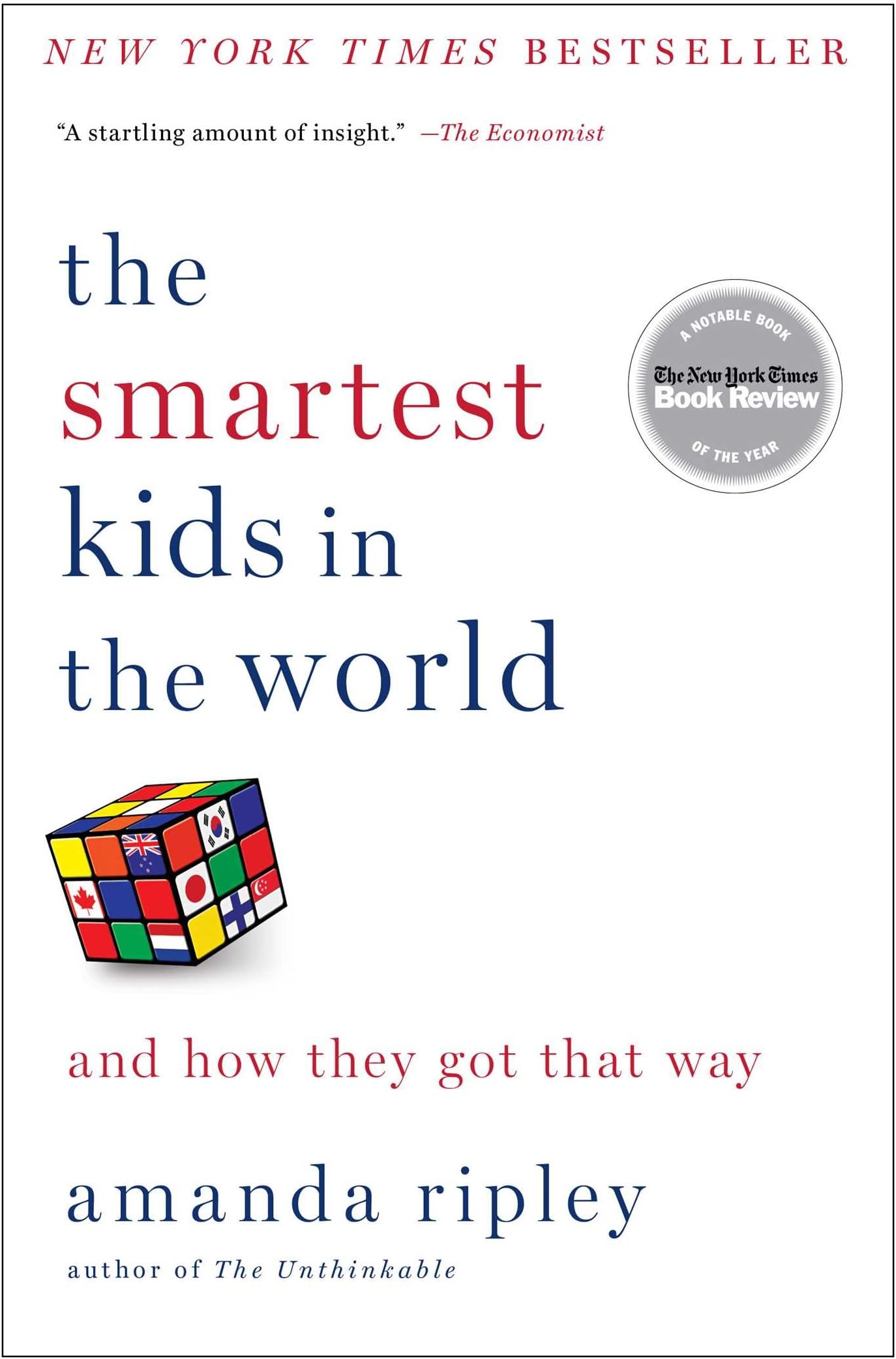
The Smartest Kids in the World: And How They Got That Way
Product ID: 2237095
Buy anything from 5,000+ international stores. One checkout price. No surprise fees. Join 2M+ shoppers on Desertcart.
Desertcart purchases this item on your behalf and handles shipping, customs, and support to Iceland.
The Smartest Kids in the World: And How They Got That Way [Ripley, Amanda] on desertcart.com. *FREE* shipping on qualifying offers. The Smartest Kids in the World: And How They Got That Way Review: Ripley can't cover all possibilities, but she sure gives us food for thought - I recently read Amanda Ripley's "The Smartest Kids in the World and How They Got That Way" and was glad someone did this work. Yes, I knew that advocates for gifted children or advocates for teachers' unions would get their hackles up over many of the points that Ripley made. They might say that clearly she doesn't "understand" the needs of gifted children, blah-blah-blah. Clearly she doesn't understand how "unfair" it would be to keep "normal" people (i.e., those who weren't the best students themselves) out of teaching with her observation that schools must have the smartest and best trained teachers from the population if their students are to do well, become smart (i.e., live and learn up to their potential). Ripley’s book is about high schools in the United States, Finland, South Korea, and Poland. But, what Ripley wrote resonated with me, as I know it actually will with many who do understand the needs of the gifted, whom I will specifically discuss at the end of this. Here are a few reasons: • Ripley advocates changing university teacher training programs from one of the lowest thresholds for admittance to a threshold no lower than the top third of their high school graduating classes. • She advocates continuing supervision, mentoring and education for the teachers once they are hired to teach. • She advocates letting the teachers decide how to teach, what to use to support those lessons, and how to decide if their students are learning what they’ve been taught. Remember, the teacher continues to be part of a team system that offers support, input, feedback and encouragement to him or her. • She points out that the smartest kids in the world know how to use what they have learned. They know how to apply it and interpret when to apply a concept, thought, idea or skill. Real life. Thinking skills. Reasons why we just learned something. I used to teach elementary school. I joke that I was among the last of the generations of women who thought their only career options were nurse or teacher. I chose teacher because, in my experience at that time, I knew I’d be on my own, make my own decisions, and not be bossed around by say, a doctor (the way nurses were). Remember, I grew up during a time when girls were supposed to understand that the constant use of the male pronouns was understood to mean both male and female. Well, we didn’t actually understand that, but I digress. So, two things have changed mightily since that time. First, smart women have tons of career options, so far fewer of them choose teaching. (Keep in mind that the low pay has been unappealing to men for a long time, and as most men always had the option of any career they wanted, few ever aspired to become teachers compared to women). Second, today’s teachers are micro-managed, told exactly what to teach and how to assess for whether or not their students learned. I assume there have continued to be good teachers who worked around the system, and I applaud them, of course. So, what about gifted children and their needs? When their teachers are smart, creative, and allowed to make decisions based upon the needs of the students in their classes, all students truly do benefit. Ripley is opposed to ability grouping. In many ways, so am I. Almost any topic or concept can be taught at many levels. It’s how you individualize the same topic. It’s how you enable students to work together, choose with whom to work on certain topics – and on different days! It’s the deep understanding, mastery and love of the topics that a smart, well-trained teacher brings to the students. It’s the nerve, creativity, and the “why can’t we do this?” attitude that smart, well-trained teachers bring to their schools when they are empowered to do what needs to be done. Ripley’s book is about high schools. Most people focus on the quality of our high schools and I personally think that it’s the elementary and middle school levels that need the most change. Just putting it out there. So, yes. I liked the book, I liked the investigation into this topic that Ripley did when preparing for the book, and I recommend it. Review: Fascinating Insight on Worldwide Education - This is a great book for folks who are interested in the state of American public schools, as compared with schools ranked higher than the U.S. in international testing. From the book, I learned about the Programme for International Student Assessment (PISA), which, per Wikipedia, is a worldwide study by the Organisation for Economic Co-operation and Development (OECD) in member and non-member nations of 15-year-old school pupils' scholastic performance on mathematics, science, and reading. This, as it turns out, is how we find out that students in the U.S. ranked 24th in reading, 28th in science and 36th in math in 2012, in comparison with about 65 participating countries. Apparently, we were 17th, 23rd and 21st, respectively, in these rankings in 2009. And, back in 2000, when all this got started, we were 15th, 16th and 20th, respectively. A trend is obvious here. In 2012, Shanghai, China, was the winner in all three categories, but the author choses South Korea, Poland and Finland as the democratically ruled countries that he trusts best to reflect equality with U.S. social components. Each of these three countries ranks very high in the international testing, each clearly higher than the U.S. The author sets out to find an American high school exchange student for each country. Using the three students, she collects data and experiences to build comparisons. Via these American kids, we get a first-hand view of public high schools in the three countries, plus we get to know the American kids, themselves, pretty well. Pretty cool, huh? There is a wealth of interesting information in each of their stories, which makes it impractical to detail here. So, what I want to do in the rest of this review is to give you some of more interesting tidbits I got along the way from the book. Then, I will go to the author's conclusions as to why U.S. students fall behind students from other countries. Some interesting tidbits: * The Korean public schools are a mess. The kids come primarily to sleep most of the day. Their learning, it turns out, happens mostly after their public schools close for the day. The kids then head out for private tutoring schools, where they may spend another eight or so hours in what sounds like grueling, exhausting "educational" experiences. No wonder the kids sleep during the day. But they do score well in international testing! * Testing for high school seniors in most Asian countries is very, very intense, so intense that the same test is given on the same day for all seniors in the country. Airlines, commuters and businesses are urged to reduce any kinds of noise or distractions during the testing period. But after the results are given, and the kids find out if they are accepted to the best schools or not, this pressure cooker is off, for the most part. In college, the kids do not take their studies that seriously, nor do the professors. No, the pressure is to prepare for the single test in high school, as if the results of it will determine their options for the rest of their lives. * American schools are crazy for sporting events, especially football. Nothing like this happens in any of the other countries that were profiled. There, sports are done via clubs outside of the schools, if at all. This element, in itself, is a huge variation for the American schools, which pride themselves on school spirit, supporting athletic competition. * Most of the higher performing countries are more selective in choosing their teachers. For the most part, the best students in college are selected. In contrast, American high school teachers tend not to be high performers in college. * Countries smaller than the U.S. are in a better position to control the training and development of their public school teachers. In Finland, for example, private high schools are not allowed, nor are charter schools. Finland does not encourage variances in the levels of excellence amongst its schools No, all the Finish schools are to be at the same level of excellence. In the U.S., states control their own training, oversight and curriculum of and for their teachers. And private high schools and charter schools are currently all the rage. * South Korean parents spend a ton of money on private tutoring for their kids, to the point that the Korean government tries to limit the excess. And, one of the most successful leaders of the private tutoring schools has said that he wants to devote his life in the future to the elimination of the private tutoring system. He wants to improve the public schools, instead. At the end of the book, the author gives us some insights into her struggles in writing the book. First, she admits that trying to make sense out of such a complex subject, even involving just three countries vs. the U.S., was overwhelming. Second, she tells us that, as a journalist by profession, she does not normally intend to lead readers to conclusions. She would rather report what she finds, then let readers make their own conclusions. But she seems to be compelled to give us some reasons why high school students in other countries are doing better in the worldwide testing than are American students. Her reasons include: * Students in other countries tend to be more engaged and to work harder. * Parents in other countries are more interested in educational progress than in excellence in sports or the arts or such in their public schools. * Schools in other countries invest far less in technology that does the U.S., which, perhaps, allows them to spend more money on teachers' and principal's salaries, instead. * Other countries have better teachers and principals, overall. * Students in other countries tend to better understand the consequences of failure; students in the U.S. tend to be told that they are doing better than they actually are, compared with students from other countries. * Overall, schools in the better-performing countries are harder than schools in the U.S. And, overall, the students in the other countries learn to have more persistence and drive than their counterparts in the U.S. Personally, I do not find the list above to be earth-shaking or alarming. I do find it educational, so to speak. But as Will Rogers famous remark goes, "The schools ain't what they used to be, and never was." The quest to be the best tends to be a never-ending, frequently redefined endeavor. I also like the adage I heard somewhere that "America produces the worst 16-year-olds and the best 30-year-olds, and no one understands why." In other words, as an educator, myself, I'm in this for the long haul. I can always learn; but I tend to think that no one, anywhere, at any time, has all the answers. American will rise again. I guarantee it!
| Best Sellers Rank | #64,480 in Books ( See Top 100 in Books ) #14 in Gifted Students Education #20 in History of Education #24 in Education Assessment (Books) |
| Customer Reviews | 4.5 4.5 out of 5 stars (1,906) |
| Dimensions | 5.5 x 1 x 8.38 inches |
| Edition | Reprint |
| ISBN-10 | 145165443X |
| ISBN-13 | 978-1451654431 |
| Item Weight | 2.31 pounds |
| Language | English |
| Print length | 320 pages |
| Publication date | July 29, 2014 |
| Publisher | Simon & Schuster |
D**F
Ripley can't cover all possibilities, but she sure gives us food for thought
I recently read Amanda Ripley's "The Smartest Kids in the World and How They Got That Way" and was glad someone did this work. Yes, I knew that advocates for gifted children or advocates for teachers' unions would get their hackles up over many of the points that Ripley made. They might say that clearly she doesn't "understand" the needs of gifted children, blah-blah-blah. Clearly she doesn't understand how "unfair" it would be to keep "normal" people (i.e., those who weren't the best students themselves) out of teaching with her observation that schools must have the smartest and best trained teachers from the population if their students are to do well, become smart (i.e., live and learn up to their potential). Ripley’s book is about high schools in the United States, Finland, South Korea, and Poland. But, what Ripley wrote resonated with me, as I know it actually will with many who do understand the needs of the gifted, whom I will specifically discuss at the end of this. Here are a few reasons: • Ripley advocates changing university teacher training programs from one of the lowest thresholds for admittance to a threshold no lower than the top third of their high school graduating classes. • She advocates continuing supervision, mentoring and education for the teachers once they are hired to teach. • She advocates letting the teachers decide how to teach, what to use to support those lessons, and how to decide if their students are learning what they’ve been taught. Remember, the teacher continues to be part of a team system that offers support, input, feedback and encouragement to him or her. • She points out that the smartest kids in the world know how to use what they have learned. They know how to apply it and interpret when to apply a concept, thought, idea or skill. Real life. Thinking skills. Reasons why we just learned something. I used to teach elementary school. I joke that I was among the last of the generations of women who thought their only career options were nurse or teacher. I chose teacher because, in my experience at that time, I knew I’d be on my own, make my own decisions, and not be bossed around by say, a doctor (the way nurses were). Remember, I grew up during a time when girls were supposed to understand that the constant use of the male pronouns was understood to mean both male and female. Well, we didn’t actually understand that, but I digress. So, two things have changed mightily since that time. First, smart women have tons of career options, so far fewer of them choose teaching. (Keep in mind that the low pay has been unappealing to men for a long time, and as most men always had the option of any career they wanted, few ever aspired to become teachers compared to women). Second, today’s teachers are micro-managed, told exactly what to teach and how to assess for whether or not their students learned. I assume there have continued to be good teachers who worked around the system, and I applaud them, of course. So, what about gifted children and their needs? When their teachers are smart, creative, and allowed to make decisions based upon the needs of the students in their classes, all students truly do benefit. Ripley is opposed to ability grouping. In many ways, so am I. Almost any topic or concept can be taught at many levels. It’s how you individualize the same topic. It’s how you enable students to work together, choose with whom to work on certain topics – and on different days! It’s the deep understanding, mastery and love of the topics that a smart, well-trained teacher brings to the students. It’s the nerve, creativity, and the “why can’t we do this?” attitude that smart, well-trained teachers bring to their schools when they are empowered to do what needs to be done. Ripley’s book is about high schools. Most people focus on the quality of our high schools and I personally think that it’s the elementary and middle school levels that need the most change. Just putting it out there. So, yes. I liked the book, I liked the investigation into this topic that Ripley did when preparing for the book, and I recommend it.
G**E
Fascinating Insight on Worldwide Education
This is a great book for folks who are interested in the state of American public schools, as compared with schools ranked higher than the U.S. in international testing. From the book, I learned about the Programme for International Student Assessment (PISA), which, per Wikipedia, is a worldwide study by the Organisation for Economic Co-operation and Development (OECD) in member and non-member nations of 15-year-old school pupils' scholastic performance on mathematics, science, and reading. This, as it turns out, is how we find out that students in the U.S. ranked 24th in reading, 28th in science and 36th in math in 2012, in comparison with about 65 participating countries. Apparently, we were 17th, 23rd and 21st, respectively, in these rankings in 2009. And, back in 2000, when all this got started, we were 15th, 16th and 20th, respectively. A trend is obvious here. In 2012, Shanghai, China, was the winner in all three categories, but the author choses South Korea, Poland and Finland as the democratically ruled countries that he trusts best to reflect equality with U.S. social components. Each of these three countries ranks very high in the international testing, each clearly higher than the U.S. The author sets out to find an American high school exchange student for each country. Using the three students, she collects data and experiences to build comparisons. Via these American kids, we get a first-hand view of public high schools in the three countries, plus we get to know the American kids, themselves, pretty well. Pretty cool, huh? There is a wealth of interesting information in each of their stories, which makes it impractical to detail here. So, what I want to do in the rest of this review is to give you some of more interesting tidbits I got along the way from the book. Then, I will go to the author's conclusions as to why U.S. students fall behind students from other countries. Some interesting tidbits: * The Korean public schools are a mess. The kids come primarily to sleep most of the day. Their learning, it turns out, happens mostly after their public schools close for the day. The kids then head out for private tutoring schools, where they may spend another eight or so hours in what sounds like grueling, exhausting "educational" experiences. No wonder the kids sleep during the day. But they do score well in international testing! * Testing for high school seniors in most Asian countries is very, very intense, so intense that the same test is given on the same day for all seniors in the country. Airlines, commuters and businesses are urged to reduce any kinds of noise or distractions during the testing period. But after the results are given, and the kids find out if they are accepted to the best schools or not, this pressure cooker is off, for the most part. In college, the kids do not take their studies that seriously, nor do the professors. No, the pressure is to prepare for the single test in high school, as if the results of it will determine their options for the rest of their lives. * American schools are crazy for sporting events, especially football. Nothing like this happens in any of the other countries that were profiled. There, sports are done via clubs outside of the schools, if at all. This element, in itself, is a huge variation for the American schools, which pride themselves on school spirit, supporting athletic competition. * Most of the higher performing countries are more selective in choosing their teachers. For the most part, the best students in college are selected. In contrast, American high school teachers tend not to be high performers in college. * Countries smaller than the U.S. are in a better position to control the training and development of their public school teachers. In Finland, for example, private high schools are not allowed, nor are charter schools. Finland does not encourage variances in the levels of excellence amongst its schools No, all the Finish schools are to be at the same level of excellence. In the U.S., states control their own training, oversight and curriculum of and for their teachers. And private high schools and charter schools are currently all the rage. * South Korean parents spend a ton of money on private tutoring for their kids, to the point that the Korean government tries to limit the excess. And, one of the most successful leaders of the private tutoring schools has said that he wants to devote his life in the future to the elimination of the private tutoring system. He wants to improve the public schools, instead. At the end of the book, the author gives us some insights into her struggles in writing the book. First, she admits that trying to make sense out of such a complex subject, even involving just three countries vs. the U.S., was overwhelming. Second, she tells us that, as a journalist by profession, she does not normally intend to lead readers to conclusions. She would rather report what she finds, then let readers make their own conclusions. But she seems to be compelled to give us some reasons why high school students in other countries are doing better in the worldwide testing than are American students. Her reasons include: * Students in other countries tend to be more engaged and to work harder. * Parents in other countries are more interested in educational progress than in excellence in sports or the arts or such in their public schools. * Schools in other countries invest far less in technology that does the U.S., which, perhaps, allows them to spend more money on teachers' and principal's salaries, instead. * Other countries have better teachers and principals, overall. * Students in other countries tend to better understand the consequences of failure; students in the U.S. tend to be told that they are doing better than they actually are, compared with students from other countries. * Overall, schools in the better-performing countries are harder than schools in the U.S. And, overall, the students in the other countries learn to have more persistence and drive than their counterparts in the U.S. Personally, I do not find the list above to be earth-shaking or alarming. I do find it educational, so to speak. But as Will Rogers famous remark goes, "The schools ain't what they used to be, and never was." The quest to be the best tends to be a never-ending, frequently redefined endeavor. I also like the adage I heard somewhere that "America produces the worst 16-year-olds and the best 30-year-olds, and no one understands why." In other words, as an educator, myself, I'm in this for the long haul. I can always learn; but I tend to think that no one, anywhere, at any time, has all the answers. American will rise again. I guarantee it!
M**S
Muy interesante para el profesorado en general para hacernos reflexionar sobre nuestros estilos educativos y para qué enseñamos, y analizar qué cambios debemos hacer para caminar hacia una escuela de calidad
G**8
Great reading for education professionals and polycy makers. As a parent, it was insightfull as critical thinking has mostly one cause: rigor to make it or fail. Also that teachers quality is the key to profiecience at a fair system which qualify students progress.
M**R
Eine aufschlussreiche, oftmals ernüchternde und dennoch spannende Reise in die Welt der Erziehung. Nicht nur für Lehrer und Eltern absolut empfehlenswert!
A**R
Great read provide a different perspective on how best to educate a child. Need to read again but a lot of good for thought
F**1
Ripley found a unique way of figuring out what to do with American's failing education system: find out what works in other countries through the eyes of American students. She followed three exchange students, one to Finland, one to Poland and one to South Korea. She chose these countries because they had scored the highest (or improved their scores the most) in international tests. While each system is radically different, what she found in common was that they all found a way to get rid of bad teachers. Either by ensuring they don't enter the system (Finland), reforming the system to weed out underperformers (Poland) or by using a private system which is accountable to students and parents (South Korea). Ripley is a true reporter. She reports what she saw, and lets the reader make up his or her mind. An enjoyable read, and an even better lesson for America's educators.
Trustpilot
1 week ago
1 month ago