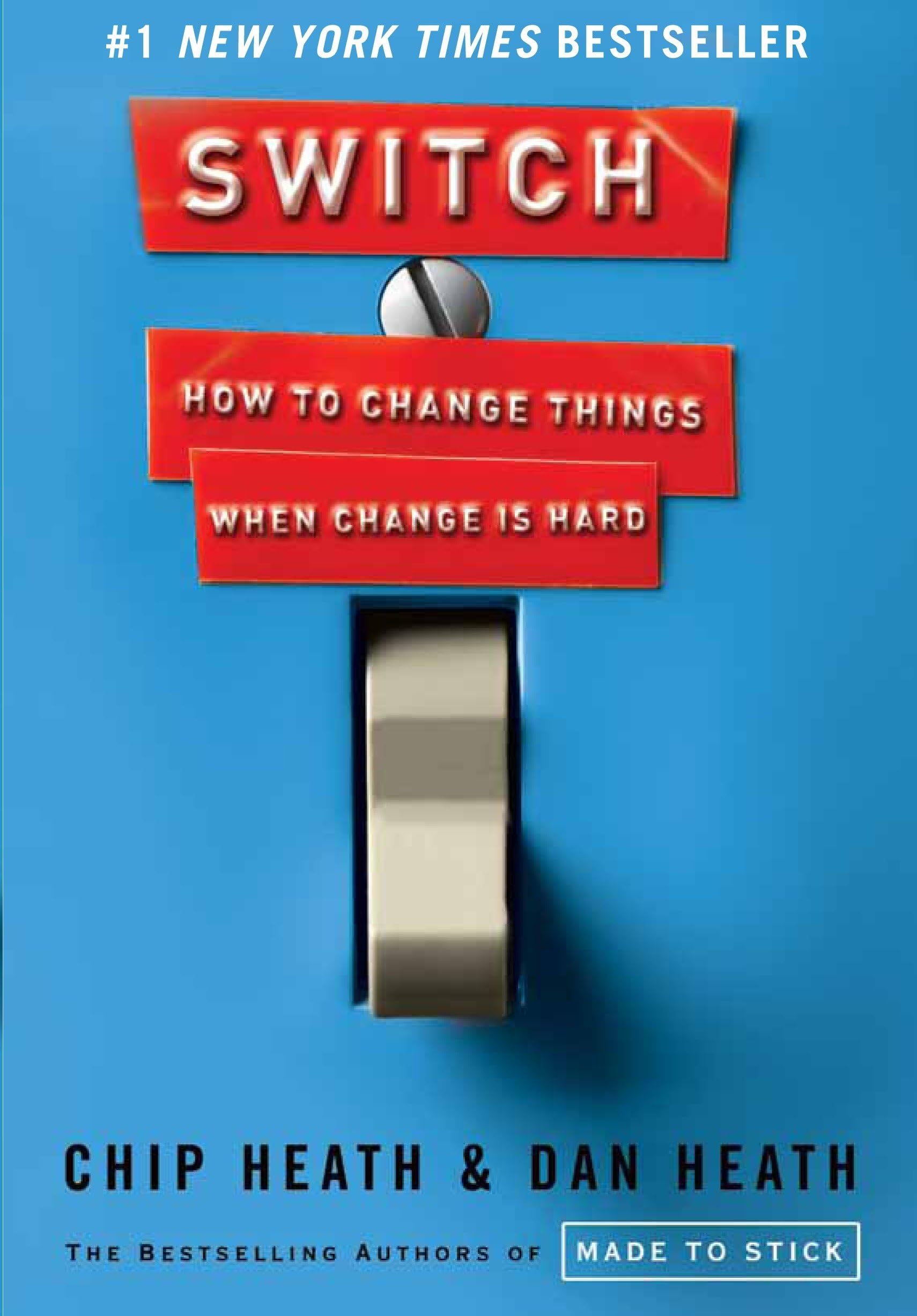
Switch: How to Change Things When Change Is Hard
Product ID: 219966
Buy anything from 5,000+ international stores. One checkout price. No surprise fees. Join 2M+ shoppers on Desertcart.
Desertcart purchases this item on your behalf and handles shipping, customs, and support to Iceland.
Why is it so hard to make lasting changes in our companies, in our communities, and in our own lives? The primary obstacle is a conflict that’s built into our brains, say Chip and Dan Heath, authors of the critically acclaimed bestseller Made to Stick . Psychologists have discovered that our minds are ruled by two different systems—the rational mind and the emotional mind—that compete for control. The rational mind wants a great beach body; the emotional mind wants that Oreo cookie. The rational mind wants to change something at work; the emotional mind loves the comfort of the existing routine. This tension can doom a change effort—but if it is overcome, change can come quickly. In Switch, the Heaths show how everyday people—employees and managers, parents and nurses—have united both minds and, as a result, achieved dramatic results: ● The lowly medical interns who managed to defeat an entrenched, decades-old medical practice that was endangering patients. ● The home-organizing guru who developed a simple technique for overcoming the dread of housekeeping. ● The manager who transformed a lackadaisical customer-support team into service zealots by removing a standard tool of customer service In a compelling, story-driven narrative, the Heaths bring together decades of counterintuitive research in psychology, sociology, and other fields to shed new light on how we can effect transformative change. Switch shows that successful changes follow a pattern, a pattern you can use to make the changes that matter to you, whether your interest is in changing the world or changing your waistline. Review: Great read, great evidence and made easy! - I would highly recommend this book to anyone looking at making changes in their lives, whether professional or personal. Switch (by same authors as Made to Stick) provides great tips and solutions presented at a user level and with a great framework. The authors first lay out the three big things: the Rider, the Elephant and the Path and describe what each of these are and provides examples so the reader can get it on his level and not some abstract thoughts. After the big introduction the authors broke the book up into parts concerning each one. The first then is about directing the Rider, the more of our conscious, self will side. To do this one should find the 'bright spots' by seeing how some things succeeded instead of what failed. Next one should script the critical moves by breaking stuff down to specific goals. Finally it's to point to the destination by giving Riders a clear view of where they're going. The second is about motivating the Elephant, more our unconscious and representative of all the inertia we have when wanting to change. Elephants are the more emotional and less logical side so the first step is finding the feeling (think those ASPCA commercials). Next one should shrink the change by making it more manageable (more on this later) and increasing the sense of accomplishment. Finally, it's about growing your people... Change will be easier if you expand the abilities and spirits of your people. The third is about shaping the Path. Within this it's about tweaking the environment (smokers know this about all the cues there are about smoking). Next it is building habits which are behaviors on autopilot and how to encourage habits. Finally one should rally the herd. Overall the book is very well written. The authors write in a very friendly style without being too personal... The couple times they do break from the books narrative to tell jokes, they work and actually made me laugh out loud. Their writing style helps the reader understand and so does the formatting, and maybe more so. While overall the book is 3 parts, there are chapters within those parts and then smaller bite sized sections. While also good for reading bit at time I have to imagine they used their own advice with it because it makes one feel more accomplished and thus wanting to read more. All their points are backed up with studies and not just opinions. Also for good measure they have independent 'Clinics' where they present a scenario and ask readers to work it out first. Therefore, overall this is a great book that I learned a lot from and have already started using both personally and in my job. Review: Review by J. Colannino - Switch is a book about managing change by the Heath brothers (Chip and Dan). Chip is a professor at the Graduate School of Business at Stanford University and Dan is a Senior Fellow at Duke University' Social Entrepreneurship center. The two have teamed up before -- in 2007 they released their critically acclaimed Made to Stick: Why Some Ideas Survive and Others Die. This latest effort focuses less on the stickiness of the idea and more on the change process itself. What should a change agent do to implement lasting change in a hard-headed organization that desperately needs it? The book is organized into eleven chapters in three parts: Part 1, Direct the Rider; Part 2, Motivate the Elephant; and Part 3, Shape the Path. The titles come from a vivid metaphor by University of Virginia psychologist Jonathan Haidt. In his book, The Happiness Hypothesis, Haidt likens a person to a rider on an elephant. The rider is the rational side of a person: the part that tells him to eat better, exercise more, and stop procrastinating, for example. The elephant is the emotional side that doesn't want to work to lose weight or exercise and would rather stay put; let's say willpower vs. won't-power; but why should that be? Whatever is autonomous and ingrained by habit belongs to the elephant. The rider is theoretically in control, but it is exhausting to continually tug on the reins and direct the stubborn elephant. Eventually the rider relents and the elephant goes back to doing what he's always done. Sound familiar? Before going much farther, you should know that two things separate Switch from so many other glib books about change: first, the book has a very solid psychological basis. Despite its accessible style, scores of major psychological findings and studies are reported and undergird the book's practical formulae for change. Second, Switch is not a self-help book. I have no doubt that the book could be used in this way, but it is really a book about how to change things. It is primarily directed toward organizational change, though its principles are much broader. And there are many surprises. The first big surprise occurs in the very first chapter. "We know what you're thinking -- people resist change. But it's not quite that easy. Babies are born every day to parents who, inexplicably, welcome that change. Yet people don't resist this massive change -- they volunteer for it. In our lives we embrace lots of big changes. So there are hard changes and there are easy changes. What distinguishes one from the other?" And the surprises keep coming. Like the two researchers who dramatically and permanently got folks to reduce their saturated fat intake. Or the doctor who saved over 100,000 lives and counting in American hospitals on schedule (18 months) by getting thousands of doctors and organizations to change their practices. Or the American who went to Vietnam and changed the face of malnutrition. Or the student who saved an endangered species in a Caribbean country that didn't give two hoots about it. What do all these stories have in common? For one, none of these change agents had the sufficient budget or authority to succeed; yet, they did. How? Every one of them gave clear rational direction to the rider by finding the bright spots, scripting the critical moves, and clearly pointing to the end goal. All of them motivated the elephant by emotionally connecting with it, and they shrunk the apparent change by carefully communicating progress. They refused to underestimate their people. Instead they provided them with a newfound identity that let them to grow into the challenge. But there was more. As the authors note, many times what looks like resistance is really confusion or even the result of misaligned incentives. That's why the path needs to be shaped by making manageable changes to the environment, building sound habits, rallying the herd, and reinforcing the new habit until it becomes a way of life. Well, maybe that sounds like a lot of work. I think it is. But speaking from firsthand experience, it will be a labor of love. And if your heart is not in the change and you do not think you can derive reward from the process, perhaps you are selling yourself short -- or, maybe you're the wrong person to lead the change and you should stop kidding yourself. And perhaps that is what I like most about this book. It does not promise a panacea. It tells it like it is without the jingoism that has become the substance of many change management essays. If you are leading organizational change, the book will provide a solid prescription for achieving lasting results because Switch uses real research, reports real experiences, and provides real guidance. Here, my recommendation is enthusiastic.


| Best Sellers Rank | #11,744 in Books ( See Top 100 in Books ) #18 in Decision-Making & Problem Solving #50 in Leadership & Motivation #75 in Personal Transformation Self-Help |
| Customer Reviews | 4.6 out of 5 stars 5,998 Reviews |
S**.
Great read, great evidence and made easy!
I would highly recommend this book to anyone looking at making changes in their lives, whether professional or personal. Switch (by same authors as Made to Stick) provides great tips and solutions presented at a user level and with a great framework. The authors first lay out the three big things: the Rider, the Elephant and the Path and describe what each of these are and provides examples so the reader can get it on his level and not some abstract thoughts. After the big introduction the authors broke the book up into parts concerning each one. The first then is about directing the Rider, the more of our conscious, self will side. To do this one should find the 'bright spots' by seeing how some things succeeded instead of what failed. Next one should script the critical moves by breaking stuff down to specific goals. Finally it's to point to the destination by giving Riders a clear view of where they're going. The second is about motivating the Elephant, more our unconscious and representative of all the inertia we have when wanting to change. Elephants are the more emotional and less logical side so the first step is finding the feeling (think those ASPCA commercials). Next one should shrink the change by making it more manageable (more on this later) and increasing the sense of accomplishment. Finally, it's about growing your people... Change will be easier if you expand the abilities and spirits of your people. The third is about shaping the Path. Within this it's about tweaking the environment (smokers know this about all the cues there are about smoking). Next it is building habits which are behaviors on autopilot and how to encourage habits. Finally one should rally the herd. Overall the book is very well written. The authors write in a very friendly style without being too personal... The couple times they do break from the books narrative to tell jokes, they work and actually made me laugh out loud. Their writing style helps the reader understand and so does the formatting, and maybe more so. While overall the book is 3 parts, there are chapters within those parts and then smaller bite sized sections. While also good for reading bit at time I have to imagine they used their own advice with it because it makes one feel more accomplished and thus wanting to read more. All their points are backed up with studies and not just opinions. Also for good measure they have independent 'Clinics' where they present a scenario and ask readers to work it out first. Therefore, overall this is a great book that I learned a lot from and have already started using both personally and in my job.
J**O
Review by J. Colannino
Switch is a book about managing change by the Heath brothers (Chip and Dan). Chip is a professor at the Graduate School of Business at Stanford University and Dan is a Senior Fellow at Duke University' Social Entrepreneurship center. The two have teamed up before -- in 2007 they released their critically acclaimed Made to Stick: Why Some Ideas Survive and Others Die. This latest effort focuses less on the stickiness of the idea and more on the change process itself. What should a change agent do to implement lasting change in a hard-headed organization that desperately needs it? The book is organized into eleven chapters in three parts: Part 1, Direct the Rider; Part 2, Motivate the Elephant; and Part 3, Shape the Path. The titles come from a vivid metaphor by University of Virginia psychologist Jonathan Haidt. In his book, The Happiness Hypothesis, Haidt likens a person to a rider on an elephant. The rider is the rational side of a person: the part that tells him to eat better, exercise more, and stop procrastinating, for example. The elephant is the emotional side that doesn't want to work to lose weight or exercise and would rather stay put; let's say willpower vs. won't-power; but why should that be? Whatever is autonomous and ingrained by habit belongs to the elephant. The rider is theoretically in control, but it is exhausting to continually tug on the reins and direct the stubborn elephant. Eventually the rider relents and the elephant goes back to doing what he's always done. Sound familiar? Before going much farther, you should know that two things separate Switch from so many other glib books about change: first, the book has a very solid psychological basis. Despite its accessible style, scores of major psychological findings and studies are reported and undergird the book's practical formulae for change. Second, Switch is not a self-help book. I have no doubt that the book could be used in this way, but it is really a book about how to change things. It is primarily directed toward organizational change, though its principles are much broader. And there are many surprises. The first big surprise occurs in the very first chapter. "We know what you're thinking -- people resist change. But it's not quite that easy. Babies are born every day to parents who, inexplicably, welcome that change. Yet people don't resist this massive change -- they volunteer for it. In our lives we embrace lots of big changes. So there are hard changes and there are easy changes. What distinguishes one from the other?" And the surprises keep coming. Like the two researchers who dramatically and permanently got folks to reduce their saturated fat intake. Or the doctor who saved over 100,000 lives and counting in American hospitals on schedule (18 months) by getting thousands of doctors and organizations to change their practices. Or the American who went to Vietnam and changed the face of malnutrition. Or the student who saved an endangered species in a Caribbean country that didn't give two hoots about it. What do all these stories have in common? For one, none of these change agents had the sufficient budget or authority to succeed; yet, they did. How? Every one of them gave clear rational direction to the rider by finding the bright spots, scripting the critical moves, and clearly pointing to the end goal. All of them motivated the elephant by emotionally connecting with it, and they shrunk the apparent change by carefully communicating progress. They refused to underestimate their people. Instead they provided them with a newfound identity that let them to grow into the challenge. But there was more. As the authors note, many times what looks like resistance is really confusion or even the result of misaligned incentives. That's why the path needs to be shaped by making manageable changes to the environment, building sound habits, rallying the herd, and reinforcing the new habit until it becomes a way of life. Well, maybe that sounds like a lot of work. I think it is. But speaking from firsthand experience, it will be a labor of love. And if your heart is not in the change and you do not think you can derive reward from the process, perhaps you are selling yourself short -- or, maybe you're the wrong person to lead the change and you should stop kidding yourself. And perhaps that is what I like most about this book. It does not promise a panacea. It tells it like it is without the jingoism that has become the substance of many change management essays. If you are leading organizational change, the book will provide a solid prescription for achieving lasting results because Switch uses real research, reports real experiences, and provides real guidance. Here, my recommendation is enthusiastic.
A**R
Switch Deficiencies and Recommendations
Switch is a book Josef Goebbels, Adolf Hitler's Minister of Propaganda, would rate with five stars. Goebbels's Principles of Propaganda, just like the Switch change framework (Direct the Rider, Motivate the Elephant, and Shape the Path) excises Values and Goal Setting from Change. What remains is a set of tactics Switch identifies to realize change no matter what goals and values the leaders want to achieve and realize. Although the change framework in Switch potentially provides powerful tactics for change, Switch has some major and fatal deficiencies. The framework with its tactics for change described in SWITCH - HOW TO CHANGE THINGS WHEN CHANGE IS HARD by Chip Heath and Dan Heath published by Broadway Books, New York 2010 has some major and fatal deficiencies. (I will use the term "change framework" as a convenient way to refer to the Switch framework and tactics for change described in this book.) The change framework * Is amoral and value neutral, * Is dangerous and provides a potentially powerful means for propaganda, * Discounts reason and is inconsistent with its formulation, * Can be used to establish and sustain totalitarianism, potentially resulting in holocausts, * Is missing the ethical compass, the Superego from Freud's standpoint, and * Is inimical to democracy and potentially supportive of totalitarianism It is recommended that the authors augment the book by providing a methodology for how members in a group can democratically formulate and support worthy goals to satisfy the critical and important needs of the group in a manner consistent with the group's prevailing pluralistic values. The change framework is amoral and value neutral. There is no discussion in Switch about what makes a goal desirable (e.g., using methods of Immanuel Kant, utilitarianism, or Sir William Walter Ross) and worthy of attainment in the context of the ethical values. There is no discussion on how to identify goals that are worthy of attainment in the context of these ethical values and real needs. In the wrong hands, it could be used as an effective recipe for despotism. The goals are critically important. The change framework is dangerous and provides a potentially powerful means for propaganda. The framework may be extremely dangerous if effective. It is like giving a loaded gun with instructions on how to effectively use it without providing the user advice on the ethical use of the gun, e.g., under what (very restricted) conditions (e.g., target practice and self-defense), it is ethically permissible to use it. Without the moral compass, Switch provides a simple framework for propaganda, which consists of tactics aimed at influencing or manipulating attitudes and behaviors of an individual or a community to help realize one or more goals. Many of the tactics identified in Switch are similar to those proposed by Goebbels and other advocates of propaganda. See [...]The change framework discounts reason and is inconsistent with its formulation. The framework explicitly discounts reason. The framework explicitly discounts reason by asserting that the Rider will think in "True But Useless" (TBU) circles if not given direction. It claims that the Rider will not be able to set the direction if the Elephant opposes the rider`s direction. But isn't the change framework itself a rational mechanism that the Rider can use to nudge or coax the Elephant to move in the direction that Rider chooses? Even though the framework explicitly discounts reason, it provides the Rider (the intellect) the means by which to influence the elephant. Therefore, the change framework enables the intellect and reason to greatly influence if not control the emotions of the Elephant. If the intellect and reason are really as Switch portrays, how did the change framework become articulated, presented, and communicated? The Rider as described in the Switch could not have formulated the change framework. It would simply think in circles (TBU). In Switch, the Leader when equipped with the framework and tactics for change is the agent of change. The framework and tactics for change must have been created by a series of clever Riders, don't you think? The Elephant didn't create the change framework. Overtime, the authors of propaganda and change literature, including the books referenced in "Recommendations for Additional Reading," accumulated knowledge that the Switch authors synthesized into this very powerful change framework. The Rider is not the weak analyzer Switch would have you believe. Riders created the change framework that enable the Rider some level of mastery over the Elephant. Reason created the change framework. Therefore, reason and the Rider are of paramount importance. The change framework can used to establish and sustain totalitarianism, potentially resulting in holocausts. Switch pays little attention to the Leaders. But how does the Leader relate to the framework and the tactics for change? Who are the Leaders and what is their relationship to the Riders and Elephants? In the case of an individual, it is your reason equipped with the change framework. Generally, a Leader is a person (Rider/Elephant) who is expert in the change framework and who is in a leadership position of responsibility for a group of people or community to help the group or community satisfy some of its most important needs by applying the framework and tactics for change in a manner as consistent as possible with the prevailing and pluralistic ethical values of the members of the group or community. There should be much more discussion about Leaders and how they relate to the change framework. The last century should have taught us that unbridled reason (The Rider with propaganda) threatens to erupt in holocaust without an ethical compass. The change framework is missing the ethical compass, the Superego from Freud's standpoint. Freud (Beyond the Pleasure Principle 1920 and The Ego and the Id 1923) would have called the ethical compass, which is totally missing in the Switch, the Superego. He would have called the Elephant the Id and the Rider the Ego. The rational Ego attempts to resolve or at least mitigate the conflict between the Id (Elephant) and the Superego (the ethical compass). The change framework is a good means to help mitigate if not resolve this conflict. Because there is no understanding of the connection between these tactics and worthy goals in the context of ethical values, Switch misses the opportunity to provide direction (to the Ego) on how identify the specific tactics for change that would be effective given the nature of the goals that ought be realized in the context of the ethical compass (Superego). The framework provides no methodology for the selection of specific tactics given worthy goals in the context of evolved ethical values. The change framework is inimical to democracy and potentially supportive of totalitarianism. For a description of totalitarianism see [...]. How does the Switch framework with its leaders relate to a democratic society? The Switch encourages the Leaders to separate themselves from the other members of the group. The Leaders somehow determine the goals (the framework provides no guidance) and use the framework with its tactics for change to manipulate the other members of the group to realize the goals. There is no discussion of how the leaders formulate worthy goals that are consistent the leaders' group ethical values and genuine needs. This framework and its tactics for change can very easily be used to establish and sustain totalitarianism. The fatal flaw of the framework is the absence of an ethical component. Some recommendations follow. The authors should augment the framework with an ethical compass. They should provide advice and methods to discover the prevailing and pluralistic values of the group. They should provide advice to the members of the group on how to democratically identify the critical and important needs of the group in the context of the group's prevailing pluralistic values. They should provide a methodology for how members in a group can democratically formulate worthy goals in the context of the group's prevailing pluralistic values to satisfy the critical and important needs of the group in a manner consistent with the group's prevailing pluralistic values. With the satisfaction of these recommendations, Switch can be transformed from a potentially dangerous amoral change framework into an ethically directed and integrated framework for change that helps satisfy real needs using tactics for change that are consistent with the group's prevailing pluralistic values.
D**L
(4.95 stars) A game-changing & empowering book full of precise prescriptions on how to change things both big and small.
Lasting change—whether on a personal, local or institutional level—is hard. Experience validates this sobering reality, and Switch explains that human beings are engineered to do the bidding of the status quo. Hence, making a switch will be tough, but it’s far from impossible. Switch by Dan and Chip Heath focuses on three general prescription areas that anyone can follow to make a change. What the reader is left with is a keen understanding of the formula successful change follows and how to apply that formula to their unique scenario. The prescriptions are directed at the three barriers in existence that deter change: the “Rider” or the overly critical, rational and analytical mind who tends to focus on why things will not work; the “Elephant” or the emotional, fickle, short-term oriented animal that gives our switch legs but is hard to get moving; and the path, which is the course the Rider and Elephant take in order to get to their desired goal. Switch provides clear advice and detailed suggestions on how to whip the Rider into action, motivate the Elephant and chart a path that everyone can follow. The suggestions are not based upon empty rhetoric but scientific data and research from the fields of psychology and sociology. Generally speaking, the Heaths do a fantastic job of boiling down major themes and ideas from psychology into succinct, plain explanations. And no, Switch is not written like an academic research book. The authors bring all of their ideas to life using real-life examples and invite you to apply your knowledge in several “Clinics” located throughout the text. The frequent stories aren’t “fluff” but help to animate the authors’ actionable advice with practical and everyday examples of transformative change. Without a doubt, this book has quickly become one of my favorites of all-time. I was so moved and inspired by the authors’ compelling narrative that I bought every other book by Dan and Chip Heath: Made to Stick and Decisive. Ultimately, whether you are looking to change yourself in a small way or lead many others down the path toward big change, Switch offers plentiful raw material to fuel your transformation. Switch does what all great books do: change the way you see the world and give you the inspiration and tools to execute that change.
O**H
Understanding The Fundamentals of Change!
Below are key excerpts from the book that I found particularly insightful: 1) "What looks like a people problem is often a situation problem." 2) "Now you've had a glimpse of the basic three-part framework we will unpack in this book, one that can guide you in any situation where you need to change behavior: 1) Direct the Rider. What looks like resistance is often a lack of clarity. So provide crystal-clear direction. 2) Motivate the Elephant. What looks like laziness is often exhaustion. The Rider can't get his way by force for very long. So it's critical that you engage people's emotional side—get their Elephants on the path and cooperative. 3) Shape the Path. What looks like a people problem is often a situation problem. We call the situation (including the surrounding environment) the "Path." When you shape the Path, you make change more likely, no matter what's happening with the Rider and Elephant." 3) "The Miracle Question doesn't ask you to describe the miracle itself; it asks you to identify the tangible signs that the miracle happened...Once they've helped patients identify specific and vivid signs of progress, they pivot to a second question, which is perhaps even more important. It's the Exception Question: "When was the last time you saw a little bit of the miracle, even just for a short time?"" 4) "Big problems are rarely solved with commensurately big solutions. Instead, they are most often solved by a sequence of small solutions, sometimes over weeks, sometimes over decades. And this asymmetry is why the Rider's predilection for analysis can backfire so easily. When the Rider analyzes a problem, he seeks a solution that befits the scale of it. If the Rider spots a hole, he wants to fill it, and if he's got a round hole with a 24-inch diameter, he's gonna go looking for a 24-inch peg. But that mental model is wrong." 5) "Ambiguity is the enemy. Any successful change requires a translation of ambiguous goals into concrete behaviors. In short, to make a switch, you need to script the critical moves." 6) "In creating change, though, we we're interested in goals that are closer at hand—the kinds of things that can be tackled by parents or middle managers or social activists. We want a goal that can be tackled in months or years, not decades. We want what we might call a destination postcard—a vivid picture from the near-term future that shows what could be possible." 7) "The Rider's strengths are substantial, and his flaws can be mitigated. When you appeal to the Rider inside yourself or inside others you are trying to influence, your game plan should be simple...First, follow the bright spots...Next, give direction to the Rider." 8) "Kotter and Cohen observed that, in almost all successful change efforts, the sequence of change is not ANALYZE-THINK-CHANGE, but rather SEE-FEEL-CHANGE. You're presented with evidence that makes you feel something. It might be a disturbing look at the problem, or a hopeful glimpse of the solution, or a sobering reflection of your current habits, but regardless, it's something that hits you at the emotional level. It's something that speaks to the Elephant." 9) " Most of the big problems we encounter in organizations or society are ambiguous and evolving. They don't look like burning platform situations, where we need people to buckle down and execute a hard but well-understood game plan. To solve bigger, more ambiguous problems, we need to encourage open minds, creativity, and hope." 10) " In the identity model of decision making, we essentially ask ourselves three questions when we have a decision to make: Who am I? What kind of situation is this? What would someone like me do in this situation? Notice what's missing: any calculation of costs and benefits. The identity model explains the way most people vote, which contradicts our notion of the "self-interested voter."" 11) "That's the paradox of the growth mindset. Although it seems to draw attention to failure, and in fact encourages us to seek out failure, it is unflaggingly optimistic. We will struggle, we will fail we will be knocked down—but throughout, well get better, and we'll succeed in the end." 12) "Change isn't an event; it's a process. There is no moment when a monkey learns to skateboard; there's a process. There is no moment when a. a child learns to walk; there's a process. And there won't be a moment when your community starts to invest more in its school system, or starts recycling more, or starts to beautify its public spaces; there will be a process. To lead a process requires persistence. A long journey requires lots of mango."
J**H
One of the best books on change out there
Just read Chip and Dan Heath's book Switch: How to Change Things When Change is Hard. After reading it, if are leading change of any kind or will at any time in the future, you need to read this book. The Heath brothers look at the idea of an elephant and a rider to show how change happens, how it is reacted to and why it is reacted to that way. The rider represents our analytical side or analytical people. They are interested in data, the why behind change and how it will play out, the plan. The elephant is the emotional side, the feelings, the impulsiveness to a change. The elephant asks, "How will this change affect me?" What they pointed out that was really interesting was the idea that people often react to change and the problem is not a people problem but a situation problem, an environment problem. What they showed through a variety of studies and examples is that often to make change happen, you need to change the environment that people reside in. One of the leadership principles that often gets overlooked that they talked about was looking for bright spots. Often leaders, especially in churches, we look for what is not working and try to change that, and that is the focus of our change. What if instead, we looked for what is working, the bright spots and look at how to replicate that. As the Heath brothers said, "Anytime you have a bright spot, your mission is to clone it." In the midst of change, uncertainty will arise at some point. In those moments, that is when the people in your church or organization will retreat to what they know. That is why clarity is so important. That is why you need to appeal to the head (the rider) and the heart (the elephant) to keep them on track, to keep them on the path as the writers point out. What was probably the most helpful was the idea of scripting moves. When making a change, changing a culture, adding something to a church, tell people what is expected, what will the new world look like once the change is complete. The authors pointed out, "The details is where people get hung up and fall off track." Ambiguity is the enemy of change. Or the flip side, "Clarity dissolves resistance." Describe for people what your church will be like when the change is complete. Paint a picture. Tell them how you will get there, what it will feel like on the way. Sometimes, prepare them for failure or what will seem like failure. Often, change efforts use the sequence of analyze-think-change, which rarely works. Instead, use see-feel-change. Often what trips up leaders in making changes is the herd, the crowd. If you get the crowd, you win the change because people follow the crowd, as behavior is contagious. The authors point out "We imitate the behaviors of others, whether consciously or not." Here are a few other things that jumped out: -For anything to change, someone has to start acting differently. -What looks like resistance is often a lack of clarity. -If you want people to change, you must provide crystal clear direction. -The core of the matter is always about changing the behavior of people, and behavior change happens in highly successful situations mostly by speaking to people's feelings. -To keep the elephant motivated, people must get a sense of progress. Without progress, people will get demoralized. -The rider needs direction, the elephant needs motivation. As I said, this is a book definitely worth picking up. I was able to read it on the plane the other day, so a fast read with a ton of nuggets in it. For more book reviews, go to [...].
A**S
Great Framework wrapped in an unfortunate metaphor
This would be a GREAT book. The framework and essential ideas are a very helpful way to think about change. However, they use a single metaphor and then carry it through the whole book. If only they ad presented the metaphor and then left it alone. I dislike the "elephant" and "rider" metaphor a lot - so it's constant use becomes annoying. I disagree with the premise that our "logical" mind is "supposed" to be able to override our emotional selves. We aren't designed to be "ruled" by logic - we are designed to cooperate with ourselves. We have internal checks and balances that work together to keep us safe. They eventually actually make the point that logic is actually designed to SERVE emotion, not rule it. So why do they overemphasize this metaphor that doesn't even really portray their real point? And then use it ad nauseum? Why not just say that we must integrate and align our head, hearts, and bodies and work with the natural change process to get the best results. Lots of other metaphors work to describe the inner leadership and collaboration required to change ourselves intentionally. Once I got past the metaphor - I discovered several great ideas and terms that have been helpful in teaching clients how to "lead" and facilitate their own personal growth and change initiatives instead of trying to control change. Favorite ideas: - Look for the bright spots - learn from your own life. Look for small examples where you are already doing what you want to do more of. Look for what works and what doesn't, what helps and what doesn't. I find all change efforts benefit greatly from focusing more on what *is* working than on what isn't working. ALL the available feedback is helpful if is *descriptive* rather than *judged* as good or bad. Feedback from what you do when you succeed can be used to redesign your strategy to fit you and your situation in areas where you are challenged. For example, if you are often late, focus on the bright spots - the examples of where you *are* on time. How do you do that? Use that to feed your creativity and design solutions for being on time more often. (I call this agilizing change.) - Love this quote " What looks like resistance is often a lack of clarity" YES! Need to get small and specific. I would also add that resistance is also often a sign of using strategies that don't fit the situation, the person, the timing, or the resources available. In my world resistance is incredibly valuable feedback for redesigning your approach and successfully leading change. - Love the languaging of "Shape" the path. You really can't "control" or "direct" change - if you work with the natural principles of how things and people organically change you will find that shaping is a far superior and more effective strategy. Overally, the model is a simple, straightforward framework that works better than most as a primer for people new to leading change. I found that with a little tweaking and using my own metaphors (based on agile mindset, and iterative, organic, systems design thinking) I was able to enhance and simplify my own Agilizen Designing for Change model making it easier to learn. This book is definitely worth reading by anyone who helps others change or is highly motivated to facilitate their own personal growth.
I**I
Making Change Easier
Not all change is difficult. We change all the time, voluntarily, in many different ways - we get married, we start a family, we take up a new job or a new role, we change ideas... just think of much you changed in the last 10 years! Based on this insight, the question is: what are the characteristics of successful change? Chip and Dan Heath set out on a quest to find what works to make change easier, at any scale - individual, organizational, societal. And in doing so they dispel 3 big myths about change: that some people are just hard to change, it is in their nature; that people are lazy, and that is why they do not change; that there is a "resistance" to change. To illustrate their findings, the authors borrow Jonathan Haidt's metaphor of the Elephant and the Rider: the conscious, analytical part of ourselves is like a rider perched on top of an elephant, the adaptive unconscious. The rider has the ability to plan, to analyze, to make rational choices - but it also has the tendency to spin its wheels and over-analyze, and it stands no chance guiding the elephant with brute force, at least not in the long run. The elephant gives us drive and power, but it is easily distracted by short term rewards. The authors use this simple metaphor as a framework to make sense of some useful strategies for change, based on research and illustrated with vivid, "sticky" stories - these strategies are grouped in 3 sections: how to "direct the rider", how to "engage the elephant" and how to "shape the path". I am a Solution-Focused practitioner, so I was very happy to see Solution-Focused Brief Therapy featured in this book. It appears, together with Appreciative Inquiry, in the section about Directing the Rider, in the chapter "Find the Bright Spots". As the authors themselves point out, an effective approach to change involves all 3 dimensions (rider, elephant, path), and sometimes this distinction is pretty fuzzy. I believe Solution-Focus interviewing protocols to be a case in point: - when we, as Solution-Focused practitioners, ask exception-finding questions, we "find the bright spots" (chapter one) - when we, as Solution-Focused practitioners, ask for concrete, behavioral details about what works, we help clients "script the critical moves" (chapter two) - when we, as Solution-Focused practitioners, ask the Miracle Question, we "point [the rider] to the destination" (chapter 3) and we also help the elephant "find the feeling" (chapter 4) - when we, as Solution-Focused practitioners, ask "what would be the smallest sign that..." we "shrink the change" (chapter 5) - and since all the questions in the Solution-Focused therapy or coaching protocols are interactional, i.e. are aimed at focusing the client's attention on the situation, we do help in "shaping the path". The more I practice Solution-Focus, the more I am impressed by how effective it is. Yet, despite the empirical nature of the work that led to the creation of Solution-focused interviewing protocols and despite the research supporting it, people have a hard time believing it can work. And that is because of ingrained assumptions about change. The authors did an excellent job in showing that there is a different way to think about change. And for that, I am very grateful to Chip and Dan Heath.
E**E
Indispensabile
Indispensabile per Leaders e attori del cambiamento in genere. Tantissimi casi pratici da cui apprendere
K**E
Buena compra
Llegó en tiempo y forma
A**D
A life changing book
A must read for everyone
E**E
Excellent read. It’s been on my list of must ...
Excellent read. It’s been on my list of must reads for a while. I don’t know why it took me so long to get around to reading it. This is a book that reiterate the fact that change is hard but there are some predictable patterns that can help effect positive change. Yes ideas are not new however the Heath brothers bring together lots of difficult concepts to presents a powerful and easy to understand framework for effecting positive change. They provide us with some great case studies and stories that brings the framework to life. I loved the book and was surprised how quickly I was able to use the concepts in my own professional life. Highly recommend it
N**A
Great book to learn more about change management
Great book to learn more about change management; for everyone: team members, leaders, CEOs...
Trustpilot
2 weeks ago
2 weeks ago