We remain fully operational. Our teams are working around the clock to ensure your deliveries continue safely.
DOWNLOAD THE APP


Customer Services
Copyright © 2025 Desertcart Holdings Limited
DOWNLOAD THE APP


🎶 Own the analog legend — where vintage soul meets modern mastery!
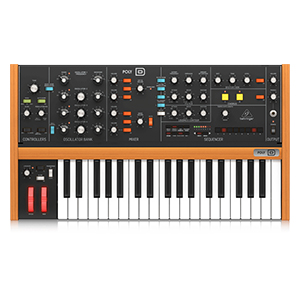
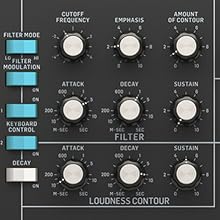
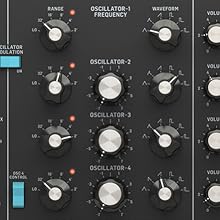
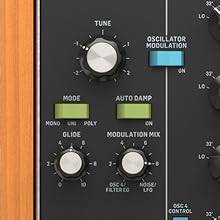
The Behringer POLY D is a 37-key analog 4-voice polyphonic synthesizer that faithfully recreates the classic 'D Type' circuitry with ultra-precise components. Featuring 4 voltage-controlled oscillators with 5 waveform options each, a 24 dB ladder filter, BBD stereo chorus, distortion, and a 32-step sequencer with arpeggiator, it delivers rich, fat tones and versatile sound shaping. Designed for both vintage enthusiasts and modern creators, it offers mono, polyphonic, and unison modes, plus extensive connectivity including USB/MIDI and modulation outputs, making it a powerful yet affordable centerpiece for any professional music setup.




| ASIN | B082BLNRXT |
| Best Sellers Rank | 31,518 in Musical Instruments & DJ ( See Top 100 in Musical Instruments & DJ ) 54 in Tabletop Synthesizers 100 in Studio Mixing Desks |
| Body material | Metal and Plastic |
| Connector | [MIXED] |
| Customer Reviews | 4.5 4.5 out of 5 stars (273) |
| Date First Available | 5 Dec. 2019 |
| Finish type | Painted |
| Global Trade Identification Number | 04033653032049 |
| Included components | Audio cables, MIDI cables, Manual, Power supply |
| Item Weight | 11.8 kg |
| Item model number | POLY D |
| Item weight | 11.84 kg |
| Manufacturer | Behringer |
| Material Type | Metal Plastic |
| Number of Keyboard Keys | 37 |
| Product Dimensions | 10.01 x 10.01 x 10.01 cm; 11.84 kg |
| Set Name | 4 |
| Size | 37-Key |
| Styling | Classic |
G**H
Product review
Great product for the money.
M**H
Sounds fantastic
I bought this as I wanted a fairly simple synth with large, quick access controls. I had been considering a (Behringer) model D for a while, but liked the idea of being able to use the oscillators individually (paraphonicly) - something I really missed being able to do with the SE-02. So far it has lived up to its hype. Sounds really good (I presume the addition of polyphony hasn't harmed the model D sound!). Yes, its not truly polyphonic (only single filter/adsr etc) unlike the Deepmind with its individual voices, but if you think of it as a monosynth-plus - all the richness with added the added benefit of being able to do simple pads and chords. The simplicity of the layout and huge controls makes this a great learning/starter tool for a beginner in subtractive syntheses (like me!), with absolutely no menu diving or hidden settings. There is a limit to the sounds you can produce, but with the options of using both the LFO and the 4th Oscillator as a modulation source you can still have alot of fun). The chorus modes also adds to the overall final sounds. If you are truly after a polyphonic synth then this might not be the right choice, but for anyone wanting the 'mini moog' sound without the technical issues associated with owning a 45yr old synthesiser or the huge costs of the later Model D, the Poly D has so much to offer. In my opinion there isn't any other analogue keyboard that (in this price range) that can do the same. If Behringer has just stuck their model D onto a keyboard it would have not had the same success and at only 35% more than the original price of their Model D, if you have the space, the Poly D is a great buy. Cons:? I have not had it long enough yet to find any big issues. I am not a massive fan of Behringer's Sequencers and this is the same sequencer that is on the MS1, Crave and ODESSEY. It works, but I don't find it that intuitive and its a shame it is limited by its 32 steps. However, if you own more than one of the Behringer range at least you only need to learn its functions once :)
E**G
Brilliant synth, stuff of legend, but mine needed firmware update to work correctly
Brilliant sounds. Lots of reviews and great tutorial from the likes of sweetwater.com NOTE: you must be prepared to update the firmware as soon as you get it. Perhaps due to a part alteration. Keyboard will not function in the correct way out of the box, actually cuts out when playing a sustained cord while simultaneously playing other notes. Do not worry though, Firmware update resolves all issues so long as you have access to a PC or MAC with a USB A - B (printer) cable your sorted in less than 5 minutes, You-tube tutorial for the job is available too.
J**J
Couldn't test, didn't have a UK adapter supplied.
I was unable to appraise the product as it didn't come with the relevant adapter for the UK, so I returned it for a refund
C**N
Quality control failed
The sawtooth and triangle wave on each oscillator was faulty. On sawtooth the gain/level was severely reduced on all oscillators compared to other wave settings. On triangle the same was evident for oscillators 1,2 & 3 compared to that of 4. The next problem was that the C3 key stuck down and returned to original position very slowly compared to all other keys. Finally out of the box the power cable retention clip was snapped off and laying under the main panel. I’ve always wanted the mini moog but it’s too expensive. The Behringer poly D seems a perfect option, but not if it doesn’t successfully operate correctly. This has put me off Behringer products particularly as I’ve heard other peoples potential gain/level problems with other units. Looks like too many “Monday morning” products are produced. AND over 3 weeks later I am still waiting for my money back from Amazon.
I**A
Total waste of money.
A total waste of money. This is the second synth by Behringer I've had to return. It was completely out of tune with itself. some adjacent keys played the same note octaves were out of tune polyphonic mode was laughable as it was completely out of tune and tuning the oscillators was impossible. it seems that Behringer has no quality control. Absolute jokers.
A**E
Polyphony
As an senior player i cannot see how this can be playably polyphonic. There are ways to sort of make it nearly possible but its not the flick of a switch. The synth is very good but if you expect true polyphony buy something else.
A**S
Sérieusement, le Behringer Crave c'est top. Promesse largement tenue. Et on peut facilement s'inspirer des patches faits pour le moog mother-32 quand on est en panne d'idée. C'est un instrument extraordinaire, je ne peux pas m'en séparer je l'adore. J'ai hâte de me procurer le Behringer Edge quand il sera à nouveau dispo, et le Spice pour compléter la collection, qui n'a hélas pas encore de date de sortie.
D**Y
I have been playing synthesizers and other instruments for several decades now and I grew up in the early days of Moog, when they were the original standard for synthesizers. This is, in short, loyal to the legacy of its design, and yet updated for a more modern era. It has a great build quality, excellent sound, and... the price is more than reasonable. If you already are conversant with synthesizers, then my review is pretty simple... This is essentially a modern version of the Mini Moog and comes extremely close to replicating the sounds and behaviors of that celebrated instrument. Unlike the Moog Voyager and other Moog evolutions of the Mini Moog (Sub 37, et al), Behringer elected to stick to the legacy Mini Moog design and layout. It does have a few welcome extras in its design, namely a built in sequencer/arpeggiator, a fourth oscillator (that can also be a secondary LFO), an adjustable keyboard after pressure, and, of course, MIDI and USB connections. It works quite well, the keyboard action is very comfortable, and the knobs and switches have a very satisfying heft to their action. The paraphonic polyphony is exactly what I would expect in this type of synthesizer, although with a quite a bit more flexibility that what I had in the early 1980s with paraphonic synthesizers. I knew what the polyphony of this synthesizer was going into this and I was not disappointed. Some people really want true polyphonic Mini Moog, and I suppose that would be neat, but you would have to have some way to independently trigger and envelope each oscillator output and... well, at that point you might as well look at something else designed in that fashion like the DeepMind, because it will not be a Mini Moog anymore. In any case, I find the paraphonic Poly D quite usable and it gives some abilities to create some beautiful sound and chord structures. It is worth noting that you can configure some elements of the Poly D through an app interface on your phone or tablet. These would include things like high/low/last note priority on the keyboard, MIDI configurations, and some other items. This is very handy and is quite easy to use. Having said that, to just play this thing, all you need is a place to plug it in to the wall and either some headphones or a keyboard amp (I use an old Roland KC-60 that I have had for a long time). I have not tried using this with my DAW or other software, yet, but if its MIDI and software interfaces follow the other Behringer designs (which it does, except for poly-chaining, as I understand), it should be a pretty straightforward process. I have a couple of Neutrons and a Crave and they all seem to work well with my Apple based environment. But, having said that, I have not tried the Poly D with it yet. The sequencer is a nice feature and quite easy to use. It has a lot of flexibility in terms of what you can sequence, and yes, it can sequence in polyphony. Thus, if you record a chord to a sequence in poly mode, that chord will be part of the sequence. You can also ratchet a sequence and add swing rates, plus some basic editing of the patterns. My understanding is that you can synchronize this through MIDI, but I have not tried that yet, obviously. This is essentially the same sequencer you will find on other Behringer products (including my Crave). The filters have a good set of ranges and do their job. The adjustments are nice in that I can put just a subtle curve in a filter envelope to add just the right level of color to a tone. When you are trying to finesse the tone and its articulation for voicing purposes, the ability to make subtle and accurate changes is important, and this is where the control panel and the filter circuit design (as well as the envelope generator) work well. I have not used the distortion tool set much yet, but it seems to work. It is not something that I will likely use much in my music (I tend to focus on more discrete classical music realizations as opposed to ambient sound mixtures, thus I am looking more for patch designs that can be incorporated into a music score. Having said that, I still like to use interesting colorings and sound contours to add expression, similar to what Tomita did in the 1970s). The Poly D has both a Chorus I and Chorus II button. I love this stereo chorus feature and while it is not something I would use all of the time, it can be great one button trick to add some meat to, say an uplifting chorus of a piece (like one would do with a Hammond Leslie). One caveat, do not try to use both buttons at once. It creates a terrifically bad phase interference. The Poly D has multiple inputs and outputs for processing external sound and triggers. Some caveats - Like all analogue circuits of these types, you need to let this warm up before you tune and play. 10-15 minutes and you should be good. - My Poly D scaled pretty well after it warmed up (in other words, the octaves were all in tune with each other and reasonably well tempered). If the tempering does not settle down after it is warmed up, you can adjust and calibrate the tuning across the octaves from some back side controls (potentiometers). This is not difficult but it can be a bit tedious and you must use the right tools and not be hamfisted so as to break the internal mechanisms. Be gentle and patient here if you need to do this. - If you are wanting a system where you can cross patch between modules, this is not your system. Connections between modules are fixed along with the processing flow. You can connect and disconnect modules through switches, but not how they connect. So, for example, if you wanted to somehow connect the LFO to say, trigger the chorus, it will not happen here. - There is no sample and hold. Of course, this was not native to the original Mini Moog, but it would have been a nice addition. - Like the original Mini Moog, there are no presets or a capability to save a patch setting. This is all knobs and switches. - You can hook an external keyboard to the Poly D through its MIDI connector. However, and this may depend upon the keyboard and connection, you may not be able to control such things as the starting note of a sequencer controlled pattern from the external keyboard. You will still have to use the built in keyboard for that. Not a big deal, really, but something of which to be aware. - While you cannot poly-chain to another Behringer synthesizer, you can send a MIDI through connection for the same keyboard signal to another synthesizer (I have done this with my Neutrons). This is a good instrument, especially if you were wanting a Mini Moog and could not afford the high prices. It is not a compromise at all to get this rig. I am having a lot of fun with it and it is nice to be able to quickly dial in a patch and just play with the sounds and music very easily without thinking through the patches and patch cords.
M**P
Funciona perfectamente!
J**N
Excelente sintetizador para aquellos mortales como yo que jamás tendrán un minimoog. La función de "polyphonic" es un plus y se pueden hacer cosas interesantes, pero NO es un sintetizador polifónico. Aún así es un gran sinte, hice la prueba con el plugin de arturia y este suena MUCHO mejor. Pero si tengan en cuenta que es un sinte limitado y además se tiene que afinar. Eso no significa que no puedes hacer sonidos interesantes, muchas veces en lo limitado nace la imaginación y el encanto. En fin, es un clon del mítico "minimoog" no creo que tenga que decir más.
E**C
Amazing, did lots of research on that, and as expected
Trustpilot
2 weeks ago
1 month ago