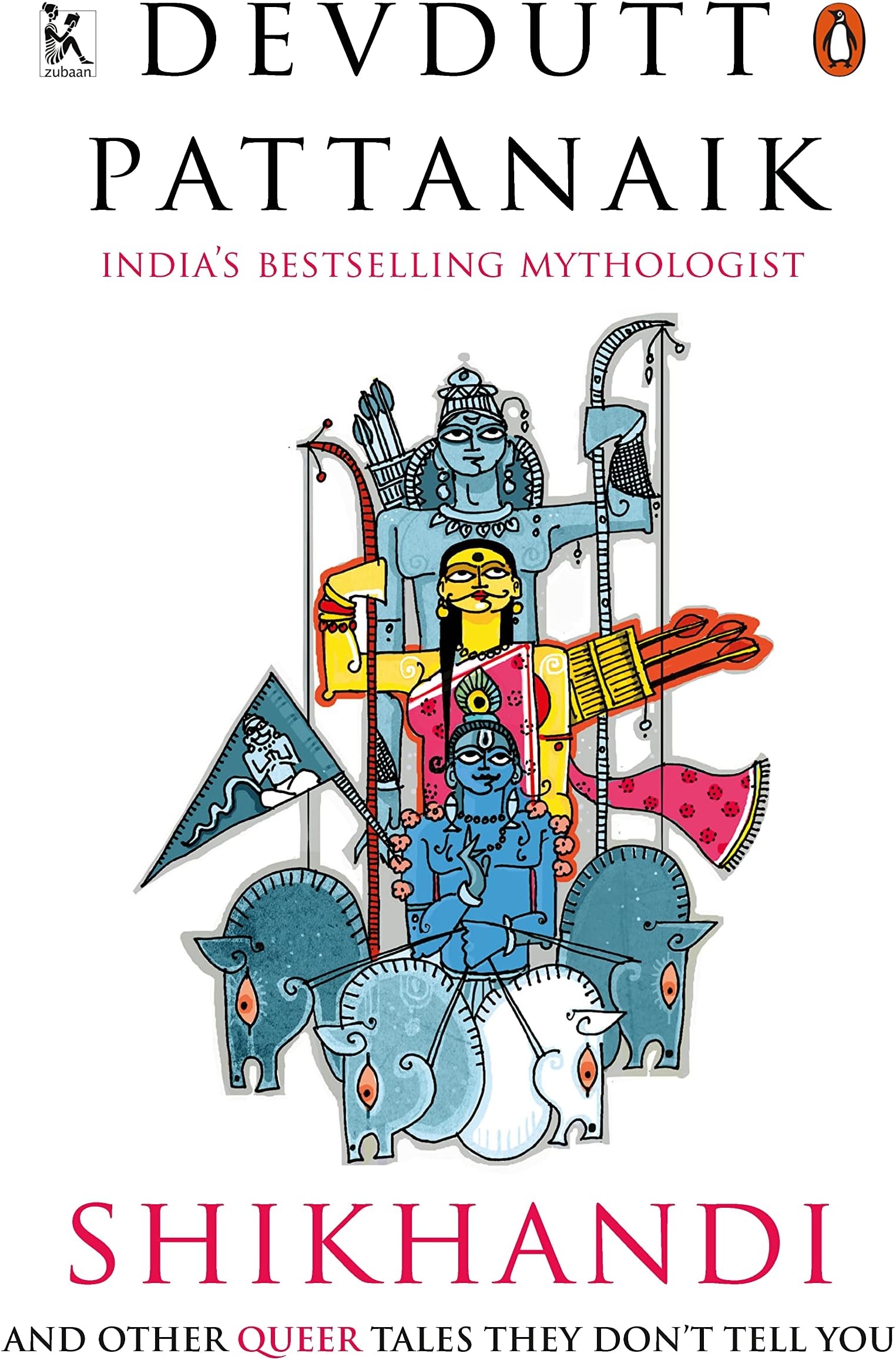
Shikhandi: And Other Tales They Don't Tell You
Product ID: 20334566
Buy anything from 5,000+ international stores. One checkout price. No surprise fees. Join 2M+ shoppers on Desertcart.
Desertcart purchases this item on your behalf and handles shipping, customs, and support to Iceland.
desertcart.com: Shikhandi: And Other Tales They Don't Tell You: 9789383074846: Pattanaik, Devdutt: Books Review: I was never bored. And - This was a very enlightening read. There were some fascinating stories/myths/history. To be sure, I was never bored. And, what's more, I learned a great deal without realizing it until the end. Devdutt Pattanaik managed to educate and enlighten with a subtle style of storytelling that made it hard to put the book down. What a great college course this would be! Mr. Pattanaik's observation/perspective on Krishna was especially inspiring and positively thought-provoking. Review: Fluidity found atlast in bound Indian mythology! - When I first read the name "Shikhandi", I was like 'oh what kind of a name is that?' I had read author's editorial published in TOI when Sec 377 was reimposed by Supreme Court throwing the ball into parliament, as I guess the judge knew he would be evaporated as the conditions were in favourable of tyrant non secular political party. So, its better to save your own hide than worry about others, isn't it? Anyways, I got the main reason why Bhisma lay on the bed of arrows, which was never shown in any Mahabharat series played on TV nor in any story telling sessions by grandparents or temples. But the best part of the book is the starting poem. It is brilliant. Rest of the stories (if you tend to believe Ramayana, Mahabharat, Krishna, etc. you need to believe these stories too... ) speak more about gender fluidity, neutrality and most important is it can gently bring you to the understanding that gender is something what you feel and think, something in your mind, while your body might be of any shape and sex. These stories also puts forth about kind of sex a human can have due to being born a human. Its refreshing to read fluidity in the current stagnant and moulded society. One suggestion to penguin people: Please proofread! Even if its written by Indian author on a controversial subject, don't just shrug off your responsibility to 'spell check' for spelling mistakes. There are quite a lot spelling mistakes for e.g. 'from' is converted to 'Prom'.
| Best Sellers Rank | #360,790 in Books ( See Top 100 in Books ) #520 in General Gender Studies |
| Customer Reviews | 4.1 4.1 out of 5 stars (774) |
| Dimensions | 5 x 0.6 x 7.75 inches |
| ISBN-10 | 9383074841 |
| ISBN-13 | 978-9383074846 |
| Item Weight | 5.7 ounces |
| Language | English |
| Print length | 192 pages |
| Publication date | August 15, 2015 |
| Publisher | Zubaan Books |
S**N
I was never bored. And
This was a very enlightening read. There were some fascinating stories/myths/history. To be sure, I was never bored. And, what's more, I learned a great deal without realizing it until the end. Devdutt Pattanaik managed to educate and enlighten with a subtle style of storytelling that made it hard to put the book down. What a great college course this would be! Mr. Pattanaik's observation/perspective on Krishna was especially inspiring and positively thought-provoking.
A**R
Fluidity found atlast in bound Indian mythology!
When I first read the name "Shikhandi", I was like 'oh what kind of a name is that?' I had read author's editorial published in TOI when Sec 377 was reimposed by Supreme Court throwing the ball into parliament, as I guess the judge knew he would be evaporated as the conditions were in favourable of tyrant non secular political party. So, its better to save your own hide than worry about others, isn't it? Anyways, I got the main reason why Bhisma lay on the bed of arrows, which was never shown in any Mahabharat series played on TV nor in any story telling sessions by grandparents or temples. But the best part of the book is the starting poem. It is brilliant. Rest of the stories (if you tend to believe Ramayana, Mahabharat, Krishna, etc. you need to believe these stories too... ) speak more about gender fluidity, neutrality and most important is it can gently bring you to the understanding that gender is something what you feel and think, something in your mind, while your body might be of any shape and sex. These stories also puts forth about kind of sex a human can have due to being born a human. Its refreshing to read fluidity in the current stagnant and moulded society. One suggestion to penguin people: Please proofread! Even if its written by Indian author on a controversial subject, don't just shrug off your responsibility to 'spell check' for spelling mistakes. There are quite a lot spelling mistakes for e.g. 'from' is converted to 'Prom'.
W**E
quick read - ideal while traveling
Easy read - impressive research and selection of stories by Dr Patnaik on the so-called 'queer and taboo' world. Would recommend only open-minded readers.
R**A
More like a compilation of short stories
Though it gives a good perspective of how Indian society had the third gender as a part of its mainstream always, the stories are very short and conclude fast. Good book nonetheless, I liked the bigger stories like Mahabharata and Ramayana better because of a longer plot
D**Y
T
TOWN Google will have the on the rings online marketing and Happy with the what ifs and Happy to get hungry faster and Happy to get the what ifs of the i think it is not the i am not a big part
K**A
Felt Cheated!
While reading this book I felt cheated many times. I have read Ramayana and Mahabharata in school (was there in curricula in CBSE) and now i realise it was a very digested version what we learned is what needs to be passed on to the next generation. I have come across people complaining about Indians (where they mostly mean Hindu) who have plenty of erotic text as part of their religious books and still the persistent neglect in talking about sex, gender and sexuality. I think part of the reason is that what's retold is usually the selected stories and then one needs to accommodate all the transmission loss which the author also mentioned. This book is a must read for people who advocate for 'Queer Rights'. I revisited the poem given in the beginning of the book that made more sense with every passing chapter. I might have it by heart by now. My eyes popped out while reading many of the chapters and I think most readers will relate to it who know parts of the stories told here but not the whole story. The title of the book is apt- these definitely are stories that elders choose not to tell or probably don't know themselves. These are not stories that are passed on. The question is- does it show some fault it our gods? I am definitely going to keep reading and referencing the chapters in my work of and Dr. Pattnaik needs to add me in his growing list of fans. Lastly, I applaud the initiative of Zubaan. I had earlier read seeing like a feminist and loved it. PS: Kamasutra added to my list of books to be read.
L**O
Shikandhi comes to the Light.
Dr Devdutt Pattanaik has once again outdone himself in this publication. Devdutt so easily and beautifully finds the balance between "ancient" tales and their interpretations. Devdutt also boldly yet tactfully tackles a taboo subject making this work one of his finest to date.
P**O
Great Little Book
Great Little Book, tells alot !!
I**R
I love this book. I read it quickly and was disappointed there weren't more queer stories, my only critic is that rape in certain stories was glorified (as I suppose it is also in non queer stories unfortunately, but it is no glorious act) and I don't believe a book of such short stories with few queer stories(regardless of that being the focus) is the best thing to do; personally that is my opinion. I do not deny that it can happen in queer relationships or that it should not be talked about and that we should censor these stories when speaking of hindu mythology when speaking of its' queer and "non queer" history, but when I got the book, I was anticipating only consensual acts (perhaps due to my lack of knowledge of this mythology to be fair ) but I am happy that my introduction to Hindu mythology started off with a book on queer stories in the mythology, for more than one reason as otherwise I have doubts that I would have come across it, and I am tremendously happy this book exists.
M**R
"In the Veda there is a line 'vikruti evam prakruti' which can be translated as 'all things queer are also part of nature'." - Devdutt Pattanaik. In Shikhandi And Other Tales They Don't Tell You, Devdutt Pattanaik brings to the forefront those tales from Indian mythology that point out our previously comfortable stance towards Queerness. He highlights even the most heard of tale in a way so us to grant us better understanding of how accepting we were at a point of time. Stories range from how Lord Krishna transforms into Mohini to how Mandhata was born of no mother. This book surpasses expectations and then some. It is so rich with characters known and worshiped by people from all over India. What's more is that after every tale, the author presents a literary analysis from the perspective of Queer Theory. This book couldn't be more appropriate in keeping with the problems of the present time. I devoured this book in a day. It was so wholesome and fulfilling, particularly because I have learned literary theory in college. We had an entire section titled "Queer Theory" in the curriculum but for some ludicrous reason it was made "self study" and not discussed in class. Some of the stories in this book are ones that we've heard from our families like that of Bhasmasura, Shikhandi, Bhagirath, Ahalya etc whereas many others were new to me. The amount of information in this book is overwhelming in its entirety because there are so many names involved and versions to each story. After a story, the author discusses the origin of the text, how it differs from place to place and even questions it from the queer perspective. But I couldn't put it down and had to finish it, so a lot of the names may have flown over my head, nevertheless I can always go back and read random stories again. I'm certain I will. The book opens with two sections that are solely about understanding the Queer with examples from all over the world. It historicizes concepts like lesbianism, cross-dressing, hijras to throw light on their prevalence even in the time of Ram Rajya. This book prods us into questioning popular beliefs and not conforming to the society's condemnation of anything that is beyond normal. It shows us that if Gods and Goddesses are accepting of gender fluidity or queerness than we shouldn't be criminalizing and looking down upon those who do not identify with the two categories of male and female. I absolutely loved this book from the very beginning and am glad it remained wonderful till the end. Maybe this book should be incorporated into school and university curriculum. If you are the least bit interested in mythology or LGBTQ stories then please please read this book. It is splendid!
S**D
''Beware of a land where celibate men decide what is good sex” And it was a queer week. Sorry for the bad joke but then LGBT community should actually thank Devdutt Pattanaik for doing so much research in justifying how much Hinduism has hidden the queer side of life. For us, it may be unnatural, immoral or indecent, but then his theological research makes you question all the tales you have been listening to since birth. Everything from Ramayana to Mahabharata has been twisted and turned to suit the requirement of each Yug, but the core is alive. And our elders always forgot to tell us stories that are related to hijra’s and LGBT that also existed in Satyug era. Maybe due to immoral standards, but then Shikhandi by Devdutt Pattanaik helps us open our mind to understand this hidden ancestral side. The book first describes a detailed version of the discovery of invention of queerness. Here Devdutt’s hard work and extensive research is described so as to help the reader understand the roots of queerness in different cultures. From India to Egypt to Mesopotamia, the author has made sure to cover as many aspects as he can to explain the different type of queer cultures in various parts of the world. The best part described is of the Hijra, titled as a local manifestation of queerness in India. Many of us don’t know that Hijras clap so that they can be seen. They want to overcome societal norms where they are treated as invisible, hence they clap to make us aware about their presence. The stories start with Shikhandi, one of the best examples of Queerness in ancient history. Amba, a princess who was promised to be married to Prince Shalva, was kidnaped by Bhishma along with her sisters and delivered to Hastinapur to be married to his incompetent half-brother Vichitravirya. But thanks to her incessant begging, he decides that satisfying her sisters would be enough, so he let her go. But then Prince Shalva rejected her because she was tainted. She then begged Bhishma to marry her, but Bhishma had a vow of celibacy, so he politely refuses. Hurt, Amba then invokes Shiva, The Destroyer God. Shiva, pleased with her prayers and dedication, grants her a boon that she will be the cause of Bhishma’s death but only in her next life. Hearing this, Amba kills herself and was born as a daughter to King Drupad, named as Shikhandi. But King Drupad wanted a son, so he raised Shikhandi like a son only and was married to a woman. But then during their wedding night, Shikhandi faces trouble that how she would be able to satisfy her woman? Confronted with harsh reality, she tries to commit suicide but then is saved by a Yaksha named as Sthuna, who lends his manhood to Shikhandi for one night. Stories like this will intrigue any reader into exploring the ancient queer practices of India. While reading the book, two of the best stories were of “Narada” who forgets that he is a man and settles as a wife. But then one day curse is broken and he finds himself transformed into a man again. Krishna makes Narada understand what exactly Maya is in the above-mentioned story. Then there is a story of “Pramila” who due to her excessive feminism, ends up making fun of passing Gandharva’s male genitals only to be banished to a Stri Rajya (Female only Kingdom) or kadalivana. Then comes sage Matsyaendranath, who answers her prayers and gets seduced and ends up fathering all the kids of the women there. But then his student Gorakhnath intervenes, who appears as a cross-dressing singer and dancer, to remind his teacher of his bachelorhood. Matsyaendranath leaves with Goraknath, along with all the sons he fathered, this leaving Stri Rajya intact. This shows a clear example of lesbianism and bisexual women, who need men only when required to father children. Otherwise, they are pretty happy on their own. In the Bhagavad Gita, Krishna shows Arjuna his cosmic form and says, ”I am all there is, was and will be”. In Hinduism, the world is not distinct from God. The world is God. God contains everything. The queer is not excluded. Maybe whoever reads this book realize what difficult times queer are living in India. A land, full of twisted tales that lead to discrimination towards queers, maybe this book enlightens them. A must read for all and especially for all the ignorant societal pricks.
P**A
Amazing Book
P**I
A collection of short stories, not even complete stories at that, just excerpts of queer mentions in old religious scriptures. The commentary at the end of every story is massively disconnected. Nothings holds the book together.
Trustpilot
1 day ago
3 weeks ago