🌟 Discover the Unseen: A Journey Beyond the Ordinary!
Proof of Heaven is a groundbreaking memoir by neurosurgeon Dr. Eben Alexander, detailing his near-death experience and the profound insights he gained about consciousness, spirituality, and the afterlife. This compelling narrative invites readers to explore the intersection of science and the metaphysical, challenging traditional views on life and death.
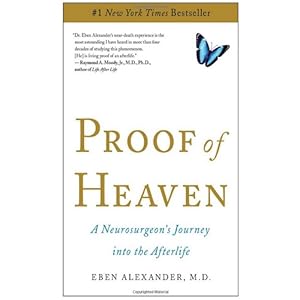
| Best Sellers Rank | #2,125 in Books ( See Top 100 in Books ) #3 in Reincarnation (Books) #4 in Near-Death Experiences (Books) #5 in Christian Eschatology (Books) |
| Customer Reviews | 4.4 4.4 out of 5 stars (25,152) |
| Dimensions | 5.5 x 0.64 x 8.38 inches |
| Edition | 1st |
| ISBN-10 | 1451695195 |
| ISBN-13 | 978-1451695199 |
| Item Weight | 2.31 pounds |
| Language | English |
| Print length | 196 pages |
| Publication date | October 23, 2012 |
| Publisher | Simon & Schuster |
B**N
Great Book, lots of questions
Great book - but lots of questions! If true, this is perhaps the most astounding, important, enlightening and uplifting story ever told. It complements, supplements and/or trumps all spiritual revelations and materialist musings up to this point in human history. If people think about this correctly (and I have little hope that the majority will), and if it can be confirmed, we would all come together and live happily ever after; this is the stuff of fairy tale; in the good sense. Is it real? Certainly for all intents and purposes, Dr. Alexander is highly credible. So either: 1) it is true, or 2) he is somehow misinterpreting a really strange hallucination caused by brain damage as reality or 3) he is making it all up. Personally I discount this last option. Is it possible that this was a strange hallucination caused by brain damage? Dr. Alexander is sure that it is not. The fact that he received validation with the photo of his sister at the end is really stunning! But I suppose it is possible that his mind (or brain) may have been playing tricks on him. A critical question for me is whether or not this journey actually did occur when his neo-cortex was non-functional as he says as oppose to being in a degraded state. He says he has time anchors which demonstrate that the majority of the really sublime experience did in fact occur when his neo-cortex was non-functional. If this journey really did occur when his neo-cortex was non-functional, then clearly, it would seem, consciousness is not reducible to material causation as materialism requires. However, even if there is some doubt about when the most exquisite elements of his journey occurred, the following very difficult question remains for those who adopt a materialist line of thinking: How can it be imagined that such advanced concepts discloses in the book which rang very true to me (there are more that are difficult to articulate) could be evoked out of a severely compromised brain? If this is real then virtually everything that nearly all the scientists in all the universities of all the world have been saying for decades about evolution, the brain and mind is spectacularly wrong! If there is a conscious mind apart from the brain then it must have been bestowed by some pre-existent intelligent entity--probably some divine entity. But materialist scientists are not going to like the idea that they themselves and the scientific paradigm itself could be regarded as fallible any more than the authority of the leaders of the church was challenged a few centuries ago. If this story gets traction, materialist scientists are going to wage war on Dr. Alexander. A few thoughts about the phenomenon of consciousness related to Dr. Alexander's experience. I have never understood how intelligent people--including Dr. Alexander until his NDE--could dismiss consciousness as a phenomenon of the physical brain. I have never accepted that for a wide variety of reason only one of which I will mention: If human consciousness were reducible to physical phenomenon then what accounts for the immutability of one's sense of self? How can it be imagined that, in Dr. Alexander's case, after the brain damage he incurred and once his neo-cortex was restored (miraculously), that his sense of self--that he is the same Eben Alexander he was before--be perfectly reconstituted? How can a physical algorithm--organic computer--account for that especially in light of the fact that his brain structure must have undergone catastrophic change? Personhood--self, identity whatever you want to call it--is constant despite radical changes in the underlying physical structure. In fact, how can trillions of firing neurons account for consciousness at all? When the best explanation offered by materialist to explain consciousness--the most real thing about us--is that it is an illusion, you know they are really grasping at straws. I am anxious to read more about Dr. Alexander's experience. He has written 20,000 words about it.
T**Y
A splendid, compelling book!
This is a splendid and important book. Its author is a long-practicing neurosurgeon who is a former faculty member of the Harvard Medical School. A few years ago, he suffered an e-coli infection that developed into meningitis, attacking his brain, leaving him comatose—without consciousness or a functioning brain—for a week, and quite nearly killing him. Against great odds (100 to 1 or worse in his view), he has recovered completely, and written this book. The book concerns his illness, the reality he quite vividly and consciously experienced while nearly brain dead, and conclusions he has reached concerning God and reality based on his experiences. Before his illness, the author practiced as an academically inclined neurosurgeon. He considered himself a scientist as well as a practicing physician, and his views about reality and God reflected his training and his career. He saw reality as consisting of things that could be perceived with the senses, either directly or indirectly using machines and instruments. In his view, reality began and ended with the physical world and the observed physical reality of our galaxy and the greater universe. Notably he did not see consciousness as existing independently from this physical reality—instead, it was an artifact of physical brain structure and brain chemistry. Although I don’t believe that he expressly stated that he believed God did not exist, it is pretty clear that he didn’t view God as being a part of this observable physical reality, and the book seems to indicate that, regardless of his belief in God, matters spiritual and religious did not play a big part in his life nor attract much of his attention. During his illness, and while his brain (at least the higher level parts responsible for consciousness, congition, personality, memory, etc.) was completely non-functional, he experienced a new reality of great beauty, wonder and peace, the most vivid aspect of which he describes as being pervasive, unconditional love. When he recovered consciousness and in the months following his recovery, he sought to apply his scientific training and experience to understanding what he experienced. He has concluded that consciousness exists independently of the physical brain and that, freed from limitations resulting from our limited sensory abilities (seeing, hearing, touching, etc.) and from the limited processing power of the human brain, his consciousness was able to perceive a much greater, multidimensional reality—the heaven of the book’s title. Though he is obviously a bit frustrated by limitations on the concepts we can express using human language (after all, a language that, while quite useful and apt in dealing with the limited reality of our physical world, was not developed for use in connection with the greater reality he experienced nor for expressing his expanded perceptions of that reality) his book does a very good job describing that reality. His writing also reflects a certain intellectual rigor and scientific analysis, and I am compelled to give greater weight and credence to his descriptions and conclusions in view of his scientific approach as well as the relative unimportance of the spiritual component of his life before he developed meningitis. This book will be food for thought for me for a long time. I recommend it without reservation. Tom Hurley
K**D
What a wonderful book.
T**4
One of the easiest and most enlightening books I have read in a long time.
F**C
Un livre écrit par un neuro chirurgien suite à une méningite foudroyante à E-coli qui aurait dû le laisser mort au mieux, ou totalement 'légumisé' au pire. Il est parfaitement rétabli, n'a perdu aucune de ses capacités et à vécu une NDE qui a transformé sa compréhension de la nature du réel. Outre le récit qui est captivant, l'intérêt majeur, il me semble, réside dans le fait qu'Eben Alexander était un neurochirurgien matérialiste et sceptique par principe. Cette expérience ainsi que ses solides connaissances scientifiques lui permettent de réfuter un à un les arguments des scientistes pseudo-scientifiques et contribue grandement à une recherche sérieuse et approfondie de l'esprit et de sa non localité. Je souhaite que ce livre soit rapidement traduit en Français pour atteindre un public encore plus grand.
T**D
In the past when reading the extract of a book and then buying it I have often been disappointed to find that the extract was the meat of the book and there wasn't much else. NOT SO with this one, though I was wondering if it was going to turn out that way when I first started. I found it interesting and compelling right to the very end. Well written and enjoyable even without the journey into the spiritual world. Quite an amazing story on many levels not to mention the fact that the writer fully recovered from a major life threatening illness that should have at least left him severely damaged if not killed him. More could have been written about this fact but didn't need to be. A very human story and the explanations of his experience rings true to my own intuitions and experiences. I liked the way the chapter alternated between the two realities. I also liked the way he deals with the issues. As with any book that gives some element of theory or ideas I did not agree with all the authors conclusions but this is not that import in order to appreciate this amazing experience. Read it - you might very well enjoy it and it certainly will give you some food for though and meditation.
S**A
It is an easy reading, the content is Amazing, very straight to the point, destinos not the end, we re here expeciencing and we ll go Back home.
Trustpilot
4 days ago
1 month ago