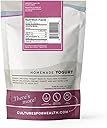
🥄 Unleash Your Inner Yogurt Artisan!
The Cultures For Health Bulgarian Yogurt Starter Culture offers a unique heirloom style that allows for endless yogurt creation. With health benefits including probiotics and essential nutrients, this versatile starter is perfect for a variety of recipes, all while ensuring safety through third-party testing.


| ASIN | B016BYWXS0 |
| Age Range (Description) | Adult, Kid, Teen |
| Age Range Description | Adult, Kid, Teen |
| Best Sellers Rank | #165,628 in Grocery & Gourmet Food ( See Top 100 in Grocery & Gourmet Food ) #56 in Yogurt Starter Cultures |
| Brand | Cultures For Health |
| Brand Name | Cultures For Health |
| Container Type | Pouch |
| Cuisine | Bulgarian cuisine |
| Customer Reviews | 3.8 out of 5 stars 1,055 Reviews |
| Item Package Weight | 0.01 Kilograms |
| Item Weight | 2.4 Grams |
| Manufacturer | Cultures for Health |
| Model Number | 3457572 |
| Number of Items | 1 |
| Package Information | Pouch |
| Package Weight | 0.01 Kilograms |
| Part Number | 3457572 |
| Set Name | 2 Packets |
| Size | 0.06 Ounce (Pack of 1) |
| Specialty | Gluten Free, Natural |
| UPC | 767563457572 814598020292 |
J**V
Be patient. Yogurt is better than store-bought with a nice tang, but not sour.
I’ve been making yogurt for a few months and grew tired of needing a new store-bought tub every few generations. Found a Sandor Katz video online where he talks of endless generations via heirloom cultures. After 5 quality generations (more than any store-bought tub produced), I’m convinced this is the better way. As Sandor explains, it’s not just a handful of lab-isolated bacteria strains in this yogurt, it’s a whole complex community of bacteria that gives it a deeper flavor. To my surprise this yogurt also cultures much faster than store starters. This yogurt is ready after a 5 hour culture, whereas store-bought greek yogurt was taking 10 hours to get to where i liked it. This Bulgarian yogurt culture has a deeper, more interesting taste than store-bought tubs. It has a nice tang, but without the sour taste that is a turnoff to me and likely other vinegar-haters out there. Culturing has worked with every method I’ve tried so far: instant pot directly in the stainless tub, mason jars in the instant pot, and mason jars 75% submerged in water with a sous vide circulator. My go-forward is the mason jars as that enables me to produce the volume of yogurt my family consumes, while keeping the container size small enough to maximize quality. I use a standard <$3 gallon of whole milk from my local supermarket and do the initial heat to 180℉ in a pot on the stove. I found that a pot is faster than instant pot, and because I stir it periodically, it warms and cools without forming a skin on top of the milk. Activation batch tips: 1) Follow directions to the letter. Printed instructions are packaged with the starter, and a video is available on the sellers website. Subsequent batches are easy, but activation from dried starter just takes longer and you don’t want to waste this relatively expensive starter. 2) Mix thoroughly. The powdered starter didn’t dissolve as easily as I thought it would. Discovered some partially hydrated clumps at the bottom as I poured into the last jar. I decided not to remix the whole batch and fortunately that worked. 3) Be patient. Instructions say to start checking the activation batch at 5 hours, and let it go until 12 hours if not set. My activation batch took 11 hours to set. Per instructions, after setting I let it set at room temperature for 2 hours and then overnight in the fridge. Subsequent generations are much easier and faster than the first activation batch. Ongoing starter tip: IMHO the instructions from the seller call for too much starter in ongoing batches. I’ve been using a single heaping tablespoon of starter (yogurt from prior batch) per 1 gallon milk and think the resulting quality is great. Too much starter results in yogurt that is sour and possibly thin/grainy. Just be sure to thoroughly mix the starter into the milk. Update: This yogurt is still great after 6 months and 31 generations of yogurt so far. A few updates to my prior comments - 1) Settled on gallon batches of yogurt in 4 quart-size mason jars with plastic lids, cultured in a sous vide circulator bath at 110F. These batches provide my family of ~5 days of high-protein breakfasts. 2) I freeze enough yogurt to fill 3-4 cubes in an ice cube tray every couple months. One of my batches turned out bad I think because of a pot that was not fully sanitized, and I used a frozen cube to resume the lineage without needing more dried starter. To restart I used 1 cube in a quart mason jar of milk. It takes a long time to culture - just like the initial activation batch, but batch 2+ then turn out perfectly. This approach protects against contamination & other production gaps (i.e. vacation!) 3) updating my guidance to one heaping Tablespoon of starter per gallon of milk. I pour ~1c from the heated pot into a measuring cup, stir in the starter, and then add back to the pot. 4) culturing time: yogurt is consistently set after 4 hours of culturing at 110F. After 4 hours I remove the jars from the water bath and let them sit at room temperature for 2 hours, then place in the fridge overnight. (NOTE - these times are for production batches from a fresh starter. Activation batches take significantly more time to culture)
J**D
My experience so far
I have ordered this item three times and of the three times only my first item (ordered on March 3, 2021) was great my siblings and I loved the taste but sadly we lost it due to parents being unhygienic or something else happened to it, so I made a second order when it was June 7, 2021 and this one came in expired my white/yellowish is powder was red/orange in color went to ask via email and I never got a reply back felt betrayed, but we really did love this taste, so I went for round three July 12, 2021 and when it came the siblings and I were excited the color and expiration date was fine . When it was done fermenting and cooling it was beautifully creamy and thick from appearance, but when I went to smell it the scent was different, but I thought maybe it would still be fine and to my surprise it was a bit sweet not a little tangy and tart like it was supposed to be when it plain. This was my experience so far I hope I can get the same thing I got back in March eventually, and I'm not even mad at the gallons of milk I lost making yogurt, just disappointed.
A**R
Be patient while it thickens!
Short answer - I like this yogurt a lot, but you must be patient or you will think it doesn't work. Mine took 13 1/2 hours to ferment and thicken.It is mildly tart, not complex, and produced a thick yogurt. It may be a good choice as a base for people who don't like complex and super-tart yogurts. Long Answer - I tested this and yogourmet side by side. Got a half gallon of regular 2% milk, put it in the crockpot on low for two hours while it simmered, then poured it into 2 quart mason jars, lightly covered, and let it rest on the counter until the thermometer read around 105F. In the meantime, I put the oven on warm and half-filled a pampered chef rockcrock with water, covered, and put it into the oven to warm. Warm gets to around 200F. When the milk was cool, I turned off the oven. Then I put a yogourmet packet in one quart and one of these packets in another. Loosely covered the mason jars and put them into the warm water in the oven. Laid a doubleup bath towel over it to insulate, and left it alone for 5 1/2 hours. When I checked, the yogourmet was thick and tart. Not my prefered flavor of tart, either. I put it in the fridge. I ate it for breakfast the next morning but had to add fruit and sweetener. But the one with this packet was completely soupy - exactly like milk. I thought I must have killed it from the heat. I put it back in the oven with the towel over it and left it alone for another 8 hours (overnight). And it was PERFECT. Smooth and thick, not lumpy. It was mildly tart, with enough sweetness that I could eat it without fruit or honey. If I have a criticism it is that the flavor was not complex enough, but that is fine. I capped it and put it in the fridge. The other comments suggest that over time this gets even better at thickening so I'm looking forward to making future cultures from this initial start.
A**R
Home-made Yogurt in Singapore
Smooth, creamy, gorgeous. When I started making my own yogurt in the US using a yogurt maker, I thought it would be a waste of money to keep buying a dehydrated starter when I could use store bought yogurt instead. Then I discovered that with this type of starter, I would only have to buy one sachet and then could keep using the yogurt as starter indefinitely. It works beautifully. This starter culture tastes very mild and has great texture no matter how long it ferments. Incubation would take about 5 hours with the yogurt maker, but I now live in Asia - without a yogurt maker. No matter. I still get great yogurt by incubating the milk in glass jars (empty pasta sauce containers work nicely) set in a big cooking pot with lid filled with hot water. I simply leave the pot outside, where the temperature is usually between 85-95 degrees. Every couple of hours I add some hot water to keep the temperature at 100 degrees. It usually takes about 7 hours for the yogurt to set - shorter when I remember to keep the temperature up and longer if it dips to 85 degrees for too long. Different from making the yogurt in the US, I do add powdered milk to thicken the mixture, which speeds the fermentation process. To thicken the yogurt in the US, I drained the yogurt of some of the whey. Both variations taste delicious and I won't go back to store-bought. It is now Oct. 2019. and I just wanted to send in an up-date. The new title should be ""Saved Yet Again". The starter in Singapore kept producing beautifully. To keep it alive, I took it with me when I traveled for longer periods of time. The culture had its own second yogurt maker in Germany! Then 2 years ago it came time to leave Singapore. I put a small amount of starter in the hotel fridge at the airport - and promptly forgot to take it with me. Back in the States, I still had that second sachet with the dried starter. Though it was relatively old, the new culture worked as beautifully as the first. I did not treat it well, but what can I say - those little bacteria are tough critters! I left a batch without feeding it for three weeks and they recovered. I traveled with a yogurt maker for several months in the US and they made it through microwaved milk (too hot and too cold), long periods without attention, and being jiggled around on the road. They have survived wrong temperatures, slightly off milk, long incubation periods (I forgot to turn machine off), sitting around in cold milk (I forgot to turn the machine on) and unscalded milk. I thought I lost them for good when I asked my brother to take care of them and he forgot. He gave the yogurt back to me saying he did not like the taste.. Funny that. He did not feed it and mold had developed. It took making 4 batches (throwing out all the batches until all the mold was gone) ) to bring the bacteria back from the brink. I am happy to report that all is well again. Off to have some yogurt!
N**.
Excellent yogurt, great savings!
I've ben making yogurt at home for the last 3 years or so; previously, I had always used my favorite store brand yogurts as starters for my yogurt. This worked great, but it was always frustrating that I had to buy yogurt every time I wanted to make yogurt, because store bought yogurt is essentially "single use" culture—if you start subsequent batches with the previous one, the resulting yogurt becomes thin and gross within 1-2 tries. This seemed really strange. Yogurt has been made, as I understand for many hundreds of years. They didn't have single-use cultures back then! In any case, while it added expense and inconvenience to the whole process, I was very satisfied with the results, at least: I could use any milk I wanted, and also add extra heavy cream to make even richer, magnificently creamy yogurt. A few months ago, I read about heirloom cultures from Cultures for Health, and it made so much sense that the reason why store-bought cultures were no good to re-use was that they were cultured from a hand-selected, narrow, unstable set of bacteria. I bought the Bulgarian starter about a month ago, and I've been working with it since. The first batch, as expected, was a little bit thin, but it definitely set, and had an okay flavor. I thought it was too bland. The second batch was much better, with a really rich, complex, mildly tangy flavor. However, while the second batch was thicker, it was still a little inconsistent, with small clumps in the yogurt that gave it a bit of a "grainy" texture, both visually and on the tongue. The third batch, though, was a total home run. I read Culture for Health's tips and tricks from their site, and thought that maybe I was heating the milk a little too quickly when scalding it. I slowed it down for this batch. Sure enough, it was perfectly smooth and creamy, with a complex, tangy flavor that is just right—not too bracingly acidic. It's just what I've wanted out of my yogurt, and it handily beats any yogurt I've had at the store—and I don't have to buy yogurt to keep making it! If there's one con to this, it's that you apparently need to keep making yogurt on a weekly basis. Before, I had been making big 1 gallon batches every 2 weeks. I really liked that spacing. I've gone down to half-gallon batches every week, and so far this is OK, but it definitely feels more like a "ball and chain" sort of commitment. On balance, though, I think I find the tradeoff just fine. This yogurt is the real deal.
D**S
2 out of 2 non-viable starters
I make yogurt on a regular basis, and thought id give this starter a try. I followed directions io s to a T. after 6 hours, the consistency was still that of milk, after 12 hours it was still the consistency of milk. I decided to refrigerate overnight - still no visible thickening. The flavor was good, but it seemed to be just that - flavor, no live bacteria. With the second package - I again flowed directions, checked i. at 6, 9, and 12hrs. Decided to leave it to ferment for 24 hours. as with the first pack - there was no visible activity/thickening. Too bad. I really wanted to like this “starter”. Im returning to just using the last 3 Tablespoons spoons of a locally made Bulgarian yogurt as my starter. It’s a pricier option, but a least I know the bacteria is alive and healthy ….
C**E
Disappointing
The yogurt produced by this culture is too thin, sometimes looks downright horrible until you stir it. I had bought a yogurt maker at the same time so blamed the yogurt maker. To test the maker, I went to the neighborhood health food store and got the only yogurt starter they had made by Yogourmet. This one worked well and it’s the one my husband will eat. I sent an email to Cultures for Health but that accomplished nothing. Their response was to itemize the same steps on the instruction sheet; i.e., can you read English and follow instructions. Another thing that’s irksome is that apparently they can’t tell you exactly what bacteria strains are in the culture. (I Googled to learn more about Bulgarian yogurt.) In spite of these problems, I am still using it because I already bought it and I like the bitterness. The fact that it’s liquidly doesn’t matter to me because I usually use my yogurt in smoothies, and since it is very tangy, my smoothies have a tart edge which I like. But most important, it’s been beneficial, has calmed down my gut. So, I will keep making it, but if I had to do it all over again, I would pass on this one.
P**S
First batch was thin; subsequent batches all great
Cultures for Health Bulgarian Yogurt Starter Culture | 2 Packets Dehydrated Heirloom Culture | I typically make yogurt in my bread machine using 1 quart of whole milk and .5C nonfat dry milk that's been heated to 180°F and then cooled to room temperature and then mixed with 3oz of plain yogurt. I then add it to the bread machine, use the yogurt cycle and typically set it for 8.5 hours. I replaced the 3oz plain yogurt with this dehydrated culture. It still looked thinner than my normal results at 8.5 hours so I added 2 more hours. I ended up with a much looser and tangier yogurt than usual. Certainly edible, just not as thick as I prefer. I reserved 3oz of it for my next batch and it produced my normal, expected result of a thick, creamy yogurt. I've been working off that, reserving 3oz for each subsequent batch, for 11 weeks with no end in sight! This culture took two tries to get the consistency of yogurt I prefer, but has been great ever since. Its noticeably tangier and has a stronger flavor overall than the yogurt that I was making with store-bought plain yogurt as a starter.
K**D
The 2nd batch came out very nice. Good consistency
The initial activation batch was quite thin, but I was expecting that after reading other reviews. The 2nd batch came out very nice. Good consistency, especially after straining for a few hours. And is very mild (low tartness/tang) as I was hoping for.
N**E
Très belle qualité
La seule petite chose c'est le le yogourt n'est pas aussi doux au goût que ce que j'espérais
Trustpilot
3 weeks ago
2 months ago