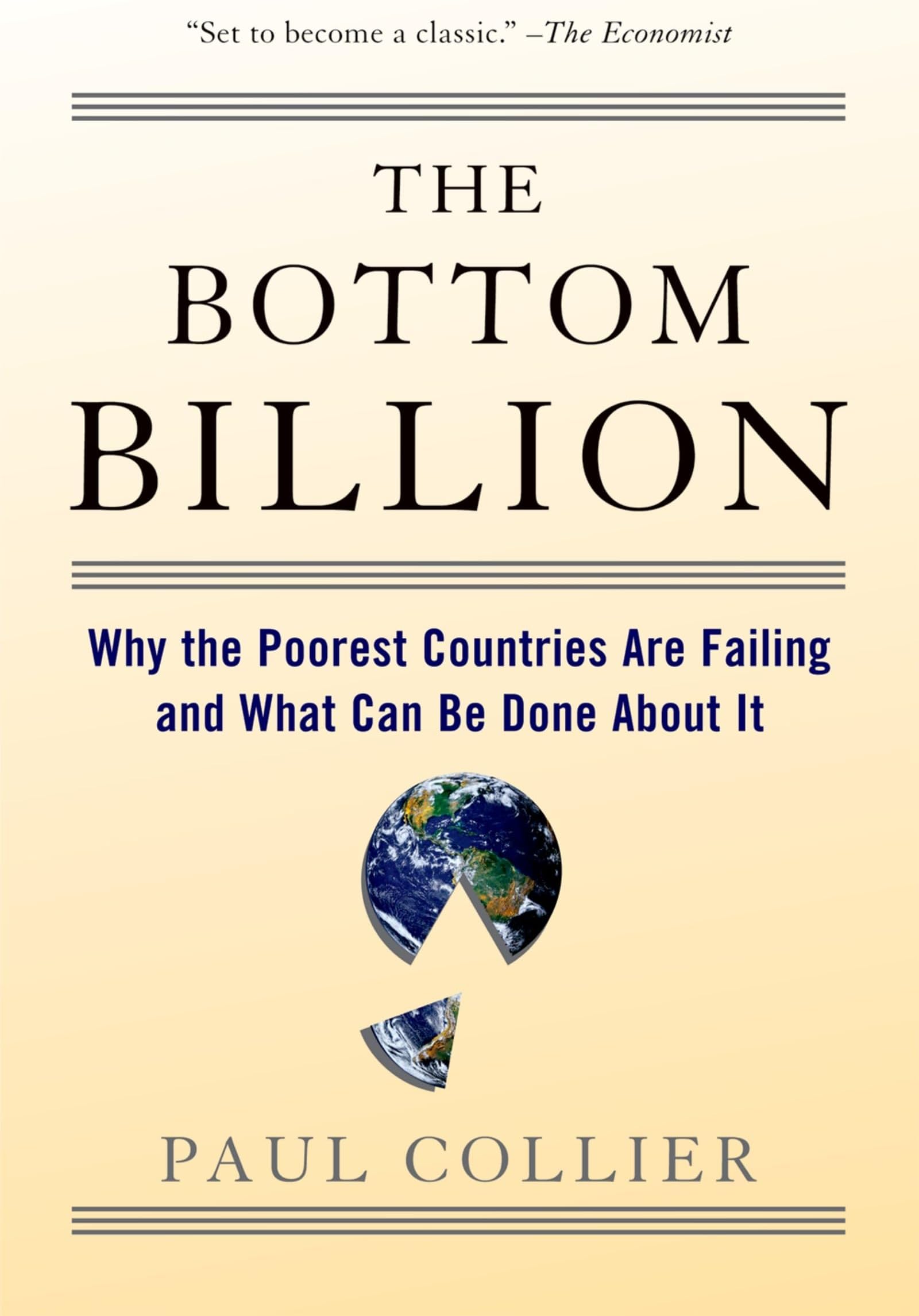
The Bottom Billion: Why the Poorest Countries are Failing and What Can Be Done About It
Product ID: 1947721
Buy anything from 5,000+ international stores. One checkout price. No surprise fees. Join 2M+ shoppers on Desertcart.
Desertcart purchases this item on your behalf and handles shipping, customs, and support to Iceland.
The Bottom Billion: Why the Poorest Countries are Failing and What Can Be Done About It [Collier, Paul] on desertcart.com. *FREE* shipping on qualifying offers. The Bottom Billion: Why the Poorest Countries are Failing and What Can Be Done About It Review: Between a Rock and a Hard Place - Developing countries are quite unlike Tolstoi's characterization of happy and unhappy families. Each happy country looks different from the other, and there are vast differences between China, India, Brazil, and other developing success stories, but there is a similarity between unhappy countries--countries that are not only failing to develop, but also going downward and falling apart. Together, these countries have a combined population of about one billion people, and what happen to this bottom billion has important consequences for the whole world. Paul Collier pioneered the burgeoning research on the economic causes of conflicts, and his work on civil wars has proved quite controversial among political science experts. Those experts tend to interpret civil wars in terms of heroic struggles motivated by grievances or ethnic strifes reflecting deeply-rooted hatreds. The author's research shows that rebel groups are usually doing well out of war, and that greed often trumps grievance as the underlying cause of conflict. He proves this by statistical analysis, showing for instance that there is basically no relationship between political repression and the risk of civil war, or between ethnic fragmentation and conflict (although ethnic polarization does play a part). Conflict is not the only trap. The author also goes through the natural resource trap, the trap of being landlocked with bad neighbors, and the trap of bad governance in a small country. Those traps often reinforce each other, and their combined effects condemn the bottom countries to the slow lane. In each case, Paul Collier not only successfully reviews the existing literature, but also offers original insights drawn from his own research. For instance, he demonstrates that far from being immune from the resource curse, democracies may create additional risks by inducing a phenomenon of "survival of the fattest". He is, to my knowledge, the first expert to point out that diversification of resource providers away from the Middle East in the name of energy security may actually increase the risk of disruption on world markets by creating new zones of instability: "Shifting our source of supply simply will not work as a security measure if the resource curse shifts with it." This research has direct policy relevance. By putting a price tag on the cost of a typical civil war (about 64 billion) or the gain of a sustained turnaround placing a formerly failed state on a secure path (about 100 billion), the author allows decision-makers to base their decisions on cost-benefit analysis. He shows that some interventions have a very large pay-off: the British Operation Palliser in Sierra Leone was a huge success, worth perhaps thirty times its cost. The protection offered by the French against military coups in Africa, now tempered by a hesitation to intervene, was perhaps also worthwhile. The European Union's new rapid reaction force may play a similar role in the future by offering a guarantee to democratic governments conditional upon internationally certified free and fair elections. "Making coups history" is certainly more controversial than the global rally against poverty, but may in the end contribute more to the plight of the bottom billion than the doubling of aid flows. Indeed, the author shows that aid offers only part of the solution, and the way it is currently managed makes it in certain cases part of the problem. Rich countries and development agencies need to narrow the target by focusing more on the bottom billion, while at the same time broadening the instruments in order to consider policy tools other than aid. This process also characterizes the author's own research, which increases the focus of economic analysis by using cutting-edge statistical tools, while broadening the scope of relevant issues, in order to inform the decisions of policy makers. To give an example, people often wonder how much of Africa's wealth has fled the continent, or how much aid leaks into military spending. Paul Collier not only addresses these issues, he answers them by giving numerical estimates (respectively 38% and 11%). The book also contributes to the broader debate on globalization. The author has little tolerance for the protest crowds of anti-globalizers who besiege international financial institutions and G8 summits. He calls them by their name: they are anti-capitalists, and they have little interest in helping poor countries benefit from the system that they are fighting against. He also challenge people who care about global poverty but are driven by slogans, images, and anger, instead of rational analysis. But he is no rosy optimist either, and he offers a sobering view on global economic integration. Although globalization has worked wonders to lift a vast portion of humanity out of poverty, it is now making things harder for latecomers, who now face formidable competitors in China or in India. In his own words: "When Mauritius escaped the traps in the 1980s it rocketed to middle-income levels; when neighboring Madagascar finally escaped the traps two decades later, there was no rocket." The Bottom Billion therefore opens horizons across political divides. To quote from the introduction: "The left will find that approaches it has discounted, such as military interventions, trade, and encouraging growth, are critical means to the end it has long embraced. The right will find that, unlike the challenge of global poverty reduction, the problem of the bottom billion will not be fixed automatically by global growth, and that neglect now will become a security nightmare for the world of our children." Review: Very informative and interesting - Already ten years old this book is still worth a read since the details are most likely still relevant to the bottom billion and perhaps others besides. In particular I note the relevant similarities to my own State of Alaska which is primarily a resource extracting state and has some of the characteristics of failing countries that Dr. Collier describes - though certainly Alaska has succeeded in saving funds for the rainy day we are in now due to the drop in oil prices. This book is loaded with detailed economic research. One thing I did notice missing though was information on global warming and its impact on those bottom billion - but this book was published in 2007 and I think much of the data on warming and its devastation of economies in those areas of Africa and the Middle East which elsewhere I read leads to migration and civil war over resources certainly should be part of this book if it is updated any time soon. On the whole the book is of course very negative in outlook though the last bit contains suggestions in each area discussed in the book regarding what we can do to help though of course in explaining each of these areas of concern Paul Collier and his assistants have done a pretty thorough job of explaining how difficult all of those ideas would be to put into place. Still, very informative and interesting.
| Customer Reviews | 4.4 4.4 out of 5 stars (667) |
| Dimensions | 5.56 x 0.58 x 8.32 inches |
| Edition | 1st |
| ISBN-10 | 0195373383 |
| ISBN-13 | 978-0195373387 |
| Item Weight | 9 ounces |
| Language | English |
| Print length | 224 pages |
| Publication date | August 22, 2008 |
| Publisher | Oxford University Press |
E**P
Between a Rock and a Hard Place
Developing countries are quite unlike Tolstoi's characterization of happy and unhappy families. Each happy country looks different from the other, and there are vast differences between China, India, Brazil, and other developing success stories, but there is a similarity between unhappy countries--countries that are not only failing to develop, but also going downward and falling apart. Together, these countries have a combined population of about one billion people, and what happen to this bottom billion has important consequences for the whole world. Paul Collier pioneered the burgeoning research on the economic causes of conflicts, and his work on civil wars has proved quite controversial among political science experts. Those experts tend to interpret civil wars in terms of heroic struggles motivated by grievances or ethnic strifes reflecting deeply-rooted hatreds. The author's research shows that rebel groups are usually doing well out of war, and that greed often trumps grievance as the underlying cause of conflict. He proves this by statistical analysis, showing for instance that there is basically no relationship between political repression and the risk of civil war, or between ethnic fragmentation and conflict (although ethnic polarization does play a part). Conflict is not the only trap. The author also goes through the natural resource trap, the trap of being landlocked with bad neighbors, and the trap of bad governance in a small country. Those traps often reinforce each other, and their combined effects condemn the bottom countries to the slow lane. In each case, Paul Collier not only successfully reviews the existing literature, but also offers original insights drawn from his own research. For instance, he demonstrates that far from being immune from the resource curse, democracies may create additional risks by inducing a phenomenon of "survival of the fattest". He is, to my knowledge, the first expert to point out that diversification of resource providers away from the Middle East in the name of energy security may actually increase the risk of disruption on world markets by creating new zones of instability: "Shifting our source of supply simply will not work as a security measure if the resource curse shifts with it." This research has direct policy relevance. By putting a price tag on the cost of a typical civil war (about 64 billion) or the gain of a sustained turnaround placing a formerly failed state on a secure path (about 100 billion), the author allows decision-makers to base their decisions on cost-benefit analysis. He shows that some interventions have a very large pay-off: the British Operation Palliser in Sierra Leone was a huge success, worth perhaps thirty times its cost. The protection offered by the French against military coups in Africa, now tempered by a hesitation to intervene, was perhaps also worthwhile. The European Union's new rapid reaction force may play a similar role in the future by offering a guarantee to democratic governments conditional upon internationally certified free and fair elections. "Making coups history" is certainly more controversial than the global rally against poverty, but may in the end contribute more to the plight of the bottom billion than the doubling of aid flows. Indeed, the author shows that aid offers only part of the solution, and the way it is currently managed makes it in certain cases part of the problem. Rich countries and development agencies need to narrow the target by focusing more on the bottom billion, while at the same time broadening the instruments in order to consider policy tools other than aid. This process also characterizes the author's own research, which increases the focus of economic analysis by using cutting-edge statistical tools, while broadening the scope of relevant issues, in order to inform the decisions of policy makers. To give an example, people often wonder how much of Africa's wealth has fled the continent, or how much aid leaks into military spending. Paul Collier not only addresses these issues, he answers them by giving numerical estimates (respectively 38% and 11%). The book also contributes to the broader debate on globalization. The author has little tolerance for the protest crowds of anti-globalizers who besiege international financial institutions and G8 summits. He calls them by their name: they are anti-capitalists, and they have little interest in helping poor countries benefit from the system that they are fighting against. He also challenge people who care about global poverty but are driven by slogans, images, and anger, instead of rational analysis. But he is no rosy optimist either, and he offers a sobering view on global economic integration. Although globalization has worked wonders to lift a vast portion of humanity out of poverty, it is now making things harder for latecomers, who now face formidable competitors in China or in India. In his own words: "When Mauritius escaped the traps in the 1980s it rocketed to middle-income levels; when neighboring Madagascar finally escaped the traps two decades later, there was no rocket." The Bottom Billion therefore opens horizons across political divides. To quote from the introduction: "The left will find that approaches it has discounted, such as military interventions, trade, and encouraging growth, are critical means to the end it has long embraced. The right will find that, unlike the challenge of global poverty reduction, the problem of the bottom billion will not be fixed automatically by global growth, and that neglect now will become a security nightmare for the world of our children."
W**N
Very informative and interesting
Already ten years old this book is still worth a read since the details are most likely still relevant to the bottom billion and perhaps others besides. In particular I note the relevant similarities to my own State of Alaska which is primarily a resource extracting state and has some of the characteristics of failing countries that Dr. Collier describes - though certainly Alaska has succeeded in saving funds for the rainy day we are in now due to the drop in oil prices. This book is loaded with detailed economic research. One thing I did notice missing though was information on global warming and its impact on those bottom billion - but this book was published in 2007 and I think much of the data on warming and its devastation of economies in those areas of Africa and the Middle East which elsewhere I read leads to migration and civil war over resources certainly should be part of this book if it is updated any time soon. On the whole the book is of course very negative in outlook though the last bit contains suggestions in each area discussed in the book regarding what we can do to help though of course in explaining each of these areas of concern Paul Collier and his assistants have done a pretty thorough job of explaining how difficult all of those ideas would be to put into place. Still, very informative and interesting.
C**R
Outlines a daunting problem, and suggests realistic policies for helping the desperate
Billions of people stuck in severe poverty represents the most shameful aspect of the modern world. In a world of plenty, with industry and capital flow generating untold wealth and agriculture producing incredible yields capable of feeding the world with great variety, it is frustrating to know that so many of the world's people have not been reached. Across the political spectrum, all people express the desire to help bring the those living in such deplorable conditions into the world economy and into economic and nutritional security. All people are embarrassed by the world's astounding failure to have accomplished this. It is when you reach the possible solutions for helping the world's desperate that you start seeing differences, and sometimes harsh criticisms of one another. Typically, the leftward leaning are proponents of direct monetary aid, education, and health care, and tend to blame the dire straits of the poor countries on unfair treatment by governments and corporations. Meanwhile, the rightward leaning argue for stabilization via security and infrastructure development, with the goal of attracting investment by governments and corporations to spur capitalistic growth. In THE BOTTOM BILLION, Collier attempts an unbiased, strictly scientific look at the problem and proposes solutions that take a more middle-ground approach. The first half of the book is dedicated to explaining the vicious cycles and patterns that keep the poorest countries in such bad circumstances. Collier outlines four major "traps" that tend to prohibit economic growth, including the Conflict Trap, the Natural Resources Trap, Being Landlocked, and Bad Government. The only one of these that at first seems counterintuitive is the Natural Resources Trap, but Collier explains that when protections are not in place, or irresponsible governments are in power, gluts of money from natural resources often lead to wasteful spending (or worse), and a boom and bust cycle dependent on commodities that generates instability. After becoming accustomed to large amounts of money and spending it on unnecessary projects that later become difficult to cut, the typical outcome is underinvestment in growth. The other traps are fairly straightforward and often inter-related. While discussing the traps that keep the bottom billion down, a number of surprising conclusions were made. One involves the problem of too much aid without focus. Just giving poor countries money does not solve the problems that keep poor countries poor. At its worse, aid can become a sort of global welfare program that doesn't encourage productive, growth-oriented change. Also, democracies are not always effective at promoting positive change. Especially in countries with strong ethnic voting blocks, democracy often leads to suppression of one group as well as vote-buying by politicians. Without strong limitations on government and strong individual protections in place, democracies can actually be less effective at bringing the poorest countries out of stagnation than more authoritarian governments. Indeed, there are a myriad of factors that make it difficult to break out of the bottom billion, even with good policy. Some of these problems seem unavoidable. Investor opinion, capital flow out of poor countries, and the migration of educated workers all hamper the development of poor countries, and are all problems without easy (or maybe existing) solutions. Collier also attempts to make a case for helping the bottom billion for our own sakes, and not just out of pity for the desperate. His intentions were to not only show the dangers of ignoring the problem (poor, desperate people may turn to violence and terrorism), but to show the benefits of incorporating more people into a common world economy. Actually putting an economic price tag on helping the bottom billion, and even stating that it may not be economically worthwhile in some cases, may seem callous at first, but it meshes with the overall tone of the book, taking an unemotional and logical look at the situation. Besides highlighting and explaining the problems and why they are so stubborn, Collier outlines his recommendations for starting to help bring the bottom billion out of the darkness. His solutions are wide-ranging, and include increased, but targeted, aid, as well as possible military interventions to enforce security. Perhaps the biggest focus of the book revolves around creating and abiding by strong international charters. Setting guidelines for economic policy and trade practices would encourage poor countries to establish growth-oriented plans with the lure of increased partnerships with rich countries. Because real change for countries of the bottom billion must happen internally, providing incentives for good management may be our most powerful tool for helping to poorest in the world. If we can help the poorest countries focus on positive change, real long-term benefits will follow. The biggest criticism I have for THE BOTTOM BILLION is the over-reliance on Collier's own research. Literally, he cites no studies that he or his collaborators did not conduct. At times, the book seems a bit self-aggrandizing, especially as Collier discusses his personal experiences rubbing shoulders with world leaders and reformers. While full of good and seemingly-accurate information, the book could have been improved by being more inclusive of other research and other opinions. Lastly, parts of the book read much like a scientific journal on economics, and can be a bit dry. Just be prepared for that, and I think you'll find the book meets or exceeds your expectations.
H**I
I think the book is very clearly structured and the writing speaks to you. The book deals with complicated problems but you feel like you are on a quest with the author - he asks the questions that you would have been thinking about. Anyway it took me good week to read this properly. I wanted to take time to understand the issues further but honestly it was a solid read and it's a pleasure to recommend it to others.
T**I
Dentro do prazo.
J**S
Working in the mining sector as a geologist and mineral economist, I had previously read Paul Collier’s Plundered Planet looking specifically at resources related economic development, so I was looking forward to reading The Bottom Billion to broaden my understanding of economic development more generally. Prof. (and knight!) Paul Collier is no doubt one of the most qualified people globally to write on this issue, as a professor of economics and public policy at Oxford University with a lifetime of experience looking at development issues in Africa. I listened to this book using the Kindle Audible Narration and was transfixed from the start. As the sub-title suggests the book effectively explains “Why the poorest countries are failing and what can be done about it”. The Bottom Billion presents a very clear framework for understanding and acting upon the problems facing the most severely poor countries. Prof. Collier describes four kinds of poverty trap: conflict, natural resources, landlocked and bad governance. He then discusses four tools which can be used for resolving these issues and importantly the limits of each: aid, military intervention, laws & charters and trade policy, before highlighting in combination the areas of most fruitful action. In particularly he makes a stand for the brave ‘heroes’ of economic development and reform in the developing world and how Western institutions and the electorate (that’s us) need to stand by and support them. I found his framework and arguments very convincing. This is in part due to the concise, lively and personal way he writes. The book is amazingly short for the breadth of material covered. However, it is clear that the book sits atop a tower of research, and thus is in no way lightweight in this respect. In this sense, Prof. Collier is very careful to highlight the sources of his information, and what has and has not been peer reviewed. One of the things I particularly like about this book is its balanced nature. For example, there is careful, nuanced but persuasive discussion of why globalisation has worked for the developed West, and is working for Asia, and will work for most other developing countries, but that for a few countries (the ‘bottom billion’) it will not work. He tackles this issue and other politically charged issues, such as aid, military intervention and international trade, carefully, and in my opinion in a balanced manner, neither leaning too left, or too right; whilst trying to use data rather than ideology in his arguments. I previously held strong (and perhaps ill informed) views on some of these issues and have found that his arguments have at least begun to change my mind and thinking about them. The mineral economist in me also found the sections on natural resources very interesting, and it is relieving to see economists moving beyond simple resource curse theory and onto more constructive arguments about how to develop countries with abundant natural resources. He expands on the subject greatly in The Plundered Planet, which would be a fine accompaniment to this book. For readers more generally interested in economic development, reading the Bottom Billion and then the Plundered Planet is probably the most fruitful order, starting broadly and then focusing on the particularly tricky issue of the resource curse. For those in the minerals or petroleum sectors, starting with the Plundered Planet covering these industries, and then taking a broader look at economic development in general via The Bottom Billion, as I have done, would be recommended. In general, whilst I am still somewhat new to the field of development economics, and I’m sure Prof. Collier is not right on everything, I would be surprised if there were many better starting points for understanding economic development in the poorest countries than this book.
E**H
This is a MUST not just for Economists in all their stages but for Law and Business students too. So they all realize the responsability and power we have.
G**N
2nd time reading this book! It is a powerful and thought-provoking book that sheds light on why the world’s poorest nations remain trapped in poverty. It’s an essential read for anyone interested in international development, economics, or global justice. Well-written, informative, and deeply insightful — this book truly broadens your perspective.
Trustpilot
1 month ago
3 days ago