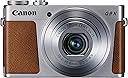
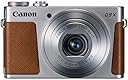
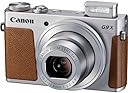
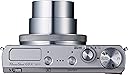
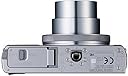
📷 Elevate your everyday moments with pro-grade power in your pocket!
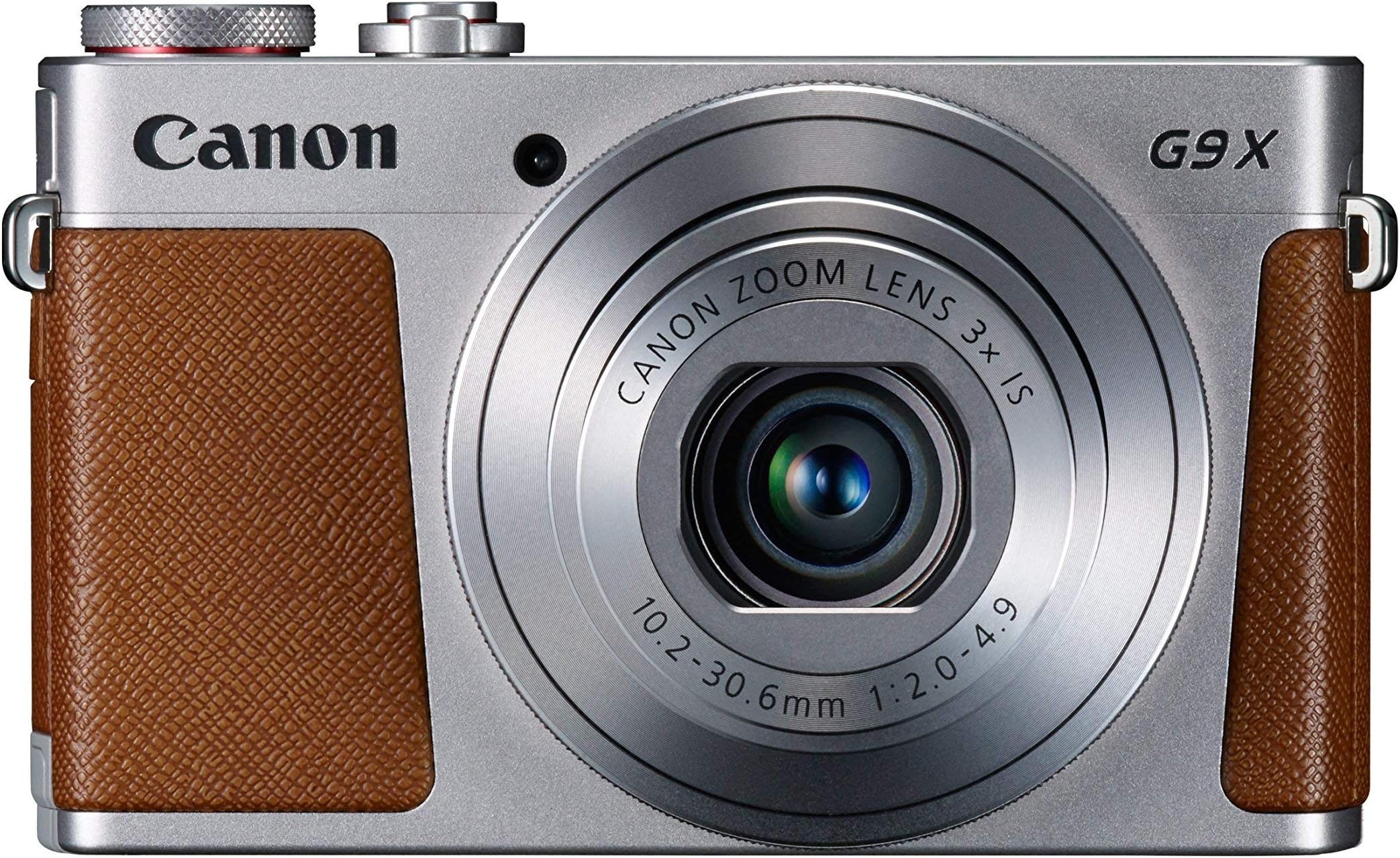
The Canon PowerShot G9 X is a sleek, ultra-portable digital camera featuring a large 1-inch, 20.2MP CMOS sensor paired with Canon's DIGIC 6 processor for exceptional image quality and low-light performance. It offers 3x optical zoom, 6 fps continuous shooting, and Full HD 1080p video recording at up to 60fps. Built-in Wi-Fi and NFC enable effortless sharing and remote control via smartphone. Designed for professionals and enthusiasts alike, it combines DSLR-level controls with a compact form factor perfect for on-the-go creativity.
| ASIN | B0167Q140U |
| Age Range Description | Adult |
| Aperture modes | F2.8-F4.9 |
| Aspect Ratio | Unknown |
| Auto Focus Technology | Hybrid |
| Autofocus Points | 61 |
| Battery Weight | 0.85 g |
| Best Sellers Rank | #181,899 in Electronics ( See Top 100 in Electronics ) #1,499 in Digital Point & Shoot Cameras |
| Bit Depth | 8 Bit |
| Brand | Canon |
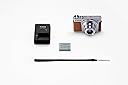
| Built-In Media | Battery Charger CB-2LH, Battery Pack NB-13L, One Year Limited One Year Limited Warranty Card, PowerShot G9 X (Silver), Printed Matter Unit, Wrist Strap WS-DC12 |
| Camera Flash | Built-In |
| Camera Lens | 28-84mm f/2.0-4.9 lens with 3x optical zoom, 10 elements in 8 groups, and image stabilization for low light performance. |
| Color | Silver |
| Compatible Mountings | Canon EF |
| Connectivity Technology | HDMI, NFC, USB |
| Continuous Shooting | 6 |
| Customer Reviews | 4.0 out of 5 stars 247 Reviews |
| Digital Zoom | 4 |
| Display Fixture Type | Fixed |
| Display Resolution Maximum | 1 |
| Display Type | LCD |
| Dots Per Screen | 121,000 dots per square inch |
| Effective Still Resolution | 20.2 |
| Expanded ISO Maximum | 12800 |
| Expanded ISO Minimum | 12800 |
| Exposure Control | Automatic |
| File Format | MPEG-4 |
| Flash Memory Bus Interface Type | UHS-I |
| Flash Memory Type | Micro SD |
| Flash Memory Video Speed Class | V10 or U1 |
| Flash Modes | Automatic |
| Flash Sync Speed | [EO] Estimated between 1/200 and 1/250 |
| Focal Length Description | 28.0 - 84.0 mm |
| Focus Features | Automatic and manual focus |
| Focus Mode | Automatic AF (AF-A) |
| Focus Type | Automatic and manual focus |
| Form Factor | Compact |
| HDMI Type | Type D Micro HDMI |
| Hardware Interface | AV Port |
| Image Capture Type | Stills |
| Image Stabilization | Digital |
| Image stabilization | Digital |
| Item Weight | 0.21 kg |
| JPEG Quality Level | Normal |
| Lens Construction | 10 elements in 8 groups |
| Lens Type | Zoom |
| Manufacturer | Canon Cameras US |
| Manufacturer Part Number | 0924C001 |
| Maximum Aperture | 2.8 millimeters |
| Maximum Focal Length | 8.4 centimeters |
| Maximum Shutter Speed | 30 seconds |
| Metering Methods | Evaluative |
| Minimum Shutter Speed | 30 seconds seconds |
| Model Name | PowerShot G9 X |
| Model Number | 0924C001 |
| Model Series | G9 |
| Number of Items | 1 |
| Optical Zoom | 3 x |
| Photo Sensor Resolution | 20.2 mp |
| Photo Sensor Size | 1-inch |
| Photo Sensor Technology | CMOS |
| Real Angle Of View | 10 degrees |
| Screen Size | 3 inches |
| Self Timer | 10 seconds |
| Sensor Type | CMOS |
| Series Number | 9 |
| Shooting Modes | Macro |
| Skill Level | Professional |
| Special Feature | Lightweight Design |
| Supported File Format | MPEG-4 |
| Supported Image Format | JPEG, MP4 |
| Total Still Resolution | 20.2 mp |
| Total USB 2.0 Ports | 1 |
| Total USB Ports | 1 |
| Total Video Out Ports | 1 |
| Touch Screen Type | Capacitive |
| UPC | 013803266450 |
| Unit Count | 1 Count |
| Video Capture Format | MP4 |
| Video Output | HDMI |
| Video Resolution | FHD 1080p |
| Viewfinder | Electronic |
| Warranty Description | 1 year coverage for labor, 1 year coverage for parts |
| White Balance Settings | Custom |
| Wireless Technology | BuiltIn; 802.11b/g/n with NFC |
| Write Speed | 6 fps |
| Zoom | Automatic and manual focus |
U**R
Good photos and features from a small package
I purchased this camera and have had it a couple of weeks now, so I am still in the learning phase for this camera, but here are some thoughts. I already have a canon SX710 which is a great pocket sized camera with a 30x zoom. However, I have been wanting a camera with a larger sensor as a lot of what I photograph are night shots at concerts and area art installations, etc. When I was in the market, I originally wanted the G7X but found a significant price difference at the time between the G7X and the G9X and they both have similar features, but the G7X has a slightly better zoom and a flip screen, but I did not find those extras compelling enough to justify the extra $200, so I went with the G9X. I also looked at the Sony RX100 (the original) which at the time was priced identical to the G9X, however that camera came out in 2012 and the G9X has the same sensor, but also has an updated Digic 6 image processor, and the newer models of the Sony series were significantly more expensive. My first impressions: For daytime photographs I am getting great results, very sharp images. Coming from another Canon, I had almost no learning curve. I love the touch screen and the ability to touch focus, and don’t think I will ever buy another camera that does not have this feature. Night time low light shots have been very hit or miss. I am still learning this. I am also finding I am missing the zoom capability of the 710 in concert environments when I cannot get close to the stage. However, as I get used to the camera and am going very high on the ISO compared to where I have stopped in the past I am getting decent results. I think it will take a little more practice to really find out how high of an ISO I can go and still get good results. Unlike the 710 and my previous camera (Canon 260) there is no low light preset on this camera so it requires manually configuring in order to get good results, the auto mode does not work well in low light. The good thing is the touch screen makes configuration of the camera even in the darkest of places fairly easy. Also the control ring is useful for quick changes, for instance you can go into manual mode or P mode and touch ISO on the screen and then use the ring to change the setting, same goes for any of the settings, making it easy to change while looking at the subject you are preparing to shoot.[EDIT] I am finding in very low light I need to crank the ISO up to 5000 to get a good light picture, but I do see some noise at that level. The images are still okay for internet sharing. [/EDIT] New edit: I have been shooting in RAW for very dark environments and have been getting good results after tweaking in post processing. /edit2 If I had my way I would have many more preset modes for common scenarios, like sports, low light, etc. I am not a pro and even though I have the basics of F-stop, ISO and shutter speed down, I am not fast at determining in my head what settings will work in what situation so I still have to experiment a bit and sometimes miss the moment because of this. Adding additional scenes in the scene mode setting seems like it would be fairly simple and a cost effective way of increasing the usability of the camera for non-pro photographers, as pros tend to stick to Manual mode anyway. I have found the HDR mode not as stark as I was hoping for, but the photos do come out nice, just not as dramatic as some HDR images I have seen on the internet.[edit] I figured out that the control ring will allow you to set different levels of HDR distortion to make photos more dramatic, I was using the least impactful mode at first [/edit] The background defocus is also not as stark as I was expecting, there have been times when a regular shot with a low f-stop looked similar to the background defocus setting, but without the delay that the defocus setting gives you. [edit] this can be increased using the control ring as well [/edit] The creative mode applies several different filters, I think it can be fun and on this camera you can specify the type of filters to apply (like Retro, auto, natural, and bold), this can be fun, but it seems like you lose some quality, I am not sure if I am imagining this or not. On the other hand, when you have seen 100 images of the same thing, sometimes the filters can make your photo stand out from the crowd. I will sometimes take one shot on creative mode (which give you 5 different pictures) and one shot with the settings I think will give the best quality results. Overall, excellent camera that takes good pictures and is fairly easy to use, and easy to carry. So far I love it. The pictures come out large, which is good as the limited zoom often means more cropping. I am still not sure if the G7X would have been the better choice, but $ made the difference and I think this camera is definitely a good buy if you are looking for a very pocketable camera with a 1 inch sensor. EDIT: I went to a concert last night and they had a large sign saying "no DSLR, SLR, or Mirrorless cameras allowed, cell phones and point and shoots okay". This little camera came right in and I got some good results. My photos turned out much better than the ones my wife took on her iPhone 6. So this is a benefit of a camera like this that appears to be just another low quality P&S. EDIT: I have been shooting in raw mode more and have been getting excellent results. I find that if I shoot in raw, even if I have to go up to ISO of 6400 I can eliminate most of the noise in a photo editor. If you are looking for a stealthy camera to bring into small concert venues that tend to be very dark, I have found I am getting near DSLR quality in a tiny package, this is especially useful in venues where they don't allow "professional" style cameras. After using this camera now for about 2 months, I am loving it more and more. I do think I would prefer the G7X for the flip screen and longer zoom range, but this camera seems to take comparable photos and is significantly less expensive.
T**E
This camera is a winner! A good balance of features and price.
I'm a part-time professional photographer, specializing mostly in portrait sessions (senior photos, engagement photos, kids, families, etc.). I consider myself an expert in technique and equipment. Artistically, however, I'm a decent amateur. I don't have the creative eye that many others do. But I know the rules of photography, and am familiar with all the latest technology and products from full-frame 35mm on down to inexpensive point and shoots. I believe I can give a fair and accurate review of the Canon G9x. The Canon G9x has what they call a 1-inch type sensor. That doesn't mean much other than it is a larger sensor than most point and shoot cameras. The sensor measures 13mmx8mm (rounded to the nearest whole number). This is fairly large for such a small camera. The largest benefit to having this larger sensor is that the camera will perform much better in lower light than a typical point and shoot or a cellphone. I mentioned a cell phone (such as the latest Apples, Androids, etc.) because these phones take excellent images and video. They are so good, in fact, that the point and shoot camera market is imploding. Sales are. Dropping significantly. The phone allows you to take the photo or video, edit it, and then save and share it...all from one device. What's not to love about that? I use an iPhone 6s Plus and am thrilled with it for my day-to-day needs. I also use a full-frame Canon 6D and assorted lenses for taking portraits or landscapes when I really want an incredible amount of detail, lots of color, and excellent control on depth of field (choosing which areas of the photo are in or out of focus). My 6D is a professional camera. But I don't enjoy bringing it on vacation unless I am traveling alone specifically for photography. So if my iPhone and my DSLR each cover my needs, why did I buy the Canon G9x? In simple terms: It takes good photos in a small package, like my phone, but allows me all the same control features of a DSLR. The results or which are pictures that exceed the quality of a cell phone, fall a little short of a DSLR, but brings theme both together quite nicely. Here's what you get with this camera that a phone cannot match (not yet..give it a couple more years). 1. The sensor is about the size of your thumbnail, unlike a cellphone that has a sensor half thee size of your pinky nail. This enables more light to get in. 2. The camera has an optical zoom that covers from 28mm to about 80mm. This is about the same range as the zoom lens that comes with most DSLRs. A typical Canon Rebel comes with a lens that is 18-55. When compared to the G9x, they both come out to pretty much 28-80mm of range. So the G9x has the width to get group shots and the reach for portraits. It's not going to help if your subject is very far away, however. This camera is for taking pictures of people and places, not birds, air shows, wildlife, etc. The camera can function automatically, like your cell phone, or you can go as manually as you want in various stages. My favorite setting is TV (time value) because I know my shots won't be blurry if I use a shutter speed that matches my subject. I let the camera choose aperture (which isn't very important on a point and shoot) and ISO. For those who want to control aperture, that feature is available as well. You can make anything manual or automatic. It's up to you. The camera can be set to automatically feed photos to your phone wirelessly while you're out and about. You can do it while you take each shot or spend a couple minutes transferring the photos to your phone or tablet while you sit down for a snack. No wifi is needed. The camera and phone communicate directly with each other. The setup process is quick, and the files transfer quickly. It can be quirky, but if you are patient with yourself and the gear you quickly learn how to undo the quirks. From my perspective, the linking of the camera to a phone seems to be monogamous. I believe you have to reset your wireless settings on the camera if you want to transfer to a different device. I found this out yesterday when my brough both my iPad and iPhone on a trip. But again, you'll get used to it and will have your pics on the phone in no time. Pocketability: This is a very small camera, much smaller than I thought it would be. I don't think anyone will be able to complain about it fitting in a pocket. It's really small. I am a 6.0 man with a very average build and average size hands. The camera is a little more than half the length of my hand. It's tiny. The thickness is more than your phone (about double the thickness of my iPhone 6splus. The lens adds another thickness similar to an iPhone, so to get an idea of how thick it is, put two iPhones in one pocket. I personally don't own any clothing that would be a problem. Skinny jeans might be an issue, but then your phone is probably only able to go in the back pocket of your skinny jeans. This would need a little bit of room. However, regular jeans are not a problem at all. It has a huge list of other features, of course, most of which a phone doesn't have or will fall short in ability: IS, flash, tripod support, sd card, zoom, zoom during video, shutter control, aperture control, iso control, and much more. Some will be disappointed that the camera doesn't have a movable screen (which helps while at concerts or anyplace you need to raise of lower the camera into odd angles). To me, I prefer NOT to have a movable screen. It keeps the camera thinner and is one less thing to break. Some will say the lens tightens up too much on the aperture when zoomed. This doesn't bother me because I'm not using it as a portrait camera and don't need a blurry background for my vacation photos. RAW: The camera can shoot in RAW mode (and jpg at the same time if you want), so that you can pull your files into photoshop or Lightroom, etc. to get the most out of your images when editing. Canon's native software (free) is also fantastic. Price: This camera is worth the price. I paid $399 and it came with a 32gb SD card. I imagine at some point the camera might be 350, but probably not until the end of summer 2016. Why the G9X, when there are other cameras that do so much more? The simple answer is that this is the least expensive of all the cameras with this size sensor. At the top end is the Sony RX100, mark 4. It's $950. It has a lot more features and can outperform the G9x in many ways, but it has the exact same size sensor. In 90% of situations the cameras will perform equally. But the Canon is 1/3 the price of the Sony, and it's incredibly small compared to the competition. If you can afford a couple hundred more, I would recommend going for the G7X or G7X mark II, but if you want a camera that won't make you feel guilt on the price, and one that you can truly put in your pocket, the G9X is a big winner. My biggest praise of this camera: It does extremely well in low light. I am thrilled with the photos I'm getting, and I'm confident I can take photos indoors and print them at 11x14 without a worry, and in good light could print poster size prints. It's a great camera, and the first point and shoot I've decided to keep. I purchased and returned several others because those tiny sensor on most point and shoots just don't get great quality photos in anything but perfect conditions. I really don't see how anyone can go wrong with this camera at the sub-400 dollar price.
A**G
Disappointed
The camera cost too much money compared to a second hand one. The camera arrived scratched and with peeling paint, missing a part that covers the camera that is simply broken and did not come with the camera. Overall the camera looks very bad. The camera did not come with anything else, even though it was written that it would come with additional things like a wrist strap, battery pack, warranty card and more.
J**H
My Initial thoughts after a few days use...
I received my Canon G9X from Amazon and I have some initial thoughts after using it about 4 days. I have owned the Canon S120 and the Canon G7X. I don't currently have either one, so I can't directly compare them side by side. However it does seem like a good cross between the two. the S120's "pocket-ability" with G7X quality in low light. 1. The G9X is slim, but does seem "slightly" thicker than the S120. The textured grip is very comfortable. I like the overall feel in the hand. It also seems VERY light. It feels so light, that it almost feels cheaper made, but I think that's just an impression you get because of the weight. I always use a hand strap and have no plans of dropping the camera anyway, so I would always prefer the lighter weight. The lighter weight is much better when carrying in the pocket. They can make some very good good high quality plastics these days, so I'm not really worried about build quality. 2. The lack of a back control dial/ring takes some getting used to. It seems very strange at first just navigating around the menus. You have to change your thinking and use it more like an iPhone or other smartphone. I really wished it had a back control dial. However... on to point three... 3. Canon has done a really good job with the new interface making it much more touch screen friendly. There are several "one" touch buttons on the screen to change functions with a single press. It really is easy to change Aperture/shutter, exposure comp, ISO, lock exposure, and more. The more I use this touch screen interface, the more I really like it. For example... 4. With one touch on the back screen, you can switch the dial around the lens to exposure comp. One more touch and it's back to your preferred setting for the dial. You can also just tap the exposure comp or ISO on the screen and then it brings up a larger graphic and you can then change it with the dial around the lens. All in all, it takes getting used to, but it's really not that bad. After I have used for a few days, I am starting to really enjoy it. 5. You can use both the dial around the lens and the zoom rocker to navigate around the menus. There is still a "set" button. So you can actually navigate around menus without touching the screen if you want. 6. The Movie button has a ring or "lip" around it which makes it slightly harder to press than the other buttons. I assume this is to make it harder to accidentally press. It's still not as hard to press as my Sony A6000. I would just prefer to leave it alone without the lip around it, but this is a personal preference. 7. The video quality seems good and I don't hear strange auto focusing noises like I always heard with the G7X. Also, the audio quality seems very good. Maybe even better than G7X? But then again, I can't really compare them side by side, it might just be my imagination, Because of the size and great low light capability, I would think this would make a great vlogger camera for those that do Youtube videos. I plan on using it for short family videos myself. 8. The image quality is also plenty good for me. I think it's better than the S120, which I am assuming this is replacing, so it's a win-win. I'm not much of a pixel peeper, but I would assume that most people would be happy with the image quality compared to other compact cameras. I haven't had it but a few days, but I am happy with the image and video quality. I think it fulfills my goals of having G7X/RX100 quality, but in a smaller body. This is my backup camera to carry in my pocket and I will use it for both stils and short videos. I liked the S120, but was never happy with the image quality (especially in low light). The only thing I will have to get used to is the lack of a back dial. But with the changes Canon made to the touch screen menu, I think I will be able to handle it fine. I would rather have the small size than the control ring in the back (if I had to choose between the two)
G**R
G9X is a worthy upgrade from my already favorite G9.
I purchased this originally for an old friend who is having problems handling his DSLR due to health problems; I wanted to find a high quality alternative to bulky body, lenses, case, etc. Sadly, I think he has given up all hope of doing photography and consequently I have this neat little camera. Pros: - SMALL. Really easy to stuff in a pocket. - I was a big fan of the old G9 because of the awesome raw output, particularly with Macro. This does well but you really need to be in manual focus mode to get the most out of it. - Quality images - yep, raw files where you are shooting 3200 ISO or lower are excellent. I noticed that the jpgs are really over noise-cleaned above ISO 1600, but the effect is still pretty pleasing if you aren't shooting for large print. - Wireless works great to pair up with Android Canon Connect, remote shooting and file transfer - Menus are familiar to Canon shooters and simpler than Sony, Nikon or Fuji (have tried multiples of all three) - nice use of the ring control in manual mode for shutter speed or aperture settings - shooting manual with auto ISO really gives you some excellent results creatively while not driving you crazy trying to meter down every shot Cons: Remote shooting with Surface Book - I haven't been able to get this working. I installed the DPP but it is asking for what I believe is the old Canon Zoombrowser (awful) software. At this point, there should be a similar app to the Android "Canon Connect" that makes it easy to pair up. Touch screen for fat fingers - if the screen was phablet sized it wouldn't be an issue, but I found myself fat fingering menus...at least I knew what it was supposed to do (familiar to Canon shooters) I am a professional photographer so I am pretty picky about the gear I buy, and I have to say this little camera is quality and gives me great pleasure when I'm not packing gobs of gear around. Turns out, this G9X is a worthy upgrade from my already favorite G9.
C**D
A True Pocket Pro's Camera
I'll give a shorter version of my full detailed review I'll be posting on my blog, here first. As the camera industry caters more to enthusiasts and pro's, it's been playing catch up to a rapidly declining market. Canon's powershot division has had a lot of hits over the last decade or so, and has been the dominant force for a choice in a serious compact camera. Sony made huge headway with the RX100 series, and thus Canon and Nikon both have responded with 1" sized sensor enthusiast compacts- the new sensor size seems to be the predominant choice for capable compact cameras. Canons's G9X though, is sort of in a class of its own. It holds the title for being the smallest and lightest camera with a 1" sized sensor. And while small and light, it somehow magically is able to not feel like a fiddly bar of soap like many ultra compacts tend too. It handles surprisingly nicely and feels like a premium product in every way. For the first time the market has a truly pro grade ultra compact capable of really amazing image quality. The G7X and RX100 series cameras largely filled this role, but are a little larger and heavier for putting in the pocket which I've avoided- plus I prefer using the G9X to both cameras as it feels and operates in a much more refined manner. The trade offs in lens brightness or zoom range imho, are minimal for what you gain. I originally dismissed the G9X because of its reliance on its touch screen and a lack of external controls when it was launched. That turned out to be a huge mistake I freely admit. Canon has refined the handling experience of the G9X with the use of the touch screen in a nearly perfect unified fashion. The screen works in conjunction with the controls in many respects (especially the front control ring) making it a pleasure to use in real life. I'm impressed with how Canon incorporated it seamlessly. Image quality is excellent from the lens and sensor both, and its got plenty of features and polished little attributes that just make you fall in love with using it. A centered to the lens metal tripod mount is another nice touch- truly Canon had pros and enthusiasts in mind when they designed it. Build quality is better than I've read and expected, its tightly engineered and all metal, the grip is just enough to keep it secure, the eyelet strap does not dig into the shooting hand, and there are more surprise touches I'll let you discover yourself. As a stand alone camera or a compliment to a DSLR, the G9X gets my highest recommendation, and is one of the nicest surprises I've reviewed in quite some time. Bring it with you everywhere pocket power that compliments your phone. For the serious photographer, it might just be the best alternative to the sub par smart phone camera out there. -Carl Garrard
T**R
Best Pocket Digital Camera for Me!
With so many small digital cameras out there, how can one decide? My priorities were: Large sensor, high quality optics, solid and attractive camera build, and intuitive user interface. The G9X has more than met my expectations, and I'm so happy to have it as my go-to pocket camera. Here's why: 1) Currently this is the smallest camera to have a 1 inch sensor, and the 20.2 megapixel images show the quality. The best I've ever had from a pocket camera. 2) The zoom lens is an f2.0-4.8; the equivalent of a 28-84mm standard 35mm lens. I wish it were a bit wider, say 21 or 24mm, and a bit faster, but for this small package, I'm very happy to have both a decent wide angle lens, and a good lens for portraits too. Given the large sensor, the 4X zoom gives much better results than I would have expected. No other manufacturer offers a better package to my knowledge. 3) This is a solid little camera. Despite its small size, most of the controls are large enough to use easily. I'm very fond of the silver model, with the brown faux leather trim. I think it's classy and a nice change from the ubiquitous all black models. 4) The touch screen user interface is new for me, and very welcome. Imagine being able to control most of your camera's options just like you do on your phone, instead of trying to figure out how to access which menu, and then endlessly using up/down/left/right arrows and the OK button to make your selection. This is a GREAT improvement. While the screen is huge, covering nearly 90% of the camera body, many options are small for big fingers, so I recommend using a cheap stylus pen like the cambond, to make things easier. 5) The ability to transfer photos to other devices via WIFI is a huge plus. So far, I've only transferred them to my iPhone via the Canon Camera Connect Ap, but this pairing is pretty easy to set up and so far, has linked reliably. You may wish to consider other options like the Sony RX100 IV, which has similar specs to the G9X, but adds some other fancy stuff like 4K video and a digital viewfinder that I don't really need; and it's twice as expensive, so why? Other options include various brands that offer very long zoom lenses, but without the solid platform that the G9 X offers with its large sensor and quality build. In my experience, long lenses on tiny cameras equal poor quality photos. Perhaps I'm a traditionalist, but I think the G9 X offers the most solid pocket camera that you can find today. I highly recommend it.
J**M
Great combination of features in a small package
This is a great little camera. My big camera is a 5D Mark III, but often it's too large and heavy to carry around. This is the perfect size to slip into my pants when I want something discreet. I'll compare this to the RX100 (I and IV) and the G7X; my family have owned these so I'm pretty familiar with them. To start, compact cameras are all about tradeoffs. Different photographers value features like view finder, tilting LCDs, lens reach and brightness differently. You have to figure out which tradeoffs you want to make, and there's really never been a better time with so many great options in cameras to suit your needs. Personally I want the smallest camera that has a 1" sensor. The smaller it is the more likely I'll take it to events instead of leaving it in a drawer. Size: This is significantly thinner than both the RX100 (especially the IV) and G7X. It makes it much easier to carry around. It's also quite a bit lighter, but that's not as big of an issue for me. Although the camera seems well built, it's not as sturdy as the solid RX100. It doesn't seem like it'll survive falls as well as the RX100 or G7X. Handling: the touch display is really well done (finally Canon!). Of course, the RX100s don't have touch screen. Once you get used to it, it makes changing the options much faster and intuitive. Selecting the focus area is also very useful and fast. At first I thought I would miss the wheel, but it seems like a good decision to remove it to make more room for the LCD. I do wish that the LCD had smaller frame so that it's an extra half inch larger. Other than that, the front dial is a pleasure to use with its ticks, and the other buttons seem solid and are well placed. Misc: there's a flash, but you can't move the angle. I wish Canon would have used the same one that's on the G7X so that we can bounce it off the ceiling. It seems unfortunate that they skimped on this; it's the biggest thing I miss. There's no electronic viewfinder or tilting screen; both features I find not very important and make the camera unnecessarily bigger. Picture quality: this is the most important thing of course, so I've saved it for last. To start, the lens is bright when it's wide, but zooming in takes it to 4.9. This is a tradeoff for size; if you want a brighter lens when zoomed in, the G7X is a better option. Personally, I find that most pictures I take with a compact are not zoomed in, so this size tradeoff is better for me. The 1" sensor combined with f2.0 lens and image stabilization means I can take pictures at ISO 3200 in dimly lit restaurants without flash that come out bright (much more than what we see with our eyes) and also contain a lot of detail. The pictures come out great when looking at the laptop, even at 100%. However, if you're a pixel peeper, there's no way to deny that the RX100 IV will take sharper pictures, as I've noticed in a few test comparisons. If you want the absolute best quality, you'll have to spend double the price of the G9X for that, and end up with a bigger camera (although it does include EVF and brighter lens). So which camera should you get? If money is of no concern and you want the highest quality pictures, and don't mind a camera that's 1/3 deeper, get the RX100 IV. If you want only one camera and you'll use it often when zoomed in, then probably the G7X will be better. However if this is a secondary camera that you use when your DSLR is too bulky, then the G9X represents the best tradeoffs in terms of size, quality, and price.
A**R
Takes great Pi
Love this camera. Takes great pictures!
J**A
Muy buena cámara, revisen la opción de la G7
Excelente cámara pero creo que la G7 es un poco mejor. Esta tiene menos zoom y menos apertura y hasta donde he leído las mismas funciones
J**N
Contenu non conforme
L’appareil photo était bien celui illustré mais il manquait la dragonne et le chargeur de la batterie n’était pas celui illustré et était de piètre qualité. De plus, le langage programme de l’appareil était le chinois et générait une difficulté additionnelle pour son utilisation. Attention, le contenu n’incluait pas le guide d’utilisation. Ne pas faire affaire avec ce vendeur qui n’est pas honnête dans ses réponses à la demande de retour/remboursement.
A**R
Awesome little camera
The camera has exceeded my expectations, especially the low light and star shooting mode
A**R
great pictures and movies
Bought this camera for scuba diving... great pictures and movies
Trustpilot
1 month ago
1 week ago