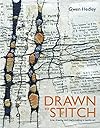
Drawn to Stitch: Line, Drawing and Mark-Making in Textile Art
Product ID: 190205075
Desertcart purchases this item on your behalf and handles shipping, customs, and support to Iceland.
A practical guide to using line and other forms of mark-making in textile art and embroidery. When used effectively, line—an essential component of textile art—can convey texture, tone, form, movement, and mood. Drawn to Stitch offers embroiderers a structured series of exercises designed to explore the technique’s potential and develop their own creativity. It covers line and mark-making tools, materials, and processes—including printing and mixed media—and then moves into stitch, explaining how to interpret different line qualities from crisp and sharp to soft and diffused, from raised and overlaid to recessed and inlaid. Full of inspiring ideas, Drawn to Stitch includes stunning illustrations of stitched-textile work by the author and other leading textile artists. Review: fresh innovative approach to interpreting line in textile art - This book is about is an exploration of one of the fundamentals of art and design: line. You'll learn how to observe and document the lines that you see around you in nature, architecture etc and then learn how to interpret those into embroidery and textile art. Broken into 4 major sections the book begins with an extensive overview of tools, materials and backgrounds. The types of drawing tools for making marks on whatever grounds you work with are followed by a discussion of how to alter your backgrounds by layering, collage, piecing, weaving and several coloring options. These backgrounds are the base for the second section of the book entitled Line Drawing and Textile Processes. This second chapter guides you in adding marks to your backgrounds using techniques such as mono-printing, printing blocks made from erasers, lifting and removing color using chalks, crayons discharge, and frisket and then moves into a discussion of several transfer techniques. Creating lines is not limited to just printing techniques though, the author also includes a section on creating needle felted lines and marks as well as making fibrous surfaces with silk tops and cocoon strippings. The first two chapters of this book are really the groundwork for the books main focus which is found in chapter three: Interpreting Line Quality - Drawing and Stitching. It's in this chapter where you'll find examples of actual design interpretations by the author as well as other artists. Each piece of the authors artwork is accompanied by a image of the original design reference and the approach she took with interpreting or drawing the line and then what stitch techniques were used. This section is an absolute feast for the eyes! Full page images of the artwork as well as clear crisp closeups allow you to see the intricate details of the pieces. Detailed explanation of how each piece was created give the reader a good understanding of the artists approach as well as a road map for the reader to consider when creating their own work. The book closes with a chapter on Using Line. Here is where you'll learn how to use stitch to interpret the textural quality of lines and marks on a surface. As in the third chapter an image is accompanied by the resulting artwork that it inspired along with a description of how the piece was created. The difference here is that the focus is on the types of stitching used; hand stitching or machine and the type of stitch used. This book is a must have for textile artists who are looking for a fresh innovative approach to interpreting line in their work. Review: An art workshop in a book - While `Drawn to Stitch' is written primarily for fibre artists, it is an excellent resource for artists working in other mediums as well. In fact this latest book from Gwen Hedley can be treated as a comprehensive workshop and worked through over a number of weeks. In doing this, you can be guaranteed to be far more skilled at observing, interpreting and transferring your creative ideas into your particular artwork than you were before. I am an abstract artist, working in mixed media, and have found `Drawn to Stitch' excellent for this purpose. I am now looking at resource material in a fresh way. As Gwen Hedley herself says, the first two chapters, based on materials and technique, are simply the lead in to Chapter 3 which she says is "the kernel of the book." Hedley demonstrates with specific examples how she goes from collecting ideas for pattern and texture to her finished fibre art. To give you an idea of how creative she is, here are some examples of her resources; A corroded metal window frame A banded pebble, Worm casts on a rock, Eroded stone in a garden wall, Scratched lines in a wooden shed, A carved column, coastal port, Cracked window glass A crumbling sea wall Office structures A wall repair Skeleton hydrangea petals Sprayed graffiti on a wall Scattered pine needles A sea urchin shell In a sense, you learn how to use the 'macroscopic lens' of your own eye to see your world in a new way. Additional artists include, Sheila Mortlock, Clyde Olliver, Bobby Britnell, James Hunting, Mathew Harris, Roanna Wells, Shelley Rhodes, Andrea Butler, Alex Mcerlain, and Alice Kettle. Most of these artists have their own websites, so you can go see the treats in store for you.
| Best Sellers Rank | #691,856 in Books ( See Top 100 in Books ) #648 in Embroidery (Books) #660 in Textile & Costume (Books) #1,079 in Mixed-Media Craft |
| Customer Reviews | 4.6 out of 5 stars 298 Reviews |
S**B
fresh innovative approach to interpreting line in textile art
This book is about is an exploration of one of the fundamentals of art and design: line. You'll learn how to observe and document the lines that you see around you in nature, architecture etc and then learn how to interpret those into embroidery and textile art. Broken into 4 major sections the book begins with an extensive overview of tools, materials and backgrounds. The types of drawing tools for making marks on whatever grounds you work with are followed by a discussion of how to alter your backgrounds by layering, collage, piecing, weaving and several coloring options. These backgrounds are the base for the second section of the book entitled Line Drawing and Textile Processes. This second chapter guides you in adding marks to your backgrounds using techniques such as mono-printing, printing blocks made from erasers, lifting and removing color using chalks, crayons discharge, and frisket and then moves into a discussion of several transfer techniques. Creating lines is not limited to just printing techniques though, the author also includes a section on creating needle felted lines and marks as well as making fibrous surfaces with silk tops and cocoon strippings. The first two chapters of this book are really the groundwork for the books main focus which is found in chapter three: Interpreting Line Quality - Drawing and Stitching. It's in this chapter where you'll find examples of actual design interpretations by the author as well as other artists. Each piece of the authors artwork is accompanied by a image of the original design reference and the approach she took with interpreting or drawing the line and then what stitch techniques were used. This section is an absolute feast for the eyes! Full page images of the artwork as well as clear crisp closeups allow you to see the intricate details of the pieces. Detailed explanation of how each piece was created give the reader a good understanding of the artists approach as well as a road map for the reader to consider when creating their own work. The book closes with a chapter on Using Line. Here is where you'll learn how to use stitch to interpret the textural quality of lines and marks on a surface. As in the third chapter an image is accompanied by the resulting artwork that it inspired along with a description of how the piece was created. The difference here is that the focus is on the types of stitching used; hand stitching or machine and the type of stitch used. This book is a must have for textile artists who are looking for a fresh innovative approach to interpreting line in their work.
S**T
An art workshop in a book
While `Drawn to Stitch' is written primarily for fibre artists, it is an excellent resource for artists working in other mediums as well. In fact this latest book from Gwen Hedley can be treated as a comprehensive workshop and worked through over a number of weeks. In doing this, you can be guaranteed to be far more skilled at observing, interpreting and transferring your creative ideas into your particular artwork than you were before. I am an abstract artist, working in mixed media, and have found `Drawn to Stitch' excellent for this purpose. I am now looking at resource material in a fresh way. As Gwen Hedley herself says, the first two chapters, based on materials and technique, are simply the lead in to Chapter 3 which she says is "the kernel of the book." Hedley demonstrates with specific examples how she goes from collecting ideas for pattern and texture to her finished fibre art. To give you an idea of how creative she is, here are some examples of her resources; A corroded metal window frame A banded pebble, Worm casts on a rock, Eroded stone in a garden wall, Scratched lines in a wooden shed, A carved column, coastal port, Cracked window glass A crumbling sea wall Office structures A wall repair Skeleton hydrangea petals Sprayed graffiti on a wall Scattered pine needles A sea urchin shell In a sense, you learn how to use the 'macroscopic lens' of your own eye to see your world in a new way. Additional artists include, Sheila Mortlock, Clyde Olliver, Bobby Britnell, James Hunting, Mathew Harris, Roanna Wells, Shelley Rhodes, Andrea Butler, Alex Mcerlain, and Alice Kettle. Most of these artists have their own websites, so you can go see the treats in store for you.
S**L
Images
I like it but images a bit fuzzy on some pages not as clear in details
K**Y
Inspiring and Challenging
This book, and Mark Making by Helen Parrott are among my favorite technique books. This book explores many ways to incorporate line and stitching into textile works. I enjoy reading it and looking at the examples, never failing to find something new to think about. The previous reviewers have provided the details about the contents. I won't therefore repeat their input. I like the descriptions of the different ways to use line and stitch, and the classification into types, e.g., recessed, crisp and hard, soft and ragged, implied, etc., with accompanying examples. The photos of objects, the drawings they inspired, and the translation into stitch are all excellent. This book will continue to inspire for a long time!
A**R
Wonderful!
I am a high school art teacher. In trying to keep a neutral stance when teaching art history or in using examples of artist's work, sometimes I struggle with a genuine appreciation in some work. Especially that of non-representational artists. Gwen Hedley's book Drawn to Stitch was a real eye opener for me in finding deeper meaning in some of the current day art. Her examples take one through the whole process from inspiration to completion of a piece. I have a new appreciation for the forms of art that only appear as color or just lines on a piece of canvas. This, in turn, has given me new approaches in my teaching techniques. On a practical side, her approach to line design has given me fresh ideas for teaching my line design and drawing units. She has opened up a whole new approach to the way I have taught these foundations of any basic or advanced art course. As an artist, I will certainly use her techniques in my own work. I am so glad that I stumbled onto this book through the Amazon.com website. The suggestion that was sent to me through the website was very beneficial to Amazon.com, my students, and me!! thanks!
A**R
Full of ideas
This book is truly excellent in the way it stimulates ideas. Although it concentrates on line, rather than fill, this is a very refreshing approach to textile embellishment. I can thoroughly recommend this book to other textile artists - especially those who work at creating individual designs rather than adapting those of others. I have watched my wife (who is the textile artist in this house - I work in glass) read and re-read this book. As she is currently studying how to use Gimp in her textile practice, ideas are many, but they are on hold to the end of her Gimp course.
C**N
A great ext with clear instructions for experimental work in textile ...
A great ext with clear instructions for experimental work in textile using a range of less than usual media. An inspiration for both the beginner and more advance textile or mixed media person
F**E
Great Book!
I am a professional artist. I work two dimensionally, both with paper and fiber arts. I found Ms. Hedley's approach to problem-solving and unusual combinations of media to be interesting and often inspiring. I would recommend this book to all fiber artists, as well as those committed to drawing and painting, who wish to "push the envelope".
M**L
Fascinating
This book contains some wonderful ideas for creating textiles from images recorded in a variety of media. The practical side is explained and described very well and there is a wide selection of projects, from relatively simple to more complex. The book is only a place to start and the possibilities are limited only by your imagination. An excellent book.
A**A
Must-have for anyone interested in textile art
Wish I had bought this book years aago. Well-written, good photos, bursting with inspiration and detailled explanations. Cannot praise this boook highly enough. Buy it now!!
C**G
Interessant, weckt Kreativität
Grandiose Ideen und Anregungen. Sehr interessant. Hat mich in meiner Kreativität gepuscht. Manche Beispiele finde ich etwas „unmodern“ aber man soll ja eigene Ideen umsetzen. Dafür ist es sehr gut.
G**I
Meraviglioso!!!
Super contenta dell'acquisto. È essatamente quello che cercavo. Ci sono vari capitoli in qui vengono spiegati diversi materiali, tecniche. Ho apprezzato in particolare i ricami che sono di tanti tipi e una spiegazione per fare carta con delle fibre naturali con il metodo che non usa la vascheta e che cercavo da tanto. In questo libro troverete tantissimi spunti. Bellisimi tutti gli esempi, armonici sua in composizione formale che cromatica, bel abbinamento di diverse texture. Un libro fantastico.
C**N
Très inspirant! J'adore!
Utilisez les fibres naturelles pour réaliser des créations en 3 d.
Trustpilot
3 weeks ago
3 weeks ago