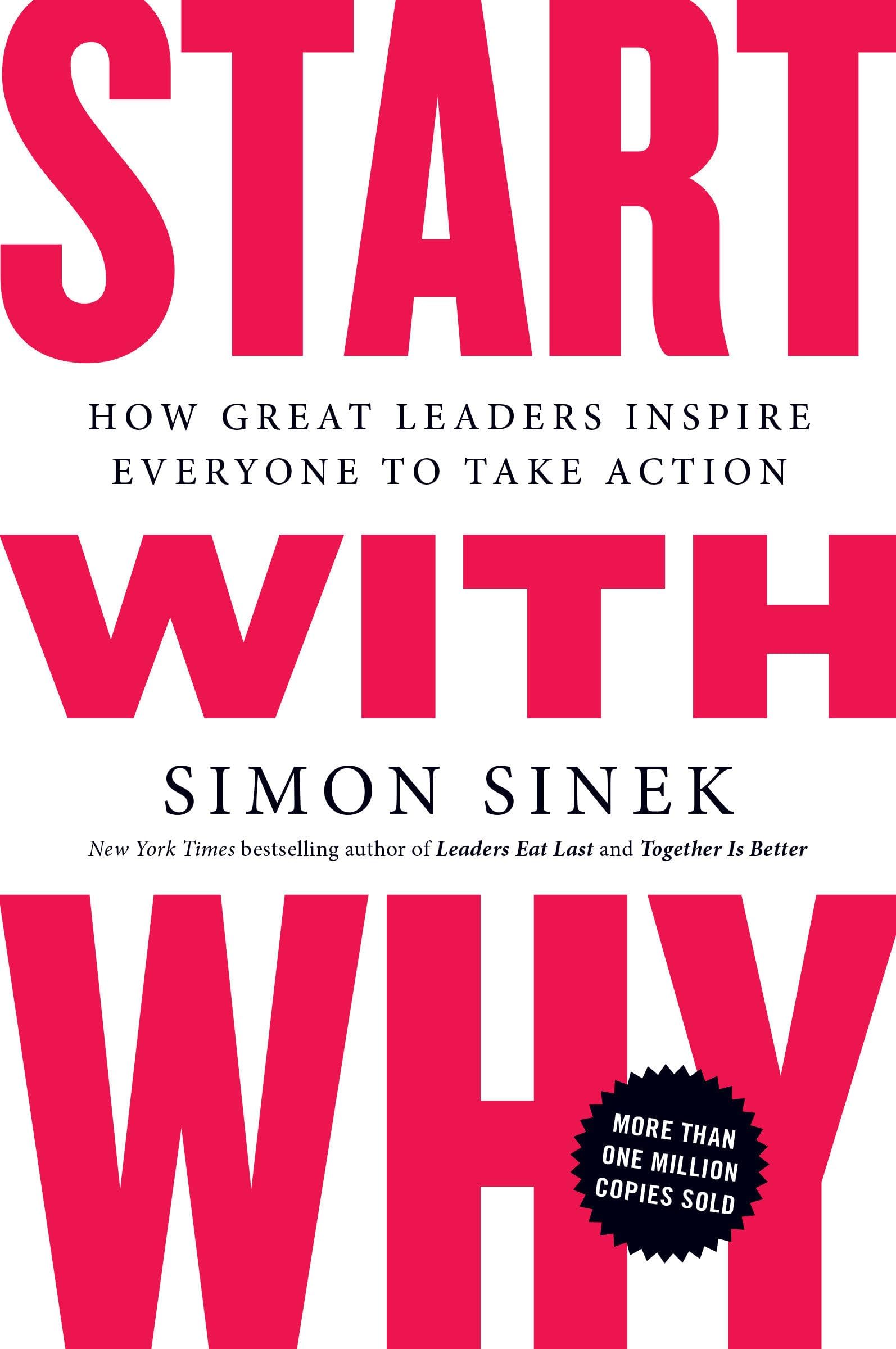
Start with Why: How Great Leaders Inspire Everyone to Take Action
Product ID: 1704862
📈Top #15 Entrepreneurship
🔥56M+ TED views
⏱️Immediate shipping
Desertcart purchases this item on your behalf and handles shipping, customs, and support to Iceland.
🚀 Lead with Purpose, Inspire with WHY — Don’t just follow the crowd, start the movement!
Start with Why is Simon Sinek’s groundbreaking bestseller that reveals the secret behind the success of iconic leaders and companies. With over 56 million views of its TED Talk and a top ranking in entrepreneurship and leadership categories, this book introduces the Golden Circle framework to help professionals and organizations find their core purpose. Ideal for managers and leaders eager to inspire innovation and loyalty, it’s a must-read that’s reshaping leadership thinking globally.


| Best Sellers Rank | #1,139 in Books ( See Top 100 in Books ) #6 in Computers & Technology Industry #15 in Entrepreneurship (Books) #39 in Leadership & Motivation |
| Customer Reviews | 4.6 out of 5 stars 27,545 Reviews |
J**G
A MASTER book of other books!!!
THIS IS THE GREATEST BOOK EVER PUBLISHED IN THE LAST 10 YEARS!!! If I could give this book 10 stars, I would! This book beats many other books. This book is so exciting to read that I read it three times! The beginning of the book said it extremely well -- This book is about an unique kind of leadership that has the natural recurring pattern of inspiring, influencing and affecting people. It is about a very small group of leaders that achieve disproportionate amount of influences in their industries/areas compare to other leaders. The most prominent example is, of course, Steve Jobs who displayed a recurring pattern of changing one industry after another. (Of all the books that study Steve Jobs, this is probably the best one although it is not a book on Jobs' biography. However, this book offers the best angle to understand his motivation and influence.) The core of this book is about the kind of WHYs that a special kind of leaders has that enable them to have the natural recurring pattern of inspiring, influencing and changing people and industries. The prime examples of this kind of leaders quoted in this book are Steve Jobs, Martin Luther King, Jr., and the Wright Brothers. This book is revolutionary. All the top business schools should reevaluate their curriculum based on this book! All the top business consultants should reconsider their theories and recommendations based on this book! All the writers on leadership should read this book and revise their theories! All political leaders in the world should read this book! All board of directors of corporations should read this book and learn how to select the next CEOs! ... This book can be considered the MASTER book to be read before reading books like "From Good to Great", "Stall Points", "The Innovator's Dilemma" and the follow-on books, "Crossing the Chasm" ... The central theme of this book is WHY -- the essence, the core, the purpose of a person's life, of leadership, and the starting point of a corporation. Without the clarity of this WHY, the life of a person, the leadership, and the products and services offered by a corporation are all fuzzy and treated as commodities. This is so very true. Look around us: Though we (persons, organizations and corporations) are special in some ways, yet we are almost all commodities -- except the very few that display the recurring pattern of major changes and influences such as Jobs, Apple and Google. These are the ones that have the clarity of WHY and the discipline of diligently and strictly enforcing their HOWs (principles, methods, criteria) in producing the WHATs (behaviors, products and services). There are three views of WHY + HOW + WHAT presented in this book: 1. Looking from the top -- the WHY in the center, the HOW in the middle and the WHAT in the outer layer form a GOLDEN CIRCLE. 2. Looking from the side -- the WHY at the top layer, the HOW in the middle layer and the WHAT in the bottom layer form a cone. 3. Viewing in three dimensions -- with the external world attached to the base of WHAT, the whole thing is a megaphone for the leader or corporation to sound out its WHY. These views are wonderful ways for us to look at leadership, to understand the life cycle of a corporation, and summarily see why companies thrived and why they died. These views can even be applied to our personal lives. Of course, this book has some blemishes. But these defects do not distract from its greatness. 1. The grammar is terrible. The whole book should be reviewed by a competent editor. 2. The WHYs are not strictly examined and evaluated. This book treats all WHYs from leaders, entrepreneurs and corporations as equal when in fact they are not. Probably most of the WHYs are the rewording of WHATs in disguise. Maybe a lot of WHYs are re-branded HOWs. Perhaps only a small number of WHYs can have the recurring pattern of inspiration and influence. I hope the future editions of this book can elucidate this point. 3. The HOWs gets much less treatment than the WHYs and WHATs in the book. It would be great if this topic is covered in more detail. 4. Maybe 60% of this book is about corporations and not on leadership as claimed in the beginning of the book. I hope the author can focus more on the recurring pattern of inspiration and influence of leadership. 5. Not everything stated in this book is correct. The points discussed in this book about Jobs and Apple are good examples. Please read "Inside Apple" and Jobs biographies for more correct views on Jobs and Apple. At the first reading, the book seems repetitious. The WHY, HOW and WHAT get repeated over and over. However, on the 2nd and 3rd reading, this apparent repetition disappears and you can see the different points that the author was trying to emphasize. I would like to recommend some future topics or books for Simon Sinek: a) Qualify and rank levels of WHYs -- not all WHYs are equal. Probably some are top-notch while most are mediocre. Also, tell us how to construct best kinds of WHYs. b) Compare the WHYs to big tech companies, the WHYs of big Wall Street firms (if they have any???) and the WHYs of big retail companies. c) Compare the WHYs of big empires in history d) Compare the WHYs of nations in WWI and WWII e) Compare the WHYs of great leaders in history f) Compare the WHYs of great geniuses g) Consider how WHYs can be incorporated into Teachers' College (Ed College). It is the teachers who educate our future generations. They need to be thoroughly immersed in the understanding of The Golden Circle, The Cone and The Megaphone. h) Consider how WHYs can be incorporated into the K-12 and the college education g) Consider how WHYs can be incorporated into and how HOWs can be enforced in our political systems. We have far too many politicians and not enough true leaders i) Consider how WHYs can be incorporated into our law schools. Our lawyers really need a strong dose of treatment. In summary, this book is dynamic. It's a dynamite! It's the best book I have read in the last 10 years!
M**K
An excellent, inspirational book
Start with Why is an excellent, inspirational book. The core concept is, as the title states, that you should start with WHY, as organizations and leaders. Have a clear purpose and have everything you do and say be in support of that purpose. From your WHY, therefore, flows your HOW and WHAT. For organizations, WHAT is the products or services you provide and HOW is your culture and approach to providing them. For leaders, WHAT is the work you do and HOW is your approach to doing that work. It is a concept that is simple in principle and yet can be very difficult in practice. All too often, organizations and individuals focus first on WHAT, sometimes have some clarity around HOW, and really do not have a clear WHY. They first and foremost try to compete on aspects of WHAT like product and price, but provide no greater reason for doing business with them. One example of a company that does this well that Sinek provides is Apple. He articulates their WHY as being along the lines of "Everything we do, we believe in challenging the status quo. We believe in thinking differently." Sinek shows how this has been the core sense of purpose with Apple, first with computers, then with music, now with phones. I very much agree with the philosophy that Sinek presents and believe he does an exceptional job discussing an idea that many companies struggle with. To tackle these challenges, companies need inspiring leaders. Leaders that have a clear sense of purpose. Leaders that work for something beyond the task at hand and beyond a paycheck. "Great leaders . . . lead with WHY. They embody a sense of purpose that inspires those around them." Sinek builds on these thoughts. Not everyone is an inspirational leader. In fact, Sinek says that most people are HOW-types. But Sinek explains the critical importance of the HOW-types. The WHY-types have the vision, the sense of purpose, but they need the HOW-types. They need to work and inspire those who have the talent and passion to figure out the details and make things happen. Both types are important. As a leader that is a WHY-type, it is important to inspire the HOW-types around you. As a HOW-type, it is important to find a WHY-type whose sense of purpose you agree with, and then work with them to help make that sense of purpose a reality. "The role of a leader is not to come up with all the great ideas. The role of a leader is to create an environment in which great ideas can happen." As organizations and individuals, when you know your WHY, you have a clear sense of purpose. You work hard every day to do better than you did before, not with the goal of beating your competition, but rather with the goal of being the best you can at achieving your WHY. You have a sense of purpose that is beyond financial results. An excellent read that I highly recommend.
M**R
If you wish to lead and inspire people, build a great company and/or spread a worthwhile idea, then you must read this book.
Brilliant Book. I recently read a book that had a simple message that basically could be told in half a page worth of words – and as it happens it actually was. But then the author kept on going and going and going and filled up a book in excess of 200 pages just on the very same idea seen from different angles and with different examples. In truth I found that book was boring indeed and found I’m, not a subscriber of a book that basically has just one idea. Now, Simon Sinek’s book “ Start With Why” is actually also about just one idea and like the other book that one idea is really told in less than half a page worth of words and yet this book too extends beyond 200 pages. But this book I loved. It’s a brilliant book indeed. Yes, possibly a little too labored and long at times, but with speed-reading, you are soon past those passages and back into the great stuff again. The difference is that the book uses so many great explorations of the importance and the applications of his idea. It brings anecdotes and references to stories of successful companies from their usage their “why” and how they turned not so successful when they swayed away from their “why”. The idea is greatly exemplified in the book by references to Apple and Steve Jobs, to Richard Branson and Virgin, to Helb Kelleher and SoutWest Airlines, to Bill Gates and Microsoft, Walt Disney and Disney, Martin Luther King and “I have a dream”, Howard Schultz and Starbucks, Michael Dell and Dell Computer and several more. You probably already know the stories of what happened to the companies when Steve Jobs left Apple (was ousted), when Howard Schultz left Starbucks and Michael Dell left Dell Computer – and then you probably know how these companies started to perform again once they came back. It contains great lessons for the rest of us who hold aspirations of leadership and entrepreneurial success and who are trying to build businesses. In other words this book is a great book along the lines of the best books on Mission and Visions. In addition, however, it also spells of the how and shows the importance of the people behind the visionary leader who have been instrumental in making the how work out for the companies – like Steve Wozniak of Apple and Steve Ballmer of Microsoft just to name two of them. Then there’s the “what” – which honestly I didn’t focus on too much when reading the book – or was it because the book didn’t focus much on it either? Either way, the why is the important and the interesting part (great to have a good “how” along the way too – as even I have experienced in at least one of my previous companies). There’s much more I could say about this book, but then I would rather just say: “Just go get it and read it for yourself”. Too much valuable stuff in there for you not to read it. Especially if you wish to lead people and/or if you wish to build a grand company, cause or spread a worthwhile idea. In closing, however, I must say, I also love the brutally honest way Simon Sinek shares his thoughts. He even calls Bill Gates a social misfit (but have no doubt, retains utmost respect for him and his brilliance). Mikkel Pitzner, Serial Entrepreneur, multiple best-selling author and author of forthcoming book: “The Automated Millionaire”.
T**T
Inspiring Read With Room for More Diversity
Great book. I’m giving this 4 stars because while the message is powerful, I wish there had been more diversity in the stories shared. That said, I really appreciated the perspective and the way the author encourages readers to think deeper about purpose, motivation, and intention. The concepts are practical, thought-provoking, and easy to apply to everyday life. Overall, a worthwhile read that offers valuable insight and inspiration.
J**Y
MIND EXPLOSION: LEADERSHIP BIBLE FOR THE REAL [⭐⭐⭐⭐⭐]
Jay Fray dropping wisdom about a book that actually deserves the hype—unlike most leadership trash cluttering your shelves. Simon Sinek's "Start with Why" isn't just another business book; it's the rare read that fundamentally rewires how you think. This isn't fluffy corporate speak or recycled motivation—it's a straight shot of clarity to the brain about what actually drives human decision-making and loyalty. The Golden Circle concept (Why-How-What) seems deceptively simple until you realize almost every organization and leader gets it completely backward. Sinek backs his framework with both compelling case studies and biological realities about how our lizard brains actually make decisions. What sets this apart is how instantly applicable these principles are. Whether you're running a corporation, leading a team, or just trying to get your roommate to do the dishes, understanding the power of starting with "why" creates immediate shifts in effectiveness. The writing style doesn't waste your time with unnecessary padding—it delivers concepts with precision and enough real-world examples to cement understanding without drowning in details. No wonder Sinek's TED Talk blew up. Jay Fray verdict: One of the few business books worth re-reading annually. Skip the airport leadership garbage and invest your time here instead. This isn't just theory—it's a practical framework that actually works in the real world.
A**7
Each chapter has a valuable 'WHY'
I loved this book, very inspiring! It delves deep into various facets of ‘great leadership’ and offers a wealth of actionable insights. All centered around one core theme, “start with WHY”. In fact, I loved it so much that I ordered three copies of this book to gift to my close friends. Addressing some of the comments from the other reviewers, I mainly see two concerns: 1. All the concepts are presented in the TED talk already, so we can skip reading this book. 2. There is a lot of repetition in the book - repetition of the same examples/concepts over and over again. I have seen Mr. Sinek’s famous TED talk before as well as after reading this book and here is how I compare them. The TED talk is an excellent trailer for the material offered in this book. Mr. Sinek (in this book) presents the “WHY concept” as a framework and then shows how this framework can be applied to different phases/aspects of leadership. “Decision making”, “Trust”, “Authenticity”, are a few leadership aspects that he expands on. Since the same framework is applied to many different aspects and scenarios, we do find that some text and examples are repeated. However, if we patiently continue, we’d find that there is a new, different point being made in every chapter. Overall, regarding the above two concerns - I disagree with the first, while I do have to partially agree with the second. The book teaches a lot about leadership. Here is what you’d learn in each chapter. In other words, here is my ‘why list’ for this book: 1. Why ‘decision making’ can’t always be data-driven? 2. Why leaders who choose to inspire (as opposed to those who manipulate) command ‘loyalty’? 3. WHY is the center of the ‘golden circle’. Introduction to the golden circle. 4. Why does the human brain/thinking align with the golden circle? The biology of it. 5. Why and how good leaders achieve ‘authenticity’? 6. Why and how good leaders manage to earn the trust of their followers/team? 1. Why good leaders hire for culture-fit rather than for mere skill? 7. Why do greater leaders have this charisma, due to their ability to communicate ‘their why’ clearly? 1. Why focusing on early adopters is important? Law of diffusion of innovations. 8. Why and how good leaders build partnerships with (how-to) people who can execute the vision to reality? 9. Why good leaders should do ‘what they do’ (your actions/results) to reflect their ‘WHY’ (vision)? 10. Why leaders use their ‘WHY’ (vision) to filter their decision making? 11. Why and how good leaders are successful (and feel successful) every day? 12. Why good leaders/companies impart their ‘sense of why’ into their culture? 13. WHY of an individual depends upon his past and upbringing. Mr. Sinek’s WHY. 14. WHY can keep you going on a long journey in-spite of failures.
B**T
Great book to make you a better leader
Start with Why: How Great Leaders Inspire Everyone to Take Action is one of those books that sticks with you long after you finish it. Simon Sinek does a great job breaking down what separates average leaders from the ones people actually want to follow. The whole concept of starting with “why” sounds simple, but it really changes how you think about leadership, decision making, and even communication. What I liked most is that it’s not just theory. Its’s practical and easy to apply whether you’re running a business, leading a crew, or just trying to improve yourself. It makes you take a hard look at your purpose and how you present it to others, which is something a lot of people overlook. This is a great read for leaders at any level, but honestly, it’s just as valuable for anyone wanting to become a more effective and intentional leader.
A**M
Nice idea, Good Aphorisms, Flawed Details
At a high level, I found Sinek's book very engaging and probably the most underlined book I'd read in a long time. It just seemed to "make sense". The ideas of having inspiring leaders leading great companies to do great things is a pretty well known idea - what Sinek attempts to do is explain the hows of how they did it, and how others do it on a routine basis. The idea is that people by "WHY you do something, not WHAT you do." However, the further and further I got into it, the more I found myself reevaluating what he was saying (since he repeats his key points a lot - not a bad thing, but we get it already), and thinking - that's nice, where's the data? Unfortunately, much of what is offered is anecdotal. After a few rounds of this, I began to put this book in the Malcom Gladwell-esque category - nice ideas, probably correct at very high levels, woefully ignorant of market forces, key indicators, detailed data, and a more in depth analysis of the "actuals" for why things happen: A few examples: (speaking of the civil rights march): "But how many people showed up for Dr. King. Zero" (implying everyone showed up for themselves, b/c it's what they believed) - Really, where are your stats on that...cause I got tons that say otherwise. "Loyalty to a company trumps pay and benefits" - Hmmm...Reid Hoffman in 'The Alliance' seems to disagree. (speaking of the failures of cheap-air competitors to Southwest, Ted and Song): "The problem was not WHAT they did, the problem was, no one knew WHY Song or TED existed" - Really, NO ONE knew why they existed? Was that the key indicator of why they failed? I doubt it. The devil, as they say, is always in the details. Insomuch as this book throws out 1-liners like it's going out of style it's very clear and good at what it does - I have a ton to go on from this book. However, I think the overall premise is just flawed, and goes headway against what real data says. Yes, there will always be outliers that inspire people to their products for various reasons. However, aside from a few key one's (Apple, for ex) mentioned in his book, I would suggest someone take a look at the majority of the top Fortune 50 and ask yourself to describe in 1 sentence if you know the "why" of what they do...bonus points if you can guess their marketing slogan (Apple: Think different). Can't? I thought so. Because "why", while important, is not everything Sinek cracks it up to be. I can think of countless charismatic dreamers who created startups with clear ideas of "why" and who got smashed by the market place, withered, and are now mostly forgotten. Oversimplifying "Why" to the point of exultation is a risk I'm not willing to take. A good read, and one I'll recommend to friends, but w/ the */* that it sees the forests and not the trees and, for better or worse, things get more interesting on the ground floor, which this book seems to miss.
D**D
Repetitive
One idea well known a long time ago repeated in more than 200 pages, the worst book I’ve ever read
J**N
Interesting to read
The language used in the book makes easy for anyone to read without a break.
W**N
Great book and content
Fast delivery, as usual :) the only issue I have is there is a slight dent on the cover, apart from that all is good.
S**D
Your why is everything
Great book
M**A
It helps professionals align decisions with long-term purpose
Start With Why is an insightful and compelling book that challenges conventional thinking about leadership, purpose, and success. Simon Sinek presents a clear and powerful framework that explains why some individuals and organizations consistently inspire loyalty, innovation, and long-term impact while others struggle to do so. Through well-structured arguments and real-world examples, Sinek emphasizes the importance of understanding and communicating purpose—the “why”—before focusing on strategy or execution. His ideas are articulated with clarity and supported by practical insights that are highly relevant for leaders, managers, and professionals across industries. Overall, Start With Why is a thoughtful and inspiring read that offers lasting value. It is highly recommended for anyone seeking to lead with greater clarity, authenticity, and impact.
Trustpilot
1 week ago
1 month ago