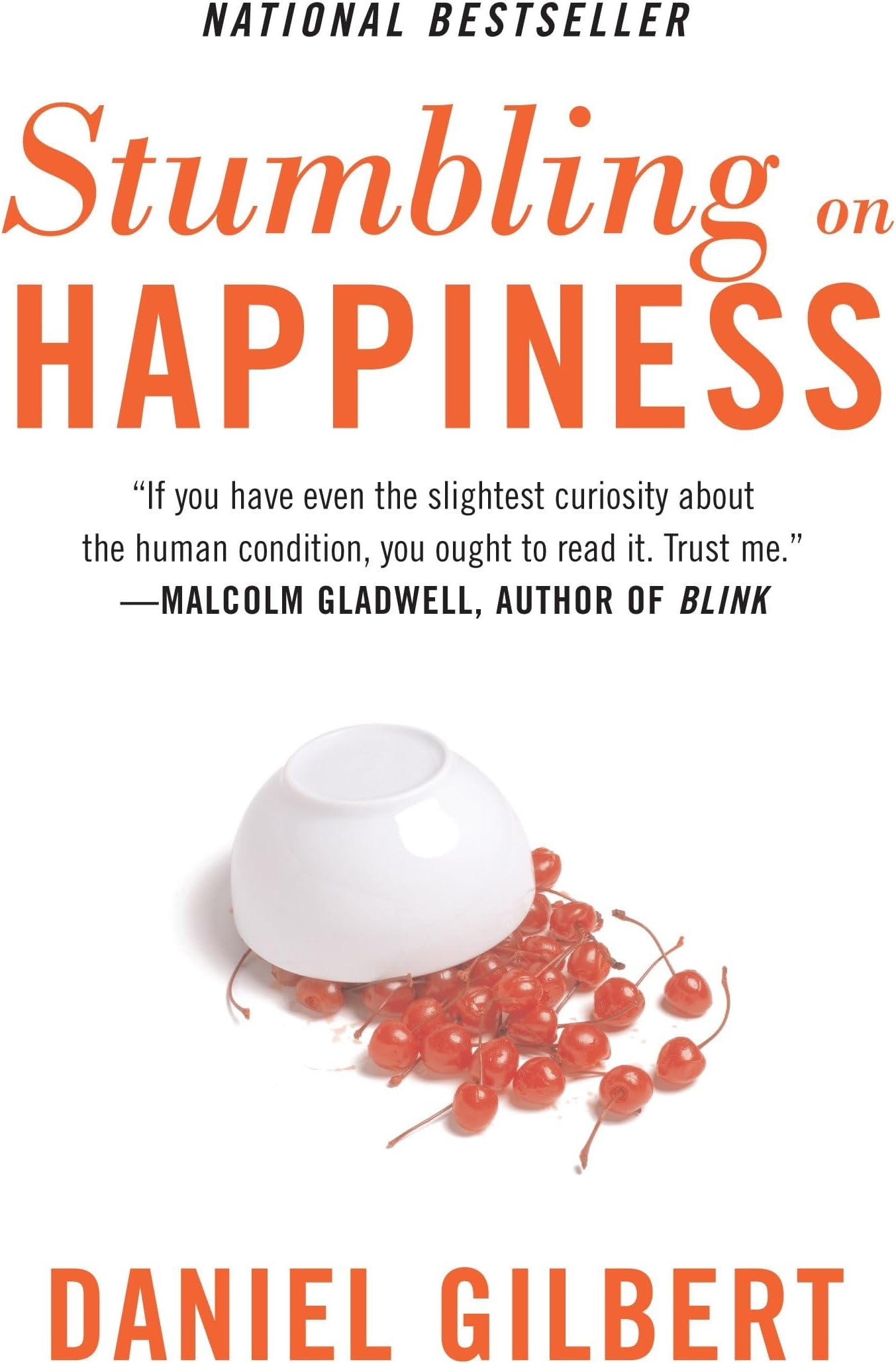
Stumbling on Happiness (Vintage)
Desertcart purchases this item on your behalf and handles shipping, customs, and support to Iceland.
Description
NATIONAL BESTSELLER • Bringing to life scientific research in psychology, cognitive neuroscience, philosophy, and behavioral economics, this witty, accessible book reveals what scientists have discovered about the uniquely human ability to imagine the future, and about our capacity to predict how much we will like it when we get there. • Why are lovers quicker to forgive their partners for infidelity than for leaving dirty dishes in the sink? • Why will sighted people pay more to avoid going blind than blind people will pay to regain their sight? • Why do dining companions insist on ordering different meals instead of getting what they really want? • Why do pigeons seem to have such excellent aim; why can’t we remember one song while listening to another; and why does the line at the grocery store always slow down the moment we join it? In this brilliant book, renowned Harvard psychologist Daniel Gilbert describes the foibles of imagination and illusions of foresight that cause each of us to misconceive our tomorrows and misestimate our satisfactions. With penetrating insight and sparkling prose, Gilbert explains why we seem to know so little about the hearts and minds of the people we are about to become.


Specifications
| Asin | 1400077427 |
| Dimensions | 5.15 x 0.74 x 7.98 inches |
| Isbn 10 | 9781400077427 |
| Isbn 13 | 978-1400077427 |
| Item Weight | 8.5 ounces |
| Language | English |
| Print Length | 336 pages |
| Publication Date | March 20, 2007 |
| Publisher | Vintage |
Reviews
User
Entertaining, Educational and LOL Funny
If you want to stumble on happiness start doing good deeds and random acts of kindness. Writing in a gratitude journal also seems to work as does changing your thoughts from negative to positive. While this book may teach you some important things (think about the positives and negatives of any future situation) it is more of an intellectual romp through psychology land.Daniel Gilbert is the type of person you'd want to be friends with. He'd provide entertaining conversation, take you to gourmet restaurants and explain why your life is such a surprising journey. Along the way he'd make you laugh a lot. He sure did in this book. I lost track of how many times I laughed. Maybe I just got his humor and his writing had high creative appeal. I also learned a few new words like panglossian.What did occur to me while reading was that I think I remember my past experiences far better than the people discussed in this book. I definitely know what would make me happy based on past experiences. I also know what won't make me happy in the future. This book did answer some of my questions however, like why I love to wait for packages from amazon. I will often choose the free shipping just so things get to me slower. This habit of forestalling pleasure brings me a lot of anticipatory joy.One thing I didn't agree with was the comments about the movie Casablanca. A person usually doesn't regret doing the right thing. In fact doing the right thing can bring a wealth of happiness. I'm also not sure the author has ever experienced a form of spiritual enlightenment as it is like night and day and you know you've never been that happy before. Some of his comments indicated he may be more concerned with science than religion although religion brings a lot of happiness to people. God was not mentioned except in passing so there was no data on people who have fallen in love with God. I also am completely convinced that some people want to be miserable. They make a choice to continue in their negative ruminations.Daniel Gilbert is however a keen observer of the world and he knows a lot about human nature. So from that angle this book is very intriguing. It is a joy to experience his deep thinking and conclusions. I also felt he was very logical and has a good handle on philosophy. He does however believe in evolution if that is of interest to you. Not a lot of time is spent on that subject besides describing aspects of the brain.I do personally think it is fun to think positively about the future but I will now use more caution when my imagination runs wild. Will I ever have pool or travel to Paris again? These are things I hope for and it is fun to think about what I will do tomorrow and which book I will read. So hope is definitely a factor in predicting happiness.So get ready to have an author uncover some dark secrets about society. Be prepared to laugh out loud. This is a very enjoyable reading experience that I can recommend to almost anyone. Just have some éclairs or chocolate cake handy. You will get hungry for foods he mentions. :)~The Rebecca Review
User
Enjoyable read, a bit scant in application
This book is a very enjoyable read, written in a funny, witty, conversational style. Gilbert uses examples from everyday life that illustrate how flawed people's perceptions and memory can be.The example he uses in order to show how people tend to dwell on the ending, rather than the overall experience is his enjoyment of the movie, "Schindler's List." He recalled that he hated the movie, while his wife recalled that he liked it. Of course he was offended that someone would tell him what he liked or disliked, which presumable only he would know best. So they watched the movie over again. The result? They were both right. Gilbert thoroughly enjoyed the movie, until the end. He found the way it ended distasteful, and that was what he remembered. His wife remembered that he enjoyed the majority of the movie.The book is filled with examples from real life and from various research studies that show how people's perceptions can often be illogical. For example, people tended to prefer a longer immersion in unpleasantly cold water, that ends with a slightly less unpleasantly cold water, over a shorter immersion in the same unpleasantly cold water that does not include the slightly warmer finish. The preference for the prolonged suffering shows the human tendency to concentrate on the ending, rather than the overall experience.He also goes on to show how human ability to perdict how they are going to feel about future events often are inaccurate. People make poor decision about their lives because their inability to imagine the future accurately. It was found that people were much more accurate in their predictions about how they would like or dislike future event when they interviewed people who were presently going through the event that they were contemplating for the future.Just like Gilbert's conclusions about "Schindler's List," I felt where this book fell a bit short was in the ending, in telling the reader how to implement all these finding to make their lives happier and better. He seems to have only one take away in term of application of the principles: rather than imagining the future, ask someone who is experiencing the very thing you are thinking of doing. Thinking of a career change? Ask someone who is going through a career change. While this advice is helpful, I felt there could have been more in the way of "how to." The "how to" section was very short, and only mentioned this interview method. I would like to have seen more in terms of how you should alter your perception of things, so that it is more conducive to happiness.
User
Superbly Insightful (Well Beyond My Expectations)
Based on this book's title and a cursory glance at some reviews, I figured that this is probably just another book on happiness, but I decided to read it anyway since the ratings are generally pretty good, credible people have endorsed it, and the topic is important. I'm pleased to report that the book far exceeded my expectations and represents an important and original contribution to this genre. Despite having read quite a few books over the years, including several good ones on happiness, I learned a lot of new and useful things from this book.In fact, this book is so packed with insights that I'll need to carefully go through it again (which I look forward to). Some readers may feel that the book goes into too many topics which are tangential to the main argument, but I personally very much appreciated the way Gilbert builds his case systematically and thoroughly, providing us with a wide array of intellectual fringe benefits in the process. Indeed, while the focus of the book is on happiness, the scope of the book is actually much broader than just happiness.The content of the book is mostly drawn from experimental psychology (the good kind), and Gilbert describes many experiments in just the right amount of detail. I sometimes felt that he neglected plausible alternative interpretations of the experimental results, but I see this as a relatively minor issue. The earlier parts of the book also mixed in some Western philosophy, which I thought was a nice touch. And the many quotes from Shakespeare were also apropo since, after all, Shakespeare just about single-handedly encapsulated the full spectrum of human experience and behavior into his body of work!Given the book's rich content, it's hard to summarize this book, but I would say that the (greatly oversimplified) main idea is that both our memory and imagination are inherently faulty, which often causes us to choose suboptimally when it comes to decisions which affect our future happiness. We can partly get around that problem by querying people who are currently having the experience we're considering having, but that approach doesn't always work, plus we're inherently resistant to taking that approach anyway. However, again, this is just an oversimplification, and you really need to read this book in its entirety.Regarding Gilbert's writing style, I think he's quite clear and easy to follow, and he also employs humor throughout the book. To be honest, I initially found his humor superfluous and a bit annoying, but I gradually came to appreciate it, since it lightens the book's atmosphere and thereby helps to sustain the reader's stamina.Overall, this is a superb book and I highly recommend it if you want to be happier, or even if you're just interested in what makes people tick. Five stars don't even begin to do justice to this book.
User
More about imagination, less about happiness
I probably stumbled on this book, expecting will give me some key to happiness. Instead, got a dose of behavioral economics. So, I guess, will need to continue my own search of happiness.Lest I trifle the work of Gilbert, let me quickly add that in this book, he does touch upon many factors that could decide your happiness. And to his credit, he has brought in substantial humour , may be at time morbid, into his writing. Else, the subject would have been too heavy to be read by commoners. His research has involved various people, some of whom should always be “unhappy” when seen from a “normal” perspective ~ for instance conjoined twins or people afflicted with terminal diseases. His researches did bring out some amazing facts about how they are also “happy”. His 8 point scale approach is quite interestingA large part of the book is on the premise that “Human being is the only animal that thinks about the future”. A very brilliant premise indeed. Our brains are constantly “nexting”. And as it does that, it always build an either-or situation. The “or” is generally unpleasant, but as it turns in Gilbert’s research, anticipating unpleasant events minimizes the impact of that. Thus, fear, worry, anxiety have useful roles in our lives.Thus, this book delves largely into the realm of imagination and how the brain actually fills in a lot of blind spot area. It is quite intriguing how we sometimes unthinkingly treat imagination as accurate representation of facts. The missing pieces are much more important than we realize. Hence, in life and business, it is so important have a third party opinions. The other view I could instantly relate to was on the out of box thinking, which has become very popular in the corporate world today. Gilbert is quite bang on when he says that we can never see how big the “box” really is. “Imagination cannot easily transcend the boundaries of present”. All predictions are thus inevitably influenced by the present. So true!! Another shortcoming of imagination is the failure to recognize things will look different once they happen – in particular, the bad things will look a whole better. The Necker Cube was a new one for me.This books also talks about how variety actually makes people less happy, about anchoring effect, comparison effect, endowment effect etc. I happened to read the works of Daniel Kahneman and Dan Ariely , hence passed over it. But for those who haven’t , it would be quite interesting.The selection and rejection criteria was also interesting. It turns out that when we select, we consider the positives and when we reject , we consider the negatives.So, did I get some ways to stumble on happiness? May be controlling pre-feelings help, because as the studies in this book suggests one remembers feeling as was expected to feel and not as was actually felt. Or may be avoiding too much regret on inaction helps. I am still on the journey and this book did give some clues…
User
Think Happiness!
As the author best words it: "Despite the third word in the title, this is not an instruction manual that will tell you anything useful about how to be happy...Instead, this is a book that describes what science has to tell us about how and how well the human brain can imagine its own future, and about how and how well it can predict which of those futures it will most enjoy...Weaving together facts and theories from psychology, cognitive neuroscience, philosophy, and behavioral economics, this book allows an account to emerge that I personally find convincing but whose merits you will have to judge for yourself."Daniel ends the book on the following note: "There is no simple formula for finding happiness. But if our great big brains do not allow us to go surefootedly into our futures, they at least allow us to understand what makes us stumble."A very highly recommended read for anyone trying to better understand how we remember our past, see our present and imagine our future. A truly creative masterpiece.Below are excerpts from the book that I found particularly insightful:1- "We insist on steering our boats because we think we have a pretty good idea of where we should go, but the truth is that much of our steering is in vain - not because the boat won't respond, and not because we can't find our destination, but because the future is fundamentally different than it appears through the prospectiscope."2- "Happiness refers to feelings, virtue refers to actions, and those actions can cause those feelings. But not necessarily and not exclusively."3- "Our experiences instantly become part, present, and future, and like any lens, they shape and distort what we see. This lens is not like a pair of spectacles that we can set on the nightstand when we find it convenient to do so but like a pair of contacts that are forever affixed to our eyeballs with superglue."4- "...the act of remembering involves "filling in" details that were not actually stored; and second, we generally cannot tell when we are doing this because filling in happens quickly and unconsciously."5- "When they (people) are asked to judge the dissimilarities...they tend to look for the presence of dissimilarities and ignore the absence of dissimilarities."6- "The problem isn't that our brains fill in and leave out...No, the problem is that they do this so well that we aren't aware it is happening. As such, we tend to accept the brain's products uncritically and expect the future to unfold with the details - and with only the details - that the brain has imagined."7- "...most of us have a tough time imagining a tomorrow that is terribly different from today, and we find it particularly difficult to imagine that we will ever think, want, or feel differently than we do now."8- "We cannot feel good about an imaginary future when we are busy feeling bad about an actual present. But rather than recognizing that this is the inevitable result of the Reality First policy, we mistakenly assume that the future event is the cause of the unhappiness we feel when we think about it."9- "...if we want to predict how something will make us feel in the future, we must consider the kind of comparison we happen to be making in the present."10- "A healthy psychological immune system strikes a balance that allows us to feel good enough to cope with our situation but bad enough to do something about it."11- "Because we tend to remember the best of times and the worst of times instead of the most likely times, the wealth of experience that yound people admire does not always pay clear dividends."12- "This tendency to think of ourselves as better than others is not necessarily a manifestation of our unfettered narcissism but may instead be an instance of a more general tendency to think of ourselves as different from others - often for better but sometimes for worse."
User
Interesting with flaws
Like many, many books, this one is better at describing the problem than it is in proposing solutions. Gilbert contends that our powers of predicting what will make us happy in the future are seriously flawed, and then proposes a simple solution which he correctly predicts that no one will use.His description of the reasons that our predictive powers are flawed is both fascinating and convincing. However, even in this part (which is the bulk of the book), he makes an unspoken (and apparently unrecognized) assumption: That is, he assumes that "real" happiness or unhappiness is defined by the emotional state that a person feels immediately after, or concurrently with, the event in question.To use an example: a couple of other reviewers have already mentioned Gilbert's story of a victory in an important college football game. Students predict in advance that they will be ecstatic if their team wins, and a different study suggests that a few months after the fact they will contend that they WERE ecstatic. However, close monitoring of their feelings at the actual time of the victory, or shortly thereafter, suggests that they weren't as happy as they expected to be, or as they later recalled being. On a less trivial topic, he makes the same claim regarding the experience of having and raising children: It isn't as much fun as the parents expect it to be. And while the child-rearing was going on, it wasn't as happy an experience as they later remembered it to be. But Gilbert is ignoring a vital point here: The anticipation of happiness, and the recollection of happiness, ARE happiness! Gilbert writes the entire book with the unexamined assumption that happy anticipations and happy memories can be discarded as mere illusions - the fabrications of irrational minds. I think he's wrong.At the end, Gilbert provides a prescription for making decisions: ask the advice of someone who has chosen each of your alternatives, and see how (s)he likes the results. The suggestion is obviously far too facile, but it does give Gilbert the opportunity to discuss the interesting fact that each of us tends to exaggerate his or her own uniqueness. He's almost certainly right about that, but it isn't enough to rescue his advice. Regardless of what the "average" person thinks, I am certain that watching "American Idol" would be an excruciatingly boring experience for me, and that I would much prefer living in Eugene, Oregon, to living in Las Vegas where I live now (and where tens of thousands of people are flooding in every year, all of them optimistic that they will be happier here than wherever they live now). I don't need to talk to another person to be confident that I would prefer a Whopper to anything served in a Thai restaurant, and that I would rather take a course in classical guitar than art history.So read this with a skeptical mind. But read it. There's lots of good stuff in it.
User
Stumbling on Brilliance
I am an academic psychologist who is interested in social behaviour and emotion. So, of course, a book about how people predict their emotional responses to future events and how this interacts with their social behaviour was always going to appeal to me. But, I don't buy every book that might appeal to me, so how did I know I'd like this one? How did I know this book would make me happy?Well, to be perfectly honest, the main reason I bought this book was this: Dan Gilbert is a fantastic writer. I knew this from having read many of his scholarly journal articles. In fact, I was so sure that this book would be brilliantly written that I preordered it. And, I was right, it is. However, predicting our likes and the things that will make us happy is not something we're always good at, and that's whole the point of this book.Just to belabor the brilliance of Dan Gilbert's writing for a second, this quote comes from the Acknowledgements section: "This is the part of the book where the author claims that nobody writes a book by himself and then names all the people who presumably wrote the book for him...Alas, all the people who wrote this book are me, so let me thank those who by their gifts enable me to write the book without them.". That's the kind of witty wordsmithery that you'll find from cover to cover of Stumbling on Happiness.Very little of the content of this book surprised me, but then again I've spent the best part of the last 13 years studying psychology. What I would expect is that this book will surprise most people, probably because most people make the same mistake economists do; they presume that they, and others, are rational. Stumbling on Happiness successfully highlights many of the limits of human rationality.In reading this book you will gain a well synthesized and up-to-date look at some of the most interesting research happening in psychology today. And, although every reviewer is at pains to point out this that is not a self-help book, you may just gain some insight into yourself.For people who enjoyed the insights this book provided about human behaviour, thinking, and emotions I'd recommend the following three books to compliment it: "Intuition" by David Myers, "Strangers to Ourselves" by Tim Wilson, and "The Illusion of Conscious Will" by Daniel Wegner. In addition, lots more examples of Dan Gilbert's fantastic writing (mostly journal articles and book chapters) can be downloaded from his website at Harvard.Finally, I've recently listened to the Audiobook (read by Gilbert) and it is also excellent.
User
the best book of 2006. a thought-provoking and entertaining read
It is my great pleasure that I listened to this book. Yes, I loved it. Loved it. One of the best books I have EVER read. Read it now (or listen to it ... the author is the reader and he has a great voice).I have been evangelizing this book ever since I was 1/3 of the way through ... and have convinced a lot of people to make the leap ... and the read.Happiness is not what is seems. It is about predicting your future self and understanding your past ... things we, as humans, do not do very well. Even kids do not make us as happy as we think.We tend to justify things to ourselves. If we spend a lot of time on something, we think it makes us happy.We accent endings. The book discusses an experiment of men getting rectal exams (not something very pleasurable). The control group was given a normal exam that took X time. The experimented group had an exam that took 20% longer ... but the last 20% was not as bad or as painful (though it was still bad). ... amazingly enough, patients from the experimented group claimed that their exam was not as bad as patients from the control group -- even though the experimented group had the same exam and then an extra 20%! And the proof was in subsequent behavior: the experimented group had a much higher rate of getting future exams than the control group.And people are really bad predicting how things will make us feel. We tend to over-emphasize how bad things will make us feel sad or how good things will make us feel happy. There was a great experiment at USC where they asked students how they thought they would feel if the football team lost on an upcoming Saturday. Students tended to think that they would be really sad or really happy depending on the outcome. What they did not realize was that there are other factors (fun parties: happy, studying for tests: sad) that also factor into one's happiness. In fact -- even if a really horrible tragedy happens (like your child dies), you will likely eventually get over it. Humans bounce back well.Even more interesting ... people tend to remember events as they thought it made them feel ... not as they actually felt. These students from USC who were asked about the football game and then followed-up with ... when asked about the event many months later they tended to remember the event as they thought it would make them feel. This is really amazing.And these thoughts are from just a few pages in the book. Read this now. The book it thought-provoking, easy-to-read, very witty, and funny too. You'll love it. Definitely my favorite book of 2006 and one of my all-time favorites.
User
A game changer
excellent. well written, relevant, great research and better still, so much food for thought. The point of the book could be summarised in one page, but every page is worth the read. There are a number of books around at present which are reshaping thought and psychology and finally putting the popular therapy style make yourself happy or you don't deserve to live, books out of print. About time! This is ne of them. One extremely important book. Don't expect the writer to tell you how to be happy. In fact, he himself points this out on numerous pages of the book.
User
Well I didn't think i would be but that's the point!
Very well written with a huge amount of information about lots of experiments that have provided some surprising insights, pun intended, into happiness, why we want it and why it's difficult to find. I enjoyed the stumble and as a very average person, I can almost guarantee you will as well, so read the book to find out why I can be so confident on this.
User
A surefooted guide to happiness but no guarantees
One thing we know about happiness is that it comes in all sorts of shapes and sizes including, for me, this wonderful book. It does its best to hide its scientific credentials beneath a spray of kindergarten colours, and enjoys the kind of garish design more usually seen on the pop psychology and self-help shelves of bookshops. That might have put me off, if Daniel Gilbert had not already come highly recommended, by no less a figure than fellow psychologist Daniel Kahneman. (Gilbert returns the compliment on the jacket of Thinking, Fast and Slow, describing it as a "masterpiece".) Both are fascinated by how our minds work - or don't, as the case may be - hence the "stumbling" part of the title. The pursuit of happiness is no simple jaunt along a primrose path of sensuous indulgence. Whatever route we take, we cannot avoid the sometimes rocky road of cognition, designed by millions of years of evolution to improve our chances of survival but not necessarily to make us happy.Some of the illusory boulders we regularly trip over include being made less happy by variety, not more, stopping loving new things soon after we buy them, and discovering that money really doesn't buy happiness. We all know this last one, of course, don't we? Once we've earned as much money as we can actually enjoy, we'll quit working and enjoy it, right? Wrong. For Gilbert, money is implicated in some dodgy cultural wisdom about happiness (it "looks suspiciously like a super-replicating false belief"). "In short, the production of wealth does not necessarily make individuals happy, but it does serve the needs of an economy, which serves as a network for the propagation of delusional beliefs about happiness and wealth."So, the activities to which we devote most of our waking hours - shopping for shiny things, working to earn spondulits, getting through that list of fifty things to do before we die - may not bring about the one thing we all want from them: happiness. On the plus side, "most people are surprisingly resilient in the face of trauma" - if you're paralysed in a car accident, after a while life won't be all that bad. We have a kind of "psychological immune system" that defends the mind against unhappiness, only we tend to ignore its power: when volunteers in an experiment were asked "to predict their emotional reactions to rejection, they imagined its sharp sting. Period. They did not go on to imagine how their brains might try to relieve that sting."There's a pattern emerging. When it comes to happiness, it's not only the objective events that matter, but what we make of them. This is why our remarkable ability to imagine - "to experience the world as it isn't and has never been, but as it might be" - is the key to understanding happiness. Being "the only animal that thinks about the future" is fantastic, but how good are we? Again, we're back on that rocky road, stumbling on happiness, and this book charts just how well the human brain "can predict which of those futures it will enjoy".Happiness seems such a highly variable and personal emotion that science ought to have little to say about it, and introducing the imagination is hardly going to make things easier. However, Gilbert begins by recalling his childhood fascination with optical illusions, which are scientifically interesting because everyone makes the same mistake and the mistakes are compelling, even when you're aware you're making them. "The errors that optical illusions induce in our perceptions are lawful, regular and systematic. They are not dumb mistakes but smart mistakes - mistakes that allow those who understand them to glimpse the elegant design and inner workings of the visual system."We make similar kinds of systematic error when "we fail to recognize that our future selves won't see the world the way we see it now" and we compound that error with our "inability to take the perspective of the person to whom the rest of our lives will happen". That things close up seem clearer is obvious; that this also happens in time as well as space less so, when it's not our eyes but our imaginations that are doing the looking. Then, "the clarity of the next hour and the fuzziness of the next year can lead us to make a variety of mistakes".While people can be wrong about what they are feeling, what we can say is that all claims of happiness are claims from someone's point of view - "from the perspective of a single human being whose unique collection of past experiences serves as a context, a lens, a background for her evaluation of her current experience". There is no view from nowhere.In "Stumbling on Happiness" Daniel Gilbert guides us through some of the latest scientific research in psychology as well as drawing upon the history of ideas and our understanding of the nature of science. He has written elsewhere about tracing his own theory of belief to the seventeenth-century philosopher Baruch Spinoza, and here he suggests that "Bernoulli's brilliance lay not in his mathematics but in his psychology" - in his realization that what we objectively get (wealth) is not the same as what we subjectively experience. "The sad fact is that converting wealth to utility - that is, predicting how we will feel from knowledge of what we will get - isn't very much like converting metres to yards... The simple, lawful relationships that bind numbers to numbers and words to words do not bind objective events to emotional experiences."Unsurprisingly, there is no simple formula for finding happiness. In a universe like ours, perhaps we should be grateful to find any kind of happiness at all. Gilbert concludes that, "if our great big brains do not allow us to go surefootedly into our futures, they at least allow us to understand what makes us stumble".
User
Changing my consciousness .
A really good book, one of the best I read so far. It helps me to change a little the way I perceived external impulses and make better decisions.
User
Wrong cover
Specifically ordered this version of the book for the cover as shown. However, this less aesthetic cover was sent. Quite disappointed, at least show that there are two versions.
Common Questions
Trustpilot