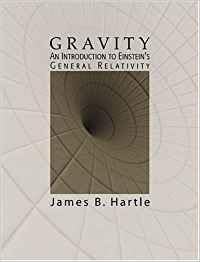
Gravity: An Introduction to Einstein's General Relativity
Product ID: 1698923
The aim of this groundbreaking new book is to bring general relativity into the undergraduate curriculum and make this fundamental theory accessible to all physics majors. Using a "physics first" approach to the subject, renowned relativist James B. Hartle provides a fluent and accessible introduction that uses a minimum of new mathematics and is illustrated with a wealth of exciting applications. The emphasis is on the exciting phenomena of gravitational physics and the growing connection between theory and observation. The Global Positioning System, black holes, X-ray sources, pulsars, quasars, gravitational waves, the Big Bang, and the large scale structure of the universe are used to illustrate the widespread role of how general relativity describes a wealth of everyday and exotic phenomena. Review: Explanations are in detail, but confusing in some parts. - "This is an excellent introduction to general relativity with a hands-on approach that is based on physical situations of interest like black holes and the expanding universe. It fills a real gap in the literature for an undergraduate or graduate student course book" - Stephen Hawking Hartle's "Gravity" is a textbook for learning general relativity. On the back cover of the book, there are a lot of praises for the book from famous physicists including Stephen Hawking's. Overall, I enjoyed the book and the reading was beneficial. The book contains many topics with detailed explanations in more than 500 pages. Considering that, as the author says in the preface, the book aims at guiding undergraduate students to general relativity, its plentiful explanations are great merits. However, the book has some shortcomings. If you feel comfortable only with mathematics textbooks that are written logically and systematically, then the book can be uncomfortable for you. The book consists of three parts. The first part introduces the readers to the basics of relativity only with elementary mathematics. The second part is about applications of relativity. For example, the book explains how general relativity explains motions of solar system by showing that Newtonian mechanics is an approximation of general relativity that can explain things more accurately. In addition, light rays under gravitational field, gravitational waves, black holes, and cosmology are discussed under the relativistic point of view. But when we use general relativity in the first two parts to analyse real physical situations, that does not mean we solve problems directly from the Einstein equation. There is a special solution of the Einstein equation, called Schwarzschild metric. By applying this metric to situations like planets in solar system and black holes, we study those things. The third part introduces the Einstein equation and its related mathematics. However, even in this part, we don't solve the Einstein equation. Solving the Einstein equation explicitly seems to be a hard thing. As I mentioned, the book's explanation is confusing in many places. For example, it is when introducing new mathematical stuffs like scalar product in the first part, and Christoffel symbols and covariant derivatives in the third part. Before reading the book, I have read two relativity books, Peter Collier's, and Ellis and Williams's. In reading such parts, the experience of reading the two books were really helpful. In particular, Collier's book was good. For the third part, I just can give three or four stars. I think that the mathematics like covariant derivative and Riemann curvature tensor is neither easily explained nor dealt with in depth. I have a plan to read another relativity book like Foster and Nightingale's "A Short Course in General Relativity". But for the first two parts, although there are many confusing parts, I want to give them five stars. They contain many valuable topics. I want to give an example. Consider a non-rotating black hole. Then the geometry around the black hole is described by a global coordinate (t, r, theta, phi) with a metric called the Schwarzschild metric. The motion of a particle can be described by (t(time), r(time), theta(time), phi(time)). The particle has some energy and momentum. Suppose I am in a rocket moving around the black hole. My motion will be described by (t'(time), r'(time), theta'(time), phi'(time)). To me, the energy and momentum of the particle will not be the same with things under the black hole's point of view. The book teaches the readers how to calculate them. More than that, the explanation is conceptual and concrete. Reading the part was really enjoyable. Here are some other points. 1. When Hawking said "it fills a real gap in the literature for an undergraduate or graduate student course book.", I think that the gap is between freshmen physics textbooks containing special relativity and graduate textbooks like Wald's "General relativity". To read the book, you should know at least the basics in special relativity. 2. The book has nearly 600 pages. Most of the readers would not have enough time to read the whole book. The wise readers should choose what to read. There is an appendix entitled Pedagogical Strategy. It was helpful in planning my reading. I recommend the readers to use the appendix also. 3. There are some typos in the book. When you get stuck somewhere, it may be because the author is not so skillful in explaining the topic or because there is a typo. Assume the results, just skip, and move forward. 4. The variational principle for a free particle (with mass) says that the world line of a free particle between two timelike separated points extremizes the proper time between them. For a photon (that has no mass), we cannot say about proper time. Then, what is the principle for a photon that explains the world line of a photon? You may think that it is ds^2 = 0. But I think this is not enough. For energy and momentum to be conserved, there should be one more principle. Regarding this issue, the book doesn't seem to give the answer. 5. The good quality of the papers of the book saved a lot of my eye's fatigue. It doesn't reflect lights. I hope that other textbooks use this kind of papers. Review: The best introduction to Special and General Relativity - I used this book for my Relativity & Black Holes course at UCI, an upper-division undergrad intro to SR & GR. The book uses an experimental approach by leading with observations and consequences of the equations of relativity without rigorous derivation. This is counter to the standard approach in physics, which is usually to derive the equations of motion, then move on to application and comparison to observation. If you're a math grad eager to apply your knowledge of differential geometry/topology then this is not the book for you're looking for. It is designed for advanced undergrad physicists to get a handle on the ideas and consequences of Einsteins theory before considering the very mathematically complicated derivations. The problems are incredibly challenging and solutions are not easy to come by. This textbook is definitely a keeper.
| Best Sellers Rank | #666,298 in Books ( See Top 100 in Books ) #413 in Physics (Books) |
| Customer Reviews | 4.6 out of 5 stars 89 Reviews |
I**E
Explanations are in detail, but confusing in some parts.
"This is an excellent introduction to general relativity with a hands-on approach that is based on physical situations of interest like black holes and the expanding universe. It fills a real gap in the literature for an undergraduate or graduate student course book" - Stephen Hawking Hartle's "Gravity" is a textbook for learning general relativity. On the back cover of the book, there are a lot of praises for the book from famous physicists including Stephen Hawking's. Overall, I enjoyed the book and the reading was beneficial. The book contains many topics with detailed explanations in more than 500 pages. Considering that, as the author says in the preface, the book aims at guiding undergraduate students to general relativity, its plentiful explanations are great merits. However, the book has some shortcomings. If you feel comfortable only with mathematics textbooks that are written logically and systematically, then the book can be uncomfortable for you. The book consists of three parts. The first part introduces the readers to the basics of relativity only with elementary mathematics. The second part is about applications of relativity. For example, the book explains how general relativity explains motions of solar system by showing that Newtonian mechanics is an approximation of general relativity that can explain things more accurately. In addition, light rays under gravitational field, gravitational waves, black holes, and cosmology are discussed under the relativistic point of view. But when we use general relativity in the first two parts to analyse real physical situations, that does not mean we solve problems directly from the Einstein equation. There is a special solution of the Einstein equation, called Schwarzschild metric. By applying this metric to situations like planets in solar system and black holes, we study those things. The third part introduces the Einstein equation and its related mathematics. However, even in this part, we don't solve the Einstein equation. Solving the Einstein equation explicitly seems to be a hard thing. As I mentioned, the book's explanation is confusing in many places. For example, it is when introducing new mathematical stuffs like scalar product in the first part, and Christoffel symbols and covariant derivatives in the third part. Before reading the book, I have read two relativity books, Peter Collier's, and Ellis and Williams's. In reading such parts, the experience of reading the two books were really helpful. In particular, Collier's book was good. For the third part, I just can give three or four stars. I think that the mathematics like covariant derivative and Riemann curvature tensor is neither easily explained nor dealt with in depth. I have a plan to read another relativity book like Foster and Nightingale's "A Short Course in General Relativity". But for the first two parts, although there are many confusing parts, I want to give them five stars. They contain many valuable topics. I want to give an example. Consider a non-rotating black hole. Then the geometry around the black hole is described by a global coordinate (t, r, theta, phi) with a metric called the Schwarzschild metric. The motion of a particle can be described by (t(time), r(time), theta(time), phi(time)). The particle has some energy and momentum. Suppose I am in a rocket moving around the black hole. My motion will be described by (t'(time), r'(time), theta'(time), phi'(time)). To me, the energy and momentum of the particle will not be the same with things under the black hole's point of view. The book teaches the readers how to calculate them. More than that, the explanation is conceptual and concrete. Reading the part was really enjoyable. Here are some other points. 1. When Hawking said "it fills a real gap in the literature for an undergraduate or graduate student course book.", I think that the gap is between freshmen physics textbooks containing special relativity and graduate textbooks like Wald's "General relativity". To read the book, you should know at least the basics in special relativity. 2. The book has nearly 600 pages. Most of the readers would not have enough time to read the whole book. The wise readers should choose what to read. There is an appendix entitled Pedagogical Strategy. It was helpful in planning my reading. I recommend the readers to use the appendix also. 3. There are some typos in the book. When you get stuck somewhere, it may be because the author is not so skillful in explaining the topic or because there is a typo. Assume the results, just skip, and move forward. 4. The variational principle for a free particle (with mass) says that the world line of a free particle between two timelike separated points extremizes the proper time between them. For a photon (that has no mass), we cannot say about proper time. Then, what is the principle for a photon that explains the world line of a photon? You may think that it is ds^2 = 0. But I think this is not enough. For energy and momentum to be conserved, there should be one more principle. Regarding this issue, the book doesn't seem to give the answer. 5. The good quality of the papers of the book saved a lot of my eye's fatigue. It doesn't reflect lights. I hope that other textbooks use this kind of papers.
R**B
The best introduction to Special and General Relativity
I used this book for my Relativity & Black Holes course at UCI, an upper-division undergrad intro to SR & GR. The book uses an experimental approach by leading with observations and consequences of the equations of relativity without rigorous derivation. This is counter to the standard approach in physics, which is usually to derive the equations of motion, then move on to application and comparison to observation. If you're a math grad eager to apply your knowledge of differential geometry/topology then this is not the book for you're looking for. It is designed for advanced undergrad physicists to get a handle on the ideas and consequences of Einsteins theory before considering the very mathematically complicated derivations. The problems are incredibly challenging and solutions are not easy to come by. This textbook is definitely a keeper.
J**N
I think it's the best and more clear introductory book to general relativity...
An excellent introduction to general relativity: it's well written, all the ideas are explained at an intuitive level and with an easy-to-understand language; furthermore no mathematical prerequisites of high level are requested. In particular, a first part is a review of special relativity: a not so brief and very good summary, useful to understand the use of the 4-vector notation, too. A successive part is committed to the general relativity foundations (the way which Einstein developed the idea in), the mathematical structure and the analysis of many observations (such as gravitational lensing, cosmic microwave background radiation, universe expansion, etc.) that give confirmations of the theory (with an additional introduction to some cosmological models). A final part is committed to Einstein equation: tensor analysis, curvature, covariant derivative are introduced at this point, and you'll be got up enough to understand all the concepts. Very good binding and hardcover: it's durable and solid, with a good value for money.
S**S
Self studier reads a textbook on general relativity
I purchased "Gravity" as part of an effort to learn more about modern physics. I do not have the money or schedule to take courses at a university, so I have been purchasing books and reading them on my own time. I wanted something that would give a deep, rigorous understanding of the subject matter. So far, after a month and a half of regular reading, I have made through the first seven chapters. So far, I am not dissapointed. "Gravity" begins from where I left off (years ago, taking the physics courses mandatory for chemistry majors in a bachelors program) and builds precept upon precept to take the reader into the world of general relativity. The book uses language that is clear, and examples that help to further explain the concepts being taught in the course. For those of us who are not "mathheads", the mathematics needed to understand the material beyond basic calculus and algebra is taught within the text. This book is helping me to gain a better understanding of this area of physics. I do have one "bone to pick", however, with the organization of the text. Like most textbooks, this one, usefully, has problems at the ends of the chapters. I like to work on a sampling of problems to solidify what I have learned. The problems are well written, and force you to think about the subject matter. However, none of the problems have answers in the back of the book! I understand that in a graded course, there is the temptation for some students to simply look up the answers, and not do the work. However, many textbooks have answers to selected problems. If this book had this, it would still leave many problems for assigned work for those taking a course, but allow self or independent studiers like me the opportunity to work some problems and see if we are on the right track in understanding the material.
D**L
Very good with caveats
Original Review: I have a math background and got this to learn GR. I couldn't follow the structure though. It tended to go from abstract idea or some experimental result, then give some equation without derivation, and maybe some examples. Some chapters have no equations at all. I really couldn't figure out what it was trying to convey. "Am I just supposed to memorize this, am I supposed to understand it deeply, or is this just thrown in for fun?" Maybe it makes more sense with a lecture to go along with it, but I found it a bit scattered for self-study. Will be looking for something a little more math-forward next time. Update: I tried jumping straight into a more advanced textbook (Wald), and while I could kinda follow it, I felt I was missing some background to really get things, so I came back to this one but with a better understanding of what I needed to get out of it. I saw that chapters 1-6 can be skipped. The real meat begins at chapter 7. (Ch 5 can be useful if you've not been exposed to special relativity). Then I went to Ch 8, skipped a bunch of chapters about applications, then read Ch 20-22. If you really want to get into the meat of GR, this is all you need. The rest is application. This progression follows that of more advanced books like Wald, but with far better concrete examples.
J**M
This is a text book.
I am not a physics whiz by any stretch. This book is a college level text. Although I have no desire to learn the math (even though I understand some of it) , each chapter has a good, thorough introduction to the specific segment of Relativity and Special Relativity discussed...black holes....gravitational waves...etc. The text is not "dry" nor is it particularly entertaining. It is, however, interesting reading and logically presented. The only issue I have found so far: the discussion of gravitational waves research is a little dated, but the theory is correct.
S**S
An Introduction to Einstein's General Relativity
This book is written for undergraduate juniors or seniors. I am trying to do graduate level study. It makes a good introduction to the material, but the author emphasizes two statements which, in my opinion, are misleading or wrong: first, gravity is a function of the geometry of space-time; two, gravity is always attractive, never repulsive. It further goes on to state that gravity is inconsequential when describing forces between subatomic particles, and the only way to study it is via cosmology. If this is true, then gravity is the only force in Nature with one 'side', namely attractive only; if it strictly a function of the geometry of space-time, there is no way to utilize it-it is a nuisance we must put up with to perform space travel. I consider any of these statements blind-sided and limiting. This is the wrong way to introduce a new subject. I hope there is more information on this subject in this book in later chapters. I do not consider this a fault of Amazon or the publisher--it is the fault of the author.
A**S
"Just in time"
When considering the purchase of a textbook, I read reviews carefully and consider these opinions a valuable aid to separating the wheat from the chaff. I am studying and taking courses in general relativity and found the reviews of books by Peter Collier, Bernard Schutz, Sean Carroll, and others to be helpful and accurate. Hartle really cares about correcting errors. His home site maintains an online list of typos and corrections to his textbook. Two reviewers of Hartle's textbook made negative statements which are unjustified. My opinion is that Hartle's book is superb for self-study and ranks alongside the seminal textbooks of Schutz and Carroll. Support for this statement is provided by Hartle's Chapter 2. In this introductory chapter on the geometry of physics, one can learn how to measure the curvature of space, how the Boomerang experiment found the universe to be flat, even how to construct a Mercator projection of a 2-sphere, all in 17 pages. Hartle's textbook is distinguished by its "just in time" approach to tensors. Collier's amazing book is intended for the beginner without a background in mathematics. Carroll's textbook is unique for its laser-like ability to focus on what is important.
D**G
Comprehensive
I'm working through it now...and it's very good. Very clear explanations that doesn't assume too much from you. I'm a physicist who is now working and I want to understand more about GR. This book covers all of the major aspects of GR and I guess would serve as a good introduction and a springboard for more advanced treatments. I have bought a couple of books that are a little too advanced or not advanced enough.This is the one for me...I demand clarity of explantion when I buy science textbooks. This ticks the box for me
C**N
Five Stars
ok
R**A
O melhor do gravidade.
É excelente para área de gravitation...
G**S
No llegó
No llegó el libro y no lo han reembolsado
A**R
Excellent book!
I was looking for a book for a complete introduction to General Relativity and this is the one! Others start with difficult math, while this gradually introduces it and explains the physical facts first. Excellent book!
Trustpilot
1 week ago
3 weeks ago