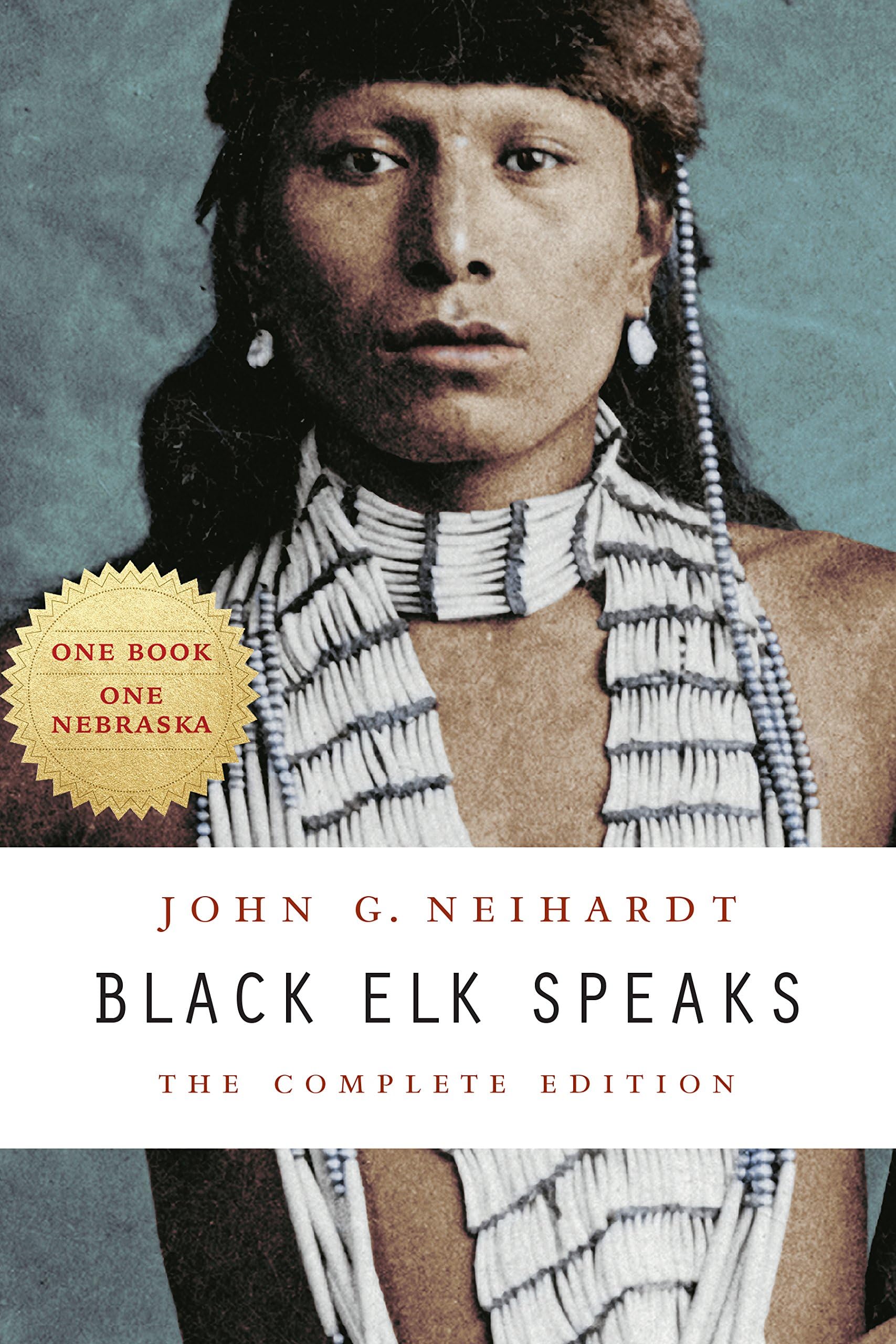
Black Elk Speaks: The Complete Edition
Product ID: 1692913
📚Complete Edition with essays & annotations
🔥Over 1 million copies sold
🗺️Includes original maps & illustrations
Desertcart purchases this item on your behalf and handles shipping, customs, and support to Iceland.
📖 Unlock the spirit of a people — Black Elk Speaks, where history meets soul.
Black Elk Speaks: The Complete Edition is the definitive collection of the Oglala Lakota visionary Nicholas Black Elk’s story, featuring over one million copies sold, a new introduction by historian Philip J. Deloria, expert annotations, original maps, and illustrations. This landmark work blends biography, Native American history, and spiritual insight, offering a profound glimpse into 19th-century Lakota life and philosophy that continues to inspire readers worldwide.
| Best Sellers Rank | #21,752 in Books ( See Top 100 in Books ) #7 in Native American Religion #28 in Native American History (Books) #28 in Indigenous History |
| Customer Reviews | 4.7 out of 5 stars 1,716 Reviews |
L**S
Beyond expectations
<i>Black Elk Speaks: The Complete Edition</i> by John G. Neihardt <i>Black Elk Speaks</i> is arguably the single most widely read book in the literature relating to North American Native history. To better understand ourselves, it is a book that everyone with a modicum of conscience should read. It is also a treasure trove for research. I'm at the point in life where there is little else to linger for save yesterday. This book took me there in spades. "It is the story of all life that is holy and is good to tell, and of us two-leggeds sharing in it with the four-leggeds and the wings of the air and all green things; for these are children of one mother and their father is one Spirit." ~ Black Elk This is a story from the perspective of indigenous beliefs, born of how they perceived the natural world they had an intimate relationship with. A people with deep respect for the unknowable, that knew well the brightness and darkness inherent in the psyche of all life forms, and that understood the connectedness of all life. That in sharp contrast to so-called civilized peoples that plunder our little blue canoe, blindly driving nails in humankind's coffin. “A savage is not the one who lives in the forest but the one who destroys it.” ~ unknown Uppermost though, it is the story of a people that were self-sacrificing for the good of all, that only wanted to live with Nature as they always had, even on what little was left them in treaties. The obstacles were overwhelming though, with the greed of the weedy materialistic culture wanting all there was, and having no respect for the natural world. It is an age old story of avarice and genocide, this genocide the greatest by far in humankind's history [see <i>Genocide of indigenous peoples</i>, and <i>Genocides in history</i> articles on Wikipedia], estimated at upwards of ninety percent of the Indigenous population. According to geographers from University College London, the colonization of the Americas by Europeans killed so many people it resulted in climate change and global cooling. And yes, in the telling there is much bloodshed and many died, because the colonialists' materialistic culture was relentless in taking all they lusted for irregardless of treaties. How could there be any saving grace in what was done to Native Americans, with the colonialists employing massacres of women and children, biological warfare (intentionally spreading the infectious diseases they brought with them), starvation (the last survivors of the northern buffalo herds were killed off in 1881), slavery, and ethnocide (e.g. the resident school system). One abhorrent example of the massacres, is in a latter chapter where Black Elk recounts what he saw first hand at Wounded Knee. "Wherever we went, the soldiers came to kill us, and it was all our own country. It was ours already when the Wasichus [white people] made the treaty with Red Cloud, that said it would be ours as long as grass should grow and water flow." ~ Black Elk “Everyone believes in the atrocities of the enemy and disbelieves in those of his own side.” ~ George Orwell Notice in Black Elk's recounting that these peoples' rituals commonly included an element of giving to those that had the least. For example, in one instance in preparing for a ceremony a holy man would find a holy tree for the dance, and a warrior would strike the tree counting coup upon it. Then the warrior would give gifts to those who were most needy, and the braver he had been the more he gave away. This in contrast to what Black Elk observed later in the story when visiting major cities. "I could see that the Wasichus did not care for each other the way our people did before the nation’s hoop was broken. They would take everything from each other if they could, and so there were some who had more of everything than they could use, while crowds of people had nothing at all and maybe were starving. They had forgotten that the earth was their mother. This could not be better than the old ways of my people." ~ Black Elk Hmm, sounds familiar. Black Elk's concept of community was as different as day and night. "The Six Grandfathers have placed in this world many things, all of which should be happy. Every little thing is sent for something, and in that thing there should be happiness and the power to make happy. Like the grasses showing tender faces to each other, thus we should do, for this was the wish of the Grandfathers of the World." ~ Black Elk Be aware in reading this book that what is conveyed is in part through metaphors and mystical symbolism in the ways the ancient ones enhanced the vividness of a telling. One example in Black Elk's vision is when he speaks of the fourth Grandfather, "he of the place where you are always facing (the south), whence comes the power to grow." The first association is that in numerous Native American beliefs, after death the soul travels south along the Milky Way. Thus, throughout life one is always facing south. The second association is of the power to grow. Restated in modern terms, the power is that of the natural world's closed loop system of life fueled by life, recycling the essential elements of physical being for a continuum of life. Other examples include the circle (hoop), which not only symbolizes life's cyclical journey, but also represents a way of life in interacting with each other in a circular fashion to negate power struggles. The number four also has special significance, as in the elements of Earth, fire, air, and water; the seasons of winter, spring, summer and fall; and the primary directions of North, South, East, and West. Symbols can also be used in combination, such as a circle divided into quarters with four arrows signifying wisdom, innocence, foresight, and soul-searching. The perspicacious reader will find more inclusive relevance in what Black Elk says, as parallels abound in the broader community and history of humankind. Something to think about is the circular aspect of life, where 'what goes around comes around.'
B**L
A very important for all!
We live in days that most spirituality has been lost by our busyiness and American, western ways of life or oppression. God or "The Great Spirit" raised up Black Elk to help his people in a very trying time in their history and those times really are still here for the Natives and all peoples of the world. This book is for both Natives and westerners because it shows the reality of the supernatural and the kingdom of God that Jesus demonstrated in the bible, its the same thing that Black Elk is talking about here but with different symbolism and a different culture. The old Native way was about honoring, praying to, following, believing and living out life in the spirit to a higher being (God or the Great Spirit). If westerners and the Natives worked together they both would find what they are looking for. If westerners would drop their traditions and seek Jesus in the fashion that the old Native way knew (some still do) which this book displays all could find life around the tree of life (The Great Spirit or God) and all would be united and at peace, this was Black Elk's goal and should everyones goal. Black Elk shows that to be in touch with the creator and to make a difference you have to seek Him and separate some from an ordinary life (this is what the bible shows also), if you do this The Great Spirit or God will invade your life and you will be in touch with why you were created. Sometimes God, The Great Spirit raises up a forerunner like Black Elk to restore the old ways that were lost and just like Black Elk says, his purpose was so all could do what he was doing and to revive things back to life. A very important book for all. Enjoy!
A**N
Great read!
Quick delivery.
R**X
Worth Reading but Disturbing
I have known about this book for years and just never got around to actually reading it. It's a powerful first-hand recitation of the horrors Native Americans faced in the 19th century. However, I found a bit of it difficult to read, not because of the emotional impact, but because it describes Black Elk's "dream" so many times and in such ponderous detail. Those sections of the book got a bit tedious and I don't feel they added much to the overall narrative.
R**K
Take your time with this…
Black Elk’s story is not merely history… it is a coded map of the soul. It is the reminder that every man is born with a vision… a blueprint placed quietly inside him before the world begins shaping him into something smaller. The tragedy of life is not suffering… it is forgetting the vision. The circle appears again and again… the sacred hoop… seasons, tribes, generations, life and death… teaching that the soul does not move in straight lines the way modern man pretends it does. The soul returns… it repeats… it spirals upward through the same lessons until wholeness is restored. Nature is not scenery in this worldview… it is family… it is living consciousness… and the earth is not beneath you, it is you. The animals are not animals… they are forces within you… the horse as the drive of life, the eagle as higher sight, the buffalo as sacred provision, the thunder as awakening and fear that cracks the old self open. And at the center of it all stands the sacred tree… the axis of the world… the reminder that every man is a bridge between heaven and earth… a pole star… a living connection point where spirit meets flesh. The collapse of Black Elk’s world is not only the fall of a people… it is the mythic truth that every man will one day watch an old world die within him… and if he clings to it, he becomes bitter… but if he understands, he passes through the ruins into deeper consciousness. Ceremony is not superstition… it is remembrance… it is the soul refusing to forget that life is holy. And the final message is simple, but relentless… the world never stopped being sacred… man simply stopped seeing it. Peace and Love🤙🏼
A**N
Love it
Great read!
A**R
good book
Finally got to read this book. It is a good account of what happened in his life- with his visions and the treatment of the Indians. It is sad, of course that he had to endure the cruelty of the white man and see so many people die. I am not Indian, but I try to do what I can for them- but it will never make up for how they have been treated- then and now.
M**T
Good book.
Excellent book, gives a good historical account of that time period b
M**O
Excelente
Ha muitos anos queria ler esse livro e minha expectativa foi correspondida. Excelente para quem gosta de histórias sobre os povos nativos americanos
L**L
delivered in time in good condition
good service, accurate information, happy me
M**A
extraordinaire dans tous les sens du terme
on en apprend a toutes les pages, fabuleux
O**N
A history of the Lakota nation with a spiritual insight
Neihardt has captured the Lakota struggles of the nineteenth century in a touching documentary style. The book opens an insight to the Lakota spirituality and their close relationship with the nature. Black Elk's vision of maintaining the Lakota loop of the nation alive was sadly not realized during his lifetime. Nor is it realized in the greater level either in this world of chaos. Who knows if it ever will.
L**N
You will be very happy with this
Quick delivery. Great book
Trustpilot
3 weeks ago
2 days ago